
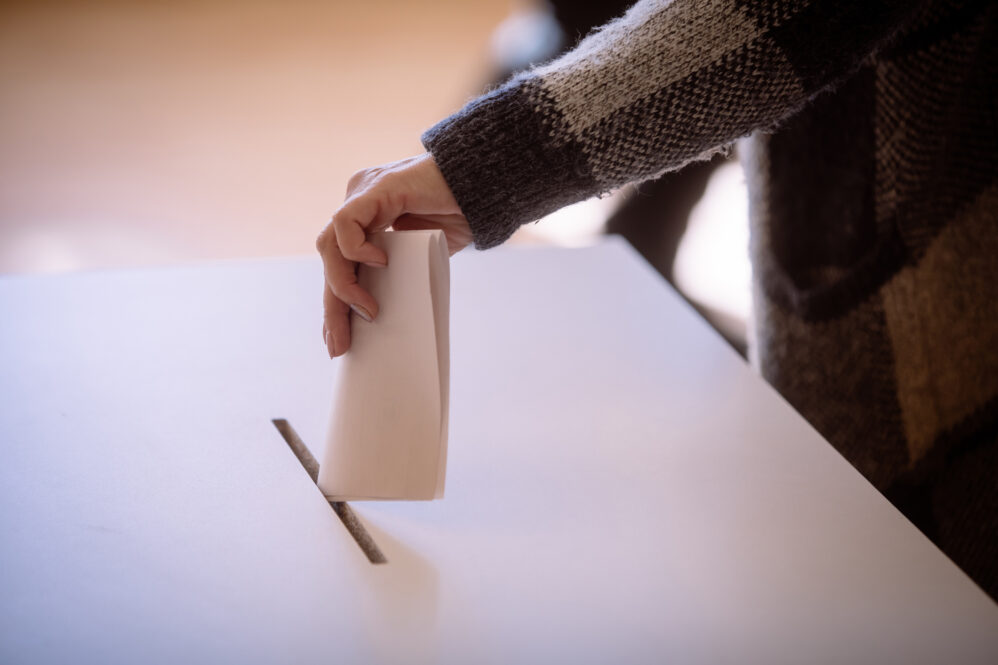
Within the space of ten days, four corners of the world are operating one lever of change: voting.
Ballot boxes in Brazil, Israel, Serbia and the United States have been opening and closing from this week into next and creaking along the same rusted hinge of history. It offers a unique moment that could, by the time the U.S. election results are finalized in the midterms, present a global shift in politics away from a rising authoritarian right and toward pro-democracy forces that are struggling to make a comeback.
These are consequential elections that will determine the fate of their nations, and reverberate around the world on a wide range of issues that connect us all, including climate change, energy policy, and the costs of inequity and corruption.
It’s too early to tell precisely what the Israeli elections on Wednesday and the formation of a government, which still lies ahead, will mean for the state of Israel, the future of the Palestinian people, and the wars in Gaza and Iran. In Serbia, longtime strongman Aleksander Vucic conceded defeat to a student movement that highlighted allegations of corruption and creeping authoritarianism in an election viewed in the Balkans as a generational turning point. And in America, the midterms are reaching a boiling point as early voting is underway, with most polls predicting a rebuke to the Republican Party and its unquestioning support for Donald Trump’s war in Iran and the soaring fuel costs that have come with it.
It is a truly global moment, one that is powerfully felt in the local community where I live on the island of Martha’s Vineyard off Cape Cod, Massachusetts. There are young Serbians on work visas at various restaurants, and many are part of the movement of students who led the revolt against Vucic. There are Israeli citizens who are part of two active Jewish congregations, and several made the trip home to Israel to cast their vote, as is required by Israeli election laws. The U.S. midterm elections are in full swing now, and this largely blue Island is left holding its breath and hoping for a blue wave of Democrats to win across the country on Tuesday.
But this week, it was the Island’s robust Brazilian community in particular that seemed transfixed on their elections and what it will mean for the future of Brazil, the fourth largest democracy in the world after Indonesia, India, and the U.S. Of the roughly 1 million Brazilian immigrants in the U.S., New England holds 68,000 Brazilians who registered to vote in the elections back home, a doubling of the number of voters compared to the last election in 2022. Massachusetts has a particularly large and vibrant Brazilian community concentrated in the small city of Framingham and on Martha’s Vineyard.
The results were announced on Sunday, with President Luiz Inácio Lula da Silva, securing a victory over Flavio Bolsonaro, a right-wing senator, the son of Brazil’s former authoritarian leader who was ineligible to run as he is serving prison time for an attempted coup.
Some Brazilian immigrants on the Island traveled to Framingham and Malden to cast their votes. According to the Brazilian Superior Electoral Court’s website, voters in the Boston area heavily favored Bolsonaro. That support emerges from the conservative and fervent Christian evangelical movement in Brazil, particularly the so-called “gospel of prosperity,” which served to fuse Bolsonaro and Trump together. Bolsonaro’s son followed in his father’s footsteps on this political fault line.
The elder Bolsonaro remains jailed on a 27-year prison sentence for his role in an attempted coup after the 2022 election, has continued to refuse to concede, and asked that the results be annulled. His son has also not recognized the election he has just lost, and criticized judges for interfering. Days after the election, Flavio Bolsonaro fled the country and landed in Miami, as he reportedly sought to elude an investigation into a money laundering case. Both Bolsonaros have clearly styled themselves after Trump by casting doubt on any election that does not result in victory.
Lula is an icon of the left in Brazil and member of the Partido dos Trabalhadores (the Worker’s Party in English), and has served time in prison on charges related to a corruption scandal during his first term as president, from 2003 to 2010. He was released from prison in 2019 after serving 18 months, and has asserted that the charges against him were an attempt to criminalize the left wing. The charges against him were annulled by Brazil’s Supreme Federal Court, and he won the presidency over the older Bolsonaro in 2022. Lula’s re-election is viewed by global political analysts as a deviation from the regional trend of victories for right-leaning Latin American presidential candidates who ally with Trump, according to the AP.
The election is fateful for the future of not only Brazil, but the planet, as concerns of climate change ran like an electric current through the process. Deforestation in the Brazilian Amazon was reduced by 50 percent under Lula after the cutting of the rainforest soared under the elder Bolsonaro, whose son was also seen as aligned with the timber industry, allowing it to continue with virtually unchecked deforestation. For environmentalists, particularly climate activists, the Lula victory was a positive development for the health of the Amazon, which is essential to cool the planet. Some, however, point out that Lula has a less-than-stellar record on agribusiness. But indisputably, Lula has over the last few years reduced poverty in the country and increased employment while succeeding in shoring up guardrails of democracy and reducing the rate of violent deaths.
Against a backdrop of a deeply polarized election, Brazil’s media landscape has been plagued by misinformation and disinformation and deepfakes generated through AI that ricochet from large corporate media entities such as Globo TV to individual influencers on the TikTok platform. The nation’s Superior Electoral Court has made sincere efforts to stem that tide, particularly on social media platforms. But, as Reporters Without Borders (RSF) has noted, the efforts seem inadequate, and there is much work to be done in the future for Brazil, like the United States, to find robust ways to expose the forces behind misinformation and disinformation campaigns.
As Artur Romeu, director of RSFin Latin America, stated: “Although ambitious on paper, the Court’s measures lack the means required for their enforcement, as the reality of the presidential election has demonstrated. Above all, this example should give the Brazilian Congress the political courage to finally provide the country with regulations governing AI and social media platforms that protect the right to reliable information by algorithmically promoting trustworthy news sources. Without meaningful regulation, both the right to reliable information and the integrity of the election are under threat.”
The threat posed by the unregulated media landscape can be felt from Brazil across the globe, including in the Brazilian diaspora in the U.S. Supporters of both Lula and Bolsonaro could be seen and heard navigating the news feeds coming from Brazil in discussions about the elections taking place across our small Island. In the port town of Vineyard Haven, where families gather at the Martha’s Vineyard Grill for traditional Brazilian barbecue, black bean stew and cheese bread, cable news channels out of São Paulo were blaring in Portuguese on Sunday night as votes were being counted across Brazil. Join the GroundTruth community.
Edna, 41, an immigrant who works at a restaurant, said she supported Bolsonaro but asked that her last name not be used. Sharing a point of view often heard among the Brazilian community on the Island, she said, “I voted for him because he reflects my Christian values and because he supports the traditional family, and because he understands that the government should stay out of our business.”
On Monday, in school parking lots, Brazilian immigrant parents who were picking up their kids were also discussing the political maelstrom back home.
A Brazilian immigrant who sometimes works as a translator in the schools said, “It is incredibly important to our democracy that Lula won and Bolsonaro lost, and now we may have a chance to work on important economic and environmental issues… We just hope the pattern of rejecting authoritarians holds up here in America at the midterms. It feels like for all of us there is just one big wave of anxiety on the Island.”
And all week in the cramped aisles of the Vineyard Grocer, shoppers picked up favorite Brazilian brands and traded points of view on the rival candidates and that high tide of anxiety that is crashing all around us.
The owner, Elio Silva, said, “It is on everyone’s mind. But I stay out of politics. They say there are three things that a store owner trying to serve a community should avoid: soccer, religion and politics.”
What all of these elections across Brazil, Israel, and the U.S. offer us is an education on how global issues are shaped on a global, national, and local level, and how they are of concern to all of us. But most importantly, these dramatic elections across these different corners of the globe remind us of the most important lesson of all. That is, that your vote matters. In Portuguese, Votar! In Hebrew, Kol! In Serbian, Glasati! And in plain old English, VOTE!
Related:
- An Election Uncovered
- How journalists can stay safe and how we can protect America’s press on Midterm Election Day and beyond
Like MediaFeed’s content? Be sure to follow us.
This article originally appeared on CharlesSennott.substack.com and was syndicated by MediaFeed.co