
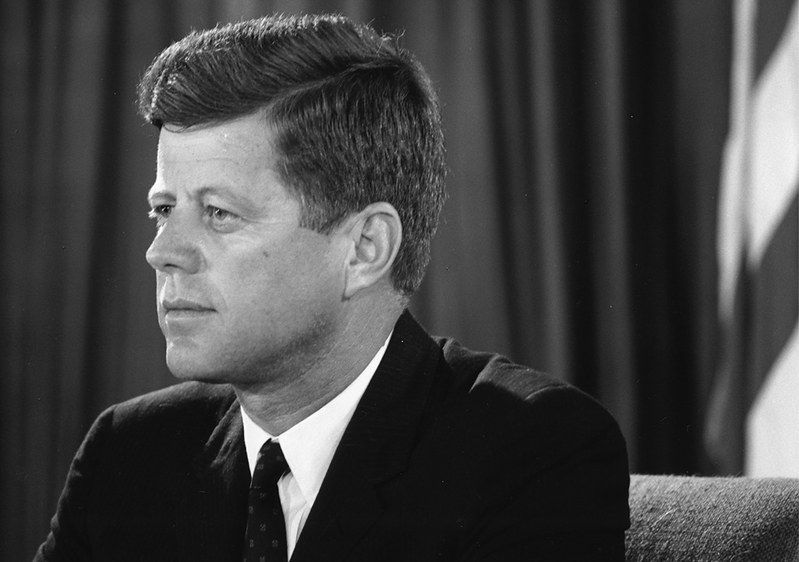
On November 22, 1963, the 35th president of the United States, John F. Kennedy, was assassinated in Dallas, Texas, as he rode in Dallas on a campaign trip with his wife, Jacqueline, Texas Governor John Bowden Connally, and his wife, Nellie Connally. Behind the president’s limousine was a convertible carrying Vice President Lyndon B. Johnson, Lady Bird Johnson, and U.S. Senator Ralph Webster Yarborough.
The journey was part of a fundraising drive for the national Democratic Party. But at approximately 12:30 P.M., President John F. Kennedy was shot.
The person who shot the president was Lee Harvey Oswald, a former U.S. Marine. After traveling to the Soviet Union in October 1959, Oswald went to the U.S. Embassy attempting to renounce his U.S. citizenship and become a Soviet citizen. However, he didn’t formally complete the legal steps, and Soviet authorities didn’t grant him citizenship.
The day after the shooting, bullet casings were found near a window on the sixth floor of the Texas School Book Depository building that belonged to a rifle, owned by Oswald, that was found as well on the same floor.
Oswald never stood trial for murder because, while being transferred after having been taken into custody, he was shot and killed by Jack Ruby, a Dallas nightclub owner. Millions saw the television coverage of Oswald’s transfer to the county jail and witnessed the shooting.
As John F. Kennedy’s coffin arrived at the White House, the state funeral began. His body was placed in the East Room. The gathering was not open to the general public; only family members, close friends, and government officials could attend.
The following day, the casket was taken to the Capitol, where thousands of people lined the streets of Washington, DC, and millions more watched the television broadcast of the funeral.
Johnson, fearing that the assassination was just the first step to destabilize the American government, asked for a transition of executive authority and left Dallas by plane.
Johnson took the oath of office on Air Force One before takeoff. Jacqueline Kennedy stood next to him, still wearing the same clothes with blood stains on them.
“… I can see this perfectly clean piece detaching itself from his head. . . . I kept bending over him saying, Jack, Jack, can you hear me, I love you Jack,” she said in an interview on Nov. 29, 1963.
On November 27, 1963, during an address before a joint session of Congress five days after President John F. Kennedy was assassinated, Lyndon B. Johnson said, “An assassin’s bullet has thrust upon me the awesome burden of the Presidency. I am here today to say I need your help; I cannot bear this burden alone. I need the help of all Americans, and all America. This Nation has experienced a profound shock, and in this critical moment, it is our duty, yours and mine, as the Government of the United States, to do away with uncertainty and doubt and delay, and to show that we are capable of decisive action, that from the brutal loss of our leader we will derive not weakness, but strength, that we can and will act and act now.”
Ask us! What questions do you have about content, strategy, pop culture, lifestyle, wellness, history or more? We may use your question in an upcoming article!
Like MediaFeed’s content? Be sure to follow us.
This article was syndicated by MediaFeed.co