The strongest evidence by far is for skin. In the largest trial, 136 people went through 30 sessions and came out with smoother texture, more collagen, and visibly fewer lines. Pair red light with near-infrared, which is invisible and reaches deeper into the body, and the research widens to cover cellular energy, tissue repair, and early work on blood sugar and mood. That research is real. It’s also thinner, and anyone presenting it as settled is selling you something.
Two things decide whether any of it works for you: how much light actually reaches your body, and how close you sit to the source. More is not automatically better. And the power rating on the box was measured at the bulb, not at you.
What red light actually is
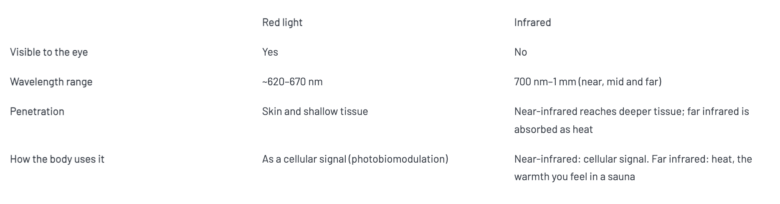
Light comes in wavelengths, measured in nanometers. Red is the long end of what your eye can see, roughly 620 to 670 nm. Just past it sits near-infrared, invisible to you, from about 700 to 1,400 nm. Past that is far infrared, measured in microns, which your body experiences as warmth.
Red and near-infrared get grouped under one name, photobiomodulation, because they do the same thing. Your cells absorb them as a signal. Far infrared is different. It gets absorbed as heat.
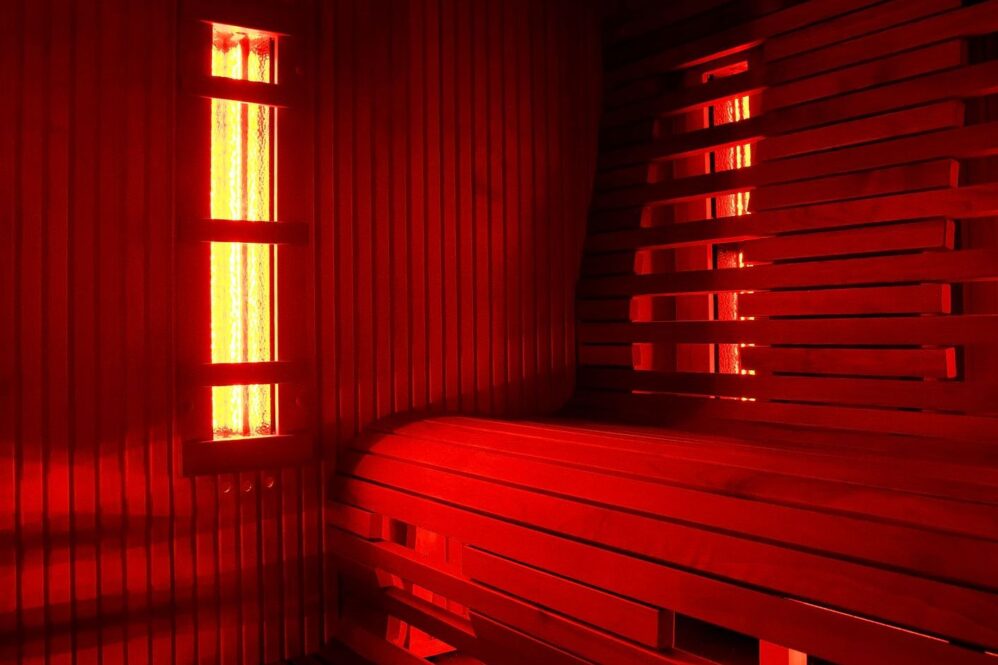
That one distinction explains nearly every mix-up in this category. Red light panels and infrared saunas sit side by side in the same shops and get talked about interchangeably, and they are doing different jobs. Red light works at and near the surface of your skin. Near-infrared reaches deeper. Neither one heats you. Far infrared does little else.
How it works
Your cells contain tiny structures called mitochondria. Their job is making energy, the fuel your cells use for everything from repairing skin to recovering from a workout.
Something inside those mitochondria absorbs red and near-infrared light unusually well. When it does, they produce energy more efficiently for a while afterward. Light goes in, cellular energy goes up, your cells have more to work with.
The timing is the part worth knowing. In a controlled lab study combining red light at 630 nm with near-infrared at 850 nm, energy production didn’t rise during the exposure at all. It peaked three to six hours later, and was still elevated a full day afterward (Ferraresi et al., 2015).
So you won’t feel anything while it’s happening. That’s the correct experience for a cellular signal. It’s also why people try red light twice, feel nothing, and quit long before any of it has had a chance to accumulate.
What it’s actually good for
Your skin. This is the strongest evidence by a wide margin. The largest controlled trial ran 136 people through 30 sessions, twice a week for about four months. Experts who didn’t know who had been treated scored their skin as measurably smoother, firmer and less lined, with higher collagen density on ultrasound (Wunsch & Matuschka, 2014). You should also know who paid for that study: the company that made the light. It remains the best evidence available on the question, and you deserve to hear that caveat from us rather than discover it yourself. In a second trial, 8 in 10 people said the lines around their eyes looked better after nine sessions (Russell et al., 2005).
Tissue repair. The striking numbers here belong to near-infrared rather than to red light on its own. LED light originally developed for NASA plant experiments made cells grow up to twice as fast in the lab. Out in the field, Navy SEALs recovered from musculoskeletal training injuries more than 40% faster (Whelan et al., 2001). One more reason the two wavelengths belong together rather than sold apart.
Recovery has a strong mechanism behind it and thin human data in front of it. If your cells are producing more energy for hours after a session, tissue doing repair work has more to draw on. That logic holds, and the cell-level evidence is real. The trials in actual humans are still small. Treat it as a good reason to try, rather than a promise about how you’ll feel on Thursday.
Blood sugar. In one study, 30 healthy adults got 15 minutes of red light before a sugary drink. The rise in blood sugar that followed came in about a quarter lower than in the group who sat under a light that was switched off (Powner et al., 2024). That’s peer-reviewed and directly on point. It’s also a single small study in healthy people that nobody has repeated at scale. We’d watch it rather than buy a sauna for it.
What red light therapy is used for, and what the evidence supports
| Benefit | What the evidence supports |
| Skin health | The strongest evidence of any use: higher collagen density and smoother texture after 30 sessions (Wunsch & Matuschka, 2014) |
| Fine lines and wrinkles | Reduced appearance with consistent use; 8 in 10 reported improvement around the eyes after nine sessions (Russell et al., 2005) |
| Pain and inflammation | Early evidence; not established by the trials cited in this article |
| Muscle recovery | Strong cellular mechanism (Ferraresi et al., 2015); human recovery trials are still small |
| Sleep | Not established; no controlled trial cited in this article supports it |
| Cellulite appearance | Mixed evidence that depends on the device and protocol |
Because red light targets surface and shallow tissue, it’s generally chosen for localized, targeted support rather than whole-body effects.
What it can’t do yet
Plenty gets claimed for red light that the research doesn’t support. We’d rather tell you than repeat it:
- Clearing out aged cells. “Clears senescent cells” shows up constantly in red light marketing. We went looking for human evidence and came up empty.
- Vagus nerve activation. There’s early preclinical work on light and nerve signaling. There is nothing resembling a controlled human trial.
- Mood. Strong trial evidence exists that whole-body heat improves depressive symptoms (Janssen et al., 2016). That’s the heat doing the work. Red light’s own mood evidence is still early, and we’re not going to borrow the heat study’s credibility to dress it up.
None of this is impossible. It just isn’t proven yet, and a company willing to tell you which is which is worth trusting on the things that are.
What most people get wrong
“More is better.” There’s a sweet spot. Too little light does nothing, the right amount works, and too much can cancel the benefit out entirely. Researchers call it a biphasic dose response (Huang et al., 2009). The right dose beats the biggest number on the box.
“Distance doesn’t really matter.” It matters more than almost anything else. Light intensity falls off with the square of distance, which has a blunt practical consequence. Move from 6 inches away to 12, and you’ve cut your dose to a quarter. A panel’s advertised output was measured at the bulb. You will never receive that number.
“If I don’t feel heat, it isn’t working.” Red light is a signal rather than a heat treatment, so feeling nothing is exactly right. If you do feel heat, that’s the sauna.
“Red light and near-infrared are the same.” They’re related, but they aren’t interchangeable. Red is visible and works near the surface. Near-infrared is invisible and goes deeper. Most of the research that makes red light interesting used both together.
“Red light gives me everything an infrared sauna does.” It doesn’t. Red light’s evidence is about skin and cellular energy. Far infrared’s evidence is about heat: raising core temperature, sweating, and the cardiovascular effects that come with heat stress (Imamura et al., 2001). They’re complementary tools.
What this means if you’re shopping
Put the last two together and you get the question almost nobody asks before buying. Not how powerful the light is. How much of it reaches you, and for how long.
Wavelength, distance, placement, coverage and session length all decide the answer, and a single panel you sit in front of leaves every one of them up to you. Because intensity drops off so steeply, the side of you facing the panel and the side that isn’t are getting very different doses out of the same session.
That’s the real limitation of red light bolted onto a sauna after the fact. The light itself is fine. Nothing about the setup is deliberate.
Red light also doesn’t compete with heat. Different mechanism, so it can run through a hot session without either one interfering with the other, which is the argument for engineering them together from the start instead of hanging a panel on a wall.
How we evaluated this comparison
Most red light therapy is delivered through a standalone panel: one fixed position, one distance from the body. Infrared sauna brands take different approaches to that problem, and they aren’t all the same. The comparison below covers five approaches to red light delivery: a generic standalone panel, Clearlight’s Sanctuary 2, Peak Saunas’ Fuji, the Sunlighten mPulse® and the Sunlighten Amplify RED.
Competitor figures come from Sunlighten’s internal comparison research, cross-referenced against publicly published specs where available as of this writing. Sunlighten’s own figures reflect internal product specifications. Pricing is excluded, since published pricing varies by model, configuration, and whether a brand publishes pricing at all.
Ask us! What questions do you have about content, strategy, pop culture, lifestyle, wellness, history or more? We may use your question in an upcoming article!
Like MediaFeed’s content? Be sure to follow us.
This article originally appeared on Sunlighten and was syndicated by MediaFeed.co.