
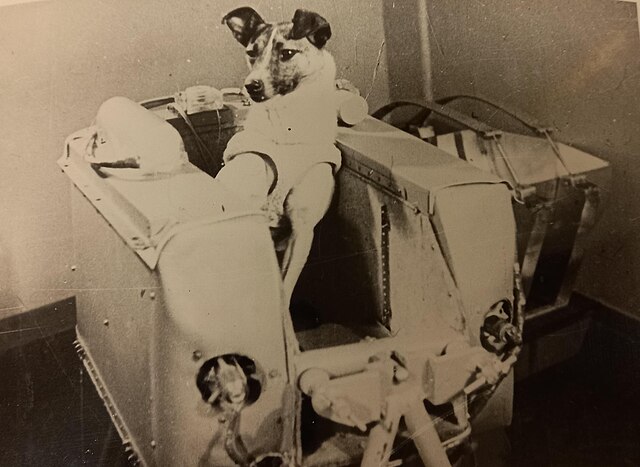
Aboard the Soviet’s Sputnik 2, Laika, a stray dog from Moscow, became the first living creature to enter orbit on November 3, 1957, but her trip didn’t have a return plan.
During The Cold War, a Space Race between the Soviet Union and the United States began in 1955. Then, on October 4, 1957, the Soviets were the first to successfully launch a rocket into space, Sputnik 1.
Following this success, Soviet leader Nikita Khrushchev ordered chief rocket engineer Sergei Korolev to launch a second satellite, Sputnik 2, to celebrate the 40th anniversary of the Bolshevik Revolution. For this one, the plan was to carry the first living creature into orbit.
Three stray dogs, Albina, Mushka, and Laika, were tested and trained for the flight. The dogs were tested in small places, put into extremely loud environments, and subjected to vibrations.
All three did well, but Laika was chosen to board Sputnik 2; she was a small, calm dog and about three years old when she was selected for the mission.
Right before launch, Laika was covered in an alcohol solution and iodine in several spots so that sensors could be placed on her. The sensors monitored her heartbeat and blood pressure to detect any changes that might occur in space.
Laika had just enough room for her to lie down or stand, with access to gelatinous space food made for her, but she never returned.
In 1998, Oleg Gazenko, a leading Soviet space scientist and physiologist who helped train Laika, said, “Work with animals is a source of suffering to all of us. We treat them like babies who cannot speak. The more time passes, the more I’m sorry about it.”
In 2002, Russian scientist Dimitri Malashenkov revealed that Laika had actually survived only about five to seven hours after liftoff before dying of overheating and panic.
In 1959, the Soviet Union issued a commemorative postage stamp honoring Laika and the early achievements of the Soviet space program. Laika was also honored with a number of monuments and memorials, such as the Monument to the Conquerors of Space, a giant obelisk in Moscow built in 1964 to celebrate achievements of the Soviet people in space exploration.
The Star City Memorial was created in 1997 and features a statue and plaque of Laika standing near Soviet cosmonauts, and a 2-meter bronze sculpture of a space rocket that morphs into a human hand, with Laika standing in its palm; it was built in 2008.
After Laika, the space race continued; the United States sent various animals into space, primarily monkeys, chimpanzees, and mice.
In 1960, the Soviet Union sent two other dogs, Belka and Strelka, which were the first animals to orbit the Earth and successfully land safely back on the ground.
Ask us! What questions do you have about content, strategy, pop culture, lifestyle, wellness, history or more? We may use your question in an upcoming article!
Like MediaFeed’s content? Be sure to follow us.
This article was syndicated by MediaFeed.co