
Key takeaways
- A living will records medical wishes before a crisis removes the ability to express them. Families forced to make those decisions without one are guessing at what their loved one wanted. They are making the call themselves, under conditions that make clarity almost impossible.
- An ethical will has no legal authority but preserves the values, reasoning, and intentions that formal documents were never built to hold. It is the document that answers not who gets what, but why any of it mattered.
- Both documents address a different kind of loss. A living will protects against medical decisions made without guidance. An ethical will protects against the quieter loss of context and the life behind the estate.
- Neither replaces the other, and a complete plan includes both. Most people finish the legal work and assume the planning is done, though this is often just the starting point, not the end.
There is a version of retirement planning that gets done thoroughly and still leaves something out. The accounts are titled correctly. The will is current. The beneficiary designations match the intent. And when it is over, the person who did all of it sits with a faint sense that the paperwork captured the what but not the why, not the story of how the money was made, not the reasoning behind the decisions, not the things that mattered most and shaped every choice in the estate now waiting to be distributed.
Legal documents were not built for that. They were built to transfer, protect, and instruct. An improperly executed will fails to protect assets. Not having a living will leaves families navigating impossible medical decisions at the moment they are least equipped to make them. Those are real failures with real consequences, and getting the formal planning right matters. It just does not cover everything.
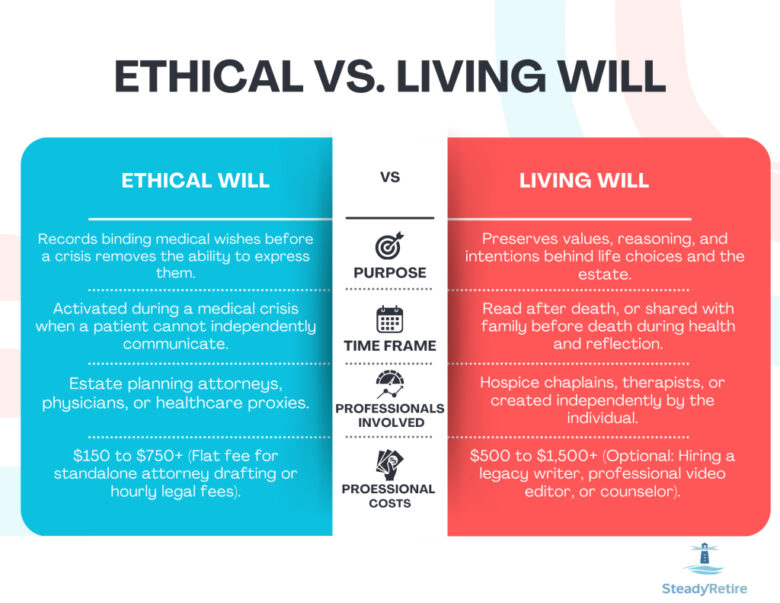
The most basic differences
A living will, also known as an advance directive, is a legal instrument with enforceable authority. It is filed, witnessed, reviewed by attorneys, and activated in clinical settings when a patient cannot speak. An ethical will is none of those things. It is a personal document, a letter, a video, a narrative, that carries no legal weight and requires no professional involvement to create. One governs a medical crisis. The other addresses the quieter question of what a life meant.
What each document is designed to protect
The most fundamental difference between the two is the kind of loss each one is built to prevent. A living will prevents a family from making irreversible medical decisions without guidance, in a hospital corridor, under conditions almost designed to produce regret. An ethical will prevents a different kind of erasure: the disappearance of context, reasoning, and values that formal estate documents lack the means to carry.
The two documents also differ in timing, format, legal standing, and the professionals involved in creating them. A living will requires state-specific language to be enforceable; an ethical will requires only honesty and the will to write it. A living will is activated in a medical crisis; an ethical will is read after death, or sometimes before. Both belong in a complete retirement plan, but they serve entirely different functions within it.
Putting the pieces of retirement together? Explore professionals who can help connect major financial and lifestyle decisions with your broader retirement plan.
Legal documents: The living will
A living will does something immediate and legally binding: it puts a person’s medical wishes on record before the moment arrives when they can no longer express them. Illness does not always announce itself with time to prepare. A stroke, a serious accident, a sudden neurological event; any of these can remove someone’s ability to participate in their own care without warning. What a living will does is ensure that the instructions given in a clear moment carry legal weight in an unclear one.
What decisions a living will covers
The document typically covers the decisions that are hardest to make under pressure:
- Whether to continue mechanical ventilation if there is no reasonable expectation of recovery
- Whether to authorize artificial nutrition
- Whether to pursue aggressive intervention in the event of cardiac arrest
State requirements and legal enforceability
These are not comfortable questions to sit with in advance but are even worse when they land on a family for the first time in a hospital waiting room, when grief and shock are already doing their work. The National Alliance for Care at Home, formed in 2024 through the merger of the National Hospice and Palliative Care Organization and the National Association for Home Care and Hospice, operates CaringInfo.org, which provides free advance directive forms for every state. The forms are a starting point; they are not a finish line. Requirements differ by state in ways that matter: some states require notarization, others require two adult witnesses, and the specific language that makes a directive legally enforceable in one state may not satisfy the requirements of another. The American Bar Association, or ABA, recommends having an advance directive reviewed by an estate planning attorney who knows the rules of the state where the person lives and holds property.
How a healthcare proxy works with a living will
A living will typically works alongside a healthcare proxy, a document also called a durable power of attorney for healthcare, which designates a specific person (a spouse, an adult child, a trusted friend) to make medical decisions when the patient cannot. While the living will provides instructions, the proxy serves as the decision-maker when a specific situation arises that the instructions do not fully address.
Planning for financial incapacity
What a living will does not do is address the financial side of incapacity. A separate document, a durable power of attorney for finances, authorizes someone to manage bank accounts, pay bills, and handle financial transactions if the account holder becomes unable to do so. These are distinct instruments with distinct purposes, and the absence of either one creates a different kind of problem.
Go Further: The ABA’s Consumer’s Toolkit for Health Care Advance Planning, available at americanbar.org, walks through the differences between state requirements and explains how living wills interact with do-not-resuscitate orders and POLST forms (Physician Orders for Life-Sustaining Treatment) in clinical settings.
Personal documents: The ethical will
An ethical will carries what legal documents cannot: the meaning that sits behind an estate. Not the assets themselves, but the life that produced them, the values that shaped it, the reasoning behind the decisions that will outlive the person who made them. It is a personal document rather than a legal one, which means it is not filed with a court, notarized, or enforced by anyone. It cannot transfer a bank account or direct the distribution of property. What it can do is speak directly to the people who will receive those things, in a voice no attorney drafts and no probate court reviews.
The history and purpose of ethical wills
Ethical wills are older than estate planning as a profession. Hospice chaplains bring ethical will writing into end-of-life care as a tool for reflection and closure. Therapists use it with clients processing legacy and meaning. Estate planning attorneys increasingly raise it with clients who have finished the formal work and find themselves wanting something it did not provide. The common thread is not tradition but need: people need to say something that a list of asset distributions cannot say.
Common ethical will formats
In practice, the document takes whatever form serves the writer. Common formats include:
- Letters addressed to a spouse, children, or grandchildren not yet born
- Video recordings made at home or with professional support
- Structured written prompts that guide reflection question by question
The content tends to cover things that formal planning never asks about:
- The values that guided a career, and the ones that got tested by it
- The failures that taught more than the successes
- What a person would do differently, and what they would not touch
- The specific hopes they hold for the people who will outlive them
How an ethical will can prevent family conflict
That last dimension is more practically useful than it might seem. Estate distributions that arrive without explanation often generate confusion, hurt feelings, and sometimes legal disputes among beneficiaries who interpret silence as a slight. An ethical will does not have legal authority over those disputes, but it can prevent many of them from arising by providing the reasoning that formal documents omit.
Ethical wills in modern estate planning
The National Association of Estate Planners and Councils, known as the NAEPC and representing estate planning attorneys, financial advisors, and trust officers across the country, has incorporated ethical wills into its resources for members working with clients on legacy planning. The recognition reflects a growing understanding in the estate planning field that what people want to leave behind is not always captured by a list of assets and their designated recipients.
Go Further: Inherited IRA Rules covers what beneficiaries need to know about the 10-year distribution rule and required minimum distributions after inheriting a retirement account, as well as the financial mechanics that an ethical will cannot address but that a financial advisor and estate attorney working together can help navigate before the account changes hands.
Passing on values
The gap between what estate planning documents can hold and what people actually want to pass on becomes clearest when the planning is finished. The will is signed. The beneficiary designations are updated. The advance directive is on file with the primary care physician. And still something feels incomplete; not because the paperwork was done wrong, but because paperwork was never the right container for it.
What most people want to leave behind is not just assets. It is context:
- The story of how the money was made and what it cost
- The values that held a marriage together through decades
- The mistakes that turned out to matter more than the successes
- The faith, the philosophy, the specific way of looking at the world that made a person recognizable to the people who knew them
None of that fits in a legal document. Most of it disappears if it is never written down.
Putting your values into words
An ethical will is one way to put it in writing. It does not require legal language, professional assistance, or a specific format. Some people write letters. Others record videos. Others work through structured prompts, asking questions about formative experiences, the people who shaped them, and what they believe and why. The National Alliance for Care at Home and several hospice organizations provide guided templates for people who want structure to get started.
Why retirement is a natural time to begin
Retirement is often a natural moment to begin, not because death is near but because distance from daily stresses and distractions has arrived. The daily urgency of a career is gone. The long view has become easier to hold. The things that mattered and the things that turned out not to matter have had time to sort themselves out. That clarity tends to produce a better document than the one written in the shadow of a diagnosis, when the emotional weight of the moment narrows what gets said.
Bringing legacy into the planning process
The estate planning community has noticed. Attorneys and financial advisors who work on legacy planning have begun raising ethical wills earlier in the conversation, mostly because writing it tends to surface things that formal planning cannot: what a person genuinely cares about leaving behind, who they want to be for the people who remember them, and what they hope travels forward beyond the assets.
How a financial advisor can help
The financial and personal dimensions of legacy planning are more connected than they appear from the outside. An ethical will that explains the reasoning behind an unequal estate distribution is more likely to be well received if the estate plan itself was executed cleanly, the beneficiary designations match the will, and the inherited accounts come with clear instructions on what to do with them. The documents reinforce each other when the planning is done well. When pieces are missing, the ethical will cannot compensate for them.
A fee-only fiduciary working with an estate planning attorney can ensure the legal architecture is in place before the personal one becomes the focus. Beneficiary designations on retirement accounts and life insurance policies supersede whatever a will says; a detail that has redirected assets away from intended recipients in more estate settlements than most people would guess. Retirement accounts that pass to beneficiaries without a plan for the required subsequent distributions can generate unexpected tax bills in the years after the original account holder’s death. A Roth conversion strategy (the process of moving money from a traditional IRA where withdrawals are taxed as ordinary income into a Roth IRA where qualified withdrawals are tax-free) executed in the right years can change what those accounts look like when they transfer, which is a gift of a different kind than what most ethical wills think to address.
The conversation about what to leave behind, and how, is more complete when both dimensions are present. What the money is for and where it goes are separate questions, and the answers to both tend to matter to the people left holding them.
FAQs
What is a living will and why does it matter for retirement planning?
A living will is a legal document that records a person’s wishes for medical treatment when they can no longer communicate those wishes directly. For anyone in or approaching retirement, it is a foundational document. The health events most likely to trigger its provisions (stroke, dementia, advanced illness) become statistically more common with age, and the decisions it governs are among the most consequential a family can face. Without one, those decisions fall to whoever is present and available, under conditions that are rarely conducive to honoring what the patient would have wanted. Every state has its own requirements for what makes an advance directive legally valid, which is why reviewing the document with an estate planning attorney, rather than relying on a generic form alone, is worth the additional step.
What is an ethical will and how is it different from a legal will?
A legal will directs the distribution of assets after death. An ethical will directs nothing. It is a personal document, a letter, a narrative, a recorded conversation, in which someone articulates the values, experiences, and intentions that shaped their life and that they want to pass forward. It carries no legal authority and requires no professional involvement to create. The difference in purpose is the point: a legal will answers the question of who gets what; an ethical will answers the question of why it mattered.
Do both documents need to be prepared by a lawyer?
A living will benefits from legal review before it is considered finished. The requirements for a valid advance directive vary enough between states, in the specific language required, the number and type of witnesses, whether notarization is mandatory, that a form downloaded from the internet may not meet the standard of the state where it needs to hold up. An estate planning attorney familiar with local requirements is the right person to check it.
An ethical will needs none of that. There is no filing requirement, no witnessing, no enforceable format. Its value is not legal precision; it is personal honesty. A hospice chaplain, a therapist, or a set of structured writing prompts can be more useful here than any attorney. The two documents call on completely different kinds of preparation, which is part of why people sometimes overlook the ethical will when they have finished the legal one and assume the work is done.
When should someone create these documents?
The living will should not wait for a health event to make it feel urgent. By definition, it is most useful before anything happens, and the window between deciding to create one and needing one is unpredictable. For the ethical will, the timing question is different. It is not about urgency but about quality. A document written from a place of health and reflection, when there is time to sit with the questions and revise the answers, tends to be richer and more honest than one written against a medical deadline. Retirement offers that window, the distance from daily professional demands, the accumulated perspective, the time to think about what a working life added up to and what it is worth saying about it before the opportunity closes.
Glossary
Living will: A legal document, also called an advance directive, that records a person’s medical wishes for situations where they can no longer express those wishes directly. Covers decisions such as whether to continue life-sustaining treatment, authorize resuscitation, or pursue aggressive intervention in the event of serious illness. What makes it legally valid varies by state, which is why having it reviewed by an estate planning attorney matters more than most people expect when they first fill one out.
Advance directive: The legal category that covers documents governing medical decision-making when a patient cannot speak for themselves. A living will is one type of advance directive. A durable power of attorney for healthcare, the document that designates who makes medical decisions on the patient’s behalf, is another. The two typically work together: the living will provides instructions, and the healthcare proxy designates the decision-maker for situations the instructions do not cover.
Healthcare proxy: The person designated, through a durable power of attorney for healthcare, to make medical decisions on behalf of someone who cannot make them independently. The legal document that creates the designation is the durable power of attorney for healthcare; the proxy is the individual named in it. Choosing the right person matters as much as having the document: this is someone who will need to make difficult decisions, sometimes quickly, under emotional pressure, and in accordance with wishes that may not fit neatly into the situation at hand.
Durable power of attorney for finances: A legal document authorizing a designated person to manage financial accounts, pay bills, sign documents, and conduct other financial transactions on behalf of someone who is unable to do so themselves. Separate from a healthcare proxy, which covers medical decisions only. Both are worth having; the absence of either creates a different problem, and neither covers what the other is designed to handle.
POLST (Physician Orders for Life-Sustaining Treatment): A set of medical orders signed by a physician that translates a patient’s end-of-life wishes into specific clinical instructions actionable at the point of care. More immediately binding in a medical setting than an advance directive alone, because it functions as a physician’s order rather than a patient’s stated preference, meaning emergency responders and clinical staff can act on it directly. Not available in all states, and typically used for patients with serious illness, advanced age, or frailty rather than as a general planning tool.
Ethical will: A personal document, not a legal instrument, in which someone records the values, formative experiences, life lessons, and hopes they want to pass on to family members or others. Requires no legal preparation, no filing, and no professional involvement to create. Its authority is entirely moral and emotional rather than legal. A legal will answers the question of who receives what; an ethical will attempts to answer the question of what it all meant.
Beneficiary designation: A formal instruction filed with a financial institution or insurance company specifying who receives the assets in an account or policy when the account holder dies. Operates independently of whatever a legal will says, meaning a beneficiary designation that names an ex-spouse will send assets to that ex-spouse even if the will says otherwise. Keeping designations current and consistent with the overall estate plan is one of the most consequential details in estate planning and one of the most commonly neglected.
Roth conversion: The process of moving money from a traditional IRA, where contributions went in before taxes were paid and withdrawals are taxed as ordinary income, into a Roth IRA, where qualified withdrawals are tax-free. Converting during lower-income years, typically before required minimum distributions begin pushing income higher, can reduce the tax burden on both the account holder and the beneficiaries who eventually inherit. The timing and amount of a conversion involve trade-offs that depend on the full income picture over the relevant years.
Required minimum distribution (RMD): The annual withdrawal the IRS requires from tax-deferred retirement accounts, traditional IRAs, 401(k)s, and similar vehicles, starting at age 73. The amount is calculated each year as a fraction of the account balance. Beneficiaries who inherit these accounts face their own distribution rules, which changed substantially under the SECURE Act of 2019 and follow-up legislation in 2022. Most beneficiaries who are not the account holder’s spouse are now required to fully distribute an inherited account within ten years of the original owner’s death, which can create a tax-planning challenge depending on the account’s size and the beneficiary’s income.
Important Information
SteadyRetire is a retirement education platform offering practical financial resources and access to a financial advisor matching service. This article is intended for informational and illustrative purposes only and does not constitute financial, legal, tax, or investment advice. The information provided does not create a professional-client relationship and should not be used as a substitute for consultation with a qualified financial advisor, tax professional, or attorney. While we strive to provide accurate and up-to-date information, rules and regulations regarding retirement are subject to change. Always consult with a certified professional regarding your specific financial situation.
Ask us! What questions do you have about content, strategy, pop culture, lifestyle, wellness, history or more? We may use your question in an upcoming article!
Like MediaFeed’s content? Be sure to follow us.
This article originally appeared on SteadyRetire and was syndicated by MediaFeed.co.