
Key takeaways
- Rockford, Dayton, Des Moines, Eau Claire, and Columbia top this list of affordable Midwestern retirement destinations, each combining low housing costs with healthcare infrastructure that outperforms what their size would typically support.
- The cities share a profile: mid-sized, economically stable, and systematically underrepresented in retirement planning conversations dominated by Sun Belt alternatives.
- Common draws across all five cities include university-affiliated medical centers, revitalized downtowns, and outdoor recreation infrastructure that retirement-age residents actually use, not just amenity lists designed to attract younger workers.
- The Midwest’s cost advantage over Sun Belt retirement destinations has grown since the post-pandemic relocation wave pushed housing costs, property taxes, and homeowner’s insurance rates in places like Phoenix, Tampa, and Charlotte to levels that have closed much of the historical gap.
Retirement location conversations have followed the same geography for decades. Florida. Arizona. The Carolinas. The Midwest came up occasionally as a punchline about winters, which is how a region with genuinely strong affordability, expanding healthcare infrastructure, and livable mid-sized cities stayed off most people’s lists for longer than the data warranted.
For many already living within these cities, housing stayed within reach. Regional hospital systems kept growing, often anchored by university medical centers that brought specialist depth to cities that would not otherwise support it. Retirees who landed in places like Dayton, Columbia, or Des Moines tended to find that the daily quality of life compared well with what they had assumed would require a much larger budget or a more famous zip code.
Bureau of Economic Analysis regional price parity figures, an index measuring the overall cost of goods and services in a given metro relative to the national average, place Midwestern metros at the lower end of the national cost distribution. That is the number. What sits behind it is harder to quantify: the downtown cores that mid-sized cities have rebuilt over the past twenty years, the trail systems and parks that retirement-age residents actually use, the university medical affiliations that bring subspecialty care to cities too small to generate it independently, and yes, the four actual seasons that a portion of retirees prefer to the monotony of subtropical weather and are not always willing to say out loud.
The five cities below were ranked using federal cost-of-living, housing, and demographic data, with full methodology at the end of this article.
Planning where to retire?
Explore professionals who can help you weigh taxes, housing costs and retirement income together.
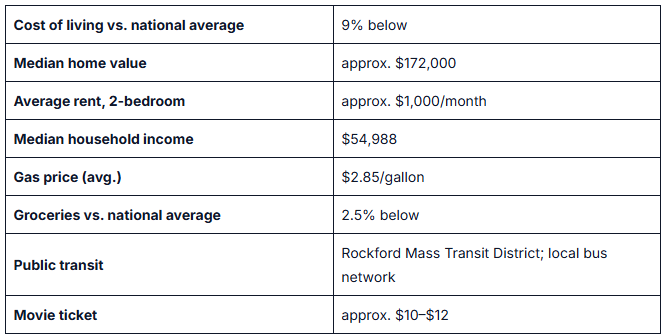
1. Rockford, Illinois
Rockford is 90 miles from Chicago yet nowhere near Chicago’s cost of living, which is the first and most important thing to know about it. The Bureau of Economic Analysis places the Rockford metro among the most affordable in Illinois by regional price parity, and HUD’s fair market rent figures for the area run well below both the Illinois and national averages for a two-bedroom unit. The housing market here has stayed accessible through cycles that pushed prices out of reach in comparable metros.
Healthcare infrastructure is stronger than the city’s size suggests. OSF Saint Anthony Medical Center and Mercyhealth both operate full-service hospitals in the city, providing redundancy in acute care that smaller single-hospital markets cannot offer. The University of Illinois College of Medicine maintains a campus in Rockford that supports local graduate medical training. Cities with academic medical affiliations tend to retain specialists at higher rates than those without, and Rockford’s is not a branch-campus afterthought.
The community infrastructure picture has improved considerably over the past decade. The Coronado Performing Arts Center, Riverfront Museum Park, and an active parks system provide the kind of amenity base that mid-sized cities have invested in to retain and attract residents. Property taxes in Winnebago County run higher than some Illinois alternatives, which is the honest knock on Rockford relative to other states on this list.
Illinois does not tax Social Security income. It also exempts pension and 401(k) distributions from state income tax, which, for retirees drawing from those sources, represents a real offset to property taxes, which run higher in Winnebago County than in some Midwestern alternatives. The state tax picture is one of the better ones in the region for retirement income specifically, even when the property tax line looks unfavorable in isolation.
Go Further: 10 Tax-Friendly States for Retirement examines how Illinois stacks up against Indiana, Wisconsin, and Missouri on the full retirement income tax picture, including what the pension exemption covers and which senior property tax relief programs are available at the county level.
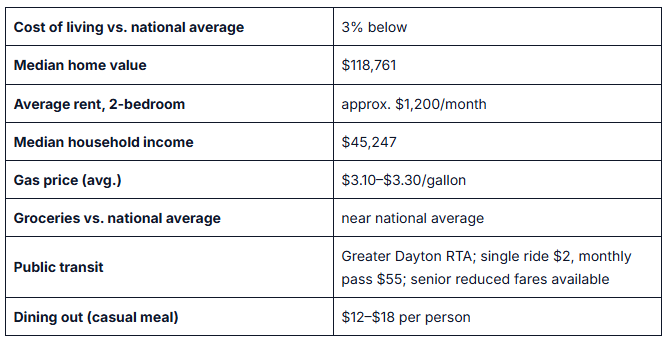
2. Dayton, Ohio
Dayton’s cost profile is among the most favorable of any mid-sized city in the country, according to the Bureau of Economic Analysis’s regional price parity measure. Median home values in the Dayton metro have remained well below the national median, and HUD fair market rents in the area reflect a rental market accessible to retirees on fixed incomes without requiring location trade-offs.
Kettering Health and Premier Health operate multiple hospital campuses across the metro, and the presence of Wright State University Boonshoft School of Medicine supports a medical community with more specialist depth than the city’s size would typically predict.
The Dayton VA Medical Center is a significant regional resource for veterans, serving a region with one of Ohio’s larger per-capita veteran populations. Its presence adds a layer of federally supported healthcare capacity that community hospital systems alone do not provide.
Beyond its healthcare infrastructure, Dayton has done something that not every post-industrial mid-sized city has managed: it has rebuilt a downtown that gives people reasons to be there. The Oregon Historic District has held its architectural character through cycles that erased comparable neighborhoods in other cities. The Dayton Art Institute operates a collection that would be notable in a city twice the size. A food and small-business scene that has grown up around Fifth Street and the surrounding blocks reflects investment in daily life rather than just in economic development brochures. Ohio applies income tax to retirement distributions but exempts Social Security and provides a senior-citizen tax credit that reduces the effective rate for lower-income retirees. Property tax rates in Montgomery County track close to the Ohio average, neither a particular advantage nor a liability relative to the state.
Go Further: Average Retirement Age examines how Ohio’s shifting retiree demographics are affecting community services, healthcare system capacity, and social programming in cities like Dayton, and what that means for someone arriving in the next five years.
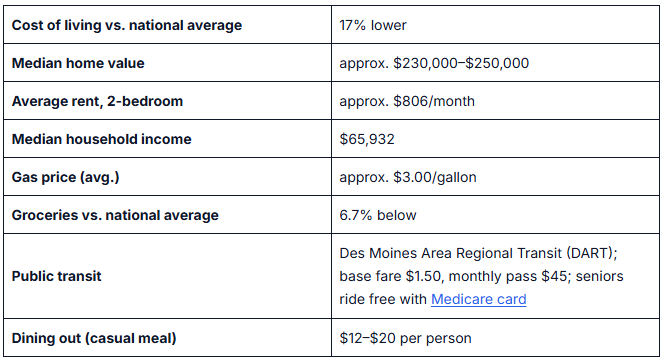
3. Des Moines, Iowa
Des Moines is the outlier on this list in the best sense: it is the largest city here, the most economically dynamic, and still among the most affordable major metros in the country by regional price parity. The Bureau of Economic Analysis consistently ranks the Des Moines metro in the bottom quartile of national costs, a position it has held even as the city has grown and its downtown has developed into something considerably more urban than most people’s mental image of Iowa’s capital allows.
HUD fair market rent data for the Des Moines metro shows a two-bedroom market that remains within reach for retirees on fixed incomes, without requiring a trade-off in location or neighborhood quality. Median home values have appreciated steadily over the past decade and still sit well below the national median, putting ownership within reach for buyers who could not access comparable housing in most other cities with Des Moines’s economic profile.
UnityPoint Health and MercyOne both operate hospital systems across the metro, with Iowa Methodist Medical Center functioning as the primary regional referral center for central Iowa. The range of specialist services available within the Des Moines system is wider than a city of its size might suggest, partly because it serves a large rural catchment area that depends on the metro for tertiary care.
Iowa does not tax Social Security benefits and, since 2023, has fully exempted qualified retirement income, including pensions, IRAs, and 401(k) distributions, for residents 55 or older or those who are disabled. Iowa also moved to a flat 3.8 percent income tax rate, which applies only to income not subject to those exemptions, such as wages or investment income. For retirees who draw primarily from Social Security and retirement accounts, the state tax burden can be minimal or even zero.
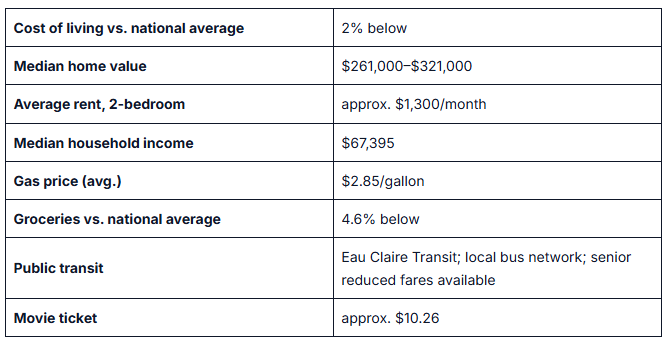
4. Eau Claire, Wisconsin
Eau Claire does not appear on most retirement shortlists, which is a function of unfamiliarity rather than any deficiency in what the city offers. HUD fair market rents for the Eau Claire area sit well below the Wisconsin average, and median home values reflect a market where purchasing a comfortable single-family home in a stable neighborhood remains achievable on a retirement budget that would be stretched thin in Milwaukee or Madison.
Mayo Clinic Health System operates the major hospital in Eau Claire, which is not a minor detail. Having Mayo’s clinical protocols, specialist network, and referral infrastructure in a city of 70,000 is an unusual combination. Retirees for whom access to healthcare drives their location decisions will find that Eau Claire punches well above its weight in this dimension.
The Chippewa Valley region surrounding Eau Claire offers outdoor recreation: the Chippewa River, state trails, and proximity to the Northwoods fit a specific retirement profile well. The city’s arts infrastructure is more developed than its size would suggest, with the Pablo Center at the Confluence serving as a regional performing-arts anchor. Wisconsin fully exempts Social Security benefits from state income tax at any income level, but taxes most pension income, as well as IRA and 401(k) distributions, as ordinary income. This is a distinction that requires modeling against the full income picture before the state’s otherwise favorable housing and healthcare costs are taken as the whole story.
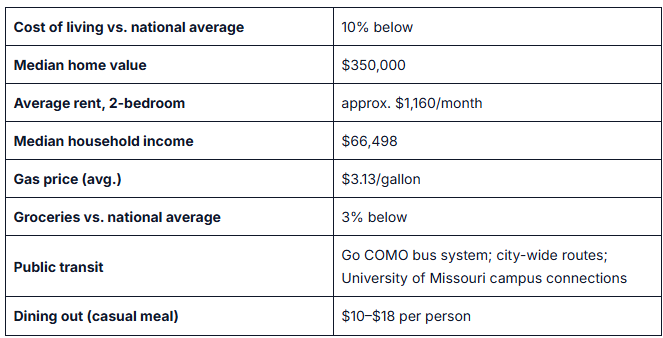
5. Columbia, Missouri
Columbia sits midway between Kansas City and St. Louis, drawing on the cultural and commercial infrastructure of both without carrying either city’s cost. The University of Missouri does something for Columbia that most employers cannot: it diversifies the economy, lowers the median age of the city’s population in ways that sustain retail and service amenities, and puts a major academic health system inside city limits. The pattern is familiar from other strong university towns, but the scale of MU’s presence in Columbia is larger than most.
MU Health Care operates a Level I trauma center in Columbia, the highest designation in the American trauma system, alongside a comprehensive cancer center. For retirees who are managing an existing condition, anticipate needing subspecialty care, or simply want access to that level of clinical depth without relocating to Kansas City or St. Louis, Columbia’s healthcare situation is not what a city of 130,000 would normally provide. That access does not come at a premium in housing cost.
HUD fair market rents in Columbia run below the Missouri average, and median home values reflect a market shaped in part by university enrollment patterns: stable demand, consistent turnover, and a rental market that has kept ownership accessible. Missouri exempts Social Security benefits from state income tax for most retirees and offers a pension exemption that covers many public and private retirement income sources. Property taxes in Boone County, where Columbia sits, are among the lower rates in Missouri. The combination produces a state tax profile that compares favorably with several alternatives on this list for retirees who draw primarily from Social Security and pension sources.
Go Further: 9 States with No State Income Tax for Retirees covers where Missouri ranks against neighboring states on the full retirement income picture and what the pension exemption actually covers.

How a financial advisor can help
A city that is affordable on paper can turn expensive in practice if the full income picture has not been modeled before the move. State income tax treatment of retirement income varies enough between these five locations to produce materially different after-tax income from the same gross sources. Iowa exempts Social Security and most qualified retirement income for residents 55 and older. Wisconsin exempts Social Security but taxes most pension income. Illinois exempts both. Missouri exempts Social Security for most retirees and offers a pension deduction. Ohio taxes retirement income but provides a senior credit. Those differences compound over a 20-year retirement, resulting in figures that dwarf the cost of professional planning.
A fee-only fiduciary can run a multi-state comparison against a household’s actual income sources: Social Security, pension, IRA distributions, investment income, and produce a projection that shows what each city on this list actually costs after taxes rather than before them. That projection changes the ranking for most households. Which city wins depends on where the income comes from, not just what housing costs.
Property tax relief programs for seniors are another dimension that rarely appears in general affordability rankings. Most Midwestern states offer some form of circuit breaker, freeze, or exemption for owner-occupied residential property above a certain age threshold, and the value of those programs varies enough across states and counties to shift the cost comparison. A local tax professional in the destination state can surface those programs in a way that a national ranking cannot.

FAQs
What makes a Midwestern city good for retirement?
The combination that tends to matter most is healthcare access, housing cost, and state tax treatment of retirement income. Mid-sized Midwestern cities have invested in healthcare infrastructure, often anchored by university medical systems, that provides access to specialists at a level disproportionate to their size. Housing markets in most of these cities have remained more accessible than those in coastal and Sun Belt cities. State tax treatment varies considerably and is the variable most likely to change a household’s financial picture, depending on where its income comes from.
Is the Midwest a good place to retire if winters are a concern?
The honest answer is that winter varies considerably across the region, and the Midwest’s reputation for severe cold applies more to northern Wisconsin and Minnesota than to Missouri or southern Illinois. Columbia, Missouri averages a winter climate comparable to parts of Tennessee. Dayton and Des Moines have four full seasons, with winters that are cold but not extreme by northern standards. Eau Claire and Rockford experience more winter, which some retirees actively prefer and others actively avoid. The region is diverse enough that dismissing it based on a generalized cold-weather concern overlooks cities whose climate profiles would surprise most people who have not checked the actual data.
How do these cities compare to Sun Belt retirement destinations on cost?
Bureau of Economic Analysis regional price parity data show that each of these five metros operates at a discount to the national average, which itself sits above most Sun Belt metros that have experienced population inflows and price appreciation over the past decade. Cities like Phoenix, Tampa, and Charlotte have absorbed enough demand to push housing costs, property taxes, and insurance rates, particularly homeowner’s insurance in coastal and storm-exposed markets, to levels that have closed much of the historical cost gap with Midwestern alternatives. The Midwest’s affordability advantage has, if anything, grown relative to the destinations that benefited most from the post-pandemic relocation wave.

Methodology
Three federal data sources anchor this ranking. HUD’s Fair Market Rents provide a standardized, annually updated benchmark for housing costs by metro area, more stable than listing prices and more comparable across markets.
The Bureau of Economic Analysis Regional Price Parities Index converts the overall cost of living in a given metro into a single number relative to the national average, capturing what housing alone misses.
Census Bureau American Community Survey data fills in median home values, age demographics, and geographic context for healthcare proximity. Each city was evaluated across all three dimensions rather than optimized for any single one.
The ranking treats cost of living, proximity to healthcare, and community infrastructure as roughly equivalent factors, on the grounds that a cheap but medically isolated or socially thin retirement is not actually a good retirement. City-level cost data in the At a Glance tables was sourced from RentCafe, Redfin, Salary.com, the Council for Community and Economic Research Cost of Living Index, and local transit authority schedules, all accessed or updated in 2025 and 2026.

Glossary
Regional Price Parity (RPP): A Bureau of Economic Analysis index measuring the cost of goods and services in a specific metro area relative to the national average, expressed as a percentage. An RPP of 90 means that the same basket of goods and services costs 10 percent less than the national average in that area. Housing, transportation, and services are weighted separately before being combined. The index provides a more complete picture of affordability than housing cost alone.
HUD Fair Market Rent: The Department of Housing and Urban Development’s estimate of the rent required to lease a modest unit in a given metro area, updated annually. Used by federal housing assistance programs to set payment standards. For retirement planning purposes, it provides a standardized benchmark for comparing rental housing costs across markets without relying on listing prices, which can reflect short-term conditions.
Median home value: The midpoint of home values in a given area, as measured by the U.S. Census Bureau in the American Community Survey. Half of the homes in the area are valued above the median; half are below. More stable as a comparison metric than average home value, which can be skewed by a small number of very high-value properties. Useful for understanding the accessible range of the ownership market rather than its ceiling.
Circuit breaker (property tax): A state or local program that limits property tax liability for qualifying homeowners, typically seniors or lower-income households, when that liability exceeds a defined percentage of household income. Named by analogy to an electrical circuit breaker: the tax is capped before it becomes a burden large enough to force a sale or move. Availability and benefit levels vary by state and county.
University medical center: A hospital or health system affiliated with a medical school, operating as a teaching institution alongside providing clinical care. Typically offers a broader range of specialist services and more complex care capabilities than community hospitals of equivalent size. Cities with university medical centers often have more specialist depth than their overall population would otherwise support.

Important Information
SteadyRetire is a retirement education platform offering practical financial resources and access to a financial advisor matching service. This article is intended for informational and illustrative purposes only and does not constitute financial, legal, tax, or investment advice. The information provided does not create a professional-client relationship and should not be used as a substitute for consultation with a qualified financial advisor, tax professional, or attorney. While we strive to provide accurate and up-to-date information, rules and regulations regarding retirement are subject to change. Always consult with a certified professional regarding your specific financial situation.
Ask us! What questions do you have about content, strategy, pop culture, lifestyle, wellness, history or more? We may use your question in an upcoming article!
Like MediaFeed’s content? Be sure to follow us.
This article originally appeared on SteadyRetire and was syndicated by MediaFeed.co.