
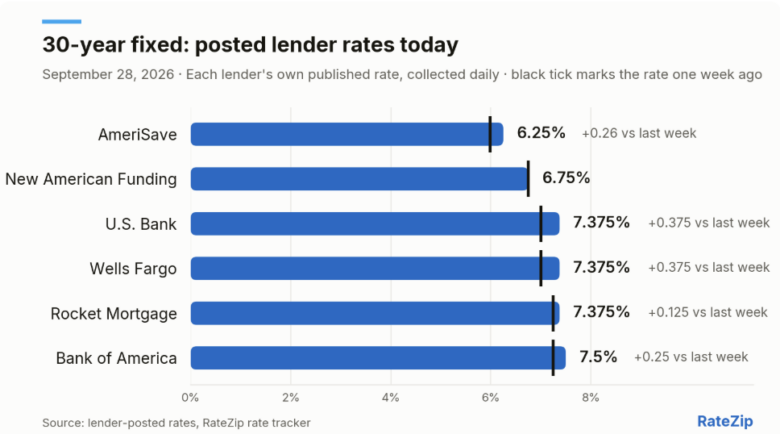
About half of outstanding mortgages carry interest rates of 4% or lower, Federal Reserve Governor Michael S. Barr said last week; nearly 80% have rates below 6%. On Monday, September 28, the 30-year fixed rates in RateZip’s lender collection ranged from 6.25% to 7.5%. Those older loans help explain why a homeowner considering a move has more to weigh than the next home’s price.
Barr brought that financing problem to a housing-affordability summit in Chicago on September 23, in remarks hosted by the Federal Reserve Bank of Chicago. In the same speech, owners who would face higher rates are less likely to move, he said.
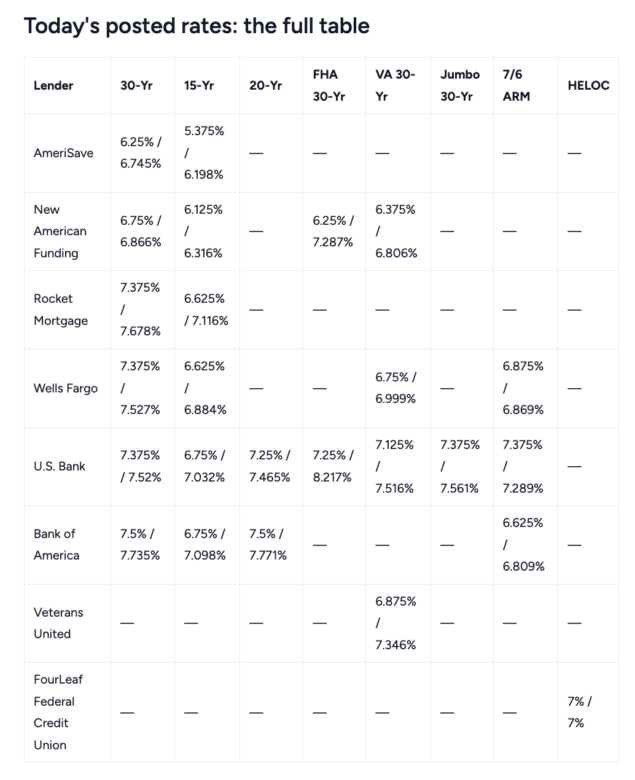
Monday’s lowest posted 30-year fixed interest rate in the collection was AmeriSave’s 6.25%, paired with a 6.745% APR. Bank of America posted 7.5% interest and 7.735% APR. These are separate lenders’ advertised observations, not competing quotes for the same borrower: credit, points, fees, loan size and eligibility assumptions differ. The spread shows the range of postings, not savings a household can count on when replacing an older loan. That range spans the 7.03% national weekly survey benchmark, a measure of a different pool of purchase loans.
National new-loan pricing rose over the week, adding to the financing question facing owners weighing a move. Freddie Mac’s survey for the week ending September 24 put the average 30-year fixed interest rate at 7.03%, up from 6.95%. Its different pool of loans comprises conventional, conforming purchases with excellent credit and 20% down.
The weekly change would raise principal and interest on a hypothetical $400,000, 30-year fixed mortgage from $2,647.79 to $2,669.27, or $21.48 a month. That measures a week’s drift in new-loan pricing; it does not measure the cost of replacing an existing low-rate loan. The illustration holds amount and term constant and excludes taxes, insurance, mortgage insurance, points, fees and closing costs. It is not a borrower quote or an offer.
The weekly increase in borrowing costs came alongside Freddie Mac’s assessment of economic strength supporting housing activity. In Freddie Mac’s September 24 release, Chief Economist Sam Khater said: “The housing market remains supported by a solid labor market and an economy that is growing at a healthy rate.” Read alongside Barr’s account, that describes a tension for buyers: economic conditions supporting housing activity do not necessarily bring more existing homes onto the market. In tight markets, Barr said, the supply lost through lock-in can exceed the demand lost, putting upward pressure on prices.
Today’s posted rates: the full table
How we collect and publish this: our rate methodology.
For closed-end mortgages, APR includes interest and certain loan charges; HELOC APR excludes fees. Adjustable-rate APR is not a maximum future rate. See the CFPB explanation.
National mortgage-rate benchmark cited in this article. Source: Freddie Mac Primary Mortgage Market Survey via FRED®, Federal Reserve Bank of St. Louis.
RateZip is operated by Peklava LLC, DBA RateZip, a licensed mortgage broker (NMLS ID 1592292). We are compensated by some of the partners shown, which may affect which offers appear and where. It does not affect our reporting or recommendations. See our editorial standards.
Read more
RateZip is operated by Peklava LLC, DBA RateZip, a licensed mortgage broker (NMLS ID 1592292). We are compensated by some of the partners shown on this page, which may affect which offers appear and where. It does not affect our reporting or our recommendations. Rates shown were last updated September 28, 2026 at 10:55 a.m. ET. See our editorial standards and how we use AI.
How we track rates: methodology. Found an error? Tell us.
Ask us! What questions do you have about content, strategy, pop culture, lifestyle, wellness, history or more? We may use your question in an upcoming article!
Like MediaFeed’s content? Be sure to follow us.
This article originally appeared on RateZip and was syndicated by MediaFeed.co.