Key takeaways
- Inflation quietly erodes retirement income. Even a modest annual price increase compounds over a 20-to-30-year retirement, reducing what a fixed income can actually buy far more than most people expect.
- The government uses a specific price index to calculate an annual Social Security raise. It may not fully reflect what retirees actually spend, particularly on healthcare and housing.
- The 2026 Social Security adjustment was 2.8 percent. On a $1,500 monthly benefit, that is roughly $42 more per month. Whether that covers the actual cost increases depends heavily on where someone lives and what they spend.
- Fixed income sources have no built-in protection. A pension that paid $2,000 a month in 2020 still pays $2,000 today, while groceries, utilities, and medical costs have all climbed.
- A single bad year can set retirees back permanently. When inflation spiked to 9.1 percent in June 2022, fixed-income retirees absorbed a loss in purchasing power that years of modest Cost-of-Living Adjustments (COLAs, defined later) cannot fully restore.
If grocery bills feel heavier than they did three years ago, that is not a matter of perception. It is inflation doing exactly what it does, quietly reducing how far each dollar goes. For retirees living on fixed incomes, that process has real consequences. A pension check does not grow because eggs got more expensive. A certificate of deposit earning 2 percent does not compensate for a year when prices rose 4 percent. The gap is real, and it widens every year it goes unaddressed.
Understanding how inflation is measured, how it relates to Social Security, and how it affects different income sources is one of the most practical things a person approaching or living in retirement can do. This article walks through each of those in plain terms.
Planning your retirement income? Explore professionals who can help you compare income sources, withdrawal strategies and long-term spending needs
CPI-W and COLA
The government calculates Social Security’s annual raise using a specific price index. That index is called the Consumer Price Index for Urban Wage Earners and Clerical Workers, or CPI-W. It is published monthly by the Bureau of Labor Statistics (BLS), the federal agency within the U.S. Department of Labor that tracks employment, wages, and prices across the economy.
How Social Security calculates COLA
By law, the Social Security Administration (SSA) uses the CPI-W to calculate the annual Cost-of-Living Adjustment (COLA) applied to Social Security benefits. The SSA compares the CPI-W from the third quarter of one year to the third quarter of the previous year. The resulting percentage change becomes the COLA for the following January.
Based on CPI-W data from the third quarter of 2024 through the third quarter of 2025, the 2026 COLA was set at 2.8 percent, affecting nearly 71 million beneficiaries. On a $1,500 monthly benefit, that works out to approximately $42 more per month. The 2025 COLA was 2.5 percent. Averaged over the last decade, the annual COLA has been approximately 3.1 percent, according to the SSA.
Why CPI-W may not reflect retirees’ expenses
The CPI-W was designed around the spending patterns of working-age wage earners, not retirees. Older Americans typically spend more of their budget on healthcare and housing, two categories that have historically risen faster than the overall index.
The BLS publishes an experimental alternative, the R-CPI-E, designed specifically to track price changes for Americans aged 62 and older. It is not currently used for COLA calculations, but it tends to show higher inflation than the CPI-W for the same periods.
Go Further: The R-CPI-E stands for the Relative Consumer Price Index for the Elderly. It is an experimental measure that tracks the specific spending patterns of Americans aged 62 and older, who typically spend more on medical care and housing than the general population. Because these specific costs often rise faster than other goods, this index generally shows a higher inflation rate than the standard version used to determine Social Security raises.
Historical inflation trends
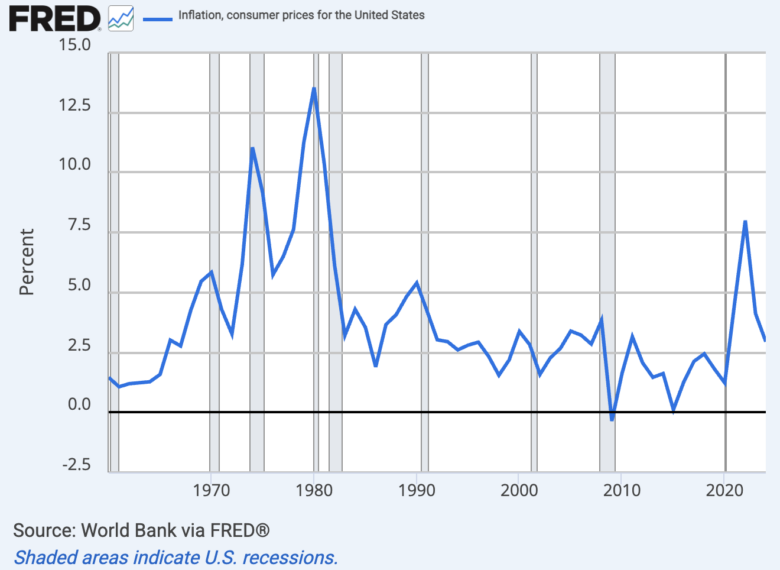
Inflation does not move in a straight line, and the distance between its floor and ceiling matters enormously for anyone living on a fixed income. The Federal Reserve, the central bank of the United States, targets an annual inflation rate of 2 percent over the longer run, according to the 2025 Statement on Longer-Run Goals and Monetary Policy Strategy. In practice, the gap between that target and reality has been significant.
Go Further: The Federal Reserve was established by Congress in 1913 to bring stability to the U.S. banking system. Its formal 2 percent inflation target was adopted in 2012, based on research showing that a low, predictable inflation rate allows households and businesses to plan without the disruptions caused by either deflation or runaway price growth. When inflation runs well above that target, as it did from 2021 to 2023, the Fed typically raises interest rates to slow spending and cool prices.
The recent inflation spike
According to the BLS Consumer Price Index release for June 2022, CPI peaked at 9.1 percent that month, the highest 12-month rate since November 1981. It then decelerated steadily, reaching an annual average of approximately 2.6 percent for 2025 and a 12-month rate of 3.3 percent through March 2026, as per the BLS Consumer Price Index Summary.
A single year at 9.1 percent erodes purchasing power more than four years of 2 percent gains can restore. For a retiree receiving a fixed pension with no inflation adjustment, that kind of spike is not temporary. It is a permanent reduction in real income that does not get made up.
How inflation affects fixed income
Not all retirement income responds the same way to rising prices. The three most common sources sit on a spectrum from partially protected to fully exposed.
Social Security is partially protected through the annual COLA. The adjustment is real but imperfect. Because the CPI-W reflects the spending patterns of working-age wage earners, it may underweight healthcare and housing costs, which consume a larger share of a retired household’s budget. The Congressional Research Service has examined this gap and its implications for benefit adequacy.
Defined-benefit pensions vary. Some public-sector pensions include inflation adjustments. Most private-sector pensions do not. A retiree receiving $2,000 a month in 2020 is still receiving $2,000 today in nominal terms, while the real cost of groceries, utilities, and medical care has climbed substantially over that same period.
Savings and fixed-rate accounts are the most exposed of the three. When the interest rate on a certificate of deposit or money market account runs below the inflation rate, the account holder is losing real purchasing power every month, even as the nominal balance grows.
How a financial advisor can help
While inflation steadily erodes purchasing power, a financial advisor helps safeguard a retirement plan by building growth and flexibility into a retiree’s long-term income strategy. Relying solely on fixed-income sources leaves households vulnerable to price spikes, as cost-of-living adjustments rarely match actual spending on volatile categories like housing and healthcare.
Because older Americans face higher inflation rates in specialized areas like medical care and insurance, advisors create tailored income models that account for health-specific cost increases rather than relying on general economic benchmarks. By continuously monitoring economic conditions and optimizing Social Security claiming strategies, a financial professional helps retirees maintain their standard of living throughout their post-work years.
FAQs
Why can stocks offer better protection against inflation than fixed income?
While fixed income offers stability, and Social Security and pensions often struggle to keep pace with inflation, the S&P 500 has historically outpaced them. Inflation acts like a “silent tax,” gradually eroding the purchasing power of every dollar received. Because fixed payments, such as Social Security or a pension, don’t always keep pace with rising healthcare and housing costs, relying on them alone can lead to a shrinking lifestyle.
In contrast, the S&P 500 represents ownership in companies that can raise their prices as costs go up, allowing wealth to grow faster than the cost of living. Over the long haul, the stock market has averaged annual returns of about 10%, providing a growth engine that fixed income simply cannot match.
Does Social Security keep up with inflation?
Partially, and the honest answer is that it depends on what is spent. The annual COLA is designed to preserve purchasing power based on CPI-W data, and the SSA applies it automatically each January. But the CPI-W is built around working-age spending patterns, not retiree ones. If a significant portion of someone’s budget goes to healthcare or housing, two categories that tend to outpace overall inflation, the adjustment may not cover the full increase in actual costs.
What is the difference between inflation and purchasing power?
Inflation is the rate at which prices are rising. Purchasing power is what that process does to money over time. At 3 percent annual inflation, $100,000 today buys what roughly $74,000 will buy in 10 years. The BLS inflation calculator lets anyone run those numbers across any two time periods using official CPI data. It is worth doing once, because the results are usually more sobering than people expect.
Is there an inflation index that better reflects what retirees actually spend?
There is an experimental one. The BLS publishes the R-CPI-E, designed to track price changes for Americans aged 62 and older, with more weight given to healthcare and housing. It is not currently used to calculate COLAs, which remain tied to the CPI-W under existing law. Research from the Congressional Research Service suggests that R-CPI-E consistently shows higher inflation for older Americans than the CPI-W does for the same periods, which has obvious implications for benefit adequacy.
Related:
Important information
SteadyRetire is a provider of educational content and information. This article is intended for informational and illustrative purposes only and does not constitute financial, legal, tax, or investment advice. The information provided does not create a professional-client relationship and should not be used as a substitute for consultation with a qualified financial advisor, tax professional, or attorney. While we strive to provide accurate and up-to-date information, rules and regulations regarding retirement are subject to change. Always consult with a certified professional regarding your specific financial situation.
Ask us! What questions do you have about content, strategy, pop culture, lifestyle, wellness, history or more? We may use your question in an upcoming article!
Like MediaFeed’s content? Be sure to follow us.
This article originally appeared on Steady Retire and was syndicated by MediaFeed