
The Vineland-3 is the one of the most widely used adaptive behavior assessments in autism and developmental evaluation — but it isn’t the only one, and it isn’t always the best fit. If you want a different domain structure, a different scoring approach, a lower clinician-time burden, or an objective measure rather than a caregiver-report one, there are strong alternatives.
Here are the main alternatives to the Vineland-3, what each does best, and how to choose.
Quick comparison
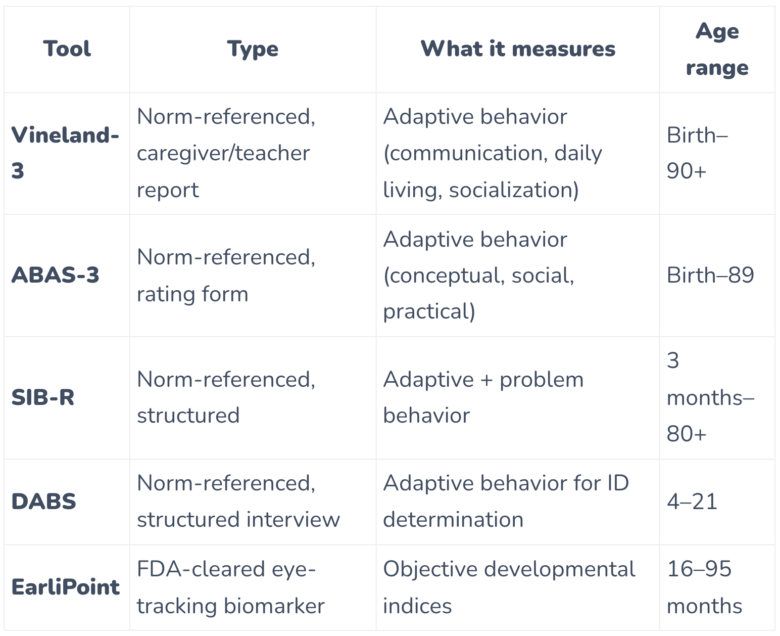
1. ABAS-3 — the closest norm-referenced alternative
The Adaptive Behavior Assessment System, Third Edition (ABAS-3), published by WPS, is the most direct alternative to the Vineland. Like the Vineland, it’s norm-referenced and produces standard scores, but it organizes adaptive behavior differently: into ten skill areas grouped under three domains — conceptual, social, and practical — summarized by a General Adaptive Composite (GAC).
It uses five rating forms covering ages from birth to 89, and is completed as a questionnaire rather than a semi-structured interview.
Choose it when: you want a norm-referenced adaptive measure but prefer the conceptual/social/practical domain structure, or a rating-form workflow that can be lighter on clinician interview time than the Vineland. The ABAS-3 and Vineland correlate strongly, though their absolute scores can differ.
2. SIB-R — adaptive plus problem behavior
The Scales of Independent Behavior–Revised (SIB-R) is a norm-referenced measure of both adaptive and problem behavior for ages 3 months to 80+. It assesses functional independence across 14 subscales in four clusters — Motor Skills, Social Interaction/Communication, Personal Living Skills, and Community Living Skills — across home, school, work, and community settings.
Choose it when: you want adaptive behavior and a structured measure of problem behavior in one instrument, especially for planning supports across multiple environments.
3. DABS — for intellectual disability determination
The Diagnostic Adaptive Behavior Scale (DABS), from the American Association on Intellectual and Developmental Disabilities (AAIDD), is a structured interview designed specifically to assess adaptive behavior for the purpose of intellectual disability determination, for ages 4–21. It focuses on conceptual, social, and practical adaptive skills around the diagnostic cutoff.
Choose it when: the clinical question is specifically about ID eligibility or determination, where the DABS was purpose-built.
A note on what “alternative” really means here
It’s tempting to treat these as a pick-one list. In practice, adaptive behavior tools (Vineland, ABAS-3, SIB-R, DABS) largely measure the same construct in different ways — so switching between them is mostly about domain structure, workflow, and funder preference. EarliPoint sits in a different category entirely: it’s the objective developmental layer that complements any of them.
Join our newsletter
So the most useful framing isn’t “Vineland vs. the alternatives.” It’s: pick the adaptive measure that fits your workflow and funder, then decide whether to add an objective developmental stream alongside it.
How to choose
- Want a norm-referenced adaptive measure with a different domain structure or a rating-form workflow? → ABAS-3
- Need adaptive and problem behavior in one tool, across settings? → SIB-R
- Assessing for intellectual disability determination? → DABS
Frequently asked questions
What is the best alternative to the Vineland?
The ABAS-3 is the closest norm-referenced alternative, with a conceptual/social/practical structure and a rating-form workflow. The SIB-R adds problem-behavior measurement; the DABS is purpose-built for intellectual disability determination.
Is the ABAS-3 better than the Vineland?
Neither is universally better. They measure the same construct — adaptive behavior — with different domain structures and administration formats, and they correlate strongly. The choice usually comes down to workflow preference and what your funder or school accepts.
Can ABA progress be measured without the Vineland?
Yes. Other norm-referenced adaptive measures (ABAS-3, SIB-R) work, as do criterion-referenced skills tools and objective developmental measures. Many practices keep an adaptive scale and add an objective measure for an independent progress signal.
Related:
- Scaling without spiraling: Smart ways to grow your ABA practice
- From fixing to flourishing: A brief history of autism in America & beyond
Like MediaFeed’s content? Be sure to follow us.
This article originally appeared on Earlipointhealth.com and was syndicated by MediaFeed.co