Fertilizer prices surge
The cost to fertilize your lawn — whether you hire a lawn treatment service or do it yourself — has gone up, in some cases way up, at the peak of spring lawn care. Global events and shifting supply chains are to blame.
We’ll explain what’s happening, why it matters for your lawn, and what you can do about it.
Key takeaways
• Fertilizer prices have risen 30%-50% since the U.S.-Israel conflict with Iran began in late February 2026.
• The Strait of Hormuz — now effectively blocked — carries roughly one-third of all globally traded fertilizer.
• Urea — the most common nitrogen fertilizer used on home lawns — crossed the $858/ton mark by mid-April 2026 (about $0.93 per pound of nitrogen). This means a few extra dollars added to every retail bag.
• Organic fertilizer alternatives can keep your lawn healthy this season while prices normalize.
Why fertilizer prices are surging in 2026
What is driving up the cost of fertilizer? Pre-existing market pressures and sudden geopolitical conflicts. When the U.S. and Israel launched strikes on Iran in late February 2026, one of the less-discussed ripple effects was an immediate disruption to global fertilizer supply chains.
Steve Rice, owner of Lawn Kings in Valencia, California, explains that this year’s increases stem from global crises rather than typical seasonal inflation.
“Every spring brings a bump, but supply chain disruptions and energy costs have pushed prices far beyond what I’d call normal,” Rice says.
He adds that nitrogen-heavy products, particularly urea-based blends, face the most volatility right now. In a rare move, his suppliers even issued early warnings about tight inventory.
Here is exactly what is driving up the costs:
- Prices were already climbing: Even before recent headlines, costs were up over the previous year. According to the Bureau of Labor Statistics, nitrogen-based fertilizers jumped 22% between February 2025 and 2026 due to tight global supplies and high European energy prices.
- A major shipping route closed: The conflict involving Iran has halted traffic through the Strait of Hormuz, which handles one-third of the global fertilizer trade. The Middle East is also a massive producer of urea and nitrogen. Closing this single waterway cut off several of the world’s top suppliers overnight.
- Manufacturing costs spiked: Simultaneously, natural gas — which is essential for making synthetic fertilizers — became much more expensive. This hit the market with a double whammy: less fertilizer available, and higher costs to make what was left.
When customers ask about their higher spring quotes, Kevin Thompson, owner of Sylvan Scapes in Staunton, Virginia, says the increases simply come down to “a mix of high production energy costs and shipping delays as importers hedge against conflict-driven disruptions.”ays as importers hedge against conflict-driven disruptions.”
How much more does it cost for fertilizer?
While retail fertilizer prices lag behind global markets, landscaping companies buying in bulk already feel the squeeze, meaning your service quotes will likely rise.
“Compared to last year, I’m seeing increases in the range of 20%-35% on common products,” Rice says. To combat this, his team focuses on applying exactly what the lawn needs, eliminating wasteful spending.
The statistics reveal the true impact on the market:
1. Instant spikes: Analysts tracking import markets report that urea prices at the New Orleans import hub jumped roughly 30% in the first week the conflict began, reflecting how quickly the shock hit import markets.
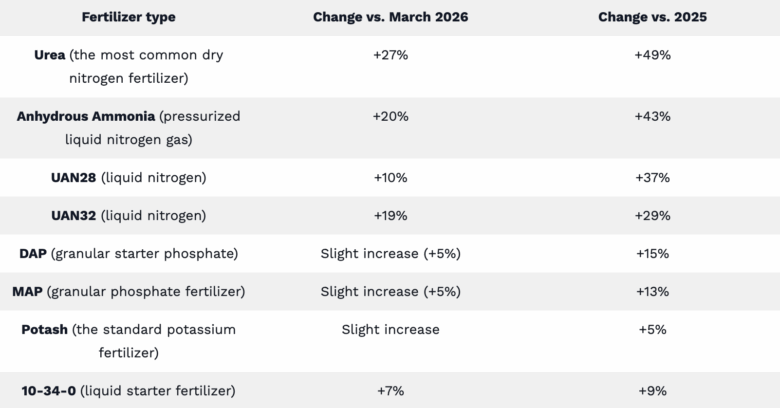
2. Steady climbs: According to DTN, which tracks retail fertilizer prices weekly, urea was 27% higher than a month earlier, with an average retail price of about $858 per ton in its mid‑April 2026 survey.
On a price‑per‑pound of nitrogen basis, DTN’s mid‑April survey put the average urea price at about $0.93 per pound of nitrogen. For you, this means paying a few dollars more per bag or absorbing higher service quotes.
Also, by mid‑April, anhydrous ammonia averaged about $1,114 per ton, up 20% higher than a month earlier and moving back toward the elevated levels seen during the 2022 price spike that followed supply disruptions from the Russia‑Ukraine war.
All 8 major fertilizers DTN tracks cost more now than last year.
Fertilizer price changes — Spring 2026
What this means for your lawn this spring
Should you adjust your fertilization plan this season? If you want to save some money, timing is everything.
“If you are restricted to one feeding, aim for a late spring application that includes a pre-emergent to prevent weed infestations,” Thompson says. He warns that starving the soil before summer heat can cause severe turf loss, ultimately leading to costly excavation or grading repair.
Andrew Day, owner of Advanced Quality Lawn in Richfield, Ohio, agrees, adding that late spring feeds build crucial root strength and help fend off common summer lawn pests like armyworms. He warns that delaying this treatment risks lawn burn and leaves your yard vulnerable to dandelions.
Smart strategies to save money right now:
- Use what you have: If you have leftover fertilizer in the garage, use it only if it has been stored properly and the bag is still dry, intact, and clearly labeled.
- Check with your pro: Ask your lawn care provider if their current quotes already include new material surcharges.
- Test your soil: A simple soil test reveals exactly what your lawn requires. As Thompson says, rising prices are pushing experts toward “more precise health analyses and soil testing to ensure every pound of fertilizer applied is actually needed by the landscape.”
- Buy strategically: Online prices for common fertilizers are already climbing, sometimes doubling overnight. If you find a fair price at the hardware store or online, buy it now before the higher costs hit everywhere.
Note: In our review of Amazon prices from March-April 2026, some products were highly volatile. For instance, Scotts Turf Builder Halts briefly reached $29.97 before dropping to $14.97, while GreenView Turf Nurture jumped from $16.92 to $23.97 and later settled at $20.48.
Organic alternatives to synthetic fertilizer
Organic fertilizer alternatives provide essential nutrients (N-P-K) and build long-term health.
“Organic fertilizers have also gone up, and they’re not necessarily cheaper right now. I’ve had projects where we shifted partially organic just to stretch applications, but it’s more about strategy than savings,” Rice says.
To lower costs, Day recommends mulch mowing and seaweed-based options, saying they “improve soil texture and stay in the ground longer than leachable synthetics, helping you build a resilient lawn that isn’t entirely dependent on volatile global markets.”
Note: Choose your organic options wisely. Thompson says manure introduces weeds, suggesting instead “core aeration or laying high-quality topsoil to improve natural nutrient uptake.”
Organic fertilizer alternatives at a glance
Best use Top-dressing, soil amendment
Notes
Excellent all-around; improves soil structure and helps retain moisture
Cow or chicken manure
Primary nutrient: Nitrogen, phosphorus
Best use Spring or fall application
Notes
Must be well-composted; avoid fresh manure because it can burn lawns
Grass Clippings (mulch mowing)
Primary nutrient: Nitrogen
Best use Light surface application
Notes
Free; leave clippings on the lawn instead of bagging
Primary nutrient: Nitrogen
Best use Year-round
Notes
Adds organic matter; use lightly and evenly
Bone meal
Primary nutrient: Phosphorus
Best use Spring
Notes
Good for root development; slow release
Blood meal
Primary nutrient: Nitrogen (fast)
Best use Quick green-up
Notes
Use sparingly; high nitrogen can burn grass
A few caveats: Organic fertilizers release nutrients slowly. If a soil test reveals a severe deficiency, a targeted synthetic treatment might still be your fastest, most efficient fix — just buy exactly what you need and nothing more.
FAQs
Will fertilizer prices come back down?
Not anytime soon. Because roughly one-third of the global seaborne fertilizer trade (around 30% of global fertilizer exports) normally passes through the Strait of Hormuz, the current bottlenecks have severely hit global supplies.
Experts expect prices to stay elevated through the 2026 growing season. Even if the conflict ends and shipping normalizes, prices will likely just stabilize rather than drop quickly, so homeowners should plan for higher costs through the rest of the year.
Is my lawn care company going to charge more for fertilization treatments?
Lawn care professionals will likely pass elevated supply costs to the consumer. Companies must pay higher prices for materials, labor, and fuel. New quotes will reflect these market conditions.
Should I skip fertilizing my lawn entirely this spring?
Yes, if your cool-season grass is healthy, you can skip spring fertilization and wait until fall. However, pale or thin lawns still need a light spring feeding to recover from winter.
Warm-season grasses require feeding when they are actively growing in late spring/early summer. If prices remain high, skip early treatments but don’t skip the late-spring/early-summer application.
Related:
Like MediaFeed’s content? Be sure to follow us.
This article originally appeared on Lawnlove.com and was syndicated by MediaFeed.co