
On April 30, 1993, CERN, the European Organization for Nuclear Research, released a statement announcing that the World Wide Web technology would be placed in the public domain. This meant that anyone, anywhere, could use the software and code for free, without paying any fees.
In 1989, a British computer scientist at CERN named Tim Berners-Lee wrote a proposal for a distributed information system. At the time, different computers often used different systems that couldn’t let them connect with each other, so Tim Berners-Lee wanted to solve that problem and provide the scientists around the world with a way to share data and results easily.
By 1990, Berners-Lee had developed the fundamental technologies that still run the internet today, the HTML (HyperText Markup Language), which is the language used to format documents. HTTP (HyperText Transfer Protocol), the system for transmitting those documents across the Internet, and the first Web browser.
It is a common mistake to think the Internet and the World Wide Web are the same thing. The Internet is a massive network of hardware, wires, and connections that links computers together. The World Wide Web is the collection of information and data that sits on top of that network.
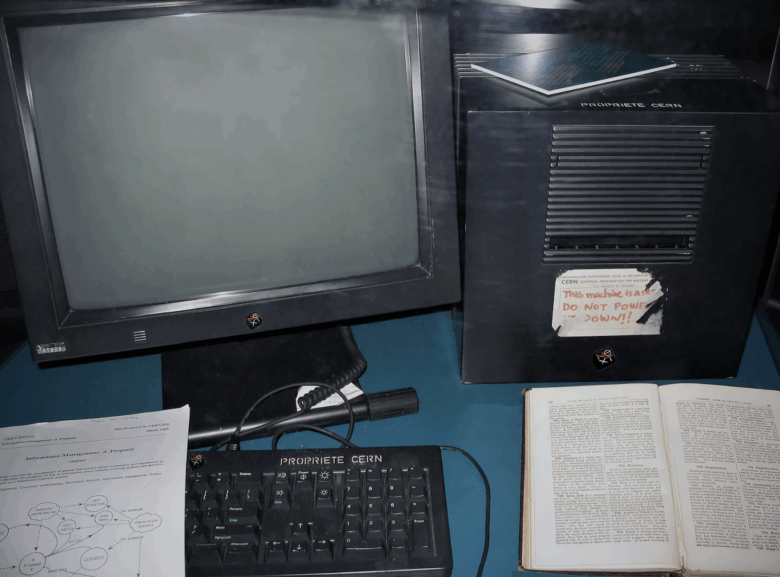
The very first website went live on August 6, 1991, but it was mostly used by scientists and researchers within the high-energy physics community.
While other information-sharing systems existed in the early 1990s, some of them required licensing fees. Berners-Lee and his colleagues at CERN realized that for the Web to truly succeed, it had to be a global, open standard. If people had to pay to use it, the Web would likely have stayed a small tool.
By making the Web public domain on April 30, 1993, CERN ensured that no one could actually own the basic architecture of the Web. This encouraged a massive wave of creativity. Developers began building their own browsers, and businesses started creating the first commercial websites. Within just a few years, the number of web servers jumped from a few hundred to tens of thousands.
Simple Web browsers like Mosaic arrived shortly after. Mosaic was released in 1993, and it was the first widely popular web browser to display images inline with text, rather than in a separate window. In just a few years, this invention completely changed how people share information and communicate. Today, the creation of the Web is seen as one of the most important moments in history.
Currently, about 4.39 billion people, more than half the world, use the internet. The average American spends 6 hours and 12 minutes looking at a screen each day.
Ask us! What questions do you have about content, strategy, pop culture, lifestyle, wellness, history or more? We may use your question in an upcoming article!
Like MediaFeed’s content? Be sure to follow us.
This article was syndicated by MediaFeed.co