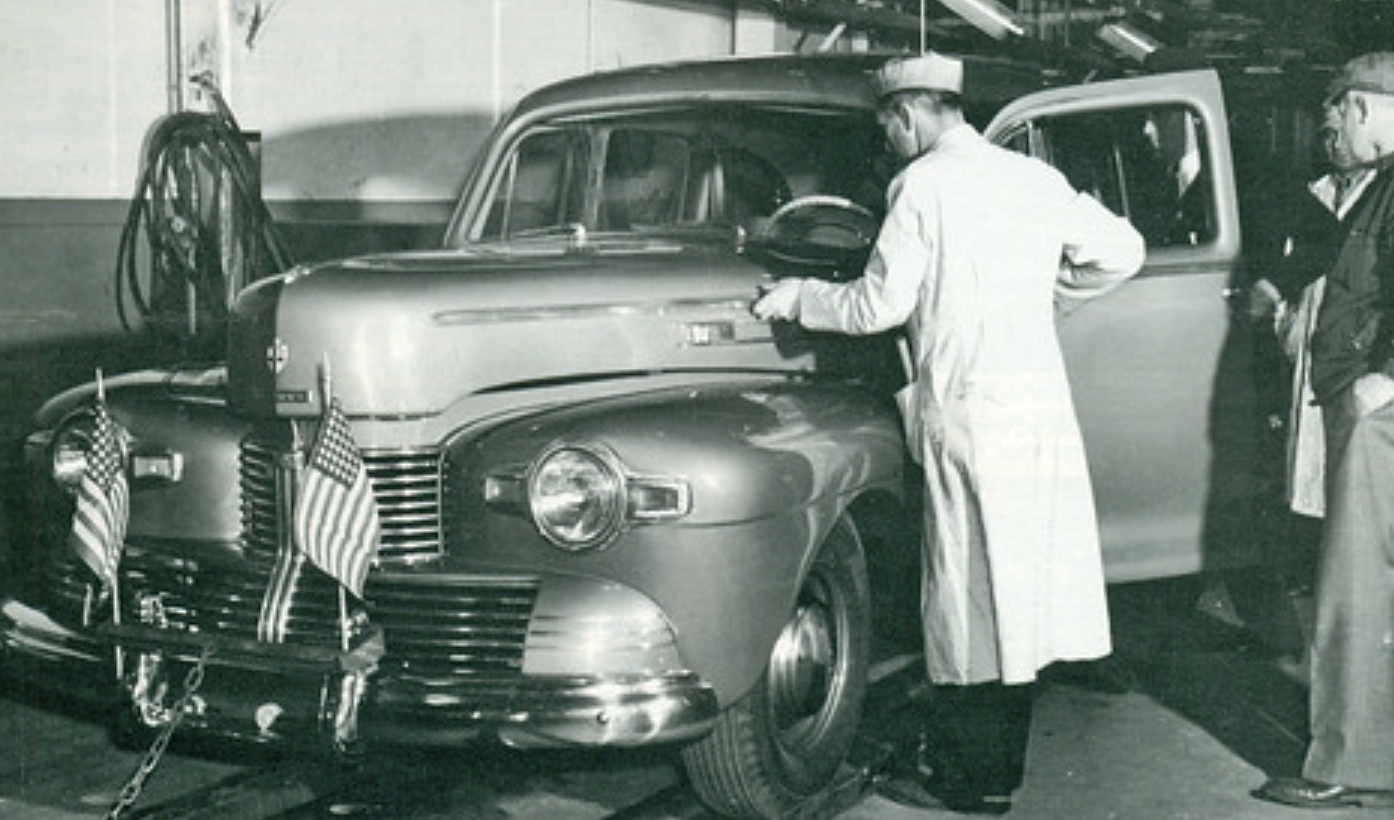
After the Pearl Harbor attack in 1941, the U.S. entered World War II, and car companies quickly switched from making civilian vehicles to building war supplies.
On February 10, 1942 Ford finished its last regular civilian cars. While a few trucks were still made for essential workers, Ford mostly used its factories, like the Willow Run plant, to build Jeeps and B-24 bombers to help in the war.
In 1941, Ford produced 691,455 cars. However, in 1942, they built only about 160,000 civilian vehicles before stopping all non-military production on February 10.
The 1942 model year was already off to a strange start. Because the government was preparing for potential conflict, they restricted the use of bright metals. This meant that the chrome trim usually seen on cars was replaced by painted parts, creating what people called blackout models.
The term “blackout” was used on production models as the wartime transition was underway, according to Jim Donnelly, automotive writer for Hemmings.
Ford transformed its massive automobile facilities into factories dedicated to military needs. Instead of sedans and coupes, Ford workers began building B-24 Liberator bombers, tanks, aircraft engines, and Jeeps.
B-24 Liberator bombers were mostly built in the Willow Run plant. This facility was designed specifically to build these bombers using Ford’s assembly line methods. At its peak, the plant was so efficient that it could produce one giant bomber every hour.
While the factories were busy building weapons, the American public faced a new reality. Since no new cars were being built, the government had to start rationing the cars that were already in stock. If you wanted to buy a new car, a person had to possess an older car with more than 40,000 miles on the odometer, or to be in a critical position to help in public safety and the war effort, like doctors, police and firefighters, farmers, and some war workers. Even then, there were very few cars available.
This rationing was necessary to ensure that the people who needed vehicles most could still get them while the nation’s resources, like rubber and steel, were saved for the military.
Civilian car production did not start again until 1945, after the war ended. The 1942 model year was a major shift for American car makers. Ford , like many others, had to switch from making cars to making heavy war machinery. Production of personal vehicles stopped entirely so that every manufacturer could focus on building the equipment needed to win World War II.
Related:
Ask us! What questions do you have about content, strategy, pop culture, lifestyle, wellness, history or more? We may use your question in an upcoming article!
Like MediaFeed’s content? Be sure to follow us.
This article was syndicated by MediaFeed.org.