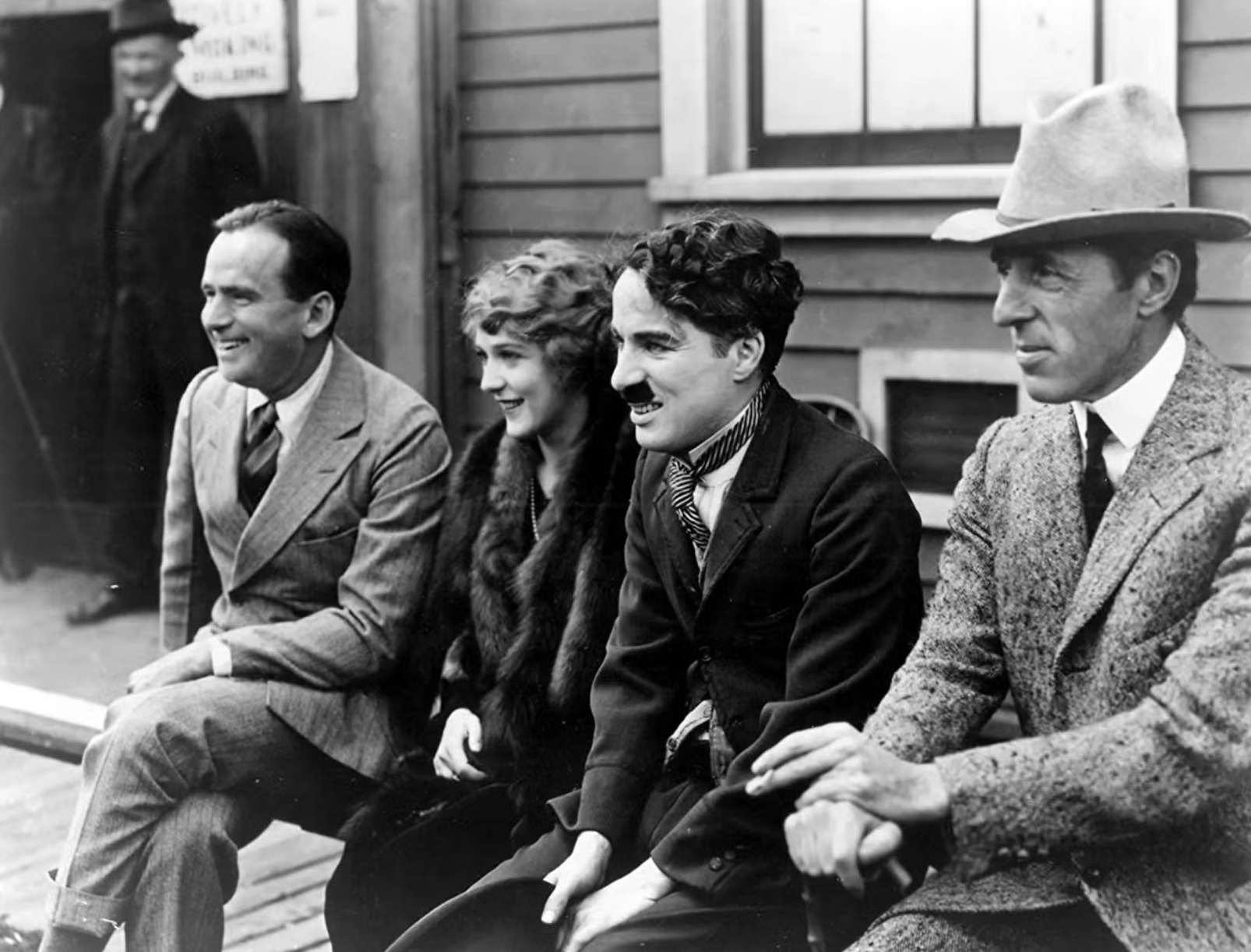
On February 5, 1919, Hollywood’s most famous names, Charlie Chaplin, Mary Pickford, Douglas Fairbanks, and D.W. Griffith, signed a document establishing the United Artists Corporation as a radical declaration of independence.
The United Artists Corporation was a reaction to the growing corporate vertical integration of Hollywood. Major production companies were increasingly controlling not just the making of films, but their distribution and exhibition as well.
A main complaint for the founders was the practice of block booking, where studios forced theater owners to purchase large packages of films sight unseen. This allowed studios to profit by bundling inferior movies with the works of superstars like Pickford and Fairbanks. In response, 26 smaller theater owners came together to buy and distribute films at competitive rates. A year later, 600 theaters were in the First National cooperative.
In 1916, one of the biggest names of the United Artists Corporation, Mary Pickford, signed a contract with them for $1,500,000 a year, and the most important, a complete artistic control, soon after that D.W. Griffith and Charlie Chaplin joined her at First National.
In 1919 during a meeting for the First National executives at the Alexandria Hotel in Los Angeles, Chaplin requested a larger budget and his request was refused. Which made him doubt the complete artistic control they were promised. After that the stars, Doug, Mary, Charlie and Griffith, hired the Pinkerton Agency to go undercover at that gathering of First National representatives, and when the rumors about First National were confirmed, the artists were ready with their own plan.
That January, Mary had been felled by the flu, but Charlotte stepped in to take her place at the meeting at Charlie’s brother Sydney’s house where their plans came together. The founders agreed to use their own money to fund their movies, giving them total freedom from outside interference, and even from each other.
They also hired former U.S. Treasury Secretary William McAdoo as their lawyer. Although McAdoo didn’t know much about the movie business, the partnership of Fairbanks, Pickford, Chaplin, and Griffith was considered the most powerful and talented team in Hollywood history.
In the early 1920s, United Artists offered some big box-office hits, like Fairbanks’ The Mark of Zorro and Robin Hood, D.W. Griffith’s Broken Blossoms, Pickford with her film version of the popular novel of girlhood, Pollyanna. United Artists acted as a shield for independent filmmakers at the time where big studios controlled everything and tried to crush competition by keeping smaller movies out of theaters. After nearly thirty years, the U.S. Supreme Court eventually stepped in with the 1948 “Paramount decrees.” This ruling finally forced the big studios to stop unfair practices, like “block booking,” and opened up the industry to more competition.
Due to difficulties United Artists went through, it experienced financial instability for years and It was often hard to hit target goals for making films. Many talents would come and go like Gloria Swanson, Buster Keaton, Sam Goldwyn, Walter Wanger, Alexander Korda, and David O. Selznick.
In the early 1930s Pickford and Fairbanks retired from the screen, and divorced. Pickford took the role of executive leadership at United Artists in 1935 but made many mistakes, among them the loss of UA’s distribution of Disney films. In 1939, Fairbanks died. In 1951, management was transferred out of Pickford’s hands, and she sold her stock in UA in 1956, a year after the other remaining founder, Charles Chaplin, had sold out.
In 1957, United Artists became a public company and was later bought by TransAmerica. During the 1970s, the studio was very successful, winning Best Picture Oscars for famous movies like Rocky and Annie Hall. However, things changed when several top bosses left to start their own company.
In 1980, UA suffered a massive loss with the movie Heaven’s Gate, which failed at the box office. The company was eventually bought by MGM.
Over the next few decades, the company changed owners many times. For a while, the United Artists name was dropped, and the studio focused on smaller “art house” films. In 2006, actor Tom Cruise tried to bring the brand back to its roots, but the studio was eventually folded back into MGM. In 2018 the UA brand was subsumed into MGM and was revived as United Artists Digital Studios.
Related:
Like MediaFeed’s content? Be sure to follow us.
This article was syndicated by MediaFeed.org.