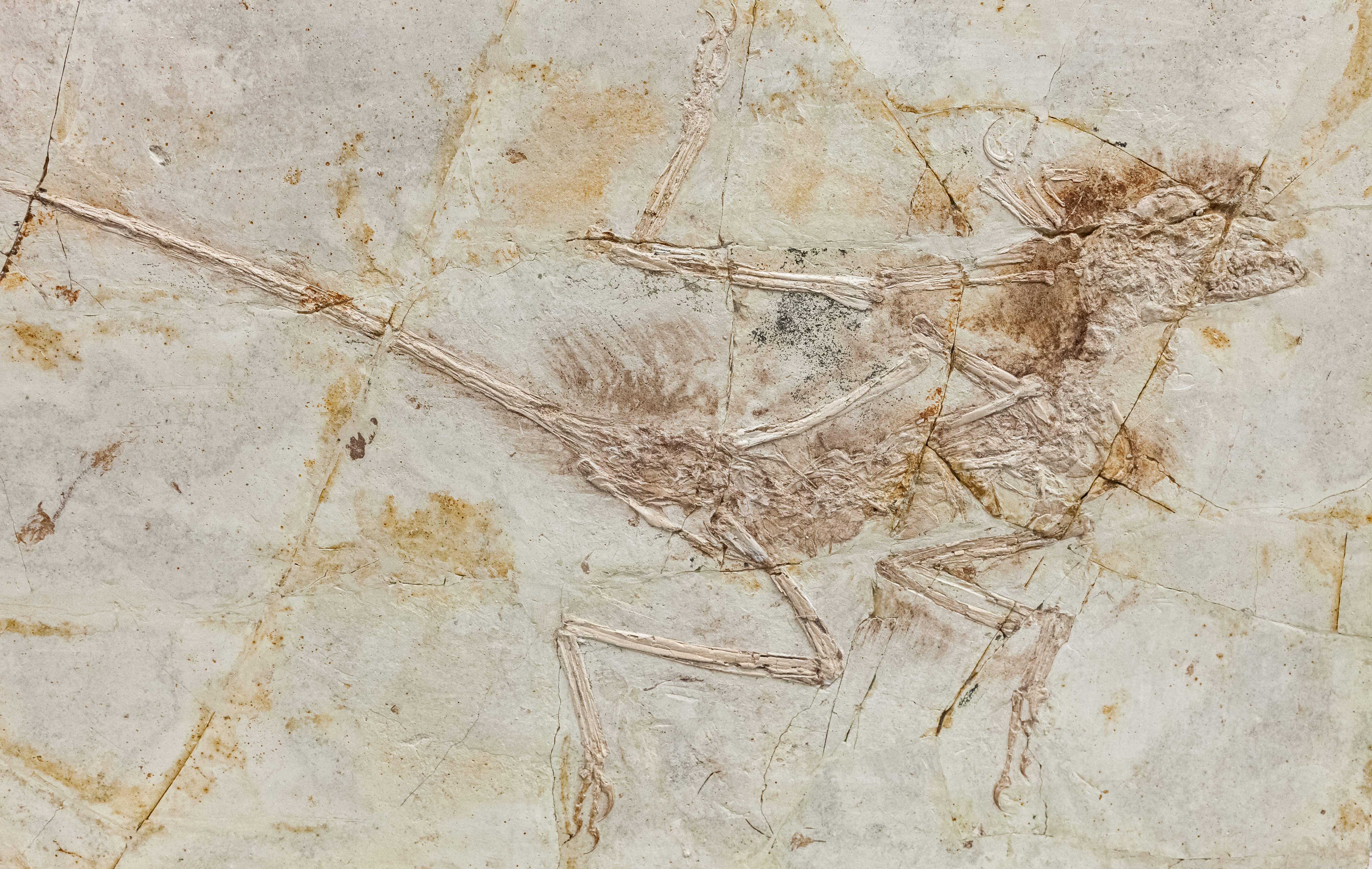
On January 22, 2003, Chinese paleontologists discovered the fossil of a dinosaur species with four wings. The 130-million-year-old fossil was covered in preserved feathers across its four wings and even its tail. The finding led to new questions about birds’ ability to fly.
The new fossils were found to belong to a species of predatory dinosaurs, the dromaeosaurs. The group of Chinese paleontologists reported in Nature, the leading international scientific journal, that the creature likely used four wings to fly between trees. Named Microrapter gui, the finding, led by Dr. Xu Xing, offered a look into the evolution of birds and flight.
Dr. Xing of the Institute of Vertebrate Paleontology and Paleoanthropology in Beijing wrote, “the forelimb and the leg feathers would make a perfect aerofoil together.” The discovery was important to understand how the ancestors of birds “first learned to glide by taking advantage of gravity before flapping flight was acquired in birds.”
Scientists had previously hypothesized that birds first flew from the ground. The discovery provided insights into this hypothesis, as Dr. Xing’s team reported that leg feathers would be a barrier to running fast. Dr. Richard O. Prum, ornithologist at the University of Kansas, supports this idea. He said the fossil “provides striking support for the arboreal-gliding hypothesis of the origin of bird flight.”
A week before the discovery, a study supported the idea that birds first flew from the ground up. The study found that flight may have evolved when two-legged dinosaurs used their feathered arms to generate more friction while climbing.
The discovery also adds to the long-standing debate over whether birds are the descendants of dinosaurs. Those who believe in the link between birds and dinosaurs say that flight began from the ground up. Eventually, running dinosaurs became airborne as their arms evolved into wings, turning rapid running into flight.
Those who do not believe in the descent said that it would not be practical for dinosaurs to defy gravity and rise from the ground. Those with this stance believe that flight evolved from the trees down, as reptiles glided from tree to tree before being able to fly. Dr. Alan Feduccia, an ornithologist at the University of North Carolina at Chapel Hill, said the traits of the fossil “argue against a ground-up origin of flight.”
Ultimately, the discovery provided revolutionary information on what we know about birds today. For Dr. Xing, the leading expert on feathered dinosaurs, Microrapter gui is just one of many discoveries. He has named roughly 80 new fossil species and leads in the number of publications in the research journal Nature.
Ask us! What questions do you have about content, strategy, pop culture, lifestyle, wellness, history or more? We may use your question in an upcoming article!
Like MediaFeed’s content? Be sure to follow us.
This article was syndicated by MediaFeed.org.