Ancient “technologies” that still have scientists baffled
Ancient civilizations demonstrated remarkable ingenuity in solving complex engineering, architectural, and technological challenges using tools and methods that often seem impossibly sophisticated for their historical periods. Archaeological discoveries continue to reveal artifacts and structures that showcase an advanced understanding of mathematics, astronomy, metallurgy, and mechanical engineering, challenging conventional narratives about the linear progression of human technological development. These discoveries compel modern scientists and historians to reevaluate their assumptions about the capabilities and knowledge of past cultures.
Certain artifacts appear so advanced for their time periods that they’ve been labeled “out-of-place artifacts” by researchers struggling to understand how ancient peoples could have created such sophisticated devices without the industrial infrastructure and accumulated knowledge that modern technology requires. These objects don’t fit neatly into established timelines of technological progress, creating puzzles that persist despite decades of research and analysis. While some of these mysteries have been partially solved through modern scientific investigation, others continue to baffle experts and inspire ongoing research.
These discoveries challenge our understanding of history and technological progress by demonstrating that innovation and sophisticated engineering existed in forms and at times that contradict simplified narratives about human development. Rather than representing impossible anachronisms, these artifacts likely reflect the ingenuity and problem-solving capabilities of ancient peoples working within their available resources and knowledge systems to create solutions that have endured across millennia.
The Antikythera mechanism: The first analog computer
The Antikythera mechanism was discovered in 1901 by sponge divers exploring an ancient shipwreck off the Greek island of Antikythera. Initially appearing as corroded bronze fragments, its extraordinary nature was revealed only through careful analysis over subsequent decades. This intricate device features dozens of precisely crafted, interlocking bronze gears, wheels, and plates, arranged in a complex mechanical system that demonstrates a sophisticated understanding of gear ratios, mechanical engineering, and astronomical calculations. The mechanism’s construction required advanced metalworking skills and mathematical knowledge, showcasing the technical capabilities of ancient Greek craftsmen.
The device’s primary purpose was to predict astronomical positions and eclipses with remarkable accuracy, functioning as a mechanical calculator that could determine the positions of the sun, moon, and known planets while also predicting lunar and solar eclipses years in advance. The mechanism incorporated multiple calendar systems, tracked Olympic Games cycles, and displayed complex astronomical relationships through its intricate gear trains. Modern reconstructions have demonstrated the device’s accuracy and sophistication, revealing calculation capabilities that wouldn’t reappear in mechanical form until the development of astronomical clocks in medieval Europe.
The most baffling aspect of the Antikythera mechanism involves understanding how ancient Greek engineers achieved such a high level of mechanical complexity over a thousand years before similar technology reappeared in European clockmaking traditions. The device requires precision manufacturing techniques, advanced mathematical understanding of gear ratios, and sophisticated astronomical knowledge, suggesting a tradition of mechanical engineering that has left few other traces in the archaeological record. While we can analyze and reconstruct the mechanism’s functions, the broader technological and educational infrastructure that enabled its creation remains largely mysterious.
Roman concrete: Stronger with time
Roman concrete structures like the Pantheon and the Colosseum stand as enduring testaments to the durability and sophistication of ancient construction techniques, having survived nearly two millennia while maintaining structural integrity despite earthquakes, weather, and human interference. These monuments demonstrate engineering capabilities that surpass those of many modern concrete structures, which typically begin to degrade within decades of construction and require regular maintenance to prevent failure. The longevity of Roman concrete has inspired extensive research into understanding the materials and methods that enabled such remarkable durability.
The secret to Roman concrete’s exceptional performance lies partly in its incorporation of volcanic ash from the Pozzuoli Bay region, known as pozzolan, which creates chemical reactions that actually strengthen the material over time when exposed to seawater and moisture. The concrete contains tiny “lime clasts” that function as self-healing mechanisms, expanding to fill micro-cracks that develop over time and maintaining structural integrity through natural repair processes. This self-healing capability represents a sophisticated understanding of materials science that enables the concrete to improve with age rather than deteriorate.
While modern research has identified key components of Roman concrete, including volcanic ash, lime, and specific aggregate materials, scientists continue to struggle to fully replicate the exact processes and achieve the same level of durability in contemporary applications. The precise mixing ratios, curing techniques, and construction methods that enabled such exceptional performance remain partially mysterious despite extensive analysis. Recent research suggests that the superiority of Roman concrete may result from complex interactions between multiple factors, including specific volcanic materials, traditional construction techniques, and environmental conditions that are difficult to replicate in modern industrial settings.
The Baghdad battery: A glimpse of ancient electricity?
The Baghdad Battery consists of a clay jar containing a copper cylinder and an iron rod, discovered in Iraq, dating to approximately 250 BCE to 250 CE. However, its original function and purpose remain subjects of intense scholarly debate. When filled with an acidic liquid such as vinegar or grape juice, the device can generate a small electrical current of about 1.1 to 2.0 volts, leading some researchers to propose that ancient peoples understood and utilized basic electrochemical principles. The construction appears deliberately designed to create galvanic action, suggesting intentional electrical generation rather than accidental chemical reactions.
Theories about the device’s purpose range from electroplating gold onto silver or copper objects to create decorative items to serving as a ritual object used in healing ceremonies or religious practices that may have involved mild electrical stimulation. Some researchers propose that multiple batteries could have been connected to generate stronger currents suitable for electroplating applications. In contrast, others suggest the electrical properties have been used for medical treatments or spiritual experiences. The debate persists because different theories offer plausible explanations for the device’s construction and materials.
The primary enigma surrounding the Baghdad Battery involves the lack of definitive archaeological evidence for electroplated artifacts from the same time period and region, which would provide concrete proof of its intended electrical applications. No contemporary texts describe electrical phenomena or electroplating techniques, and the archaeological record lacks clear examples of objects that show signs of ancient electroplating processes. This absence of supporting evidence leaves the device’s proper function as a subject of speculation, with some scholars arguing it may have served non-electrical purposes such as storing scrolls or serving ritual functions unrelated to its electrical properties.

The Iron Pillar of Delhi: The rust-proof monument
The Iron Pillar of Delhi stands as a massive monument, over 23 feet tall and weighing approximately 6 tons, remarkable not only for its size but also for its resistance to rust and corrosion, despite being exposed to the elements for over 1,600 years. Located in the Qutb complex in New Delhi, the pillar displays minimal signs of corrosion, despite India’s monsoon climate and urban pollution, which would typically cause rapid deterioration of iron structures. The pillar’s Sanskrit inscription indicates it was created during the reign of Chandragupta II in the 4th-5th centuries CE, making its preservation even more remarkable.
Analysis of the pillar’s composition reveals that it consists of high-grade wrought iron with distinctive metallurgical characteristics, including a high phosphorus content (around 1%) and remarkably low sulfur content (less than 0.05%), creating a unique alloy that forms a protective oxide layer, thereby preventing deeper corrosion. The iron’s purity and specific chemical composition, combined with traditional forging techniques, create a material that develops a thin protective coating shielding the underlying metal from oxidation. The phosphorus content creates a catalytic effect that promotes the formation of stable oxide layers rather than the flaking rust that typically destroys iron structures.
The puzzle surrounding the Iron Pillar involves understanding how ancient Indian metallurgists achieved such sophisticated control over iron composition and forging techniques using methods and equipment from the 4th to 6th centuries. Creating such a large, uniform structure from wrought iron requires advanced furnace technology, precise temperature control, and sophisticated hammering techniques to consolidate the metal without introducing impurities or structural weaknesses. While modern analysis can determine the pillar’s composition and explain its corrosion resistance, replicating the manufacturing process using period-appropriate methods remains challenging for contemporary metallurgists.
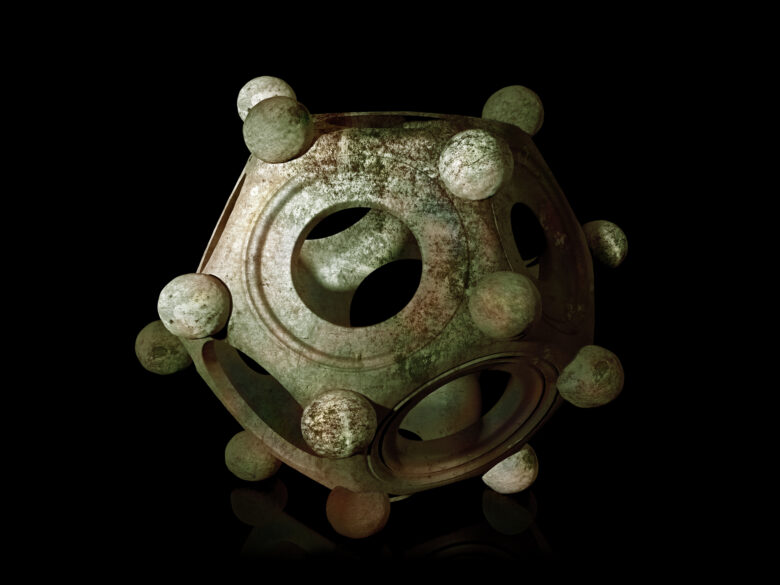
The Roman dodecahedron: An unknown purpose
Roman dodecahedra are hollow, twelve-sided bronze objects featuring circular holes of varying sizes on each pentagonal face. Over 100 specimens have been discovered across former Roman territories in Europe, primarily in Gaul, the Germanic regions, and Britain. These artifacts typically measure between 4 and 11 centimeters in diameter and display careful craftsmanship, with precisely formed geometric shapes and consistently placed holes, suggesting standardized production methods and specific functional purposes. Most examples date from the 2nd to 4th centuries CE and are found in both military and civilian contexts, indicating widespread use across Roman society.
The complete mystery surrounding these objects involves their intended function, as no contemporary Roman texts describe their purpose, and no clear pattern emerges from their archaeological contexts. Theories proposed by researchers include surveying instruments for measuring distances or angles, calendrical devices for tracking seasonal changes, religious or ritual objects used in ceremonies, candlestick holders, gaming pieces, or even military range-finding tools. Some suggestions include using them as knitting tools for creating gloves, although this theory lacks supporting evidence from textile archaeological remains.
The dodecahedra’s standardized form across broad geographic areas suggests they served essential practical or ceremonial functions that were widely understood throughout the Roman world, yet this knowledge apparently disappeared without a written record. The objects’ geometric precision and careful manufacture indicate significant investment in their production, suggesting they weren’t merely decorative items but served specific purposes important enough to justify widespread production and distribution. The absence of a definitive explanation, despite extensive research, makes Roman dodecahedra among the most enigmatic artifacts from the ancient world.

The Quimbaya airplanes: Ancient aerodynamics
The Quimbaya artifacts are small pre-Columbian gold objects created by the Quimbaya people of Colombia between 1000 and 1500 CE, featuring distinctive shapes with wings, triangular tails, and geometric forms that bear striking resemblances to modern aircraft designs. These artifacts, typically measuring 2-3 inches long, display aerodynamic features including swept wings, vertical stabilizers, and rudder-like tail sections that distinguish them from typical zoomorphic art found in pre-Columbian cultures. The objects’ metalwork demonstrates sophisticated goldsmithing techniques and attention to three-dimensional form, creating surprisingly aircraft-like silhouettes.
The debate surrounding these objects centers on whether they represent stylized birds, fish, or insects common to Colombian environments, or whether they demonstrate some understanding of aerodynamic principles that wouldn’t be formally recognized until the development of powered flight in the early 20th century. Proponents of the aircraft theory point to features such as delta wings, cockpit-like indentations, and landing gear-resembling projections that appear inconsistent with biological forms. Some researchers have created scaled-up working models based on these artifacts that can successfully fly, suggesting the original forms incorporate functional aerodynamic principles.
Conventional archaeological interpretation views these objects as artistic representations of local fauna, possibly depicting flying fish, rays, or birds rendered in stylized forms consistent with other Quimbaya artistic traditions. The similarity to aircraft may result from convergent design principles where functional aerodynamic shapes appear in nature and were observed and reproduced by ancient artists. However, the objects’ specific proportions and geometric features continue generating discussion about whether they represent pure artistic interpretation or indicate some level of understanding about the principles of flight and aerodynamic design.

Conclusion
These artifacts represent far more than historical curiosities or mysterious anomalies; they demonstrate the sophisticated problem-solving capabilities, technical knowledge, and innovative thinking of ancient civilizations that challenge simplistic narratives about technological progress and human development. Each discovery forces reconsideration of assumptions about when specific capabilities emerged and how knowledge was transmitted across cultures and time periods. Rather than representing impossible technologies, these objects likely reflect the ingenuity of ancient peoples working within their available resources to create lasting solutions to complex challenges.
The persistence of these mysteries reminds us that significant gaps remain in understanding ancient technologies, manufacturing techniques, and knowledge systems that enabled remarkable achievements with tools and methods very different from modern approaches. These artifacts serve as humbling reminders that innovation and sophisticated engineering have appeared throughout human history in forms that don’t always align with contemporary expectations about technological development.
Check out our other archaeology and history articles here at MediaFeed to discover more fascinating stories about ancient innovations and the ongoing efforts to understand the remarkable achievements of past civilizations.
Related:
- Real-life historical facts that sound like fiction
- Take a look at one of America’s oldest cemeteries
Like MediaFeed’s content? Be sure to follow us.
This article was syndicated by MediaFeed.org.