There’s a quiet kind of magic in Erfurt Germany, a city that doesn’t try to impress you but simply welcomes you in. It isn’t loud or overly polished, yet somehow it lingers. You’ll walk streets where shop doors open with a soft bell, where artisans work just as they have for generations, and where the past isn’t trapped in a museum because it’s woven into daily life.
I came to Erfurt to film an episode of The Design Tourist, expecting charming streets and preserved architecture. What I found was something far more personal: a place where tradition hasn’t been repackaged for tourists but continues to evolve in the hands of real people. Here, papermakers, goldsmiths, puppet artists, fashion designers, and chocolatiers still craft by hand, not for display, but because that’s how life works here.
If you’re a traveler drawn to culture, creativity, and real connection, this post is for you. These aren’t just recommendations; they’re places I stood, conversations I had, and crafts I watched come to life.
Why Erfurt Captures the Imagination
Erfurt isn’t always on the radar of travelers exploring Germany, yet it should be. Located in the state of Thuringia, it offers everything you’d expect from a well-preserved medieval town, including cobblestone lanes, pastel timber-framed houses, twin cathedrals, and a picturesque old market square. Beyond the architecture is a sense of living heritage. People aren’t just telling the stories of the past because they’re still shaping them.
This is the city where Martin Luther studied and later joined the Augustinian Monastery. It’s home to one of Germany’s oldest universities and was once a major stop on European trade routes. Those routes helped shape the now-famous Krämerbrücke, or Merchants’ Bridge, a 14th-century stone span lined with artisan shops on the ground floor and homes above. It’s the only bridge of its kind in Europe that remains inhabited in this way.
Erfurt also carries the spirit of the Bauhaus movement, which began just a short train ride away in Weimar. The city’s artists and designers, many of whom studied at Bauhaus University, still carry forward those modernist values in unexpected and beautiful ways.
Why Visit Erfurt?
- Historic Krämerbrücke: Europe’s only inhabited bridge lined with authentic artisan workshops dating back over 700 years.
- Bauhaus-Inspired Design: Modern, minimalist aesthetics deeply influence local craft.
- Captivating Crafts: Experience handmade chocolate, jewelry, paper art, traditional woad dyeing, marionettes, and more.
- Compact and Walkable: Just a two-hour high-speed ICE train ride from Berlin or Frankfurt, making it ideal for a short but memorable visit.
Getting to Erfurt & Around Town
- Train: Direct ICE connections (~2 hours from Berlin; ~1 hour 40 minutes from Frankfurt).
- On Foot: A simple 10-minute walk from Erfurt’s main train station to Krämerbrücke; the historic city center is compact and pedestrian-friendly.
- By Car: Parking available at Domplatz or Anger garages (the historic center itself is pedestrian-only).
7 Must-Visit Spots on an Erfurt Walking Tour
1. Krämerbrücke
Some places feel frozen in time; the Krämerbrücke feels alive.
Built in 1325 from stone and stretching across the River Gera, the bridge is lined with thirty-two narrow buildings, each one home to both a shop and a residence. It was once a hub for medieval merchants selling spices, herbs, textiles, and perfume. Today, it houses artists and craftspeople who carry on the same tradition, selling goods made with intention, skill, and story.
“We have a long tradition,” one local told me. “About seven hundred years of a stone bridge we are walking over. And from the beginning, they sold nice goods such as spices, expensive textiles, pharmacies, herbs, and perfume.”
The rhythm of the day here is gentle yet purposeful. People open their shutters, greet their neighbors, and begin working, folding paper, carving wood, melting chocolate, and stitching fabric, not as performance but as a way of life.
2. Qnik Paper Studio
Inside a cozy, light-filled shop, Claudia and Claudine, both graduates of the Bauhaus University in Weimar, showed me their paper creations: foldable lampshades, handmade cards, and festive piñatas.
“The Bauhaus University is very open-minded and minimal. As you can see in our lamp shapes, it’s just stripes, but it creates something elegant,” Claudine told me.
Their shop felt less like a store and more like a creative lab. One lampshade folds completely flat, ideal for travelers. Another forms a perfect sphere, cut with geometric precision. Each piece reflects the quiet balance of beauty and function, hallmarks of Bauhaus.
3. Gunda Löhle Jewelry
Just a few steps away, I met Gunda Löhle, a goldsmith and jewelry designer whose work feels like sculpture in miniature. Her clean, geometric pieces are deeply influenced by architecture as well as by her husband, who happens to be an architect.
“First I did an apprenticeship in goldsmithing,” she said. “Then I studied jewelry design. The influence of Bauhaus is definitely there. I like to play with form and geometry.”
Her rings and earrings are sleek, precise, and thoughtful. Even her studio space reflects Bauhaus: minimalist, intentional, and quietly powerful.
4. Erfurter Blau & Maboni
Woad dye was once Erfurt’s greatest export, producing the signature “Erfurter Blue” used in royal garments and sacred textiles. Today, Rosanna Minelli, a paint-restoration expert, has revived the tradition in her shop Erfurter Blau.
“The fabric isn’t blue at first,” she explained. “You pull it out of the dye bath and it’s green, but when the air touches it, the blue comes out.”
It felt like watching alchemy. The longer the fabric soaked, the deeper the hue. Rosanna works alongside Mone Lhun, a fashion designer who incorporates the dye into a modern Bauhaus-inspired clothing line called the White Blue Collection, a collaboration that fuses heritage, design, and sustainability.
5. Martin Gobsch Marionette Workshop
In a small window on the bridge, puppets come to life with the drop of a coin. This is the work of Martin Gobsch, a master puppet maker whose workshop is equal parts storybook and stage.
“He first imagines the story,” one local explained. “Then he sketches it, carves the puppets, and builds the tiny stage by hand.”
The performances are whimsical, silent, and surprisingly moving. For one euro, you get a full show with lights, movement, and charm, crafted entirely by hand. And yes, you’ll want to watch more than one.
6. Tilibom Teddy Bears
A few steps farther along the bridge is Tilibom, the smallest workshop in Erfurt. It’s here that Andrea Heese-Wagner lovingly hand-sews collectible teddy bears that look and feel like heirlooms.
“Each one takes about eight to thirteen hours,” she told me. “Some are made to look vintage so they feel like they’ve been loved for years.”
She even uses a small tool to distress the fur. The result is a bear that growls, moves, and feels like something passed down through generations. The workshop is cozy and warm, filled with tiny clothes, spools of thread, and memories in the making.
7. Goldhelm Schokolade
At the far end of the bridge, the scent of chocolate draws you into Goldhelm Schokolade, founded by Alex Kühn after a long journey around the world to learn chocolate-making traditions.
“He started as a one-man company,” Sophie explained. “Now there are about eighty of us, and everything is still handmade.”
I tried their 73 percent dark chocolate, rich, balanced, and unforgettable. You can also order a hot-chocolate tasting flight, which I highly recommend. Every sip tells a story. It’s not just dessert because it’s craftsmanship in a cup.
Beyond the Bridge: Cathedrals, Courtyards, and Cultural Layers
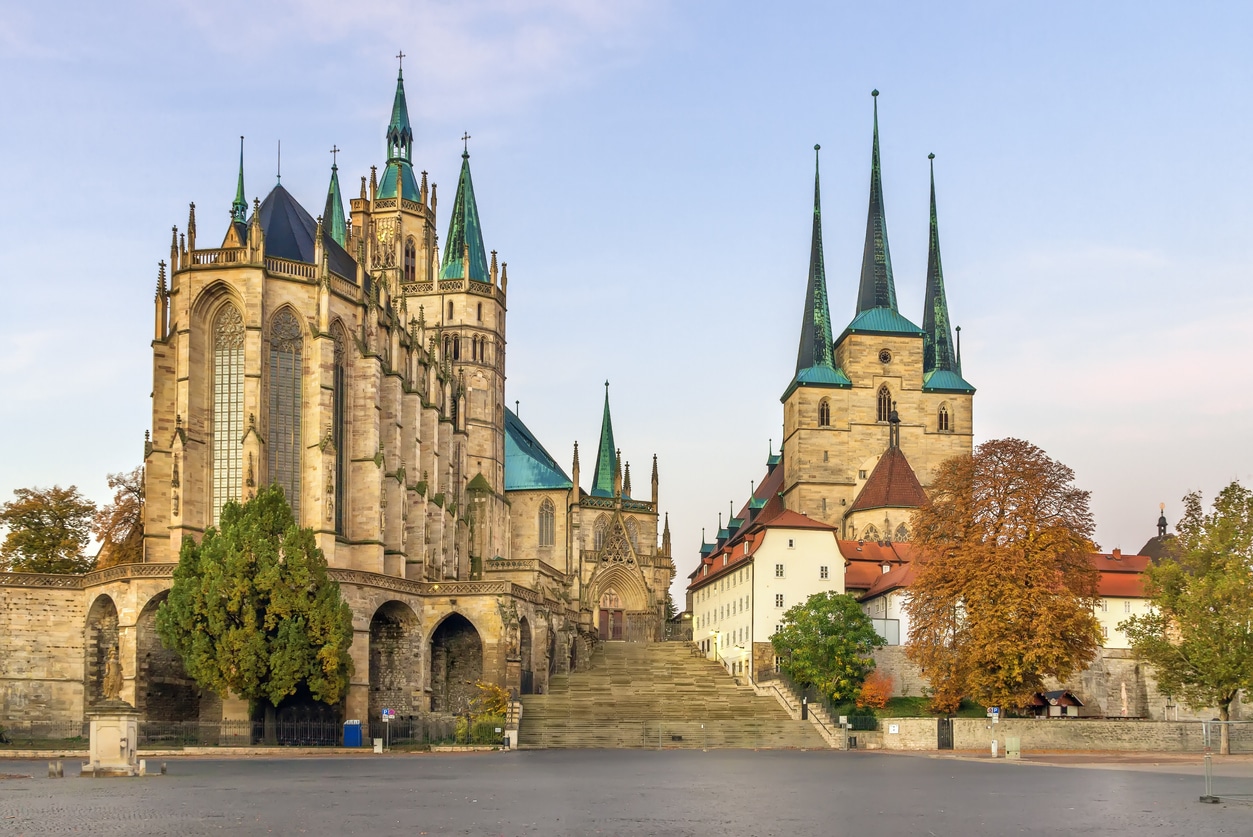
Just a few minutes’ walk from the Krämerbrücke is Domplatz, home to St. Mary’s Cathedral and St. Severus Church. These towering landmarks dominate the skyline, with steps leading up to one of the city’s quietest views.
Inside St. Mary’s is Gloriosa, the largest free-swinging medieval bell in Europe. It rings only a few times a year, namely on Christmas Eve, Easter, and August fifteenth, yet even in stillness, the cathedral feels sacred.
“The churches reflect both power and peace,” one local told me. “You feel the weight of history here.”
For food, I recommend a classic Thuringian bratwurst from the market square: just grilled sausage and mustard, simple, authentic, and delicious. Or try the squash soup drizzled with pumpkin seed oil at Wirtshaus Christoffel, a medieval tavern where the ambiance transports you to another era.
Where to Stay: Hotel Krämerbrücke
If you want to stay immersed in the old town, check into Hotel Krämerbrücke, located directly on the bridge. This boutique hotel was once a medieval wagon yard for merchants, and today it offers beautifully restored rooms with warm wood beams and historic charm.
“This building was first mentioned in 1310,” Antonia at the front desk told me, “and the facade has barely changed since.”
Some rooms even overlook the bridge itself, perfect for watching the city wind down at night.
Evening on the Bridge
As the sun set, I returned to the bridge one last time. The shops were closing, the streets were quiet, and the puppet window glowed softly in the distance. I dropped a coin in, and the marionettes performed their short play again only for me.
“It’s not about the puppets,” someone nearby said. “It’s about remembering that small, handmade things can still move us.”
That moment stayed with me.
Two Days in Erfurt: An Artisan’s Itinerary
Day 1
- Morning: Explore Qnik, Gunda Löhle, and Erfurter Blau
- Lunch: Bratwurst at Domplatz market
- Afternoon: Visit St. Mary’s Cathedral and Cathedral Hill
- Evening: Chocolate tasting at Goldhelm and puppet-show window
Day 2
- Morning: Revisit favorite makers or explore Fischmarkt and nearby squares
- Lunch: Café near the River Gera
- Afternoon: Tour Hotel Krämerbrücke and shop for gifts
- Evening: Stroll the bridge and soak in the quiet beauty of Erfurt at night
Quick Tips for Visiting Erfurt
- Carry cash – Some shops and the puppet show accept only coins or cash.
- Wear comfortable shoes – Cobblestones are charming but tough on feet.
- Ask before taking photos – Most artisans are open, yet it’s always respectful to ask.
- Go slow – This isn’t a city to rush through; the magic is in the details.
Frequently Asked Questions About Visiting Erfurt Germany
Is Erfurt walkable?
Very much so. The historic center is compact and pedestrian-friendly. From the train station, it’s about a 10-minute walk to the bridge, and most shops, cafés, museums, and cathedrals are within a few short blocks. Comfortable shoes are all you need.
What’s the best time to visit Erfurt?
Late spring (May through June) offers ideal weather and blooming gardens. But if you want to see Erfurt in its full storybook magic, go during the Advent season. The Christmas market fills the square with lights, the cathedral bell Gloriosa rings, and even the puppet shows get a festive twist.
Where to stay in Erfurt?
Hotel Krämerbrücke is the most memorable place to stay in Erfurt. It’s built right on the historic bridge and gives you front-row access to the shops below. You’ll fall asleep to the quiet charm of cobbled streets and wake up in the heart of it all.
What is the Merchants’ Bridge known for?
The Krämerbrücke, or Merchants’ Bridge, is one of Erfurt’s most iconic landmarks. It’s the only bridge in Europe where all the buildings are still inhabited and used by artisans. Every house has a shop on the ground floor and a residence above. Walking across it feels like entering a living craft village, with paper studios, puppet theaters, jewelry galleries, and chocolate shops all tucked inside centuries-old timbered buildings.
Is Erfurt good for slow, experience-based travel?
Absolutely. If you love hands-on moments, like watching silk turn blue in a dye vat or seeing a lamp folded like origami in front of you, Erfurt is ideal. It’s not a rush-around destination. It’s a place where you pause, chat with the makers, and savor every handmade detail. The city invites you to slow down and truly connect.
Handmade Memories That Last
Erfurt stands out not just for its charming streets and preserved medieval architecture, but for the way it celebrates handmade traditions in a modern world. Whether you’re browsing paper goods on the Krämerbrücke, tasting locally crafted chocolate, or chatting with artisans in their studios, you’ll experience a city that values creativity, community, and storytelling.
If you’re planning a trip to Germany and want something more soulful than touristy, Erfurt offers a refreshing blend of authenticity and design inspiration. Add it to your itinerary and prepare to leave with more than souvenirs. You’ll take home stories worth remembering.
Related:
Like MediaFeed’s content? Be sure to follow us.
This article originally appeared on Thedesigntourist.com and was syndicated by MediaFeed.org