Exploring the top things to do in Cairo has always been a dream of mine. My fascination with Egypt and its artistic achievements started at the age of 7 when my parents took me to the Treasures of Tutankhamun exhibition at the New Orleans Museum of Art. It was 1977 and the visiting exhibit sparked a Bayou State obsession with all things Egyptian. Nile Style consumed the deep south like the cultural force of a hurricane. I was mesmerized by King Tut’s golden gleaming, bejeweled Pharaoh death mask and the treasures buried with the young king.
2022 marked the 100th anniversary of the discovery of King Tut’s tomb in 1922 by archeologist Howard Carter, in the Valley of Kings, an ancient Egyptian royalty grave site west of the city of Luxor. That year, I decided to fulfill my lifelong dream of exploring Egypt, the country that captivated my childhood imagination and served as a creative muse into adulthood.
I flew into Cairo and met up with Cairo Transport & Touring which put together my 10-day tour of the country. As a woman traveling alone in the Middle East, I wanted peace of mind, knowing that I was safe and free to absorb, learn, and explore Egypt. Cairo Transport & Touring, founded in 1952 and based in Cairo, has a team of experienced, local, English-speaking guides. My guides, Amir and Mohamed, and a dedicated security guard accompanied my group throughout our trip.
Image Credit: Anna Nelidova/Istockphoto.
Giza Pyramids A Testament to Cairo’s Ancient Wonders
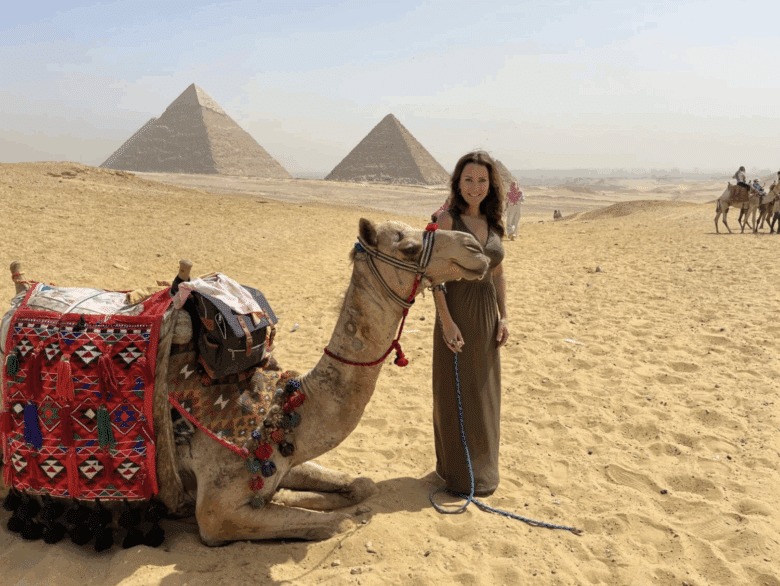
During my exploration of Cairo, Egypt, the Giza Pyramids stood as a testament to ancient engineering marvels, a must-see for anyone visiting the city. I start with Egypt’s emblematic experience, a visit to these pyramids, west of Cairo, at the edge of the Sahara Desert. The archeological site is known as the oldest and only surviving of the 7 Wonders of the Ancient World. The Giza Pyramid complex holds 9 pyramids built during the 4th Dynasty around 2620 BC. To put the pyramids in historical context, consider that Egypt’s story begins in 3001 BC with the union of upper and lower Egypt by the first pharaoh Menes. He founded the ancient Egyptian capital called Memphis in the north. Thirty Egyptian dynasties followed and ruled until 332 BC when the Greeks arrived.
The Great Pyramid, King Khufu’s tomb, is the largest on-site, towering 481 feet and made of 2.3 million stone blocks. The Cheops Pyramid has interior burial chambers open to the public. You can go inside the pyramid for an extra ticket, but there isn’t much to see inside the small space with low ceilings. It’s hard to stand up because the interior chambers were not built for visitors. You won’t see any hieroglyphics inside the pyramids because Egyptian pictorial writing started in the 5th dynasty.
Like many people, I’ve seen a lot of photos of the Giza Pyramids but to experience them up close— I’m speechless. Each pyramid is a fascinating feat of human engineering. The lower part of each pyramid is made of granite from quarries in Aswan that traveled by the Nile more than 550 miles to the site of the Giza pyramids. The top levels of the pyramid are made of limestone. Three large pyramids honor the kings and six honor the queens.
Image Credit: The Design Tourist, Karen LeBlanc.
A Unique Cairo Experience Camel Rides at the Giza Pyramids

A highlight of my Cairo itinerary was a camel ride at the Giza Pyramids, a truly authentic Egyptian experience. This was a bucket-list item for me and the rides here are the real deal. You climb on the camel from the ground not an elevated platform. A word of advice—if you don’t lean back as the camel stands up, you will topple forward. This camel ride demands a little physical agility but once I’m up, it’s so surreal. A camel handler holds the reigns and walks the camel with you.
Now, a word of caution— watch out for scammers. My tour guide Mohammed helped me negotiate a fair price for my camel ride. There are incidences where camel handlers will take you behind the pyramids and ask for more cash to take your picture. It’s a popular shakedown you can avoid by getting your traveling companions to take photos of your camel ride. Overall, the experience is well worth it.
Image Credit: The Design Tourist, Karen LeBlanc.
The Great Sphinx of Giza An Iconic Symbol in Cairo’s Landscape
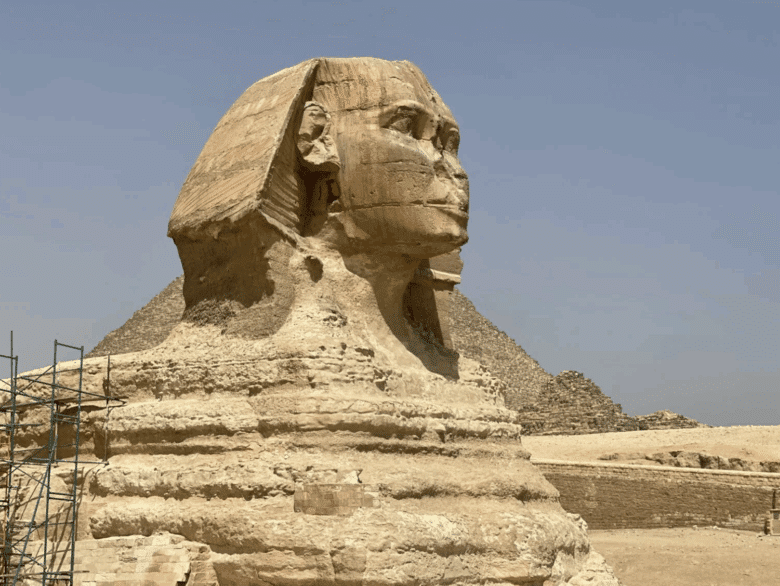
The Great Sphinx of Giza, another iconic landmark in Cairo, Egypt, represents the fusion of human ingenuity and ancient mythology. Next to the pyramid complex, this Sphinx stands as the most famous and oldest. The Sphinx, carved out of limestone during the 4th Dynasty, about 2620 BC, depicts the head of King Chephren and the body of a lion.
Image Credit: The Design Tourist, Karen LeBlanc.
The Temple of the Valley Where Egyptian Mummies Lies

The Temple of the Valley next to the Great Sphinx is where Egyptians mummified the bodies of their dead royalty.
Egyptians mummified the bodies in a 40-day process here before transferring them to a neighboring temple to continue the mummification process for another 30 days. The mummification practice began during the Fourth and Fifth Dynasties about 2600 BC and continued for more than 2,000 years, into the Roman Period from 30 BC to 364 AD. Egyptians removed all organs except for the heart and preserved the main organs separately in alabaster jars, buried with the mummy.
Image Credit: The Design Tourist, Karen LeBlanc.
Cairo’s History at The National Museum of Egyptian Civilization

The National Museum of Egyptian Civilization offers an up-close look at Egypt’s royal mummies, adding a unique educational aspect to your trip. I headed there to explore this large collection.
The museum opened in 2021, and one of its biggest draws is The Royal Mummies Hall.
Here you can see 20 Royal Mummies, 18 Kings, and 2 Queens, most notably Queen Hatshepsut. Ancient Egyptians expressed their reverence for the afterlife in art, architecture, and customs. The museum holds hundreds of objects that depict their beliefs about life and death.
Image Credit: The Design Tourist, Karen LeBlanc.
The National Museum of Egyptian Civilization

Unlike the voluptuous bodies depicted in many European masterpieces, I’m struck by how ancient Egyptians painted the human form as svelte and stunning, wearing revealing fashions, elaborate jewelry, and dramatic makeup.
My guide, Amir, explains why: “In Egyptian art, you never see somebody ugly or overweight, everybody looks perfect. You see the kings wearing garments that show their legs and muscles. The ladies are wearing tight dresses to show off their beautiful bodies. Egyptians depict the human body from the profile. They show the face in the profile but the full eye and never show the belly button. This is not a mistake in art. Egyptians want to show every organ in the body in the most flattering way,” Amir says.
Image Credit: The Design Tourist, Karen LeBlanc.
The Gift Shop

While visiting the National Civilization museum, I met an artisan outside the gift shop crafting statutes with inlaid copper and silver wires that he hammers by hand into each piece.
He says some pieces can take a month to finish. He also crafts intricately engraved copper plates.
He is one of many modern-day masters of ancient Egyptian craft techniques. “If you look at the culture and heritage, you will see that Egyptians were always into art since they were one of the very first populations to have an interest in painting, having an interest in showing their lives and putting them in pictures in temples and tombs. Egyptians were always keen to make things look different and nice and to use materials from nature to create new things and to express how they lived, even their thoughts of life after death,” explains Mustafa Seif, Assistant GM, Cairo Transport & Touring.
Image Credit: The Design Tourist, Karen LeBlanc.
Cairo’s Egyptian Museum

A visit to the Egyptian Museum in Cairo is essential for anyone interested in the rich tapestry of Egypt’s history. Located in Tahrir Square, it holds a vast collection of ancient artifacts. The neoclassical structure opened in 1902 to protect, preserve and prevent the export of Egyptian antiquities.
One of my personal highlights was the King Tut collection of jewelry and precious objects, including the young king’s iconic Golden Pharaoh mask, unearthed in his tomb in the Valley of the Kings.
The museum resides about a 45-minute drive from the Giza Pyramids.
In 2023, the Egyptian government is planning to open the new Grand Egyptian Museum near the Giza Pyramids, making it easier for tourists to travel between the two sites.
The Grand Egyptian Museum will display, for the first time ever, King Tut’s entire treasure collection alongside artifacts throughout Egypt’s history from prehistoric times to modern-day culture.
Image Credit: The Design Tourist, Karen LeBlanc.
Shopping Trip to Khan El Khalili bazaar
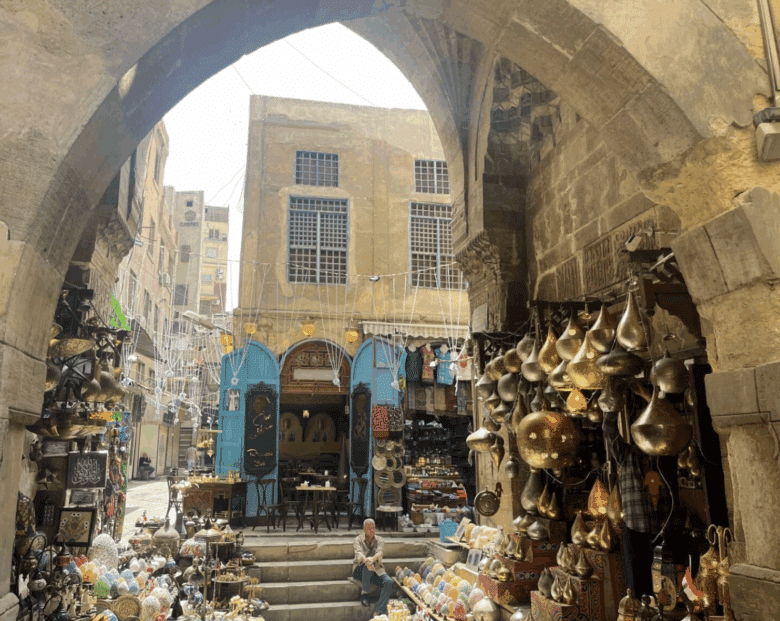
I ended my time in Cairo with a shopping trip to Khan El Khalili bazaar, a 14th-century market located in the Islamic district of Cairo.
Be prepared to haggle over prices. Vendors typically start with a high price and expect you to negotiate a fair price or a deal that feels like a bargain.
If you are looking for souvenirs, Khan El Khalili is a great place to shop; however, if you are looking for handcrafted products, the bazaar is not the ideal source for artisan-made items. Many booths sell similar merchandise, often mass-produced elsewhere.
Alabaster, papyrus, and perfumes are cultural treasures you can take home that embody Egypt.
Image Credit: The Design Tourist, Karen LeBlanc.
Papyrus Museum and Shop

For handmade papyrus items, I suggest a visit to the Papyrus museum and shop.
You can watch artisans at work creating the paper art and purchase a personalized papyrus page painted with your name in Hieroglyphics.
Image Credit: The Design Tourist, Karen LeBlanc.
My Takeaway

As I reflect on my time in Cairo, I will say that it’s relatively safe; however, the country stands on guard for potential unrest. As a traveler, I encountered a strong police presence with bomb-sniffing dogs, frequent car and trunk inspections, and metal detectors at many establishments.
I found the country’s security measures both reassuring and unnerving. The city itself is bustling, chaotic, and colorful. I loved Cairo’s energy and the warm hospitality of the locals.
What to know if you go:
A visa is required for Egypt, and you can get one from the Egyptian Consulate Office in your area or upon arrival in Egypt.
All around the pyramids and most tourist attractions, you’ll encounter pushy vendors selling souvenirs—anything from stone scarabs to scarves. Some will approach you and hand you an item saying it’s a gift but don’t be fooled, they are expecting payment for said gift. Nothing is for free. Egyptians are very friendly people, but the vendors are there to make money. Don’t be shy or embarrassed about returning an unwanted gift they hand you.
In Egypt, tipping comprises a significant part of many people’s wages.
Egyptian tour operators recommend dressing modestly in clothing that covers your back and shoulders outside the hotel area. Women should cover their arms when visiting mosques.
Egypt’s weekly day of rest is Friday, the equivalent of Sunday in the United States.
Islamic holidays including Ramadan, are based on the lunar calendar and change yearly.
Standard business hours are 9 am to 5 pm daily except Friday. Many businesses also remain closed on Saturday.
Related:
Like MediaFeed’s content? Be sure to follow us.
This article originally appeared on Thedesigntourist.com and was syndicated by MediaFeed.org
Image Credit: The Design Tourist, Karen LeBlanc.