
As a small business owner, understanding your company’s cash flow is critical to maintaining financial health. When using your cash flow statement to analyze your financial health, you can track either levered free cash flow (LFCF) or unlevered free cash flow (UFCF).
These terms could be foreign to you, but we’re here to explain the differences between unlevered vs. levered free cash flow so you can better understand how to apply them to your business.
What is free cash flow?
Before we dive deeply into the differences between levered and unlevered cash flows, it’s essential to understand what free cash flow is. Free cash flow refers to the amount of money your business has after settling debts, such as taxes, payroll, and operating expenses.
Both levered and unlevered cash flows are considered discounted cash flows (DCF), which attempt to measure how much value a business creates.
Levered and unlevered cash flow comes into play during the first portion of free cash flow projections. You can use levered or unlevered funds for the free cash flow amount in your DCF analysis. The option that you choose has a significant impact on your future valuation.
What is levered free cash flow?
Levered free cash flow projects the cash flow after removing interest expenses, capital expenditures, operational expenses, and taxes. Levered cash flows attempt to directly value the equity value of a company’s capital structure.
Essentially, levered free cash flow demonstrates a company’s cash flow after it satisfies its financial obligations and provides an accurate look at a company’s financial health and the amount of available cash. You can find levered free cash flows on the balance sheet.
What is unlevered free cash flow?
Unlevered free cash flow refers to the cash flow a business has available before satisfying its interest and other debts. In other words, it’s what you have before levered cash flow—the funding left after meeting financial obligations. Like levered cash flows, you can find unlevered cash flows on the balance sheet.
Unlevered cash flows provide a look at the company’s enterprise value, which is a measure of the company’s total value. Enterprise value goes more in-depth than equity market capitalization since it considers both short-term and long-term debts and can show what a company is actually worth.
Difference between levered and unlevered free cash flow
To better understand the difference between unlevered vs. levered free cash flow, let’s look at some key differences between the two.
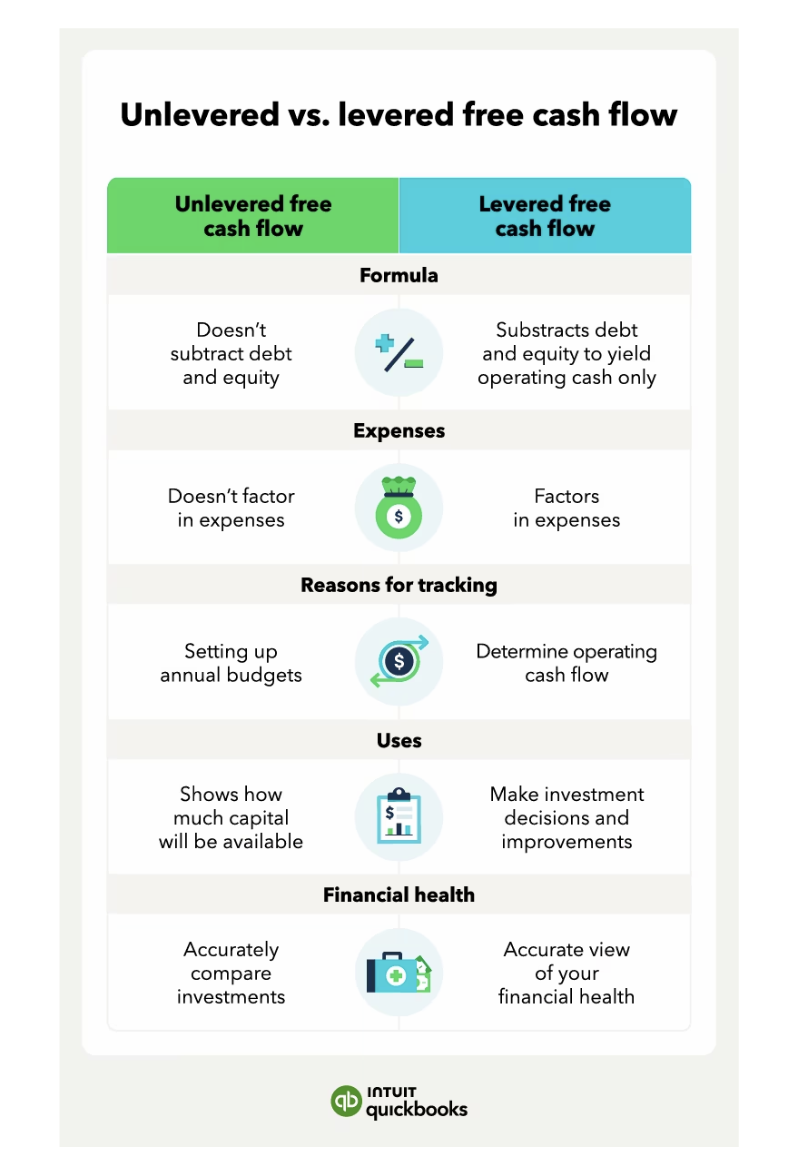
Formulas
The first difference between unlevered vs. levered free cash flow is the formula. The equation for levered free cash flows is:
LFCF = EBITDA – change in net working capital – CAPEX – mandatory debt payments
The formula for unlevered free cash flow is:
UFCF = EBITDA – CAPEX – working capital – taxes
In these formulas, EBITDA represents your company’s “Earnings Before Interest, Taxes, Depreciation,” and CAPEX represents your capital expenditures, which is the money used to fund daily business activities.
As you can see, the equation for unlevered free cash flow is less extensive than the one for levered free cash flow. That’s because the levered free cash flows equation subtracts debt and equity to yield operating cash only, while unlevered free cash flows do not.
Expenses
One of the main differences between levered and unlevered free cash flow is how they treat expenses. Levered cash flows factor in expenses, such as operating expenses, debt payments, interest expenses, and taxes.
In contrast, unlevered cash flows do not factor them in. Essentially, unlevered free cash flows are what you have before expenses and levered cash flows are what you have after.
Reasons for tracking
If you have a healthy amount of debt and net working capital, then you may want to consider using levered free cash flows to determine how much operating cash flow your business has to expand.
For instance, a company can have a negative levered free cash flow if it has significant debt holders. This type of financial performance isn’t ideal, but investors shouldn’t be too wary if it’s temporary. It could mean the company made significant capital investments, and they have yet to begin paying it off.
In contrast, companies often utilize unlevered free cash flows when setting up their annual budgets and determining whether or not departments are utilizing their funding effectively. If unlevered cash flow levels are too low, there’s a good chance the company will fail to satisfy its debts and, in the long run, face bankruptcy.
Additionally, a company may track UFCF to paint the business in a better light to shareholders and potential buyers. The firms that carry significant debt tend to report unlevered cash flow instead of levered cash flow. As a result, the company may appear more successful and solvent than it truly is, demonstrating a higher amount of working capital.
Uses
Unlevered free cash flow is useful for investors and prospective buyers. When investors purchase a company, one of their goals is to pay off debts to enhance the business’s long-term market value. Unlevered free cash flow reveals how much capital will be available after making interest payments and paying down the net debt balance.
Levered free cash flow is also useful for investors and prospective buyers, but instead, they use it to make investment decisions and find ways to make improvements since it shows how much cash your business has to expand. In some ways, levered cash flows are seen as the more reliable method of financial modeling as they are a better indicator of a company’s future profitability.
Financial health importance
As you can see, levered free cash flow provides a look at your company’s “present value” and an accurate view of your financial health, which allows you to measure your operating income.
Unlevered free cash flows can help with budgeting and forecasting, as it shows the gross cash flow amount. This allows you to better compare the value of different investments and businesses, as some might have a higher interest expense and others don’t.
Why you should compare levered and unlevered cash flows
It’s useful for a business to regularly distinguish its levered and unlevered free cash flows. While a smaller gap between LCF and UFCF indicates that fewer funds are available for investment and expansion, a more significant difference suggests a robust and healthy business.
Additionally, the difference between unlevered and levered free cash flow can reveal whether the business has taken on too much debt. If a company is earning less than it’s paying out in expenses for a prolonged period, the odds are good that the business is in trouble.
When evaluating your company, investors may ask to see unlevered and levered cash flows. Ideally, you want to show investors unlevered cash flow projections, as this will paint your business in a better light.
Still, owners and investors shouldn’t jump to conclusions if levered free cash flow is negative or very low for a single period. As mentioned, this could mean nothing more than taking on a healthy amount of debt to expand your business.
The most important thing to consider regarding levered and unlevered cash flows is that you should conduct these analyses on your own. Doing so can give you a better look at your company’s financial health. You should look for levered and unlevered cash flow trends before making important decisions regarding your company’s financial future.
Streamline your accounting and save time
In the business world, cash is king, and a lack of liquid money can leave a company unable to pay for employee salaries and other expenditures. When you start running a business, you need to pay much more attention to in-depth financials like unlevered vs. unlevered free cash flow.
Proper financial management for small businesses will put you in a better position to secure loans and grow your company. Using accounting software can give you a quick look at everything you need to know about your company’s health and better track your finances.
This article originally appeared on the QuickBooks Resource Center and was syndicated by MediaFeed.org.
More from MediaFeed:
11 women-focused business grants

Women are a core pillar in business, but in far too many cases women face inordinate challenges and find themselves behind their male counterparts based on several measures when it comes to business ownership and incomes. While there are many incredibly success entrepreneurs that come to mind when discussing women in business, women remain underrepresented at the workplace and often earn less than their male counterparts for the same work. These 11 grants are doing something to solve that problem. If you are a woman looking to start or grow a business, these female-focused business grants may be just what you need to get to the next level.

The Eileen Fisher Women-Owned Business Grant is one of the best known women focused grant programs around. Since 2004, this grant program has helped women-owned companies that are already beyond the startup phase expand their business, with attention paid to social and environmental impact.
Eileen Fisher is a women’s clothing brand, and it awards $100,000 in annual grants. Up to 10 recipients get at least $10,000 injected into their business. Learn more at Eileen Fisher.

The Small Business Association, or SBA, is responsible for the InnovateHER Challenge. This competitive process goes back to 2015, and awards three InnovateHER Challenge awards ranging from $10,000 to $40,000. Applicants go through a rigorous process, and ten finalists get major press coverage through the SBA.
InnovateHER is managed by the Office of Women’s Business Ownership, a great resource for any woman looking to start or grow a business. Learn more about the InnovateHER Challenge here.

The Amber Grant is a monthly $500 grant, with opportunities to qualify for larger grants in some rare cases. While the dollars are not as big as the five-figure award you may be after, every dollar counts. Women can apply at the Amber Grants for Women website, and winners are picked from a judging panel from WomensNet.
This grant started in 1998 when a 19-year-old young woman named Amber passed away before reaching her entrepreneurship dreams. The grant is designed to help women reach that same goal in her honor.

While the FedEx Small Business Grant isn’t exclusively for women, the sponsoring company makes a point to fairly distribute awards between men and women. 10 winners total take home a price, up to $25,000 for first place. Winners also get access to free FedEx Office print and copy services on top of their cash prize.
This grant recognizes “incredible small businesses from across the country.” If you are a woman that runs such a business, make sure to apply! Learn more at FedEx.

Idea Cafe offers grants of $1,000. The quick and easy grant application is highly competitive, but if you have a great business idea that is “ground-breaking or a simple, but yet creative solution to an everyday problem, [Idea Cafe] would like to hear about it.”
This one is not specific to women, like the FedEx grant, but is very friendly to women applicants. The last three winners are women, as a matter of fact. Learn more and apply.

The American Association of University Women, or AAUW, offers Community Action Grants for one or two year community-based projects. These grants are more focused on education than general business ownership and entrepreneurship, but if your business idea overlaps with any clearly defined activity that “promotes education and equality for women and girls,” you are in the running.
This grant is part of a long string of funding going back to 1972. As it comes from a women’s organization, it is only fitting that this grant is woman focused. Recent winners include programs like ECO Girls, a Michigan based organization that seeks to connect minority girls with the environment through a unique and exciting program.

The Cartier Women’s Initiative Awards seek to advance female entrepreneurs all across the world, including North America. They will review all applicants and choose 21 finalists, who will receive personalized business coaching prior to Awards week, media visibility, and a scholarship to attend the INSEAD Social Entrepreneurship 6-Day Executive Programme.
From the pool of 21 finalists, 7 laureates will be chosen and will each receive $100,000 in prize money along with one-on-one mentoring, while the 14 remaining will receive $30,000. Get more information and apply with Cartier Women’s Initiative Awards.

Open Meadows Foundation grants are biannual awards of $2,000. The grant is awarded to smaller organizations with an operating budget of under $75,000 per year. Grants are specifically for women-led projects that benefit women and girls.
The foundation looks for projects that are designed and implemented by women and girls, and focus on building community. Those with limited financial access have the best odds of taking home the prize. Learn more at the Open Meadows Foundation website.

This women-focused grant is also industry-focused. The Halstead Grant is an annual grant awarded to an exceptional jewelry designed working in silver. For 2018, the winner takes home $7,500 and $1,000 in supplies, plus a trip to Halstead’s offices in Prescott, Arizona.
This grant is certainly not for everyone, but it is great for women working with silver jewelry. If that sounds like you, learn more and apply.

A group of women investors came together to create 37 Angels. They recognize that just 13 percent of angel investors are women, and work to bring that to 50 percent. 37 Angels grants come with an accelerator program to bring your entire business to the next level.
While the capital inflow comes in the form of an investment, not a grant, it could be just what your business needs to grow and succeed. Learn more at 37 Angels.

Belle Capital offers investments in early stage, women-led companies. Like 37 Angels, they want a return on their investment. The Belle Capital fund is targeted to invest in 10 to 15 high growth companies. Like other venture capital firms, they want to participate and bring expertise to help the business grow. This is no handout.
Learn more at Belle Capital, including the strict investment criteria. They are looking for businesses that can reach $20 million in revenue within five years.

Women in business have more opportunities than ever before. With these grants, you have a little more ammunition to reach the next level in your business adventure. If you are looking for additional grant opportunities, be sure to read our list of small business grants for general audience.Keep in mind that business isn’t all about grants. While they help, remember to focus on your revenue, bottom line, and business credit score (check yours for free with Nav) to keep other borrowing and capital opportunities available to your and your business.
This article first appeared on Nav.com and was syndicated by MediaFeed.org.
Featured Image Credit: DepositPhotos.com.