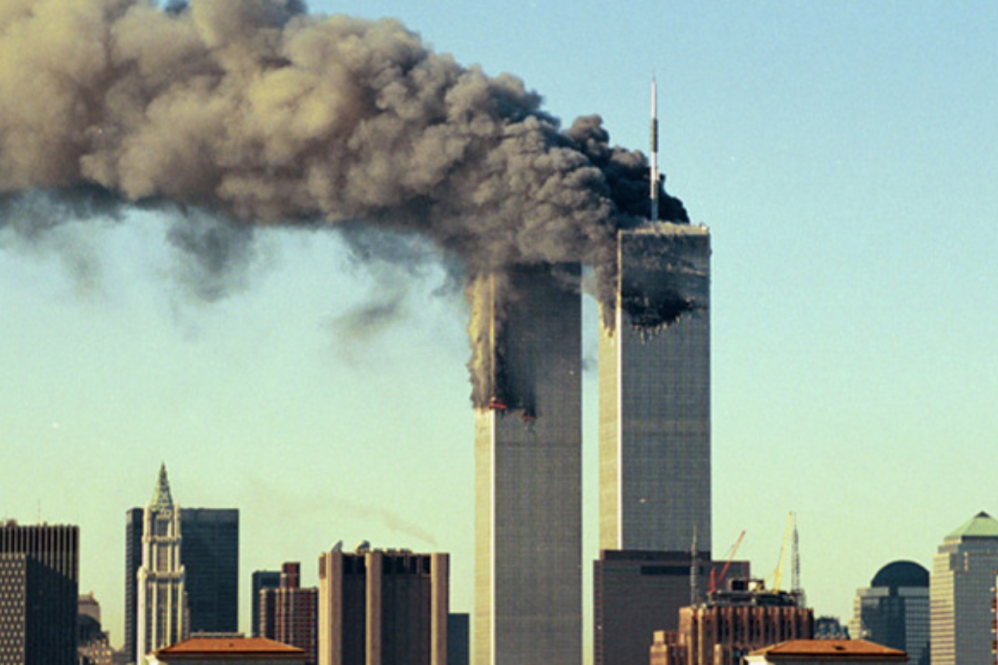
Twenty-five years ago this week, in the immediate aftermath of September 11th, 2001, I was heading for Afghanistan to report for The Boston Globe.
I was with a small group of colleagues and we would be among the first Western reporters to get to Afghanistan. Looking back, it is hard to explain just how raw emotions were and how taut our nerves were as we, like America, tried to grapple with the fact that the horrific terror attack had changed the world. How do you begin to cover a story that big? I was a father of three young boys at that point, and the calculus of risk was intense. Everything felt perilous. Everything felt fateful. I was eager to get there and start writing the first draft of history.
Over the 25 years that would follow, many more drafts of history would be written. Afghanistan would move toward a new and more hopeful future and gradually develop its own independent media that would start to write the country’s own story. Then more recent drafts would tell of the sudden pullout of U.S. forces and a subsequent return of the Taliban to power, who would go on to quickly and systematically dismantle the Afghan free press. Other drafts of history would draw parallels with the jarring shift in American power with the emergence of Donald Trump and his dismantling of USAID, as well as his unprecedented steps to undercut independent journalism in America.
With this week marking World News Day, it is essential to reflect on the fact that this history is all still being written, with Afghanistan serving as a warning of what we would lose if we let those in power dismantle independent journalism.
Our flight departed from London, where just a few days before I had been transferred with my wife and family to serve as bureau chief for the Globe’s international desk. Our flight from Heathrow would transfer through Munich, Germany to Dushanbe, Tajikistan, aboard what was one of the only flights into Central Asia given the restrictions to airspace after the hijackings. And this flight was only being offered once a week, so the thing I was the most focused on was simply making sure we did not miss the connection and, from Tajikistan, plot a very uncertain path across the border and into Northern Afghanistan.
I was carrying a very carefully packed duffle bag with only essentials: a robust first-aid kit, a detailed map of Afghanistan, a bulletproof vest, a helmet, a sleeping bag, a set of warm clothes, a spare pair of boots, a shortwave radio, extra batteries, a power storage pack, instant oatmeal and packets of miso soup and, most importantly, a clunky, but trusted old Russian satphone that would serve as a backup to the more modern Inmarsat Compact-M, which I carried on my shoulder along with my laptop, an IBM Think Pad which was the workhorse of choice back then. I always packed tight so I did not have to check bags, but in the immediate post-9-11 period you were simply not allowed anything other than one shoulder bag. So my satphone and laptop and a stack of notebooks and pens were all I was carrying. Join the GroundTruth community.
Sitting with New Yorker writer Jon Lee Anderson on the plane into Dushanbe, we talked about our wives and kids and loved ones back home and how both precarious and precious life seemed in this moment. We quickly discerned that we both shared extensive experience in war zones and that we both had learned lessons on how to avoid unnecessary risks. We were confident we both had enough previous experiences in the region, and we decided to partner on the journey and go in together.
When we landed in Dushanbe, there was a problem. The duffle I had so carefully packed did not make it on the flight into Frankfurt. We couldn’t wait, of course, so I plunged into the Hindu Kush mountains that shape Afghanistan’s impenetrable terrain with only a shoulder bag and a prayer. I am incredibly grateful to this day that Jon Lee was generous and helpful as we plunged into covering the war.
Within hours of arriving in Dushanbe, we were greeted by soldiers from Afghanistan’s Northern Alliance. They were establishing themselves as America’s new ally in its War on Terror. The Northern Alliance would provide critical intel as the United States plotted a campaign to hit its primary targets of Osama bin Laden and his Al Qaeda fighters, as the self-proclaimed authors of the 9-11 attacks and the chief suspects in the murder of 2,977 people, many of whom at this point in the first days of a new era were still lying buried in the rubble at Ground Zero. After these targets were hit, the military was planning to train its crosshairs on the Afghan Taliban leadership which had allowed bin Laden and Al Qaeda to base operations in the rugged terrain of Afghanistan.
The Northern Alliance stunned us with an offer to fly us into Afghanistan. Without much thinking, we accepted and with stunning speed we were suddenly on our way to the frontline of the first global war of the 21st century. We flew into Faizabad on a harrowing trip that ended with a wild landing on a makeshift runway fashioned out of corrugated tin in the middle of the ravaged warscape that was Afghanistan at that time. I still did not have my bag. It would take several weeks for that duffle bag to catch up with me, and I pictured it circling around the baggage claim in Dushanbe with the best sense of humor I could muster. It was, actually, the least of my worries.
We disembarked from the cargo plane from the rear, and as we walked off the ramp, the first Afghans we saw were tribal elders dressed in frayed robes with long beards and elaborate turbans that indicated some level of standing in the local community. They looked at us with bewilderment as we set foot in Afghanistan. That day, we learned from our Northern Alliance colleagues that the Afghans at the tarmac did not know about the attacks on the World Trade Center. The news had not reached them. They thought we were Russians, which is perfectly understandable since the Soviet Union was the last empire to land on that tarmac. The airfield, overgrown with weeds, was littered with the remnants of shot-down Russian MIGs and the hulking and burned-out carcasses of Russian armored vehicles. It was a stark warning of what awaited America in this ancient country that repelled empires throughout history.
In that first phase of reporting, we were American journalists with the blast waves of 9-11 still ringing, in a virtual way, in our collective ears. We did our jobs, but in the very earliest part of that conflict we were not so focused on challenging our government and its institutions. We were quietly pondering what it meant to be engaged in a sweeping war that had barely been defined beyond punishing those who attacked us, but we knew it was an extraordinary global moment and it was our job to cover it as faithfully and fearlessly as we could.
With this week marking World News Day, I am looking back on this time and realizing just how much more robust the international press corps was at that time. Newspapers the size of the Boston Globe were dedicating themselves to covering the story and unquestioningly making sure we had the resources we needed to cover the story safely and to the best of our ability. I’m grateful to our editor back then, Martin Baron, for his confidence in our ability to serve our readers in Boston. I would venture to say that the Globe today would not be able to deploy, certainly not at the level it did back then. These days, even great newspapers like the Globe are weakened economically and increasingly forced to narrow their mission.
Back then, not only was I impressed with the American news organizations’ commitment to the story, I was impressed with the U.S. government’s swift commitment in the months and years ahead to helping Afghanistan to develop its own independent media. The U.S. helped cultivate a new media landscape in Afghanistan that within just a few years yielded multiple independent outlets. There was some $150 million invested in media by a then robust US Agency for International Development (USAID), and the effort was transforming Afghanistan and enlightening and informing its people. They were starting to emerge from the darkness that the theocracy of the Taliban had brought.
There was Tolo TV and solid news organizations online such as the Pajhwok Afghan News, which was established in 2004. It felt like a vibrant sector of an emerging civil society. “We went from having no media to being one of the most vibrant landscapes for media in the region and we made that very long journey in just two decades. We have lost more than 100 journalists to explosions, suicide attacks and targeted killing. Media became the liberators of the Afghan people in the past 20 years, they provided platforms for all sectors of the society,” said Samiullah Mahdi, who I would get to know through the years of reporting, in an interview that came just after I had returned from Afghanistan to cover the 20th anniversary of the 9-11 attacks. In 2020 Madhi published a report for the Shorenstein Center at Harvard University on the state of media in his country titled “The Pen versus The AK-47: The future of Afghan media under the Taliban.” It was released just weeks before the chaotic pullout of US forces. Now, six years after the U.S. left the country, Mahdi’s words feel more despairing than ever.
“It is a total heartbreak for us, for my family, my friends and my colleagues. Most of the people I knew were not willing to leave. They had the chance, but they refused. They wanted to be there and to do something for our country. The media was just starting to cover issues beyond war, such as the condition of roads, health, the economy.”
Mahdi reflected on the pullout of U.S. troops and the return to power of the Taliban and how quickly they would move to dismantle the scaffolding of a free press that USAID and so many other organizations in the international community had committed to. He warned that the pullout would leave a great deal of wreckage in its wake.
His words were prescient. Indeed, the free press has been obliterated in Afghanistan. There are no more innovative news websites or courageous warriors for the truth out there trying to tell the story of their own country.
And the U.S. has its own sins to reflect on, and some of them date back to the original reporting in Afghanistan in those very early days.
I have often made the comparison that journalists are to the family of America what second sons in a big family are often to their families: the truth tellers. The ones who ask the hard questions. The ones who can appear irreverent and at the end of the day are unafraid to ask any question. But like a family mourning together and heading to a funeral, there were times when even the second son knew to downshift the curiosity and keep their mouths shut. I am humbled to say I think many of us were in that mode as we plunged forward in covering the story in Afghanistan.
It was a form of self-censorship, or perhaps self-reflection would be more accurate, about how we should carry ourselves. I certainly can’t speak for all of the American journalists, but that was how I felt and I knew it was how some of my closest colleagues felt. And the hesitancy of the U.S. media to criticize was even more pronounced as the George W. Bush administration directed forces away from Afghanistan and brought us into the war with Iraq. As that fateful and ill-considered path unfolded, we in the media too often remained muted for too long. We were hesitant in shining a spotlight on the U.S. presence in Iraq, and the moral and strategic failure it represented. Eventually, we as a tribe would get our act together and there was good reporting on the abuses of the U.S. military in Iraq, but it took too long.
Now, we are not self-censoring. We are actually facing something in our own country that is starting to look like true censorship, and we have seen the country move away from its role in supporting a free press in the U.S. and globally.
USAID has been dismantled by the Trump administration, and the efforts to support independent media around the world have ended. And even in the United States, which was once a beacon of a democracy with a robust free press, is finding its institutions imperiled and under threat like never before.
In the last week, we saw President Trump announce that he was banning CNN, MS Now, and Politico from the White House grounds, citing their critical reporting, and journalists from those outlets had their press credentials revoked. Following public outcry, a boycott from several outlets, and litigation on behalf of the three affected, the ban has since been lifted.
But this event was just the latest in what has been an all-out war by the Trump administration on journalism and the free press. Alongside ceaseless rhetoric that frames the press as “the enemy of the people,” he has sued several news organizations who have published critical reporting, ended federal funding for public broadcasting, and has overseen the detainment and arrest of journalists by ICE. Poynter has documented over 100 federal actions taken by Trump and his administration in an attempt to undermine journalism since taking office last year.
While we face censorship, the Afghan media faces all-out violence and threats of intimidation. And while we are still far from a landscape of total censorship like Afghanistan, in the last 25 years we have seen a dramatic erosion of journalism and the protections it had to speak truth to power.
Mahdi said in 2020, “My nightmare was that someday I will lose my country. Now we are living that nightmare. Everything has collapsed. … Unfortunately, I see that many of my colleagues left behind in different media outlets are under threat of their lives. The nightmare has become all too much a waking reality.”
I think about Mahdi these days, and I wonder if American journalism is not sleepwalking toward the same nightmare and the same risk of losing our country. On this World News Day, we should all wake up and ponder just how perilous a loss of a free, independent press would be not only for America, but for the whole world.
Note: This post is part of a continuing series for GroundTruth on Substack titled “The Road From 9-11,” documenting Charles M. Sennott’s coverage of the 25th anniversary of 9-11 and the U.S.-led war in Afghanistan following the attacks.
Like MediaFeed’s content? Be sure to follow us.
This article originally appeared on Charlessennott.substack.com and was syndicated by MediaFeed.co