Key takeaways
- Registration and disciplinary history are publicly searchable before any meeting takes place. The SEC’s Investment Adviser Public Disclosure database and FINRA BrokerCheck both allow anyone to look up an advisor’s background at no cost.
- The fiduciary question is the most consequential one to ask. Whether an advisor is legally required to act in a client’s best interest at all times, or only to recommend something suitable at the moment of a transaction, shapes every recommendation they make.
- Compensation structure determines where conflicts of interest live. Fee-only advisors are paid directly by the client. Commission-based advisors are paid by product providers, creating incentives that may not always align with the client’s goals.
- Form ADV and Form CRS are the two disclosure documents every registered advisor must provide. Both are available on request and free of charge, and reading them before an initial meeting is one of the most efficient ways to understand what kind of relationship is being proposed.
- Specialty and experience matter as much as credentials. An advisor with deep experience in retirement income planning serves a different function than one whose practice centers on wealth accumulation for high earners.

7 questions to ask a potential financial advisor before hiring
Choosing a financial advisor is one of the more consequential decisions in a retirement planning process, and it is one that most people make with very little structured information. The financial services industry is large, terminology-dense, and populated by professionals operating under meaningfully different standards of conduct, compensation models, and areas of expertise. The questions below are designed to help any prospective client surface the information that matters most before entering a professional relationship.
These are informational queries. The goal is to understand the structure of the relationship being considered, not to find a single correct answer.
Looking for the right financial advisor?
Take a short matching quiz to explore financial professionals based on your goals and preferences.

Financial advisor versus financial planner
Neither term is legally defined or regulated at the federal level, which means either can be used by professionals operating under very different standards, credentials, and compensation structures.
A financial advisor is a general term for a professional who helps manage finances or investments. A financial planner is a specific type of advisor who develops a detailed, long-term strategy for their clients’ overall financial well-being, including retirement, tax planning, and estate planning.
The most meaningful distinctions come from registration status, fiduciary status, and compensation model, rather than from the title itself. An advisor who is a registered investment adviser, operates as a fiduciary, and is compensated only by the client describes a specific and verifiable set of characteristics. A professional using the same title but holding only a broker-dealer license operates under a different legal framework entirely.
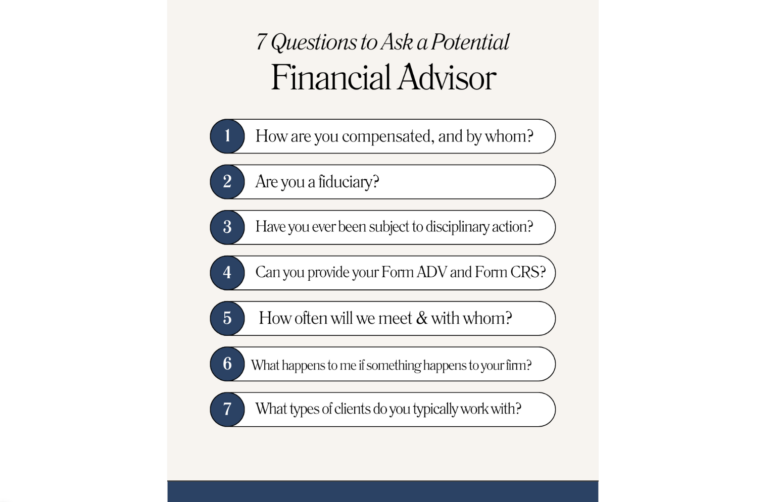
1. How are you compensated, and by whom?
This is the foundational question because the compensation structure determines where potential conflicts of interest exist. The two primary models are fee-only and commission-based.
A fee-only advisor is paid exclusively by the client. Compensation may take the form of a flat fee, an hourly rate, or a percentage of assets under management. No third-party payments are involved (read more here). The National Association of Personal Financial Advisors, or NAPFA, defines fee-only advisors on its website and maintains a searchable directory of members. Two additional searchable directories serve different client profiles. The Garrett Planning Network focuses on hourly and as-needed planners without minimum account requirements, making it an option for clients who want financial advice without a long-term engagement. The XY Planning Network is organized around fee-only advisors who specialize in serving Gen X and Millennial (technically Gen Y) clients, often through monthly subscription or flat-fee models.
A commission-based advisor earns compensation when a client purchases a financial product, such as an annuity, a mutual fund, or a life insurance policy. The commission is paid by the product provider. This does not automatically make the advice poor, but it does mean the advisor has a financial incentive tied to specific products.
Some advisors operate under a fee-based model, which combines elements of both. They charge fees for some services while also earning commissions on product sales. Understanding which model applies and where commissions are possible is essential to evaluating any recommendation that follows.

2. Are you a fiduciary?
The term fiduciary describes a legal obligation to act in the client’s best interest at all times, placing the client’s interests above the advisor’s own or their firm’s. This standard applies to Registered Investment Advisers, or RIAs, registered with the SEC or a state securities regulator, per SEC guidance. The fiduciary duty is ongoing. It does not apply only at the moment of a recommendation but extends to the continuous management of the client’s account.
Not all financial professionals are fiduciaries. Broker-dealers are held to a different standard under Regulation Best Interest, or Reg BI. That standard requires recommendations to be in the client’s best interest at the time they are made. It does not, however, impose a general duty to monitor client accounts on an ongoing basis, which is a meaningful practical distinction from the RIA fiduciary standard, per the SEC’s Regulation Best Interest compliance guide.
Some advisors hold dual registration as both an RIA and a broker-dealer. In those cases, the applicable standard depends on the capacity in which the advisor is acting at the time of a given recommendation. Asking directly and requesting that the answer be confirmed in writing is a reasonable step.
Go Further: Not all RIAs are regulated by the same body. Advisors managing under $100 million in client assets generally register with their state securities regulator rather than the SEC. Both SEC-registered and state-registered RIAs are bound by the fiduciary standard, but oversight differs. The SEC’s Investment Adviser Public Disclosure database at adviserinfo.sec.gov includes both categories. When using the database, the registration status column indicates which regulator oversees a given firm.

3. Have you ever been subject to disciplinary action?
Every registered investment adviser is required to disclose disciplinary history in their Form ADV, the mandatory registration document filed with the SEC. Every registered broker-dealer’s disciplinary history, including customer disputes, regulatory actions, criminal disclosures, and civil judgments, appears in FINRA BrokerCheck.
Both resources are publicly available before any meeting takes place. The SEC’s IAPD database allows anyone to view a registered investment adviser’s most recent Form ADV at no cost. FINRA BrokerCheck covers broker-dealer backgrounds and is similarly free and publicly accessible.
Go Further: If an advisor commits an infringement, it will show up on both sites because FINRA BrokerCheck and the SEC’s IAPD database pull their individual background information from the exact same underlying system, known as the Central Registration Depository (CRD). When a dually registered financial professional commits a violation while acting as a broker-dealer, that misconduct is permanently attached to their unique CRD number. Consequently, the red flag automatically flows into their Form ADV, specifically in the regulatory disclosure questions of Part 1 and the “Brochure Supplement” (Part 2B) that details the individual’s history, ensuring that a client reviewing their investment adviser profile will see their past broker-dealer misconduct, suspensions, or fines.
Asking the question directly in a meeting and then independently verifying the answer through these databases provides a complete picture.

4. Can you provide your Form ADV and Form CRS?
Form ADV is the mandatory disclosure document all registered investment advisers file with the SEC. It describes the advisor’s business, services, fees, compensation structure, conflicts of interest, and disciplinary history. Part 2A of Form ADV is a narrative brochure written in plain language. Part 2B covers the backgrounds of individual advisors at the firm.
Form CRS, also known as the Client Relationship Summary, is a standardized two-page document that registered broker-dealers and investment advisers are required to provide to retail investors, per the SEC. It covers the types of services offered, fees and costs, conflicts of interest, the applicable standard of conduct, and whether the firm or its professionals have reportable disciplinary history. Both documents are available on request and must be provided at no cost, per SEC rules. Reading them before engaging a professional is one of the most efficient uses of pre-meeting time.

5. How often will we meet, and who will I be working with day to day?
Communication expectations vary significantly across firms and advisors. Some provide quarterly review meetings as a standard offering. Others operate primarily through digital platforms with limited direct contact. At larger firms, the advisor who conducts the initial meeting may not be the person who manages the account on an ongoing basis.
Understanding the communication structure before engaging avoids misaligned expectations later. Questions worth raising include:
- Whether the advisor or an associate handles routine client inquiries
- What the typical response time is for client communications
- Whether the frequency of reviews is fixed or responsive to changes in market conditions or personal circumstances

6. What happens to my accounts if something happens to you or your firm?
Succession planning is a practical consideration that is easy to overlook in an initial meeting. For solo practitioners in particular, the question of what happens to client accounts in the event of retirement, disability, or death is worth raising explicitly. Many advisors have documented succession plans or arrangements with other firms. Others do not.
For clients working with larger registered investment adviser firms, accounts are subject to the custody rule under the Investment Advisers Act of 1940 (Rule 206(4)-2). That rule generally requires advisers with custody of client assets to maintain those assets with a qualified custodian (typically a bank or registered broker-dealer) that sends quarterly account statements directly to clients.
Advisers that do not rely on a qualified custodian to send those statements are generally required to undergo an annual surprise examination by an independent public accountant. The specifics of which requirements apply depend on how custody is structured at the firm, per SEC guidance.
Go Further: Assets held in brokerage accounts are covered by the Securities Investor Protection Corporation, or SIPC, which protects securities and cash up to $500,000 per customer, including a $250,000 limit for cash, if a SIPC-member brokerage firm fails, per the SIPC at sipc.org. No equivalent federal protection exists for assets held directly in investment advisory accounts. When assets are custodied at a third-party brokerage firm on behalf of an advisory client, SIPC coverage may apply to that custodial account. Understanding where assets are actually held and under which entity’s name is a question worth raising explicitly.

7. What types of clients do you typically work with, and what is your experience with retirement income planning?
Not all financial advisors specialize in the same areas. Some focus on accumulation, helping working adults build wealth over time. Others specialize in distribution, structuring income from accumulated assets in retirement. The two require meaningfully different technical knowledge and planning approaches.
A client approaching retirement with a mix of Social Security decisions, required minimum distributions from tax-deferred accounts, Medicare premium planning, and estate planning considerations benefits from an advisor with specific experience in those areas. Asking directly about the composition of the advisor’s existing client base and what percentage of clients are in or approaching retirement is a practical way to assess fit.
Credentials can also serve as a proxy for specialization. The Certified Financial Planner designation, or CFP, requires completion of a comprehensive education program, passage of a national exam, and adherence to a code of ethics maintained by the CFP Board. The Certified Public Accountant Personal Financial Specialist, or CPA/PFS, is held by CPAs with additional training in financial planning. Both designations represent a structured and verifiable commitment to the field. That distinguishes them from titles such as “wealth manager” or “financial consultant,” which carry no standardized educational requirements, no licensing exam, and no mandatory code of ethics at the federal level.

The bottom line
The seven questions above are a starting framework, not a complete picture. A financial advisory relationship involves ongoing communication, evolving financial circumstances, and changing regulatory environments. The documents described here, Form ADV, Form CRS, and the records available through the IAPD database and FINRA BrokerCheck, are public tools that exist precisely so that the information gap between advisor and prospective client can be narrowed before any agreement is signed. Using them before the first meeting rather than after is the most straightforward form of due diligence available.

Selected an advisor? Here’s how they can really help
Choosing the right advisor may feel like a job in itself. However, once selected, they can help their clients’ financial situations in a number of ways. While the selection process focuses on evaluating credentials and compensation structures, the actual working relationship shifts toward long-term execution. An advisor provides specialized expertise across critical areas like retirement income planning, tax minimization, estate structuring, and ongoing portfolio management. By serving as an objective partner, a professional ensures that complex financial decisions are made rationally rather than emotionally during periods of market volatility.
An advisor also helps clients navigate critical life transitions and evolving regulatory landscapes that are difficult to manage alone. From optimizing Social Security claiming strategies and calculating required minimum distributions to coordinating with estate attorneys and tax professionals, an advisor coordinates the moving parts of a client’s financial picture. This ongoing oversight helps prevent costly oversights—such as tax inefficiencies, improper asset titling, or misaligned insurance coverage—ensuring that every decision works cohesively toward long-term financial security.
A qualified advisor saves clients time and reduces the stress associated with managing wealth independently. Rather than forcing individuals to continually monitor shifting market conditions, tax laws, and economic data, a financial professional provides continuous monitoring and proactive adjustments. This ongoing relationship delivers peace of mind, empowering clients to focus on their personal lives and retirement goals while knowing their financial plan remains on track.

FAQs
Is it possible to verify an advisor’s credentials before the first meeting?
Yes. Registration status and disciplinary history for investment advisers can be checked at no cost through the SEC’s IAPD database at adviserinfo.sec.gov. For broker-dealers, FINRA BrokerCheck at brokercheck.finra.org provides the same function. Credentials such as the CFP designation can be verified through the CFP Board’s public verification tool at cfp.net. These checks take minutes and are available to anyone.
What is the difference between a financial advisor and a financial planner?
Neither term is legally defined or regulated at the federal level, which means either can be used by professionals operating under very different standards, credentials, and compensation structures. The most meaningful distinctions come from registration status, fiduciary status, and compensation model, rather than from the title itself. An advisor who is a registered investment adviser, operates as a fiduciary, and is compensated only by the client describes a specific and verifiable set of characteristics. A professional using the same title but holding only a broker-dealer license operates under a different legal framework entirely.
What documents should be requested before signing any advisory agreement?
Form ADV Part 2A, the narrative brochure describing the firm’s services, fees, and conflicts of interest, and Form CRS, the standardized relationship summary, are the two most directly useful documents. Both are required to be provided by registered investment advisers and broker-dealers upon request, per SEC rules. Reading both before signing any agreement provides a factual basis for the questions above and surfaces any discrepancies between what was discussed verbally and what is disclosed in writing.
Glossary
- Certified Financial Planner (CFP). A professional designation awarded by the CFP Board to individuals who have completed a specified education program, passed a comprehensive national examination, and agreed to adhere to the CFP Board’s code of ethics and standards of conduct.
- Certified Public Accountant Personal Financial Specialist (CPA/PFS). A credential held by licensed CPAs who have completed additional training and examination requirements in personal financial planning, administered by the American Institute of CPAs.
- Commission-based. A compensation model in which a financial advisor earns payment from a product provider when a client purchases a financial product such as an annuity, mutual fund, or insurance policy. The client does not pay the advisor directly for those transactions.
- Fee-based. A hybrid compensation model in which a financial advisor charges fees for some services while also earning commissions on the sale of certain financial products.
- Fee-only. A compensation model in which a financial advisor is paid exclusively by the client, with no commissions or payments from third parties. Compensation may take the form of a flat fee, an hourly rate, or a percentage of assets under management.
- Fiduciary. A legal obligation requiring a financial advisor to act at all times in the client’s best interest, placing the client’s interests above their own or their firm’s. The fiduciary standard applies to Registered Investment Advisers registered with the SEC or state regulators and is ongoing, not limited to the moment of a recommendation.
- Form ADV. A mandatory disclosure document filed by registered investment advisers with the SEC. It describes the advisor’s business, services, fees, compensation structure, conflicts of interest, and disciplinary history. Clients and prospective clients are entitled to receive it at no cost upon request.
- Form CRS (Client Relationship Summary). A standardized two-page document required by the SEC that registered broker-dealers and investment advisers must provide to retail investors. It covers services offered, fees and costs, conflicts of interest, the applicable standard of conduct, and disciplinary history.
- Registered Investment Adviser (RIA). A firm or individual registered with the SEC or a state securities regulator to provide investment advice for compensation. RIAs are legally required to operate under the fiduciary standard in their advisory capacity.
- Regulation Best Interest (Reg BI). An SEC rule that took effect June 30, 2020 that requires broker-dealers to act in the best interest of retail customers when making investment recommendations. It substantially raised the prior suitability standard while remaining a separate and lower standard than the fiduciary duty that governs RIAs. Unlike the RIA fiduciary duty, Reg BI does not impose a general obligation to monitor client accounts on an ongoing basis.
- Securities Investor Protection Corporation (SIPC). A congressionally chartered nonprofit corporation created by the Securities Investor Protection Act of 1970 that protects customers of SIPC-member brokerage firms if the firm fails. SIPC covers securities and cash up to $500,000 per customer, including a $250,000 limit for cash. Advisory accounts are not directly covered by SIPC unless assets are held at a SIPC-member custodian.
Sources
- SEC – Investment Adviser Public Disclosure (IAPD): https://adviserinfo.sec.gov/
- SEC – Staff Bulletin Standards of Conduct for Broker-Dealers and Investment Advisers: https://www.sec.gov/about/divisions-offices/division-trading-markets/broker-dealers/staff-bulletin-standards-conduct-broker-dealers-investment-advisers-care-obligations
- SEC – Regulation Best Interest Compliance Guide: https://www.sec.gov/resources-small-businesses/small-business-compliance-guides/regulation-best-interest
- SEC – Form CRS Investor Bulletin: https://www.investor.gov/introduction-investing/investing-basics/glossary/form-crs
- SEC – Investor.gov CRS Resource Page: https://www.investor.gov/CRS
- SEC – Form ADV Data: https://www.sec.gov/foia-services/frequently-requested-documents/form-adv-data
- FINRA – BrokerCheck: https://brokercheck.finra.org/
- NAPFA – What is Fee-Only Advising: https://www.napfa.org/financial-planning/what-is-fee-only-advising
- Garrett Planning Network – Find a Planner: https://directory.garrettplanningnetwork.com/
- XY Planning Network – Find an Advisor: https://connect.xyplanningnetwork.com/find-an-advisor
- CFP Board – Verify a CFP Professional: https://www.cfp.net/verify-a-cfp-professional
- SIPC – What SIPC Protects: https://www.sipc.org/for-investors/what-sipc-protects
- Investor.gov – SIPC Protection Investor Bulletin: https://www.investor.gov/introduction-investing/general-resources/news-alerts/alerts-bulletins/investor-bulletins/investor-bulletin-sipc-protection-part-1-sipc-basics
SteadyRetire is a retirement education platform offering practical financial resources and access to a financial advisor matching service. This article is intended for informational and illustrative purposes only and does not constitute financial, legal, tax, or investment advice. The information provided does not create a professional-client relationship and should not be used as a substitute for consultation with a qualified financial advisor, tax professional, or attorney. While we strive to provide accurate and up-to-date information, rules and regulations regarding retirement are subject to change. Always consult with a certified professional regarding your specific financial situation.
Related:
- What is a Form ADV? How to read an Advisor’s Disclosure
- How to use BrokerCheck to verify financial professionals
Ask us! What questions do you have about content, strategy, pop culture, lifestyle, wellness, history or more? We may use your question in an upcoming article!
Like MediaFeed’s content? Be sure to follow us.
This article originally appeared on SteadyRetire and was syndicated by MediaFeed.co.