

There’s no shortage of ways consumers can make payments, including cash, electronic transfers, credit cards, and cash apps like Venmo. This makes us wonder, do people still use checks?
While it may seem like making payments via a check is no longer in style, in 2021, 11.2 billion checks were written by U.S. consumers at an average of $2,430 each, according to Federal Reserve Board data. It may not be common to use checks to pay for everyday purchases anymore, but some consumers still turn to them for larger purchases.
Let’s take a closer look at today’s usage and popularity of checks (Learn more at Home Affordability Calculator).
Image Credit: AndreyPopov/istockphoto.
The Persistence of Check Usage

To better understand why writing checks is still so common despite the myriad of other payment options available to consumers, here is some helpful context surrounding check usage to keep in mind.
Overview of Check Usage in the Digital Age
From online bill payments via electronic transfers to splitting the bill with cash apps to waving a digital wallet over a payment terminal, there’s no shortage of options for making payments without having to lug around a checkbook.
All that being said, though, 55% of Americans still wrote a check in 2022.
Statistics and Trends Indicating That Checks Are Still in Use
Not only were billions of checks used in 2022, but they were used for large sums of money. What are checks used for? The average check written in 2021 was worth $2,430 — which does point to the likelihood of checks being more commonly used for large payments like rent or a down payment on a car.
Image Credit: fluxfoto/istockphoto.
Examination of the Reasons Why People Still Use Checks
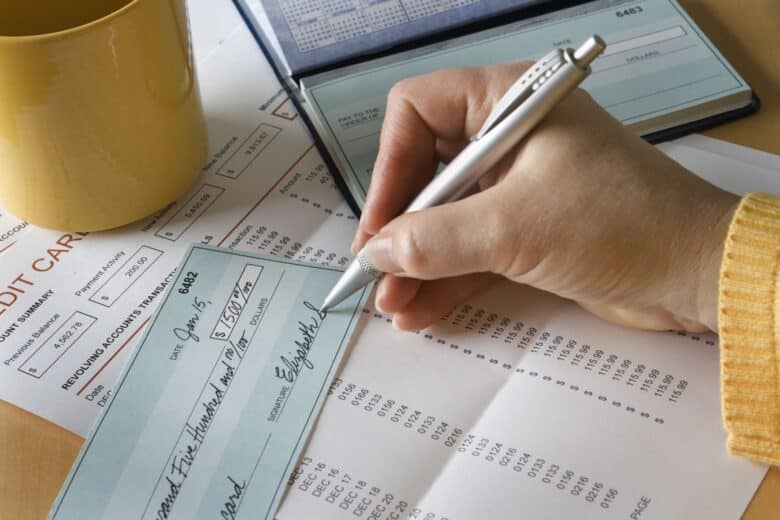
So, why do people still use checks?
- Familiarity and habit. Many individuals, particularly older generations, are accustomed to using checks as a traditional form of payment. They may feel more comfortable and confident with a payment method they have used for years. Many older consumers simply don’t have access to the technology or the understanding of it to make payments online or by using smartphones (which they may not even have).
- Preferred payment method for specific transactions. How consumers make payments isn’t always up to them. Some businesses and individuals prefer checks for certain types of transactions. For example, landlords often request apartment rent payments by check, as it provides a paper trail and can be easily recorded for accounting purposes.
- Convenience in certain situations. Checks can be convenient in situations where other payment methods are not readily available or feasible. For instance, when making a large purchase, such as a car or real estate.
- Trust and security factors. Checks offer a physical form of payment, which can feel more secure than electronic transactions.
(Learn more at Home Affordability Calculator).
Image Credit: YinYang/istockphoto.
Exploring the Purpose of Checks

In this day and age, it’s easy to wonder why people use checks. Below are some times when checks may come in handy.
- Personal transactions and payments. Checks are often used for personal transactions, such as repaying loans between friends or family members, splitting bills, or making purchases from individuals who may not accept electronic payments. In these situations, checks offer a tangible way to transfer money securely.
- Business transactions. Checks play a significant role in business transactions. They are used for making payments to suppliers, vendors, or contractors who may prefer or require payment by check. Checks provide a paper trail for accounting purposes, making it easier to track expenses and reconcile financial records.
- Paying bills. Many individuals still rely on checks to pay bills, such as rent, utilities, or other recurring expenses. Writing a check allows individuals to have control over the timing of their payments and serves as proof of payment in case of any discrepancies.
Image Credit: AndreyPopov/istockphoto.
Factors Influencing Check Usage

Now, let’s address some factors that influence check usage.
Digital Alternatives and Their Impact on Check Usage
Digital payments are rising in popularity and their ease and convenience (aka never having to worry about ordering checks again or sending them via the U.S. Postal Service) are very appealing. It’s easy to see why younger consumers are swapping checks for payment apps and online bill pay.
According to TouchNet’s annual Student Financial Experience Report 2022, there has been a significant increase in the percentage of students using mobile banking and payment apps. The report reveals that 80% of respondents now use mobile banking for bill payments and money transfers, a 7% increase compared to 2020.
Additionally, 73% of students use mobile banking for making deposits. The survey highlights the growing popularity of digital wallets among students, with 25% using Apple Pay (a 56% increase from the previous year) and 12% using Google Pay (double the usage from the previous year).
Image Credit: damircudic/istockphoto.
Why Using Checks to Pay Bills Is Less Popular

There are three primary reasons (as evident by the stats shared above) using checks to pay bills is less popular:
- Emergence of online banking and bill payment systems
- Convenience and speed of electronic payments
- Desire to avoid potential drawbacks and limitations of using checks
Image Credit: gzorgz/istockphoto.
Comparison of Check Usage Among Different Demographic Groups

According to the Federal Reserve Bank of Atlanta, older individuals, low-income earners, and nonminority group members are more inclined to make payments using paper checks.
When considering demographics and household income, consumers tend to use checks for higher-value transactions, such as utility payments, rent, charitable donations, government taxes and fees, and payments to building contractors.
How someone earns their income also determines how often they interact with checks. Among different sources of income, rental income and self-employment income are more commonly paid by check compared to other types of income.
Image Credit: wdstock/istockphoto.
The Takeaway

While the usage of checks has declined in recent years, it’s important to recognize that they still play a significant role in certain financial transactions. Specifically, checks are commonly used for higher-value payments like utilities, rent, and government taxes and fees.
Understandably, the popularity of checks for bill payments has decreased as more convenient electronic payment methods have emerged. Digital alternatives, such as online banking, mobile payment apps, and direct transfers, have gained popularity due to their convenience and efficiency.
When it comes to making monetary decisions, such as whether or not to use checks, it’s crucial for individuals to consider their own circumstances.
This article originally appeared on SoFi.com and was syndicated by MediaFeed.org.
Lantern By SoFiSoFi receives compensation in the event you obtain a loan, financial product, or service through the Lantern marketplace. This Lantern website is owned by SoFi Lending Corp., a lender licensed by the Department of Financial Protection and Innovation under the California Financing Law, license number 6054612; NMLS number 1121636. (here). This site is NOT owned and operated by SoFi Bank. Loans, financial products, and services may not be available in all states.All rates, fees, and terms are presented without guarantee and are subject to change pursuant to each provider’s discretion. There is no guarantee you will be approved or qualify for the advertised rates, fees, or terms presented. The actual terms you may receive depends on the things like benefits requested, your credit score, usage, history and other factors.*Check your rate: To check the rates and terms you may qualify for, Lantern and/or its network lenders conducts a soft credit pull that will not affect your credit score. However, if you choose a product and continue your application, the lender(s) you choose will request your full credit report from one or more consumer reporting agencies, which is considered a hard credit pull and may affect your credit.All loan terms, including interest rate, and Annual Percentage Rate (APR), and monthly payments shown on this website are from lenders and are estimates based upon the limited information you provided and are for information purposes only. Estimated APR includes all applicable fees as required under the Truth in Lending Act. The actual loan terms you receive, including APR, will depend on the lender you select, their underwriting criteria, and your personal financial factors. The loan terms and rates presented are provided by the lenders and not by SoFi Lending Corp. or Lantern. Please review each lender’s Terms and Conditions for additional details.Many factors affect your credit scores and the interest rates you may receive. SoFi is not a Credit Repair Organization as defined under federal or state law, including the Credit Repair Organizations Act. SoFi does not provide “credit repair” services or advice or assistance regarding “rebuilding” or “improving” your credit record, credit history, or credit rating. For details, see the FTC’s website on credit (here)Financial Tips & Strategies: The tips provided on this website are of a general nature and do not take into account your specific objectives, financial situation, and needs. You should always consider their appropriateness given your own circumstances.¹SoFi’s Insights tool offers users the ability to connect both SoFi accounts and external accounts using Plaid, Inc.’s service. When you use the service to connect an account, you authorize SoFi to obtain account information from any external accounts as set forth in SoFi’s Terms of Use. SoFi assumes no responsibility for the timeliness, accuracy, deletion, non-delivery or failure to store any user data, loss of user data, communications, or personalization settings. You shall confirm the accuracy of Plaid data through sources independent of SoFi. The credit score provided to you is a VantageScore® based on TransUnion® (the “Processing Agent”) data.
Personal LoanSoFi Lending Corp. (“SoFi”) operates this Personal Loan product in cooperation with Engine by MoneyLion. If you submit a loan inquiry, SoFi will deliver your information to Engine by MoneyLion, and Engine by MoneyLion will deliver to its network of lenders/partners to review to determine if you are eligible for pre-qualified or pre-approved offers. The lenders/partners receiving your information will also obtain your credit information from a credit reporting agency. If you meet one or more lender’s and/or partner’s conditions for eligibility, pre-qualified and pre-approved offers from one or more lenders/partners will be presented to you here on the Lantern website. More information about Engine by MoneyLion, the process, and its lenders/partners is described on the loan inquiry form you will reach by visiting our Personal Loans page as well as our Student Loan Refinance page. Click to learn more about Engine’s Licenses and Disclosures, Terms of Service, and Privacy Policy.Personal loan offers provided to customers on Lantern do not exceed 35.99% APR. An example of total amount paid on a personal loan of $10,000 for a term of 36 months at a rate of 10% would be equivalent to $11,616.12 over the 36 month life of the loan.
Student Loan RefinanceSoFi Lending Corp. (“SoFi”) operates this Student Loan Refinance product in cooperation with Engine by MoneyLion. If you submit a loan inquiry, SoFi will deliver your information to Engine by MoneyLion, and Engine by MoneyLion will deliver to its network of lenders/partners to review to determine if you are eligible for pre-qualified or pre-approved offers. The lenders receiving your information will also obtain your credit information from a credit reporting agency. If you meet one or more lender’s and/or partner’s conditions for eligibility, pre-qualified and pre-approved offers from one or more lenders/partners will be presented to you here on the Lantern website. More information about Engine by MoneyLion, the process, and its lenders/partners is described on the loan inquiry form you will reach by visiting our Personal Loans page as well as our Student Loan Refinance page. Click to learn more about Engine’s Licenses and Disclosures, Terms of Service, and Privacy Policy.NOTICE: The debt ceiling legislation passed on June 2, 2023, codifies into law that federal student loan borrowers will be reentering repayment. The US Department of Education or your student loan servicer, or lender if you have FFEL loans, will notify you directly when your payments will resume For more information, please go to https://docs.house.gov/billsthisweek/20230529/BILLS-118hrPIH-fiscalresponsibility.pdf https://studentaid.gov/announcements-events/covid-19If you are a federal student loan borrower considering refinancing, you should take into account the new income-driven payment plan, SAVE, which replaces REPAYE, seeks to make monthly payments more affordable, and offers forgiveness of balances that were originally $12,000 or lower after 120 payments, among other improvements. Also, please note that once you refinance federal student loans you will no longer be eligible for current or future flexible payment options available to federal loan borrowers, including but not limited to income-based repayment plans, such as SAVE, or extended repayment plans.
Auto Loan RefinanceAutomobile refinancing loan information presented on this Lantern website is from Caribou, AUTOPAY, Engine by MoneyLion, and each of Engine’s partners (along with their affiliated companies). Caribou, AUTOPAY, and Engine by MoneyLion pay SoFi compensation for marketing their products and services on the Lantern site. Auto loan refinance information presented on this Lantern site is indicative and subject to you fulfilling the lender’s requirements, including but not limited to: credit standards, loan size, vehicle condition, and odometer reading. Loan rates and terms as presented on this Lantern site are subject to change when you reach the lender and may depend on your creditworthiness, consult with the lender for more details. Additional terms and conditions may apply and all terms may vary by your state of residence.
Secured Lending DisclosureTerms, conditions, state restrictions, and minimum loan amounts apply. Before you apply for a secured loan, we encourage you to carefully consider whether this loan type is the right choice for you. If you can’t make your payments on a secured personal loan, you could end up losing the assets you provided for collateral. Not all applicants will qualify for larger loan amounts or most favorable loan terms. Loan approval and actual loan terms depend on the ability to meet underwriting requirements (including, but not limited to, a responsible credit history, sufficient income after monthly expenses, and availability of collateral) that will vary by lender.
BankingSoFi Lending Corp. (“SoFi”) operates this website in cooperation with Engine by MoneyLion presenting promotions for products and services offered by other banks, lenders, and financial institutions. If you select a promotion above, you will be connected to the website of the company offering the product. The promotions presented on this site are from companies that pay SoFi and Engine by MoneyLion compensation for marketing their products and services. This may affect whether a provider is featured on this site and could affect the order of presentation. Lantern and Engine by MoneyLion do not include all providers in the market or all of their available offerings. Click to learn more about Engine’s Licenses and Disclosures, Terms of Service, and Privacy Policy.
Image Credit: AndreyPopov/istockphoto.
More from MediaFeed

How can I remodel my bedroom on a budget?
Image Credit: Joe Hendrickson/istockphoto.


