“Multiple income streams” is a term that may either sound to you like the myth of millionaires or a scam. Am I right?
Well, they aren’t either of those.
Anyone who has a job and another way of bringing in income, even if that is something as simple as a 401(k) match from your employer, has multiple income streams. Do you also sell your stuff from time to time on Facebook Marketplace on the side of your day job? Then you also have multiple income streams.
A few of my own multiple income streams include:
- My day job and its 401(k) match
- My IRA and brokerage account at M1
- This website
- Freelance writing / ghostwriting
- Rover pet sitting
- Digital products I sell on Shopify and Etsy
You can read more about how I specifically built these income streams in an article I wrote for CNBC. If you want to learn how to build multiple income streams of your own, keep reading.
How to Build Multiple Income Streams
Building multiple streams of income can be either taking on a side hustle, a second job or starting to build your own streams of passive and semi-passive income.
First, you have to decide what you want to do and how you want to do it.
1. Decide What You Want to Do
To decide what kind of income stream you want to start, you can get started using this free side hustle quiz. Once you take the free side hustle quiz, you’ll be matched to your perfect type of side hustle based on your lifestyle, goals, available time and the answers to the questions pertaining to what you want to exactly do. You’ll also be given a list of free resources based on your match for you to actually get started building your new income stream.
In addition to the quiz, you can also do a good ‘ole fashioned brain dump. Start by listing all the things you want to do, things that make you curious, hobbies you love to do and various skillsets you have or want to build on. Then, go through that list and highlight what excites you while crossing out what doesn’t.
Repeat until you have a set of items from the list you want to take forward.
2. Determine Your Customer and Your Mission
For your new idea to work, it has to have a mission that targets a specific customer.
You might not think you have to do this if a gig app is the only way you want to build multiple income streams or you want to invest in the stock market, but those routes actually fit this too.
For example: If you want to pet sit on Rover, there may be a lot of competition in your area, but maybe not a lot of folks that have experience administering medications to pets or they lack experience with elderly dogs. That is where you could fill your gap and actually market your Rover account tailored to people that have elderly dogs by highlighting that experience in your bio.
This example, investing in the stock market, would be knowing your why. Why are you wanting to invest this money? What is your intention with it? It may not be a mission shared with others, but it is a mission shared with yourself. However, you don’t have any customers in this example. But for something like building a blog, YouTube, podcast, selling digital products or any other online side hustle where you have customers to satisfy, you have to know who you are speaking to.
Once you have your mission, start thinking about your ideal customer and build a customer profile. If your income stream needs customers in order to thrive, you will complete this step. Otherwise, you can skip it.
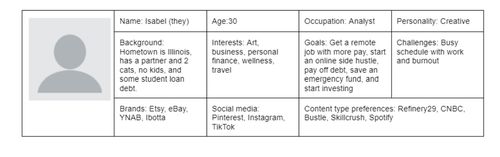
To create this customer profile, start listing details of your ideal reader like:
- Name
- Age
- Occupation
- Personality
- Interests
- Goals
- Challenges
- Brands they love
- Social media platform of choice (this one will help you know where to go to reach your audience, too)
- Content type preferences
Here is an example of a completed profile:
3. Understand Your Customer’s Problems and Frustrations (but Also What They Love)
Jumping off from the customer profile exercise, you may already have a good idea of some of your ideal customer’s problems and frustrations. You may also know what they already love. However, researching these areas deeper will give you a deeper understanding to how you might reach your customer.
To continue researching these further, turn to free tools like Ubersuggest and Answer Socrates. Enter keywords that your ideal customer might be searching for online and see what the top asked questions are. Answer Socrates can show you these questions, and Ubersuggest will help you determine the volume of those keywords and questions, meaning how often folks searching for these online.
Then take the highest keyword volumes, and that is what you could start targeting in your content and offer to the customer. To take it one step further, you could also browse forums online that pertain to these questions and keywords that your idea customer is already searching for, such as Reddit.
4. Choose a Platform to Reach This Customer
By this step, you already know who you want to reach and your why. But you don’t necessarily know how and where you will actually reach your customer unless you charted that out already in your customer profile.
Your research from the last step might come in handy for this. The types of questions your customer is asking online will determine where they probably like to spend their time online.
The way I categorize out the different platforms are as follows:
- Google: Your customer likes searching for their questions and reading answers via articles or videos (a website might work well for you if your customer exists here)
- YouTube: People who want video content for what they are searching for
- Podcasts: People who are busy and like to listen to podcasts on the go
You can set up a website for $2.95 a month using Bluehost, the same hosting provider I used when I started.
Social media platforms to build your community:
- TikTok and Pinterest: People go to look for ideas, entertainment, how-to’s
- Instagram: People looking for inspiration, lifestyle content, shopping
- Facebook: Family oriented, mostly Millennial, Gen X and Boomer generations, marketplace shopping, groups
- Twitter: Networking, quick tips, discussion
Depending on where your customer profile fits, is where you should start. Focus on one platform at first while claiming your usernames on all the platforms that you would like to eventually use. Then when you’ve mastered one, automate and move on to the next.
5. Create Your Offering
Finally, you have all the behind-the-scenes leg work done. Now it’s time to create your offering.
Your offering could be a website of resources where you make money from ads and affiliates; it could be a free offering like a checklist that gives you ideas for a paid offerings down the line while also adding them to your email list, or it could be something like a content library behind a pay wall.
To start building your email list, use Convertkit for free (this is what I use)!
Whatever your offering is, is entirely up to you.
Before you create any sort of paid offering, you can find ways to give your customer quick wins through a freebie email opt-in to both hook them into your brand and add them to your email list. You should be focusing on converting your social media followers to email list members because you have no idea when that social media platform might disappear one day (and your audience along with it).
Experiment with one free offering and one paid offering, measure the results, review and refine from there. Your first paid offering should be an offer that provides the smallest number of benefits necessary to make a sale.
Ideas for Creating Multiple Income Streams
Now that you have the exact steps of how to actually build your new income stream, let’s go through some ideas of real life examples.
The trick to it all is that there is no trick. There is only experimenting, measuring your results, tweaking and repeating. It takes work and it takes time, but the benefits are all worth it.
This article originally appeared on ILikeToDabble.com and was syndicated by MediaFeed.org.
More from MediaFeed
38 ways to earn passive income

Having more than one source of income is pretty common these days. For some people, it’s a way to make ends meet. For others, it’s a way to grow their wealth. It can also be a way to feel more financially secure. If one source of income dries up, there is another that can fill in the gap. While a common source of income is the type earned from a regular job, there is also passive income.
Creating and managing passive income streams isn’t a passive activity. It requires upfront work and sometimes investment to build up a source of passive income. Depending on what your passive income source is, such as a blog or podcast, it may require you to put in time each week to keep it earning you cash.
Related: 25 things to know when renting out an Airbnb
Khosrork/ istockphoto

Passive income is money that you earn without active involvement. In other words, it is income that isn’t attached to an hourly wage or annual salary. Passive income streams could include things like cash flow from rental properties, dividend-yielding stocks, sales of a product (that requires little or no effort), royalties and more.
SARINYAPINNGAM / istockphoto

In addition to passive income streams, there are other types of income you can earn:
- Earned income: This is the most common type of income
- — money you make from a job. With earned income, you are trading your time for money.
- Profit income: Profit income comes from the sale of a product after expenses have been deducted.
- Interest income: This can be money earned from one entity lending to another entity, such as a person, company or bank. This can also be referred to as interest from accounts such as savings accounts and certificates of deposit (CDs) in which you receive a 1099-INT at the end of the year.
- Dividend income: Most dividend income is earned by the distribution of income from companies to shareholders owning stocks that pay dividends.
- Rental income: Rental income is earned when you rent or lease a house, car, or other property you own to someone else.
- Capital gains: This generally refers to profit (or gain) that is subject to taxation when you sell an asset such as stock or real estate. There are both long- and short-term capital-gains tax rates depending upon how long you held the asset before sale.
- Royalty income: Royalty income is generated when you own the rights to a piece of art, music, literature or another asset licensed for other people to use, or from the extraction of oil, gas, or minerals.
Pinkypills / istockphoto

There are only 24 hours in a day. If you go to a job each day that pays you a set amount of money, that is the maximum amount that you’ll ever make in a 24-hour period. That is called earned income.
By investing some of that earned income and creating sources of passive income, you may be able to increase your earnings. Diversifying your income stream may also improve your financial security.
Depositphotos

- More free time: By earning money through passive income sources, you might be able to free time in your schedule. You may choose to spend more time with your family, pursue a creative project or new business idea, or travel the world.
- Financial security: Even if you still plan to keep your 9-to-5 job, having multiple sources of income could help increase your financial security. If you lose your job, become sick or get injured, you may still have money coming in to cover expenses. This is especially important if you are supporting a family.
- Tax benefits: You may want certain legal protections for your personal assets or to qualify for tax breaks. Consulting with an attorney and/or tax advisor to explore setting up a formal business structure like a sole proprietorship, a limited liability company (LLC) or a corporation might help you decide if this is a good route for your particular situation.
- Location flexibility: If you don’t have to go into an office each day, you’ll be free to move around and, possibly, live anywhere in the world. Many passive income streams can be managed from your phone or laptop.
- Achieve financial independence: The definition of financial independence is having enough income to cover your expenses without having to actively work in order to cover living expenses. This could allow you to retire early and have more freedom to live your life the way you choose. Whether you’re interested in retiring early or not, passive income can be one way to help you reach financial independence.
- Pay off debt: Passive income may help you to supplement your income so that you will have the opportunity to pay off any debts more quickly.
Depositphotos

Although it might sound like a dream come true to quit your job and travel the world, earning through passive income is not quite that simple.
- Earning passive income is not a passive activity: Whether you earn passive income through a rental property, running a blog or in another way, you will still need to put in some time and effort. It takes time to get these income sources up and running, and they don’t always work out as planned. If, for example, you run an Airbnb, you have to maintain the property, ensure a high-quality experience for guests, and address any issues or concerns guests may have to secure positive reviews.
- Passive income requires diversity: In order to earn enough passive income to quit your job and cover all your expenses, you would most likely need more than one source of income. Although you may no longer need to clock into a 9-to-5 job, you will likely still need to spend time managing multiple income streams.
- It’s lonely at the top: It might sound great to never have to go to the office again and to have the freedom to travel, but earning money through passive income can become lonely. Not having anyone to talk to during the day might make you feel lonely, and if you aren’t self-motivated, you may find it difficult to stay on task if you need to manage your passive income streams.
- Getting started may require investment: Depending on how you plan to earn passive income, it may require an initial financial investment. You may need money for a down payment on a rental property, the development of a product you plan to sell or for investment into dividend-yielding stocks.
Depositphotos

There are a number of ways to earn passive income. Some options, like the following, take relatively little active supervision.
SIphotography / istockphoto

By simply putting your money in the bank, you may be able to start to earn passive income on it. If you invest in an FDIC-insured account, the first $250,000 of your money is protected. There are both banks and online platforms that offer high-yield savings accounts.
DepositPhotos.com

Although this may take an up-front investment, buying into a business and becoming a silent partner can be another passive income source.
DepositPhotos.com
Using a peer-to-peer or crowd-lending website, you can be matched to an individual seeking a loan and lend your money as an installment-type loan, earning interest on it. You might earn even more than from a bank, depending on the loan.
AndreyPopov/istock

Another popular passive income source is rental property. You might want to purchase a home to rent out to an ongoing tenant or list a property on a short-term rental site like Airbnb. Hiring a property management company lessens your day-to-day involvement, thereby making this venture more passive than active.
DepositPhotos.com

If you don’t have thousands of dollars to spend on a piece of property, you can always check out your options on crowdfunded real estate sites like Fundrise and CrowdStreet. For Fundrise, you only need $500 to start.
DepositPhotos.com

There is no guarantee that investing in dividend-paying stocks will continue to earn you passive income, but some investors may enjoy the thrill of the ups and downs of the stock market. Dividend-paying stocks typically pay investors quarterly or annually and often allow investors to reinvest the dividends.
DepositPhotos.com

If you’re just getting started with investing, you may want to use automated investing tools to help you choose the appropriate allocation of assets for your goals.
AndreyPopov / istockphoto

When you open your retirement account, you can choose to invest it however you want. One way to earn passive income on a retirement account is through mutual funds. You can choose the level of risk you want to take with your money by finding a mutual fund that is higher or lower risk.
Flickr: American Advisors Group

When you join a company’s affiliate program, you earn a commission from every product that someone purchases from that company. All you have to do is post the link on your blog, website or social media pages. Amazon Associates is a great place to start.
CarmenMurillo / iStock

Another one of the best passive income opportunities is renting out your car on a site like Turo. It’s basically the Airbnb of cars, and, according to Turo, the average annual income for one car on the site is $10,516.
DepositPhotos.com

If you have a clean driving record and a newer car, consider getting in touch with a car advertising agency. You simply drive around town with ads on your car and easily earn passive income.
kzenon/istock

Do you have space in your driveway that you aren’t using? Then rent it out on platforms like Stow It, where you can find people who will pay to rent out the space.
KatarzynaBialasiewicz/istock

If you have extra space in your garage, shed or storage unit, then you could earn passive income by using a peer-to-peer storage site like Stashii to find people who need your space.
DFTidrington / istockphoto

You may not have space to store other people’s things, but you might consider investing in a real estate investment trust (REIT) that focuses on storage units. For example, one option is Public Storage, which has ownership or interest in 2,548 properties located in 38 states.
DepositPhotos.com

Perhaps you don’t have a car, but you do have a bike that’s just sitting around. Your bike could be a lucrative passive income source, especially if you live in a high-traffic area. List your bike on Spinlister to get started.
DepositPhotos.com
Even if you don’t own a rental property, with your landlord’s permission, you may be able to rent out a room in your apartment or list it on Airbnb and start adding to your passive income streams.
DepositPhotos.com

If you love pets, you can earn passive income by welcoming pets into your home while their owners are on vacation. For instance, you could charge $30 to $80 per day just for running a doggy daycare. You can gain clients through word of mouth or use a site like Rover to find customers.
DepositPhotos.com

When your friends go out of town, they may need someone to stay in their home and do simple things like water their plants and collect their mail. You can easily make money and have somewhere new to stay for a little bit. Along with making yourself available to friends, you can sign up to be a house sitter on HouseSitter.com.
Valeriy_G / iStock

Some domain names are cheap, while others cost a lot of money because they are in high demand. One thing you could do to start another passive income stream is to purchase domain names you think will be popular. Purchase low for around $10 to $100 and then sell them for a much higher price later on.
DepositPhotos.com

Have you ever done a home improvement project that required you to purchase tools? You may never need to use those tools again. Thankfully, now you can rent tools, and rent out your tools, on peer-to-peer platforms such as Sparetoolz to earn passive income.
artisteer / istockphoto

Let’s say you don’t have any songwriting ability, but you would like to make money on other artists’ work. You can invest in royalties through Royalty Exchange and earn passive income on the intellectual property.
Drablenkov / istockphoto

You can make thousands of dollars per month if you own a billboard where companies can advertise their products and services. Do your research and make sure you get the right permits before committing to a billboard.
Zyabich/istock

If you don’t have the time or energy to create content for your own blog, then look into ones that are already successful and see if the owners are willing to sell. You could also hire someone to manage your blog so that you’re truly earning in a passive way.
DepositPhotos.com

If you have a special skill or knowledge about a certain topic, you may be able to create a video course where you teach people about that topic and charge them to take the course.
fizkes/ istockphoto

You may want to research online platforms where you can sell everything from digital art to e-books. Whether you’re an artist, graphic designer or writer, you can create digital products to sell online.
DMEPhotography / istockphoto

Many companies, bloggers and individuals use stock photos on a regular basis. You may be able to upload your best photos to stock photo sites and earn passive income on them.
DepositPhotos.com

If you’ve been dreaming about an amazing phone app that you think a lot of other people would use, you may want to look into hiring a development team to create it.
DepositPhotos.com

You may be able to earn passive income through sales of a product that you create. This could be a book that you write or a physical product that you design and make. You might also list items you already own on sites like eBay and earn extra income through those sales.
CrispyPork/ istockphoto

Do you love to write songs? Then you could license your music and start to earn passive income. You’ll just have to team up with a music licensing company to get started.
Rohapp

Through platforms like Amazon’s KDP, you can self-publish a book and earn a royalty on it every time someone makes a purchase. You will be able to set the price of your book and be in full control of your book’s Amazon page, where you can list pictures of the book, reviews and videos promoting it.
DepositPhotos.com

You can start selling books online without having to write anything. How? By focusing on blank books, such as journals, sketchbooks and planners. Simply find a design you believe will appeal to people and begin collecting royalties when people buy your books.
dmitriymoroz/istock

Another artistic endeavor that could be a good passive income stream is creating greeting cards that you sell to a wholesale or retail stationery company that accepts independent artist submissions.
VictoriaBee / iStock
If you want to sell products online but don’t want to store any of the goods, you could always look into dropshipping to earn passive income. With dropshipping, you don’t have to have much money to start since you don’t need inventory to fulfill orders for customers.
Depositphotos

If you like to write and are passionate about a certain topic, you might want to start a blog and earn money through ads and affiliate links.
DepositPhotos.com

If you enjoy creating videos more than writing, then consider starting your own YouTube channel. Once you get enough viewers, you can earn passive income through YouTube advertising.
DepositPhotos.com

Podcasts are all the rage, and they can generate some passive income streams for you. If you start a podcast that resonates with people, then you can grow your audience and monetize your show by sponsoring with ad partners. If you get enough listeners, you may be able to sign up for podcast advertising networks.
vadimguzhva / istockphoto

When people are out at a bar or nightclub or they’re frequenting a cash-only business, they may need cash right away. If you own an ATM business and you place your ATM in high-traffic locations, you could start to earn passive income through surcharge fees. Typically, you could earn around $3 per withdrawal.
DepositPhotos.com

Similar to an ATM business, a vending machine business allows you to use your creativity and determine high-traffic areas where you could make a lot of money. If you buy in bulk, you’ll be able to save on the snacks and drinks you purchase for your machines.
DepositPhotos.com

No matter which type of passive income you choose to pursue, it’s important to keep track of your finances and both your short-term and long-term financial goals.
Tracking multiple sources of income in a monthly budget can be a complex task. To be profitable, it’s important to pay attention to how much money you put into the maintenance of your passive income stream(s), such as property upkeep or monthly online services.
Portra

Establishing passive income streams is one way to diversify your income and can help you build wealth and achieve financial freedom in the long term. There are a variety of ways to earn passive income, such as through investing, rental properties and earning royalties. Some passive income sources require a financial commitment upfront, such as purchasing a rental property, and others may require a time commitment.
Learn more:
This article originally appeared on SoFi.comand was syndicated by MediaFeed.org.
SoFi Money
SoFi Money is a cash management account, which is a brokerage product, offered by SoFi Securities LLC, member FINRA/SIPC. Neither SoFi nor its affiliates is a bank. SoFi Money Debit Card issued by The Bancorp Bank. SoFi has partnered with Allpoint to provide consumers with ATM access at any of the 55,000+ ATMs within the Allpoint network. Consumers will not be charged a fee when using an in-network ATM, however, third party fees incurred when using out-of-network ATMs are not subject to reimbursement. SoFi’s ATM policies are subject to change at our discretion at any time.
SoFi Invest
The information provided is not meant to provide investment or financial advice. Investment decisions should be based on an individual’s specific financial needs, goals and risk profile. SoFi can’t guarantee future financial performance. Advisory services offered through SoFi Wealth, LLC. SoFi Securities, LLC, member FINRA/SIPC. SoFi Invest refers to the three investment and trading platforms operated by Social Finance, Inc. and its affiliates (described below). Individual customer accounts may be subject to the terms applicable to one or more of the platforms below.
1) Automated Investing—The Automated Investing platform is owned by SoFi Wealth LLC, an SEC Registered Investment Advisor (“Sofi Wealth“). Brokerage services are provided to SoFi Wealth LLC by SoFi Securities LLC, an affiliated SEC registered broker dealer and member FINRA/SIPC, (“Sofi Securities).
2) Active Investing—The Active Investing platform is owned by SoFi Securities LLC. Clearing and custody of all securities are provided by APEX Clearing Corporation.
3) Cryptocurrency is offered by SoFi Digital Assets, LLC, a FinCEN registered Money Service Business.
For additional disclosures related to the SoFi Invest platforms described above, including state licensure of Sofi Digital Assets, LLC, please visit www.sofi.com/legal. Neither the Investment Advisor Representatives of SoFi Wealth, nor the Registered Representatives of SoFi Securities are compensated for the sale of any product or service sold through any SoFi Invest platform. Information related to lending products contained herein should not be construed as an offer or pre-qualification for any loan product offered by SoFi Lending Corp and/or its affiliates.
SoFi’s Relay tool offers users the ability to connect both in-house accounts and external accounts using Plaid, Inc’s service. When you use the service to connect an account, you authorize SoFi to obtain account information from any external accounts as set forth in SoFi’s Terms of Use. SoFi assumes no responsibility for the timeliness, accuracy, deletion, non-delivery or failure to store any user data, loss of user data, communications, or personalization settings. You shall confirm the accuracy of Plaid data through sources independent of SoFi. The credit score provided to you is a Vantage Score® based on TransUnion™ (the “Processing Agent”) data.
External Websites: The information and analysis provided through hyperlinks to third party websites, while believed to be accurate, cannot be guaranteed by SoFi. Links are provided for informational purposes and should not be viewed as an endorsement.
Third Party Brand Mentions: No brands or products mentioned are affiliated with SoFi, nor do they endorse or sponsor this article. Third party trademarks referenced herein are property of their respective owners.
Tax Information: This article provides general background information only and is not intended to serve as legal or tax advice or as a substitute for legal counsel. You should consult your own attorney and/or tax advisor if you have a question requiring legal or tax advice.
designer491/ iStock

monkeybusinessimages / istockphoto
Featured Image Credit: Artem Bali on Unsplash.