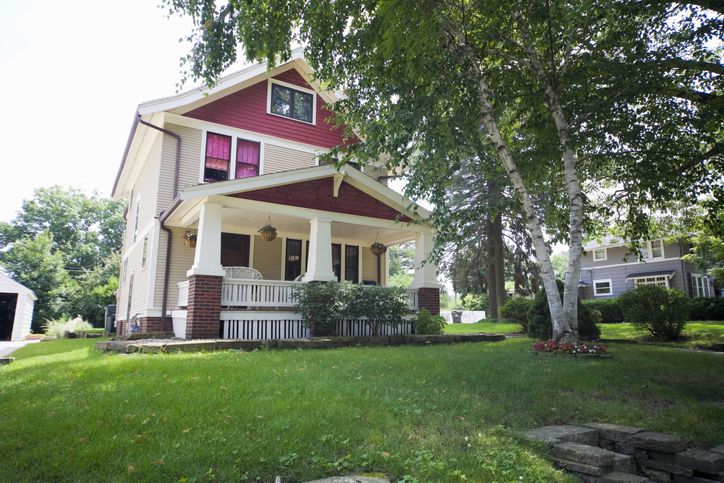
Homeownership is the American Dream. At least it used to be.
Some of the shine wore off after the 2008 housing crash. For the first time, many Americans began to see how buying a home wasn’t the good investment they thought it would be.
When you look at buying a house in the cold light of real estate investment strategy, it is easy to see how buying can be a bad decision. It blocks your cash flow, limits your diversification, and costs you money just to hold with no guarantee that you will ever see a profit.
So, from an investment perspective, maybe renting is the better choice?
Why is a House a Bad Investment?
Purchasing a home isn’t a bad thing. There is nothing wrong with owning a home as a means to keep a roof over your head. But from a real estate investment strategy perspective, purchasing a home might not be a good investment to pursue.
Investing is all about growing your wealth and financial security. In fact, investing is defined as “expend[ing] money with the expectation of achieving a profit or material result by putting it into financial plans, shares, property, or by using it to develop a commercial venture.”
So a good investment is anything that can help you grow your wealth (achieve a profit). Stocks, mutual funds, cryptocurrency, precious metals, bonds. These are all types of investments. Even real estate is an investment type. So why is buying a house a bad investment?
Well, there are two reasons.
The first relates to your investment strategy. Houses are expensive, they eat up a lot of cash, both upfront and throughout the duration we own them. This limits your cash flow and has a negative impact on your diversification.
The second reason regards investment performance. Would you buy a stock knowing that it won’t make you any money? Probably not. Taking out a mortgage without any intention of ever selling your home is the same thing.
And even if you do sell it, there is no guarantee that depreciation and inflation won’t deprive you of profit.
Traditional real estate investing takes place in the form of purchasing REITs or by becoming a landlord and renting out a home or other investment property. This offers the real estate investor a cash flow, potential diversification, and potential for long-term growth.
When comparing that to purchasing a home to live in, it begins to become clearer as to why buying a home is a bad investment.
It Blocks Up Your Cash Flow
If you purchase a home with the intent to make it your primary residence, then as an investment, your mortgage, or monthly payment, will kill your cash flow.
Real estate investors who purchase a home to rent out, take rent money in and pay loan money off. If they’re smart, they are charging more for rent than the monthly mortgage payment. Which means they have a positive cash flow.
Once you tie up a significant portion of your cash in a home purchase, this can slow your overall cash flow to a trickle.
If you instead took the down payment money and mortgage payment and invested it in a diversified index fund, you would likely achieve a 6-8% return and begin earning passive income.
Lack of Diversification Because of Blocked Up Cash Flow
Ever heard of the old adage, “never put all your eggs in one basket”? If you are like me, you are probably tired of hearing it, but it is still a great way to communicate the basic tenet of investing: which is diversification.
In this case, the basket is your house. With the median house price in the US hovering around $440,000, that is a pretty sizable basket.
Depending on your overall investment goals, and whose advice you listen to, it is recommended that real estate make up only 5% – 40% of your portfolio. So, unless you have another $510,000 to $6.5 million sitting around in other investments, then you are not properly diversified.
And why is diversification so important? Well if you drop your basket, you have no more eggs. Likewise, if you lose your home, you have no other investments with which to cover your loss.
See also: The Best Net Worth Trackers in 2022
You Might Never Sell Your Home
If you view your house as your forever home, then sorry to break it to you, it’s not really a real estate investment property.
The same applies to anything else you buy with no intention of reselling. Would you call your car an investment? Your iPhone? Your custom-made death star fire pit? No.
So, if you never intend to sell your home, then at best, you can call it an asset, and your mortgage an expense.
Even if you do choose to sell your home, there is no guarantee you will make a profit. Sure, you can consider it an investment in this case, if not a bad one.
And even if you do manage to sell your home for a sizable profit, you could be hit with a tax bill if you don’t meet the qualifications for a tax break on the sale.
Additional Costs Associated with Owning a Home
The single best feature of renting is the fact that you are not responsible for maintenance, the landlord is. But when you own the house, you’re the landlord.
On average, routine home maintenance costs the average homeowner 1% to 4% of their home’s value each year. And that doesn’t include expensive one-time fixes like replacing the roof.
And maintenance isn’t the only homeownership cost. There are also the dreaded taxes that seem to go up every year. Depending on whether you live in a rural or populous area, taxes range from 0.3% of a home’s value up to 2.21% of a home’s value. Yikes!
Some other costs you may need to watch out for when owning a home include:
- Insurance
- Homeowner’s Association (HOA) fees
- Mortgage insurance
- Utility deposits
- Utility payments (when you can’t shop providers)
And don’t forget about all of the hidden fees associated with purchasing that home. Closing costs, inspection fees, loan origination fees, etc. You’ll likely never see any of that money back again.
Appreciation Isn’t Guaranteed
When the market is hot, it can make buying a home seem like a great investment. Housing prices always go up, right? Wrong.
I must remind you of the 2008 housing bubble and subsequent market crash where home prices fell to rock bottom prices leaving many people underwater on their mortgage loans. Especially those who had bought into the “anyone can start investing in real estate” fad.
But, a major market downturn isn’t the only reason a home can lose its value.
If the major employers in an area leave, this could kill the housing market, i.e. Detroit after the car manufacturers left. Natural disasters can permanently wipe out an area’s housing values. For example, when Katrina hit New Orleans.
Or maybe the government steps in and builds a new highway or pipeline in your backyard.
And the house itself could have unforeseen problems that kill the value. A foundation issue that you find a few years from now could tank your home’s value and/or force you into a very costly repair.
Renting vs Buying
How many times have you heard that renting is just a waste of money? That homeownership and building equity is the way to go?
But is it really?
While your rent money doesn’t earn you home equity, that doesn’t mean you are getting value for your money. Aside from a roof over your head, you won’t need to pay a dime for maintenance, that is the landlord’s responsibility.
If a tree falls on the roof, you might need to replace a few of your things, but the repairs to the house will come out of your landlord’s budget.
And if the county or school district decides to raise property taxes, yep, it is the landlord’s responsibility to fork over that cash.
Once your lease is up, you are free to move, with your only cost being the transport of all of your stuff and maybe some lost deposits.
In contrast, owning your own home means the cost of all maintenance, repairs, and taxes comes out of your pocket. And when you get ready to move, you have to go through the lengthy home selling process before you can move on.
That doesn’t mean that there aren’t upsides to owning a home.
If you want to repaint a wall forest-green, go for it, you own it. If you want to chop down a tree, have at it, just watch for power lines.
While you are renting, the landlord could decide to sell the place and kick you, the tenant, out. Which is one nice thing you don’t have to worry about when you own your own home.
And of course, you could build equity in your home. Just be aware that interest is loaded on the front of the loan, so you may not be building equity as fast as you thought you were.
Buy a House with the Correct Mindset
Buying a home is a big decision and one that shouldn’t be taken lightly. Put aside the “you need to buy a home” advice for a minute and evaluate your life goals and financial situation to determine if buying a home is the right move for you.
Aside from the considerations on whether or not taking out a mortgage is the best financial decision for your family, you need to figure out if the home will be an investment property or an expense.
Once you have this figured out, then you can approach the home buying process with the appropriate mindset and expectations.
Amanda Garland is a personal finance blogger living in Dallas, TX. 10 years ago she was living paycheck to paycheck and knew nothing about how credit works. She learned some hard lessons in her fight for financial stability. Now she has a friendly competition going with her husband to see who can reach a credit score of 850 first. She is also a poet, having obtained a Bachelor of Fine Arts degree in Creative Writing.
This article originally appeared on DigitalHoney and was syndicated by MediaFeed.org.
More from MediaFeed:

Everyone loves a deal, a chance to get more for their money. Look no further than the hordes of stampeding shoppers every Black Friday.
Fortunately for real estate investors, cheap real estate in the U.S. is available year-round for those who understand the risks. Here’s what you need to know about buying cheap real estate, as well as a list of cities with the cheapest real estate in the United States.
shironosov/istockphoto

So, where can investors buy the cheapest real estate in the United States? Better yet, where’s the cheapest real estate in the U.S. that’s still attractive and worth buying?
Using raw data from Zillow, we compiled a list of the 100 most affordable cities and towns in the country. Without further ado, below are the cities with the cheapest real estate in the United States (all numbers in hundreds of thousands of dollars).
SPONSORED: Find a Qualified Financial Advisor
1. Finding a qualified financial advisor doesn’t have to be hard. SmartAsset’s free tool matches you with up to 3 fiduciary financial advisors in your area in 5 minutes.
2. Each advisor has been vetted by SmartAsset and is held to a fiduciary standard to act in your best interests. If you’re ready to be matched with local advisors that can help you achieve your financial goals, get started now.
DepositPhotos.com

- Median Home Price: $73,877
- Last 12 Months’ Appreciation: 6.41
BOB WESTON / iStock

- Median Home Price: $67,549
- Last 12 Months’ Appreciation: 13.04
Cindy at City of Coffeyville / Wiki Commons

- Median Home Price: $66,029
- Last 12 Months’ Appreciation: 13.21
JillLang / iStock

- Median Home Price: $64,317
- Last 12 Months’ Appreciation: 8.25
wellesenterprises / iStock

- Median Home Price: $64,285
- Last 12 Months’ Appreciation: 17.06
Kaethesson / Wiki Commons

- Median Home Price: $63,047
- Last 12 Months’ Appreciation: 3.26
Brandonrush / WikiMedia Commons

- Median Home Price: $60,846
- Last 12 Months’ Appreciation: 5.05
Billy Hathorn / Wiki Commons

- Median Home Price: $60,574
- Last 12 Months’ Appreciation: 6.25
Calvin Beale / Wiki Commons

- Median Home Price: $59,486
- Last 12 Months’ Appreciation: 12.17
danthi66 / iStock

- Median Home Price: $31,974
- Last 12 Months’ Appreciation: 3.66
Thomas R Machnitzki / Wiki Commons

Many connect the word “cheap” with poor quality. But when comparing average home prices across cities and towns, workmanship has nothing to do with it.
In the context of the cheapest real estate in the United States, we’re simply referring to the average price to buy a property in each city.
That doesn’t mean that these real estate markets are a bargain. These towns may never see ballooning median incomes or may never rank among America’s expensive cities, no matter how many centuries go by. Or someone could discover natural resources in one of these towns tomorrow, skyrocketing the cheapest land to surpass the national median. My crystal ball is no clearer than yours.
But the cheapest cities in the U.S. do have a few advantages over their overpriced peers for savvy real estate investors.
DepositPhotos.com

As inflation roars in the wake of the coronavirus pandemic, many Americans have looked to move for lower cost of living. Here are a few reasons why investors should consider buying some of the cheapest real estate in the United States.
Deposit Photos

The housing crash and Great Recession slashed housing starts from over 2.27 million in January 2006 to 478,000 in April 2009. While construction has increased since 2009, housing starts remain lower than they did in the 2000s, at 1.7 million in December 2021.
With developers building fewer homes over the last decade, the average sales price of a new home nearly doubled from $259,700 in 2011 to $453,300 in late 2021.
Over that time, the percentage of American households who rent their homes increased by more than 20%, according to Pew Research. More than one in three families live in a rental unit today.
DepositPhotos.com

The U.S. has recovered to full employment levels with an unemployment rate of 3.9%, the lowest in decades and below the 5% healthy market target. Real wages have risen sharply, especially for lower-wage workers. In fact, the U.S. faces a labor shortage, where there are too many jobs courting too few workers.
Since those with lower incomes are the largest group of renters, the trend is favorable for landlords of cheap rental real estate.
DepositPhotos.com

Low median sales prices mean low down payments. If you don’t buy outright in cash, that is.
And yes, you can take out an investment property loan on cheap real estate. Lenders from traditional mortgage lenders to portfolio lenders like Visio and Kiavi to hard money lenders like LendingOne all lend against low-cost properties. Although minimum loan amounts do range from $50,000 to $100,000, depending on the lender.
That means more options than ever before for using real estate leverage and getting a loan for a rental property, even if you’re self-employed or looking for a mortgage on a rental property owned by an LLC.
See our comparison chart of investment property loans and terms for a range of options and pricing.
Kritchanut/istockphoto

The average interest rate on 30-year fixed-rate mortgages has fallen from a high of 18.37% in 1981 to around 3.45% in 2022.
For more, read up on today’s interest rates when getting a loan for a rental property.
Deposit Photos

Cheap real estate, by definition, is priced below other properties as a consequence of perceived problems: poor location, condition, or tenants. Investors willing to investigate specific properties often find “diamonds in the rough” — real estate that is excessively discounted.
For example, a low income is not, by itself, an indication of character and future tenant defaults. Successful landlords employ low-cost, proactive tenant screening to identify and avoid potential problem tenants.
fizkes/istockphoto

Buyers of cheap real estate have multiple financing methods to acquire property, including an all-cash payment. While loan-to-value ratios (LTV) for investment real estate are generally 70%-80%, buyers have several options to minimize their down payment. Investors interested in property selling in the lowest price ranges should be aware that many lenders require minimum loan amounts of $50,000-$75,000.
shironosov/istockphoto

Owning multiple small assets versus a single high-value asset is a recommended strategy to reduce risk, whether buying stocks or cheap real estate. Investors can easily acquire several lower-priced properties varying by location, tenant mix, and condition for the cash outlay required for a single premium property. To illustrate, an investor with $100,000 might acquire a single home costing $400,000 (75% LTV) or four individual homes, each valued at $100,000 in different locations, for the same out-of-pocket costs.
The combination of these trends presents a rare opportunity to build a portfolio of cheap real estate assets. Carefully selecting a diversified group of affordable rental properties (single-family homes to fourplex units) in the right locations, attracting stable, credit-worthy tenants, and taking advantage of low-interest mortgage loans can produce a steady cash-on-cash return with favorable tax treatment and the possibility of significant long-term capital gains.
Drazen Zigic/istockphoto

No investment is risk-free; cheap rental real estate includes unique risks in addition to everyday economic and environmental hazards. Potential investors may confront some or all of the following:
- Lower demand. Cheap real estate is often located in the less desirable areas of the cities with poor schools, inadequate public transportation, and deteriorating public services. As a result, crime increases so that newcomers avoid the area, and residents seek to move if possible.
- Population & economic decline. You don’t need to be an expert on real estate markets to know that shrinking populations spell lower average home prices. As demand and property values fall, wealthier residents and business owners often move elsewhere, or at least stop investing in their property or community. This cycle of urban decay can continue until the area becomes a wasteland.
- Low incomes. Average home prices in any region reflect median household incomes. Low median incomes often correlate with low education levels and socioeconomic problems, such as crime and high unemployment rates.
- Troubled tenants. Those who reside in the cheapest rental properties in deteriorating neighborhoods typically earn a low income, are unemployed, or depend on public welfare programs such as Social Security and HUD’s Housing Choice Vouchers (Section 8).
- Landlord-tenant disputes. Public agencies and interest groups actively intervene between landlords and tenants as a result of past discrimination and abusive property owners. Anyone who acquires cheap rental real estate should be aware of the local political environment, zoning requirements, and state and local ordinances that might affect a rental contract or dispute.
djiledesign/istockphoto

Beware of property damage, equipment thefts and high tenant turnover unless anticipated by the new owners. Fortunately, many of the above issues can be avoided or alleviated with diligent research before purchase combined with on-going, active site management, implementation of a comprehensive, non-prejudicial tenant screening process and proactive landlord-tenant communications.
SolisImages

Wondering which housing markets you should invest in with low property prices and (relatively) high rents?
Zillow only provides rent data for the 100 or so most populous cities in the US, and none of the cities on the list of cheapest housing markets above make that cut. Still, here are the top five cities by best GRM (gross rent multiplier) that are affordable, with median home prices between $150,000 – $190,000.
- Jackson, Mississippi: With a median rent of $1,273, a median home price of $162,524, and a GRM of 10.64, Jackson offers a tempting price/rent ratio. Home values rose 12.11% over the last year, while rents rose 5.21%.
- Winston-Salem, North Carolina: Winston-Salem boasts a GRM of 10.80, with median rents at $1,468 and median property values at $190,261. The median home sales price rose 15.88% last year, and median rents rose an impressive 10.38%.
- Memphis, Tennessee: Memphis offers a similar average home price at $190,005, and an average rent of $1,425, for a GRM of 11.11. Real estate prices grew at 15.62% over the last year, while rents grew 11.92%.
- El Paso, Texas: On the border, El Paso offers a GRM of 11.51, with a median sales price of $162,622, and a median rent of $1,177. The real estate market saw prices rise 16.86% over the last 12 months, and rents rose 7.39%.
- Toledo, Ohio: Median prices in Toledo offer a bargain at $149,028, while median rents clock in at $1,068. Home prices rose 14.04% over the last year, and rents rose 9.31%.
While they don’t rank among America’s largest cities, they do constitute major housing markets, unlike most of the cheapest real estate in the U.S.
dima_sidelnikov/istockphoto

If you opt to invest in real estate long-distance, you have plenty of options, from Roofstock to Asset Column to local wholesalers and turnkey property sellers. In fact, nearly two-thirds of transactions on Roofstock involve buyers who live over 1,000 miles from the property!
One factor to be considered before you purchase cheap real estate long-distance is property management. Who will deal with tenants, collect rents, and maintain the property? Many investors prefer to manage their properties personally, and we’re happy to help with our online landlord software.
But if you prefer to hire a property manager, start with Roofstock’s list of certified property managers as a good starting point. In more populous cities, you’ll have more options to choose among, for property managers.
Happy investing!
Related:
- How to find a financial planner
- Flood risks are on the rise. Here’s what that means for real estate investors
- What in the world is digital real estate (and why should you care)?
This article
originally appeared on SparkRental.comand was
syndicated by MediaFeed.org.
Drazen Zigic / istockphoto

dragana991/istockphoto
Featured Image Credit: istockphoto.