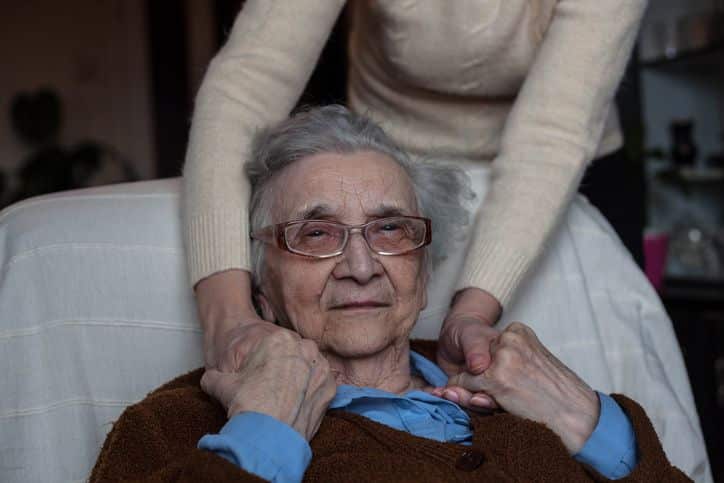
My preconceptions about older people first began to crumble when one of my congregants, a woman in her 80s, came into my office seeking pastoral care.
It is a strange and wonderful feature of my job that I get to be a confidant and advisor to people at all stages of life. She had been widowed for several years but the reason for her distress was not the loss of her husband. It was because she had fallen in love with a married man.
As she shared with me her story over a cup of tea and Kleenex, I tried as much as possible to keep a professional and compassionate countenance, though, internally, I was bewildered by this realization that people still fall in love in that teenage, butterflies-in-the-stomach kind of way even into their 80s.
I have a great privilege of working with people who are double and even triple my age. This is not the case for many as the economic structure and workforce are stratified in that people are employed within their own demographics.
But because I am a minister in a mainline denomination with an aging base, the people I primarily interact with are over the age of 60.
I came into my job assuming that I, a Korean-American woman in my mid-30s, would not be able to connect with these people from a completely different racial and cultural background. It did not take long for me to discover how very wrong I was.
We all have joys, hopes, fears and longings that never go away no matter how old we get. Until recently, I mistakenly associated deep yearnings and ambitions with the energy and idealism of youth. My unconscious and unexamined assumption was that the elderly transcend these desires because they become more stoic and sage-like over time. Or the opposite: they become disillusioned by life and gradually shed their vibrancy and vitality.
The initial realization that my assumptions might be wrong set me on a trajectory of further researching the internal lives of older people. Using my congregation as a resource, I interviewed several members in their 90s with a pen, notebook, a listening ear and a promise to keep everyone anonymous.
The interviews
I did not hold any of my curiosity back and asked them my burning questions about their fears, aging, sex lives or lack thereof. Fortunately, I had willing participants, many of whom were flattered that I was so interested in them as American society tends to pay less attention to people as they age.
I began each conversation by asking if they had any regrets. By this point, they have lived long enough to look at their lives from a very broad perspective so I knew their responses to this question would be insightful.
Most of their regrets revolved around their family and how they wish relationships, usually either with their children or between their children, turned out differently.
These relational fractures, I could see on their faces, still caused them much pain and sorrow. One of my interviewees has two children who have not seen or spoken to one another for over two decades. She lamented that this, among all the mistakes and regrets she could bring to mind, was the singular thing that kept her up at night.
I then moved onto the topic of the happiest times of their lives. Every single one of these 90-something-year-olds, all of whom are widowed, recalled a time when their spouses were still alive and when their children were younger and living at home.
As a busy young mom and working professional who frequently fantasizes about the far away, imagined pleasures of retirement, I quickly responded, “But weren’t those the most stressful times of your lives?” To which they all agreed. There was no hesitation though, that those days were also the happiest.

Mary Pipher has a radical idea: that you can age with joy.
A clinical psychologist and cultural anthropologist out of Lincoln, Neb., Pipher is perhaps best known for her 1994 book, a guide to girldom called Reviving Ophelia: Saving The Selves of Adolescent Girls.
She’s now doing the same for her own demographic in the latest of her 10 books, Women Rowing North: Navigating Life’s Currents and Flourishing As We Age, published out this week.
Think of Women Rowing North as a GPS for navigating your later years. And while Pipher, 71, says she wrote it specifically for women crossing from middle age to old age, there is much in the book that is useful for any of us.
Women face a lot as they get older: harmful cultural stereotypes, ageism, misogyny, to name a few. But Pipher urges us to remember we have the capacity to make it a better journey.
“Women in their sixties and early seventies are crossing a border,” she writes. “And everything interesting happens at a border.”
Here are the five important insights from her latest book that may help you navigate your own journey through getting older.
Depositphotos

“Attitude may not be everything, but it is almost everything,” Pipher writes.
We don’t always have control as we age, she reminds us, but we do have choices over how we deal with it.
Yes, it is the timeless half-full look at our existence, that is not about settling for less, but about seeing the most in what you have in front of you.
“Happiness,” Pipher says, “depends on how we deal with what we are given.”
Books, book groups, travel tour groups, writing, grandchildren, friendships, and family can all be assets to cultivate so that we survive the hard times better.
“Friends are emotional health insurance policies,” she writes, and female friends are the best return on investment for women, helping to define us.
Depositphotos

Our bodies wear out. We have afflictions, heartbreak, hardships, physical, emotional and mental exhaustion from the realities of aging such as caretaking, grief, and unwanted limitations.
“Pain drives us deeper and makes us kinder,” Pipher writes. “It also toughens us up.”
One paradox, Pipher notes, is that at times those who have a terminal illness may see their post-diagnosis lives as particularly joyful.
“Part of what allows us to deeply appreciate our lives and savor our time is our past despair,” Pipher writes.
Never diminishing or abolishing the negative, Pipher advises instead to do a “subject change” in order to shift into positivity.
Volunteering, activism, even taking care of grandchildren can offer purpose and dilute the taint of despair. “Especially when we act together, we can create power out of thin air. “
Acknowledging “our goals can be greater than our energy levels,” Pipher writes, our desire for action should not be seen as another burden.
“None of us has the responsibility to singlehandedly save the world, but we can all do our best under the circumstances,” Pipher writes.
Depositphotos

So many of us know people who tell the same old, same old sad stories, rooted in tragedy, loss and pain. Husbands die, children move away, get angry, disconnect, relationships with friends end, illness or isolation are the new realities.
Yes, these stories can all be very true and an accurate account of our existence. But is it the only story?
Instead, we can “train ourselves to think in stories that allow us to flourish,” Pipher writes.
The true story of hardship and obstacles can be re-told as a story of resilience and of lessons learned, a way to reshape ourselves.
“Grant ourselves mercy,” Pipher writes.
And while we are reframing our own stories, we can also reframe the story of aging that society enforces and that minimizes everyone of a certain age.
“We can take responsibility for educating other people about the negative stereotypes and the reality of our lives,’ Pipher says.
Depositphotos
The older we get, the more we deal with death. A death positive movement is making hospice more accessible and accepted as is the idea of telling the whole truth to patients who are dying, keeping them informed of what is happening to them.
More people speak about and prepare openly for the end of life. While every death is sudden, it doesn’t have to be feared for ourselves or for those we love.
“Losing a loved one is rather like being in a bad storm, often we discover surprising reserves of strength and courage,” Pipher writes.
This is not to say we shall not mourn each loss on our own timeline and at our own pace, but as we will each face dying, we do not have to look at it with fear.
Depositphotos
As we age, we gain perspective, hopefully, a forgiving one of ourselves. It is not about denial, but it is about honesty.
You can be more self-aware and become more authentic as you grow older. She advises to say no when it serves you and to “say yes to your own needs” when you can.
Keeping a “circle of kin strong and vital” while maintaining partnerships and friendships that allow you to be your true self will help you appreciate who you are in the greater world, allowing others the chance to shine as well.
Pipher writes, “We need to sort out what we truly desire and then go for it.”
This article originally appeared on Considerable.com and was syndicated by MediaFeed.org.
Depositphotos

Nasty financial surprises that could derail your retirement
Related:
Tinpixels
“The U-bend of Life”
Their responses intrigued me as it contradicted the well-known article on happiness in The Economist that went viral in 2010, “The U-bend of Life”.
This was a common topic of conversation among my family and friends during this time as it had a particular resonance with people in both its counter-intuitive yet completely reasonable analyses.
The theory of the U-bend came about as researchers discovered consistent findings from independent research projects on happiness and well-being all over the world.
That is, happiness, pleasure and enjoyment are most tenuous during the middle-ages of life, starting in the 20s with depression peaking at 46, which the author described as “middle-age-misery.”
The happiness of peoples’ youth however, not only returned but were experienced in higher levels in their 70s.
Researchers hypothesized that middle-age-misery was due to the overwhelming number of familial, professional and financial demands during these years and that people became more self-accepting, less ambitious and more mindful of living in the present moment instead of the future as people approached their 70s.
My interviewees’ contradicting thoughts on the happiest times of their lives led me to reflect upon the complex nature of happiness and possibly the changing understanding of happiness as people age. When we are younger, perhaps we think of happiness as a feeling than a state of fulfillment, meaning or abundance, which my interviewees were associating it with.
Regardless, their responses came as a sobering reminder for me to fully appreciate and soak in these chaotic days of diaper changes, messiness and minimal me-time. They may just end up being my happiest times.
Love, family & relationships
Another subject I was dying to know about was if their spouses of many decades were the loves of their lives. As it turns out, this was true for some and not for others. In both cases, it did not keep them from trying to make their marriages work.
I got the sense from what they were sharing that after they had children, their marriages became much less important to their happiness than the overall nuclear family dynamic.
This focus upon the family unit, however, did not mean that their desire and passion went away. They still longed to be wooed and pursued. They still experienced intense attraction to people who were not their spouses and continue to experience intense attraction for other people to this day.
Of course, sex becomes more tiresome, but the desire for companionship is as present as it was during the height of their youth.
On beauty and aging
My interviewees’ thoughts on beauty and their aging bodies were also varied in that their changing physical appearances only mattered insofar as it mattered to them when they were younger.
Those who were valued for their good looks or athleticism experienced much more grief in regards to their current bodies than those who derived confidence from admirable qualities that were much less time-fixed.
A great example of this is one interviewee who was well-known in her community for being a writer and columnist in local newspapers. When I asked her if she was saddened by her aging appearance, she responded, “Well, I never thought I was pretty to begin with so, no.”
The ones who did experience greater negative emotions about aging though, shared that the peak of that grief occurred in their 70s and has diminished since then.
It’s not the death, it’s the dying
The same woman who told me she wasn’t bothered by her aging appearance also shared with me that she wasn’t afraid of death but of dying. I found this to be a profound distinction.
She believed in an afterlife, as one might expect given that she is a church member. She had an assurance that she would, in one way or another, be well taken care of after her time here came to an end.
She is still very physically and mentally healthy so it was that final leg of her journey that worried her. Would she be restricted to a hospital bed, just a mess of tubes and needles? Would she still recognize family and friends? Would she be in constant pain?
Being old didn’t bother her until it affected the quality of her life in an incredibly detrimental way. In fact, being old, she shared, brought a lot of advantages: more time, more perspective, less hustling to be the best and most successful and urgency to strengthen the important relationships in her life.
On accomplishments
This radical relational orientation of all my subjects caught me by surprise. As someone who is entering the height of my career, I expend much more energy on my work than my relationships.
And when I imagine my future, I envision what I will have accomplished rather than what my relationships will be like. These 90-something-year-olds emphasize the opposite when they look back on their lives.
Their joys and regrets have nothing to do with their careers, but with their parents, children, spouses and friends. Put simply, when I asked one person, “Do you wish you accomplished more?” He responded, “No, I wished I loved more.”
My conversations challenged me. I certainly won’t be giving up my job to hang out with my family more because I also recognize that satisfying careers and financial stability are great sources of fulfillment, which in turn, affect family well-being. But these different perspectives helped me to focus on what really matters in the face of competing responsibilities and priorities.
That sermon really does not have to be the best sermon in the world when my son is starving for my attention. My husband really does not need to get the highest-paying job he can find if that means I can spend more time with him.
However, the biggest impact they left on me was not reprioritization but being OK with aging. I confess that prior to my conversations, I had an intense fear about growing old.
This, I realize, was what motivated me to begin this research in the first place. I assumed the elderly lost their vibrancy and thirst for life. That couldn’t be further from the truth. They still laugh like crazy, fall in love like mad, and pursue happiness fiercely.
This article originally appeared on Considerable.com and was syndicated by MediaFeed.org.
More from MediaFeed:
20 exercises you can do at home to pump up aging muscles

Regular physical activity is one of the most important things you can do for your health as an older adult. Not only can it help to prevent many health problems that often come with age, it helps to keep your muscles stronger so day-to-day activities are easier.
While the Centers for Disease Control recommends at least 150 minutes of moderate aerobic activity each week for older adults, it’s important to remember that some physical activity is better than none at all, so do what you can. But the benefits usually increase with the more physical activity that you do.
The following 20 exercises are for seniors to help strength and balance.
All exercises can be done without weights and with minimal movement.
If
you are new to exercise, start with no more than 5 repetitions for each
exercise to relieve pressure on your ligaments and tendons. If you have health conditions, it’s important to understand how they might affect your ability to do regular physical activity safely. Talk to your doctor before beginning any new workout regimen.
Wavebreakmedia/istockphoto

1. Stand up straight and tall.
2. Raise your arms to shoulder height.
3. Place your feet hip’s width apart and point them straight ahead.
4. Feel most of your weight on your heels.
5. Slowly squat down to a comfortable depth, without slumping your
back.
6. Slowly squat down to a comfortable depth
7. Keep your back firm, without slumping.
8. Slowly stand back up straight and tall to beginning position.
Kirk Charles

1. Sit on the edge of a chair.
2. Lean back on the chair.
3. Extended your knees.
4. Keep your heels on the floor with toes point upward.
5. Kick your right knee up as high as possible.
6. Extend it back to the ground/floor.
7. Then kick your left knee up as high as possible.
8. Extend it back to the ground/floor.
Kirk Charles

1. Lie flat on your back.
2. Keep your hips and shoulders firmly on the ground.
3. Keep your feet together.
4. Raise your left leg as high as possible.
5. Keep you left knee bent with your hips firmly on the ground.
6. Lower your left leg back to the ground.
7. Repeat steps 4-6 with your right leg.
Kirk Charles

1. Lie on your back.
2. Bend your knees.
3. Keep your feet flat on the floor/ground.
4. Raise your hips as high as possible.
5. Keep both shoulder blades flat on the ground.
6. Lower your hips down to the ground to starting position.
Kirk Charles
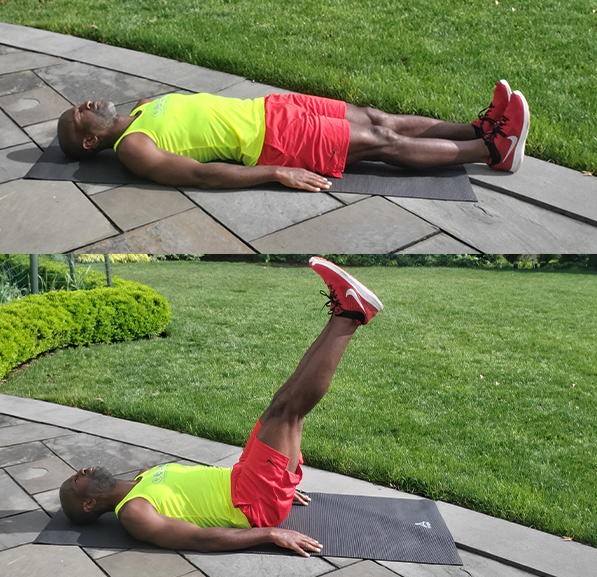
1. Lie flat on your back.
2. Keep your hips and shoulders firmly on the ground.
3. Keep your feet together.
4. Raise both legs up to the sky.
5. Keep your feet together.
6. Keep your knees extended as much as possible.
7. Lower your legs back to the ground.
8. Repeat steps 4-7.
Kirk Charles

1. Lie on your back.
2. Bend your knees.
3. Keep your feet flat on the floor/ground.
4. Raise both knees as high as possible.
5. Keep your knees bent.
6. Lower your feet back to the ground to starting position.
7. Repeat steps 4-6.
Kirk Charles

1. Kneel on hands and knees.
2. Keep your hands under your shoulders.
3. Keep your knees under your hips.
4. Raise your left arm and right leg fully extended.
5. Lower your left arm and right leg back to starting position.
6. Raise your right arm and left leg fully extended.
7. Lower your right arm and left leg back to starting position.
8. Repeat steps 4-7.
Kirk Charles
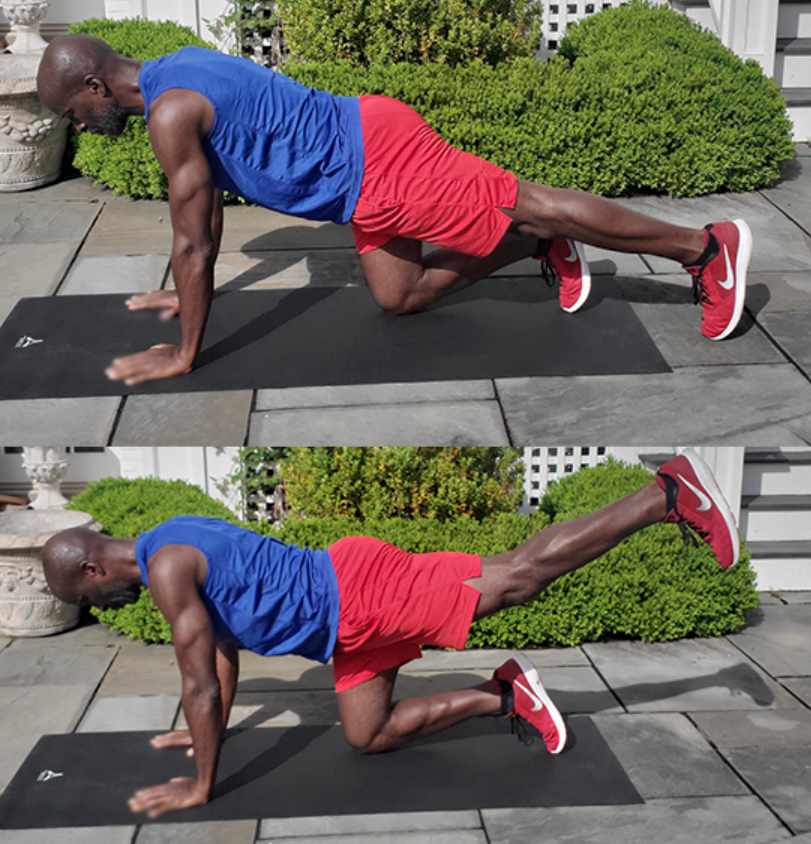
1. Kneel on hand and knees with left leg fully extended.
2. Keep your left toe on the ground.
3. Keep hands directly underneath shoulders.
4. Raise your left leg toward the sky.
5. Keep your left knee fully extended with your left leg as straight as
possible.
6. Bring your left toe back to the ground.
7. Repeat steps 4-6.
Kirk Charles

1. Kneeling position with palms on the floor.
2. Knuckles should be directly below the eyes.
3. Knees should be hip’s width apart.
4. Raise knees off the floor to a plank position.
5. Bring knees back down to the floor to the starting position.
6. Repeat steps 4 and 5.
Kirk Charles

1. Sit in a chair.
2. Knees at a 90-degree angle.
3. Feet flat on the floor.
4. Raise your left foot by extending your left knee.
5. Bring your left foot back to the floor to starting position.
6. Raise your right foot by extending your right knee.
7. Bring your right food back to the floor to starting position.
8. Repeat steps 4-7.
Kirk Charles

1. Sit on the floor.
2. Keep your back firm (don’t slump) and lean back slightly.
3. Keep knees bent at a 90-degree angle.
4. Keep heels on the floor with toes pointing up.
5. Place hands on hamstrings for back support.
6. Raise your left foot by extending your left knee.
7. Bring your left foot back to the floor to starting position.
8. Raise your right foot by extending your right knee.
9. Bring your right foot back to the floor to starting position.
10. Repeat steps 6-9.
Kirk Charles
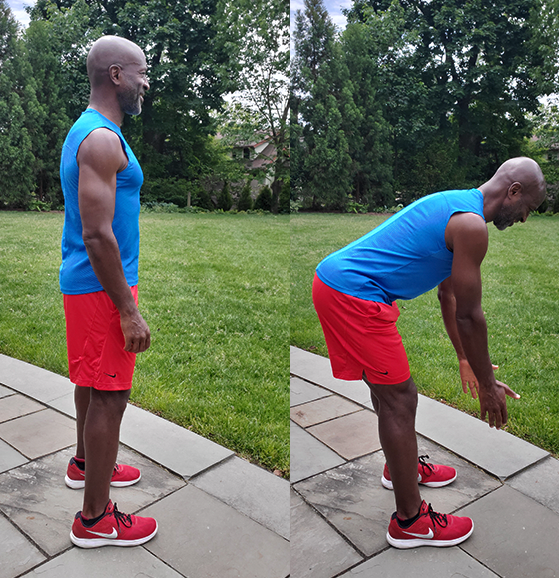
1. Stand straight up.
2. Feet shoulder width apart.
3. Arms hanging at the side.
4. Bend over by hinging at the waist.
5. Do not slump the lower or upper back.
6. Arms hanging gently toward the floor.
7. Stand back up to starting position.
8. Repeat steps 4-7.
Kirk Charles

1. Stand with your feet shoulder width apart.
2. Raise your arms to shoulder height.
3. Bend your elbows to 90-degrees.
4. Lower your hands to shoulder height, while keeping your elbow high.
5. Raise your arms back to starting position.
6. Repeat 4 and 5.
Kirk Charles

1. Stand tall with feet shoulder width apart.
2. Let your arms hang gently at your side.
3. Palms are pointing toward each other.
4. Raise arms forward until hands point upward toward the sky.
5. Lower arms back to your side to starting position.
6. Repeat steps 4 and 5.
Kirk Charles

1. Stand tall with feet shoulder width apart.
2. Raise your arms to the side at shoulder width height.
3. Bend you elbows 90-degrees with palms facing downward.
4. Keep your hips stable while rotating your shoulders to the left.
5. Rotate your shoulders in the opposite direction to the right.
6. Repeat steps 4 and 5.
Kirk Charles

1. Lie on your back.
2. Raise your hands to gently touch your head.
3. Bend your knees.
4. Keep your feet flat on the floor/ground.
5. Raise your head and shoulders off the floor/ground.
6. Lower your back and head toward the floor/ground.
7. Repeat steps 5 and 6.
Kirk Charles

1. Stand tall with feet shoulder width apart.
2. Let your arms hang gently at your side.
3. Raise your left knee and right arm.
4. Lower them back to the floor/ground.
5. Raise your right knee and left arm.
6. Lower them back to the floor/ground.
7. Repeat steps 3-6.
Kirk Charles

1. Kneel on hands and knees.
2. Keep your hands under your shoulders.
3. Keep your knees under your hips.
4. Raise your right arm straight forward.
5. Lower your right arm back to the floor/ground.
6. Raise your left arm straight forward.
7. Lower your left arm back to the floor/ground.
8. Repeat steps 4-7.
Kirk Charles
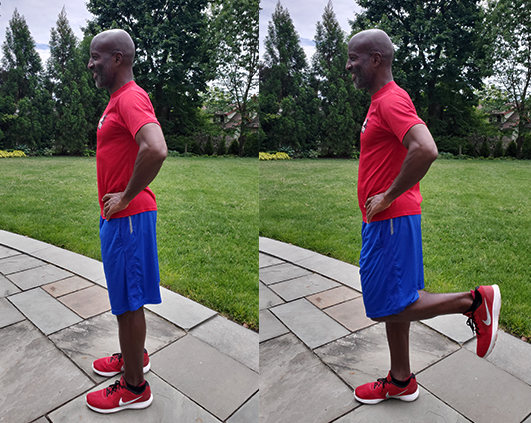
1. Stand tall with feet shoulder width apart.
2. Place hands on hips or let your arms hang gently at your side.
3. Flex your left knee and raise your foot backward.
4. Lower your left foot back to the floor/ground.
5. Flex your right knee and raise your foot backward.
6. Lower your right foot back to the floor/ground.
7. Repeat steps 3-6.

1. Stand with feet shoulder width apart.
2. Raise arms to shoulder height with palms facing each other.
3. Swing arms backward as far as possible.
4. Bring arms back to shoulder height.
5. Repeat steps 3 and 4.
Kirk Charles is a Certified Personal Trainer and Corrective Exercise Specialist with the National Academy of Sports Medicine; a Group Exercise Instructor with the Aerobics & Fitness Association of America; and a Certified Golf Fitness Instructor with the Titleist Performance Institute. He has authored a self-empowerment book, Live in the Power Zone; and he has developed a unique and exciting workout program for those who are in a sedentary profession entitled The 2-Minute Office Workout.
This article was produced and syndicated by MediaFeed.org.
Kirk Charles
Featured Image Credit: EllenaZ / istockphoto.