Raising a child can cost more than $12,000 a year, [1] but many Americans in the “sandwich generation” expect to financially support their parent(s) as well.
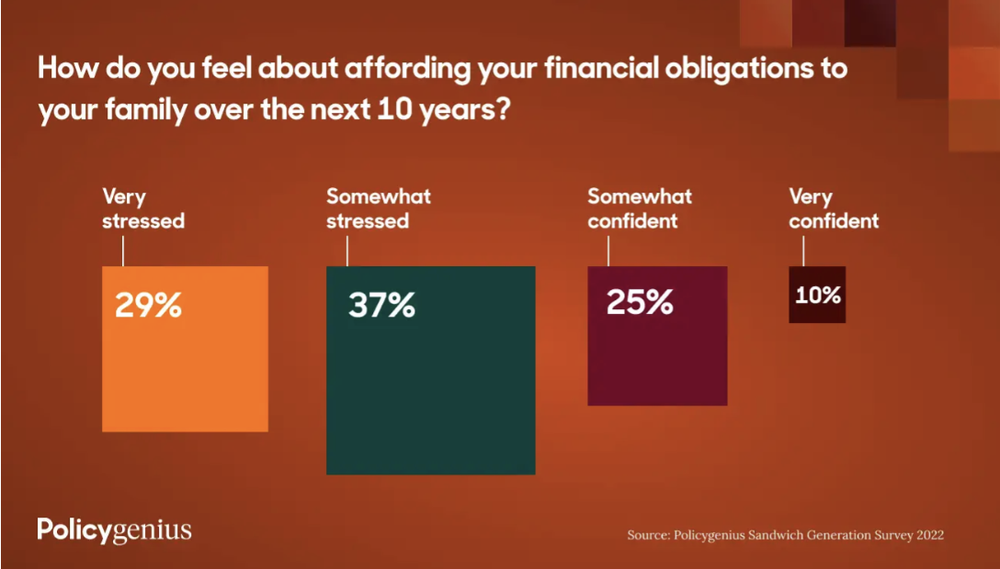
Roughly two out of three members of the sandwich generation (66%) — Americans with at least one living parent age 65 or older who are also raising or financially supporting children — feel “very stressed” or “somewhat stressed” about affording their financial obligations over the next 10 years, according to the Policygenius Sandwich Generation Survey.
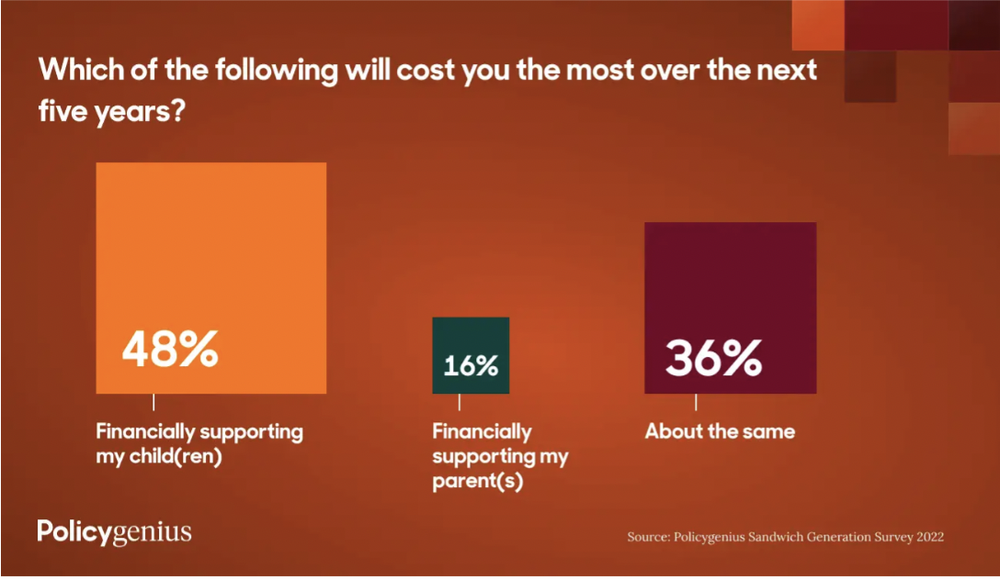
And as expensive as raising children can be, over half of the sandwich generation (52%) expects supporting their parent(s) will cost just as much — or even more — than their kids over the next five years.
Key findings
-
66% of the sandwich generation is either “very stressed” (29%) or “somewhat stressed” (37%) about affording their family’s financial obligations over the next 10 years.
-
More than half (52%) expect supporting their parent(s) will cost just as much or even more than supporting their children over the next five years.
-
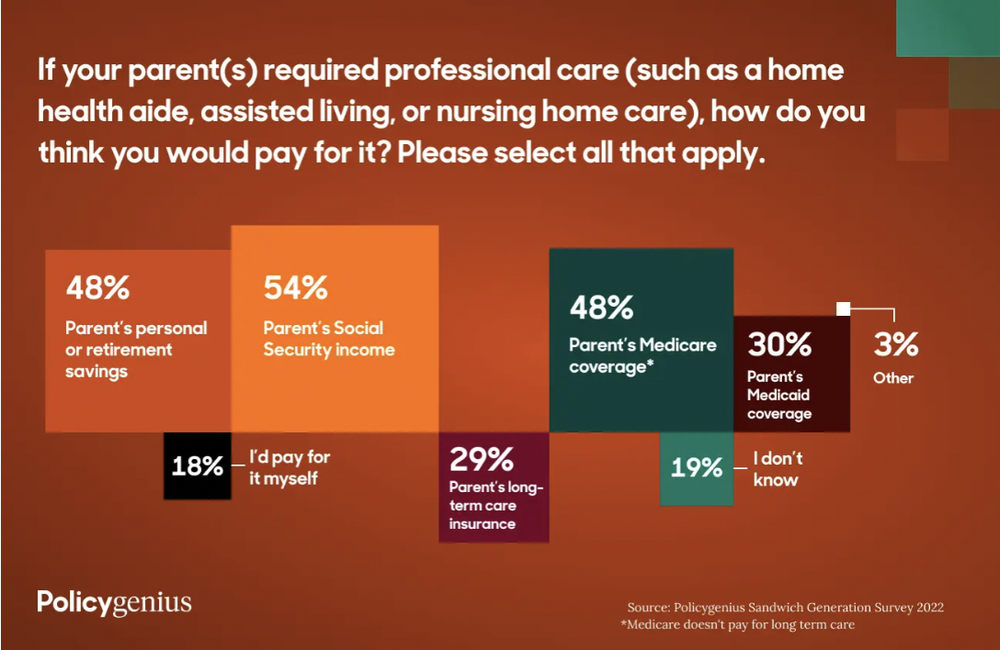
When asked how they would pay for long-term care for their parent(s),
-
48% said they would use Medicare — even though Medicare doesn’t pay for long-term care,
-
18% said they would have to pay for it themselves,
-
and 19% said they don’t know how they’d pay for it.
-
-
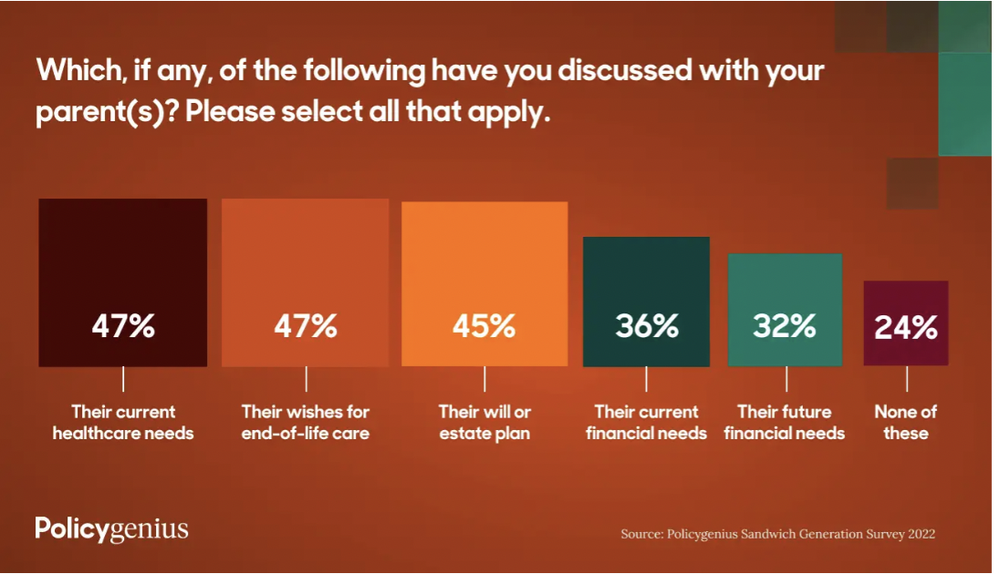
24% haven’t discussed financial needs, health care needs, a will, end-of-life care wishes, or estate planning with their aging parent(s).
-
49% don’t have life insurance to help financially support their loved ones after they die.
-
For many, supporting parent(s) will be just as costly as supporting kids
Many sandwich generation members expect to financially support both their parent(s) and their children. While 36% expect financially supporting their parent(s) will cost just as much as financially supporting their children over the next five years, 16% expect supporting their parent(s) will cost even more.
More than half of the sandwich generation (52%) have provided some kind of assistance to their parent(s) in the past 12 months. For most (73%) of this group, this assistance comes in the form of logistical support like scheduling doctor’s appointments or transportation. 44% have provided financial assistance, and 55% have provided hands-on care, like helping with medical needs, bathing, or eating.
More than half of the sandwich generation is at least somewhat stressed about their financial obligations
The result of these burdens is stress.
“There’s enough complexity when it comes to the typical life goals that an average family would have, like saving for retirement or education for their children,” says Tom Massie, a certified financial planner who focuses on the sandwich generation. Many of his clients know they’ll eventually add supporting parent(s) to the mix, and “there’s a lot of stress and anxiety and uncertainty that comes along with it,” he says.
When asked how they feel about affording their financial obligations to their family over the next 10 years, 37% said they were somewhat stressed, and 29% said they were very stressed.
More than half of the sandwich generation is at least somewhat stressed about their financial obligations
The result of these burdens is stress.
“There’s enough complexity when it comes to the typical life goals that an average family would have, like saving for retirement or education for their children,” says Tom Massie, a certified financial planner who focuses on the sandwich generation. Many of his clients know they’ll eventually add supporting parent(s) to the mix, and “there’s a lot of stress and anxiety and uncertainty that comes along with it,” he says.
When asked how they feel about affording their financial obligations to their family over the next 10 years, 37% said they were somewhat stressed, and 29% said they were very stressed.
Only 29% of the sandwich generation plans to use long-term care insurance for parent(s)
While many members of the sandwich generation expect to provide some kind of support for their parent(s), they don’t have much clarity on how they would pay for it.
For example, when asked how they would pay for professional care like a home health aide, assisted living, or nursing home, 48% said they would use Medicare, the federal health insurance provided to people 65 and older. However, Medicare — and most other forms of health insurance — doesn’t pay for long-term care.
30% said they would use Medicaid, a federal and state program that provides health care for lower-income Americans. But in many states, the income and asset limits are stringent. For example, in North Carolina the monthly income limit for someone 65 or older receive Medicaid is only $1,133 — and you can have no more than $2,000 in assets, not counting your home, car, furniture, clothing, and jewelry.
Long-term care insurance covers these costs, but only 29% of the sandwich generation said they would rely on it to cover professional care costs. How to care for older parent(s) is a significant concern, since 70% of adults who survive to age 65 will develop “severe” long-term service and support needs before they die, while 48% will receive some paid care.
33% of the sandwich generation would take on debt to care for parent(s)
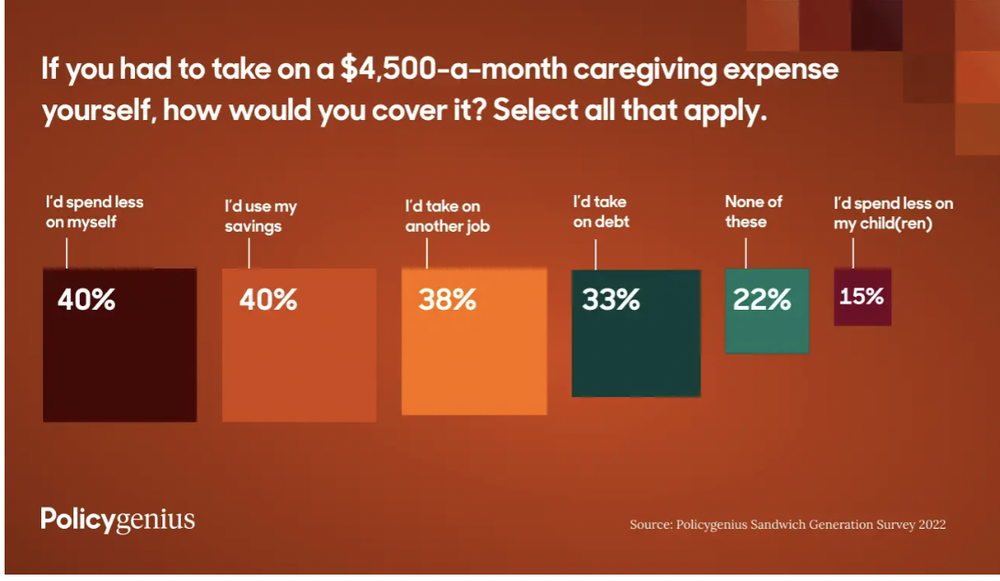
The median cost of an assisted living facility in the U.S. was $4,500 a month in 2021. When asked how they would cover this cost if they had to pay $4,500 a month in caregiving expenses out-of-pocket, 33% of the sandwich generation said they would take on debt. Few people would give up any support for their children — only 15% said they would spend less on their kids to cover this expense.
Only half of the sandwich generation has life insurance
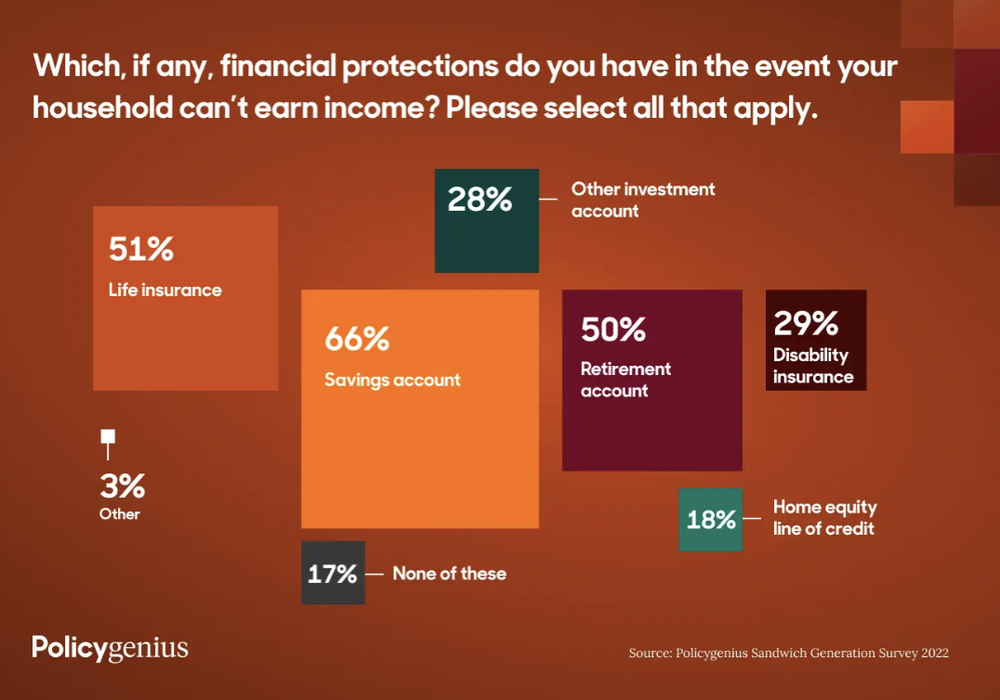
While they’re aware of their looming financial responsibilities, many members of the sandwich generation lack key protections in the event they can’t earn income. For example, 49% of the sandwich generation doesn’t have life insurance. If you die while a life insurance policy is active, life insurance can financially protect your children and your parent(s). (In general, experts say your life insurance coverage should be 10 to 15 times your income.)
In the event their household was unable to earn income, 66% of the sandwich generation have a savings account to rely on, and 50% would draw on a retirement account. Only 29% have disability insurance, which provides a safeguard in case you become too sick or injured to work.
Methodology
Policygenius commissioned YouGov to poll 2,368 Americans 18 or older, of whom 310 confirmed 1) having a living parent age 65 or older and 2) either being the parent or guardian of a child under the age of 18, or giving financial support to an adult child age 18 or older in the last 12 months. Members of this group are referred to as the “sandwich generation” in this report. The survey was carried out online from Nov. 7 through Nov. 9, 2022. The results have been weighted to be representative of all U.S. adults. The margin of error was between +/-3% and +/-6% depending on the question. Percentages were rounded to the nearest whole number, so some totals may not add up to 100.
About Policygenius
Policygenius is the online insurance marketplace combining cutting-edge technology with the expertise of real licensed agents to help people get the coverage they need to protect their family, property, and finances with confidence. Since 2014 we’ve helped over 30 million people shop for insurance and placed more than $150 billion in coverage from our headquarters in New York City and Durham, North Carolina.
This article originally appeared on Policygenius.com and was syndicated by MediaFeed.org.
More from MediaFeed:
- The surprising last meals of notorious death row inmates
- The most craveable hot dogs in America
- The surprising last meals of notorious death row inmates
Like MediaFeed’s content? Be sure to follow us.
Tips for comparing life insurance policies

Life insurance is one way to help protect loved ones.
But, with numerous life insurance choices sold in the U.S. market, it can be challenging to pick which policy to go with. There are plenty of details to keep track of — such as getting insurance quotes, understanding payment options and figuring out coverage.
From selecting a reputable insurance provider to estimating an adequate amount of coverage, navigating various life insurance options may feel like wandering through a labyrinth.
Below are tips for comparing life insurance policies and understanding the insurance buying process.
Related: Strategies for building an investment plan for your child
SolisImages / istockphoto

Before comparing life insurance options, it can be helpful to select the right type of policy. Since choosing the right kind of life insurance policy can be confusing, here are a few guidelines.
DepositPhotos.com

Term life insurance is designed to provide protection for a specific amount of time, usually in 5, 10, 15, 20, 25, or 30 years. Term policies can match the length of time coverage if needed.
For example, if the top priority is providing income for dependents to fund their college, a 20-year policy might be applicable. Perhaps the top priority is the ability for beneficiaries to repay existing debts. In this case, maybe a 25-year policy would make more sense.
One reason buying term life insurance may make sense is if the budget is limited. Generally speaking, term life insurance only pays out if the policyholder dies before the end of the policy term.
One reason buying term life insurance may make sense is if the budget is limited.
So, the rate per thousand of death benefit typically costs less than permanent life insurance policies — which, while more expensive, typically covers a policyholder’s whole life.
With term life insurance, the coverage usually expires when the policyholder lives past the length of the policy. Renewal is possible, but terms and rates may vary based on the applicant’s health and age.
Policyholders who wish to extend their policies may want to contact different providers to determine how lengthening their life insurance terms generally works.
If financial needs change during the term of the life insurance policy, some insurers may offer a convertible policy.
With a convertible policy, policyholders can convert the policy to a permanent policy in exchange for higher premiums. And, with some providers, medical exams are not required for conversion to a permanent policy.
DepositPhotos.com

So, how’s a buyer to recognize the key differences between term vs. whole life insurance?
Permanent life insurance (aka whole life) is designed to provide protection for a policyholder’s entire lifetime.
In other words, the policy will pay a death benefit no matter when the policyholder passes away. For term policies, the benefit is normally paid out only if the death occurs before the end of the covered term.
Permanent life insurance policies may also come with a savings component, which can grow on a tax-deferred basis. Policyholders can use this saving component to borrow funds for a variety of reasons.
The savings component might also be used to pay premiums if making payments on the policy becomes a challenge in the future. Even if a policyholder has less than ideal credit, the funds can still be borrowed against. In that case, the death benefit is considered collateral for the loan.
In practice, this can mean that when a policyholder passes before what’s borrowed against the policy has been repaid, the life insurance company deducts what’s still owed from the beneficiary payout.
There are several other options for permanent life insurance worth, including:
• Whole life insurance. This coverage provides foreseeable lifelong coverage, which includes a fixed premium and death benefit.
• Universal life insurance. This type of coverage provides flexible lifelong protection and several cash accumulation options.
• Variable universal life insurance. This type of coverage offers flexible death benefits and several investment options for the cash accumulation component.
It’s important to note that permanent life insurance is typically more expensive than term life insurance. So, when weighing out the options, the cost might be a crucial factor to calculate.
DepositPhotos.com

There are several different ways to calculate how much coverage is necessary. Some insurers recommend multiplying a policyholder’s salary by 5 to 10 times.
Using a free life insurance calculator can also simplify estimating the cost of different coverages. With online insurance calculators, people shopping for life insurance answer a few questions to estimate the amount of coverage they may need.
Since the 5 to 10 rule of thumb creates results that can vastly vary, it’s essential to account for all the beneficiaries’ anticipated needs. For instance, children may require a higher death benefit than spouse’s because of the anticipated cost of attending college or to cover other educational expenses.
On the other hand, if additional resources or assets are available to the beneficiaries at the time of a policyholder’s passing, a lower coverage amount might make more sense.
When using a life insurance calculator, it’s crucial to include all the debt that beneficiaries or an estate may be responsible for — including shared revolving debt.
It’s important to note that the amount of life insurance coverage that the buyer deems necessary is one major factor that affects how high or low the monthly premiums amounts end up costing.
Kanizphoto / istockphoto

After determining the right type and amount of life insurance coverage needed, it’s time to gather life insurance quotes and decide which insurers to look at.
Searching for insurance companies with established financial histories, strong consumer ratings and flexibility of product offerings may increase the policy value.
With this in mind, here are a few things to chew on when selecting insurance companies.
JackF/istockphoto

Several credit rating agencies produce analyses on the financial health and the claims-paying ability of insurance providers.
Rating agencies look at insurance providers’ overall financial strength and their ability to meet existing insurance obligations (i.e., paying out the benefits).
While no rating is guaranteed, buyers may want to review various companies’ ratings when researching who to seek a life insurance quote from.
For example, A+ and A++ are A.M. Best’s superior ratings — representing companies that, according to the agency’s analyses, have shown an exceptional ability to meet their insurance obligations and have evidenced financial strength.
istockphoto/fizkes

To obtain a life insurance quote, some providers offer simple online applications. The insurance company can provide an accurate quote by asking potential policyholders to share some personal details — with questions typically covering the applicant’s age, location, gender, health and desired coverage.
Since permanent life insurance policies tend to be more complex, it’s sometimes wise to consult with an agent who can help compare the pros and cons of different life insurance policies.
Drazen Zigic/istockphoto

DepositPhotos.com

Life insurance providers’ underwriters generally determine the cost of each policy. The underwriters look at numerous factors, including applicants’ age, health condition and medical history, to determine the risk for taking on the contract.
While each provider may use similar methodologies, costs can vary depending on the amount of coverage they are willing to give and the price paid by the policyholder.
But, again, the value of the company and the services offered can also play a role in how much a policy may cost.
So, while aiming to get the lowest monthly bill may seem like the right solution, it’s wise to evaluate if that lower-priced option can provide the desired coverage over the life of the policy.
Julia_Sudnitskaya / istockphoto

Customization is one additional factor that people shopping for life insurance may want to keep in mind. Since no two policyholders have the same financial goals or coverage expectations, some insurers offer policies designed to match a given applicant’s specific needs.
For example, insurers may offer different riders or payment plan options to make each policy more customizable to the policyholder’s goals. Insurers who offer more flexibility might be a better fit for some buyers.
DepositPhotos.com

Buying life insurance from a company that offers a wide range of products is not only a convenient way to shop for insurance, but it may help policyholders to save money. Insurance companies at times offer discounts for bundling multiple insurance policies together.
People shopping for life insurance can review the other products each insurance company offers to determine if buying a specific insurer’s bundled policies can save time, money and the potential hassle of working with more than one provider.
For instance, it may be possible to bundle life insurance alongside automobile or rental insurance.
zimmytws/istockphoto

Since permanent life insurance has a cash value component that can grow over time, it’s important to factor this trait when comparing each policy’s potential value. Although low-cost policies may seem like an attractive option, they may not provide as much coverage over the policy’s life.
For buyers who prioritize cash value and dividend distribution, picking a life insurance policy that offers either or both features may be a good choice. But, keep in mind: Policies with higher dividend payouts are, typically, more costly each month.
William_Potter / istockphoto

While it’s possible to buy life insurance online, sometimes, it’s wiser to contact an insurance agent. Because different life insurance products come with varying fine print details, an insurance agent could help buyers grasp the key differences between policies and products. Buyers can also ask them any lingering questions.
And, an agent who is well versed in the product’s details can explain important distinctions like cost, coverage limits, varying terms, etc. It’s worth recalling that any insurance agents are paid on commission.
Before a buyer consults with an insurance agent or broker, it can be a smart idea to hone in on exactly how much life insurance is needed and what budget exists to pay for it.
SeventyFour / istockphoto

Life insurance can be one part of financial planning for the future. Comparing life insurance policies may help ensure that loved ones are appropriately protected if a policyholder passes away.
Learn more:
This article originally appeared on SoFi.com and was syndicated by MediaFeed.org.
Ladder Life term life insurance policy made available through Ladder Insurance Services, LLC (Ladder) and underwritten by Fidelity Security Life Insurance Company, Kansas City, MO. Product availability and features may vary by state. Not available in New York. The California license number for Ladder is OK22568. Policy Form No. ICC17-1069, M01069, Policy No. TL-146.
External Websites: The information and analysis provided through hyperlinks to third party websites, while believed to be accurate, cannot be guaranteed by SoFi. Links are provided for informational purposes and should not be viewed as an endorsement.
Deposit Photos
Featured Image Credit: Depositphotos.com.