Being a small business owner means wearing multiple hats. From CEO to social media manager — you can do it all. However, if you don’t have a solid understanding of small business finances and taxes, it may be in your best interest to employ a tax professional.
When tax season arrives, consider partnering with an accountant who can get the job done while you focus on running a successful business.
And in doing so, you might wonder, “What do I need to give my accountant for small business taxes?” Read on to learn about the 13 things you need to give your accountant to file your small business taxes.
We even include a small business tax preparation checklist at the end to help you keep track of every document! Take a look at the 2023 tax dates to see when you need to give them to your accountant.
1. Identification information
Your accountant will need personal information to file taxes on behalf of your small business. Here are some of the identification documents you will share with them:
- Social Security Number (SSN): Share the SSNs of yourself, your spouse, and any dependents. Also, include everyone’s full legal names.
- Employer Identification Number (EIN): If your business has an EIN, share it with your accountant. You can find your EIN in previous tax returns.
- Driver’s license (ID): Although not always necessary, consider sharing copies of your ID as well as your personal and professional permanent addresses.
If your small business has other employees, you may need to gather their personal information, and share it with your accountant.
2. Tax return
For optimal small business tax preparation, share a copy of last year’s tax return with your accountant. Although this form is not necessary, the tax return can help your accountant get familiar with the financial health of your business.
The tax return can also inform your accountant of what tax deductions your small business may qualify for and help expedite the preparation of this year’s tax return.
3. Financial statement
A financial statement communicates the financial health of a business.
Here are some essential financial statements:
- Cash flow statement: This summarizes how well your company manages its cash position and how well the company generates cash to pay its obligations or fund its expenses.
- Balance sheet: This shows a company’s assets and liabilities as well as the owner’s equity during a specific period.
- Income statement: This focuses on your company’s revenue streams and expenses over a particular period.
- Profit and loss report: This report states the earnings, revenue, and losses your business experiences in a year.
Because your company’s financial statement provides you with a formal record of all financial activities, it’s a necessity during tax time to ensure the accuracy of your taxes.
4. Relevant tax forms
Every business type requires you to fill out different tax forms. The forms you need to file for each business type are:
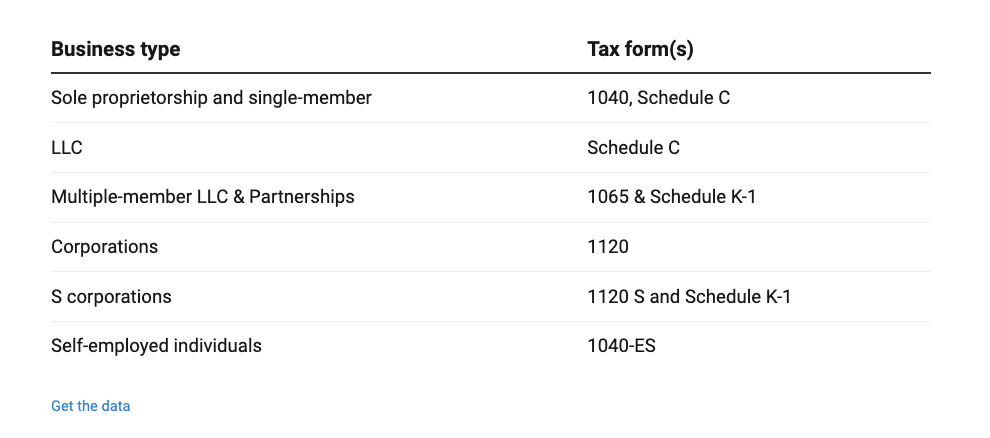
Once you understand which category your small business falls into you can begin business tax preparation by filling out the appropriate tax forms.
5. Capital-asset activity
A capital asset is an asset that benefits your business for more than one year. It’s typical for a business to have many assets, both tangible and intangible.
During the year, if you traded, bought, or sold any capital assets owned by your business, you’ll need to account for these transactions on your tax return.
Here are examples of capital assets that you will share with your accountant:
- Land: Any property that your business has owned for over a year
- Equipment: This includes research and development equipment
- Buildings: Any structures that your business has owned for over a year
- Vehicles: Any vehicles your business has owned for over a year
- Copyrights: An intangible asset that you are responsible for documenting
- Patents: Active and inactive patents need to be a part of your tax return
- Trademarks: An intangible asset that you are responsible for sharing
The sale of a capital asset results in capital gain or loss. If you use small business tax accounting software, print out any capital-asset activity, so your accountant has the details necessary to file an accurate tax return.
6. Business loan information
Share any documents that state how you fund your business. Give your accountant small business loans and applicable grants in the form of:
- Business loan invoices: Show any proof of receiving a business loan.
- Funding receipts: Show any proof of receiving grant funding
- Accrued interest statements: Show any statement of interest.
- PPP loans: Share any evidence of recieving through the CARES act.
Provide as many records of payment, reimbursements, and receipt of funds as possible with your accountant to ensure an accurate tax return.
7. Income records
When paying taxes as a small business, it’s important to share any documents that show how much income your business made in the preceding year.
This can include:
- Bank statements: Share your most recent bank statement.
- Deposit slips: Share deposit slips from the year prior.
- Sales invoices: Share any invoices from the year prior.
Consider digitizing your income records and other financial documents to expedite the small business tax filing process through automatic business reporting services.
8. Expense records
Along with your income records, documents that record your yearly expenses need to also be shared with your business tax accountant. You can generally find expense records like credit card statements on your online banking portal. You can also utilize software that automatically tracks expenses for your business.
Expense records can include:
- Receipts: Share as many receipts as possible, from office supplies to new machinery.
- Bills: Share copies of the bills you paid in the year prior.
- Credit card statements: Share your most recent credit card statements.
Some accountants will ask for your original receipts, including indirect and direct expenses, while others will only want a summary of expenses. Check with your accountant to see which they prefer, and compile your documents prior to scheduling a meeting.
9. Potential deductions
One of the best things about hiring a tax accountant is that they can help you find new tax deductions that your small business qualifies for. In order for them to find these deductions, you’ll need to share the following information:
- Home office expenses: If you work from home, you can deduct a part of your living expenses.
- Business vehicle mile log: If you drive for work, you can deduct that mileage.
- Business travel expenses: If you travel for business, you can deduct flights.
- Charity contributions: Your charitable contributions are tax-deductible.
- Health insurance: You can deduct how much you spend on health insurance.
- Utilities: Your monthly utilities for your business are tax-deductible.
- Marketing materials: You can deduct anything you spend on marketing
- Legal fees: Deduct any fees spend on legal services
For optimal results, share any documents that have a chance of qualifying as a deduction. Speak with your tax accountant if you are unsure about which expenses will meet the mark.
10. Payroll information
Send your business tax accountant your payroll data as well as any pertinent employee information, like their full names and SSNs. Here are tax forms that you should include:
- W-2s: This shows the amount of taxes withheld by your employer.
- W-3s: This is how employers report income to the IRS.
- 1099-MISCs: This form is how you report contractor income.
Let your tax professional know what kinds of employees your small business has, like contractors, full-time, and part-time employees, so they know how to properly fill out your tax return.
11. Inventory information
If your small business does a yearly inventory check, be sure to share the inventory data with your tax accountant. It may be in your best interest to complete a fresh inventory check before submitting your tax return.
You will also need to include a copy of cost of goods sold (COGS), a document that shows how expensive it is to produce your goods and services.
12. Investment Information
Make sure to share any income your business earns from investments and appreciation of the following asset classes:
- Stocks: Share any stocks your business owns shares of.
- Bonds: Share any bonds that are in your professional business portfolio.
- Real estate: Share any investment properties that your business owns.
- Cryptocurrency: Share the amount of cryptocurrency your business owns.
Even if your business did not benefit from appreciation or earn money from your investments in the preceding year, it’s still important to let your accountant know which assets your business invests in for future tax returns.
13. Mortgage interest and property taxes
If you work from home or operate a business from your residential property, you can claim this amount on your tax return. Calculate how much of your home is dedicated to business operations and claim the same percentage when you file your taxes.
A 1098 form can showcase the property tax and mortgage interest amount that you plan on claiming. Give these to your accountant even if you operate a home business for only part of the year.
What do I need to give my accountant for small business taxes? You now know the essential 13 documents that will help your accountant file your taxes on your behalf.
Ensure you prepare the right forms for your business type and talk to your accountant about possible deduction opportunities.
Before you hand off these documents to your small business tax accountant, double-check the 2023 tax dates to ensure you’re hitting the right deadlines.
This article originally appeared on the Quickbooks Resource Center and was syndicated by MediaFeed.org.
No degree, no worries: 9 high-paying jobs that don’t require a college degree

Many people believe you must have a college degree to land a secure, high-paying job and build a successful career. However, going to college can be expensive in its own right and require taking on significant debt.
That’s why it may be wise to consider the rewarding and well paying jobs that are possible without a degree. Instead of requiring an associate’s or bachelor’s degree, these careers often vet interested candidates through a certificate program, an apprenticeship, and on-the-job training.
Read on to learn about nine careers that pay well but don’t require a college degree.
Anchiy/istockphoto

Though it may appear as a niche industry, there are approximately 23,200 people employed as elevator and escalator installers and repairers in the United States.
To enter the field, the National Association of Elevator Contractors offers two types of certification: Certified Elevator Technician (CET) and Certified Accessibility and Private Residence Lift Technician (CAT). Completing CAT Education Program involves two years of coursework and paid on-the-job training, whereas the CET Education Program is a four-year program.
Both programs require applicants to be at least 18 years of age and possess a high school diploma or equivalent.
Although the training and certification requirements parallel the time it takes to earn an associate’s or bachelor’s degree, this field has some of the best jobs without a degree from a financial standpoint. In the most recent survey, the median salary for elevator technicians was $97,860, according to the U.S. Bureau of Labor Statistics (BLS). (Learn more at Personal Loan Calculator).
THANATASDcom/istockphoto

Obtaining a bachelor’s or associate’s degree in computer science or a related field are common paths to computer programmer jobs. However, it’s still possible to forgo a formal degree program to enter this career path with the right skills and knowledge of programming languages, such as Java, Ruby, and Python.
There are a variety of platforms offering free coding classes for beginner and experienced programmers, including Coursera, Udemy, Codecademy, and edX. In some cases, these courses are drawn directly from top universities.
With a median salary of $93,00, computer programming is one of the top-earning jobs without a degree.
dima_sidelnikov/istockphoto

There are several levels of certification for pilots, ranging from recreational purposes to a career flying commercial and passenger aircraft. Becoming a commercial pilot requires a high school diploma or equivalent and a commercial pilot’s license from the Federal Aviation Administration (FAA).
The commercial pilot certification process involves a minimum of 250 hours of flight time in varying conditions and in-depth training requirements.
Commercial airline pilots are able to operate charter flights, rescue operations, and aircraft used in large-scale agriculture and aerial photography. To work for an airline, such as Delta or JetBlue, pilots generally need a bachelor’s degree and an Airline Transport Pilot (ATP) certificate.
The median annual wage for commercial pilots was $134,630. This is competitive with many of the highest paying jobs out of college.
Maravic/istockphoto

Looking for high paying jobs without a degree or serious mechanical or tech skills? A career in real estate could be an option worth considering.
Every state has its own set of requirements for obtaining a real estate license. Generally speaking, this entails taking a set module of coursework and passing an exam.
Once certified, real estate agents are authorized to help clients buy, sell, and rent real estate for a sponsoring broker or brokerage firm. Depending on the state, real estate salespersons may also need to complete additional training or work a certain number of years to become a real estate broker.
The median salary for a real estate sales agent is approximately $65,850. (Learn more atHome Affordability Calculator).
Paperkites/istockphoto

The airline industry offers other high-paying jobs, with no degree required. Working as a flight attendant can be a well-paying job that also affords the ability to travel.
Requirements can vary somewhat between airline carriers, but some universal qualifications include being at least 18 years old, passing a background check, and holding a valid passport.
Flight attendants may also need to pass physical and medical evaluations and meet certain vision and height requirements based on the airline.
Once hired, flight attendants will complete training with the airline, which typically runs from three to six weeks. Training can cover emergency procedures, first-aid, and soft skills related to customer service.
The median flight attendant salary was $61,640.
Akarawut Lohacharoenvanich/istockphoto

Instead of finding a job that pays for your college degree, how about getting paid for learning on the job? Through paid apprenticeship and education programs, that’s exactly what most electricians do to begin their careers. Typically, apprenticeships span four to five years and include a combination of classroom instruction and paid on-the-job training every year.
Rules for electrician apprenticeship programs vary by state and location. A handful of industry groups, such as Independent Electrical Contractors and the National Electric Contractors Association, provide resources for finding apprenticeship programs.
Electrician earnings are impacted by specialization and location, but the median wages for the industry totaled $60,040.
andresr/istockphoto

Installing and repairing piping and plumbing fixtures can be counted among jobs that pay well without a degree. Plumbers accounted for 469,000 people in the workforce.
The path to becoming a plumber parallels the apprenticeship and training requirements for electricians. A standard plumber apprenticeship spans four to five years and 2,000 hours of on-the-job training and classroom coursework. In most cases, a high school diploma or its equivalent is required to be accepted into a program.
Apprentices can be sponsored by plumbing companies or trade unions. This map , managed by Explore the Trades, is a helpful tool to find apprenticeships by state in plumbing, HVAC, and electrical professions.
Plumbers can be called in on evenings and weekends to respond to emergencies, such as burst pipes. This, among other factors, is why the median annual pay for plumbers ($59,880) is higher than some other trades.
Wirestock/istockphoto

Considering careers without a degree but worried about long-term prospects? A job in wind energy could be a safe bet. Between 2021 and 2031, the BLS projects wind turbine technician jobs to grow by 44%, making it one of the fastest growing occupations in the United States.
Wind turbine technicians may perform tasks related to maintenance, repair, inspection, and analysis of wind energy systems. Community colleges and technical schools often offer associate’s degrees and certificates in wind energy technology that can improve a candidate’s prospects.
Upon hire, technicians usually complete about 12 months of on-the-job training related to electrical safety, equipment operation, and climbing wind towers. Wages can vary by location, but the median pay for wind turbine technicians was $56,260 in the most recent survey.
Pituk Loonhong/istockphoto

Court reporters type word-for-word transcriptions of a trial, deposition, or other legal proceeding, using shorthand, machine shorthand, or voice writing equipment. They may also be asked to read back portions of the transcript by judges.
Court reporters often work with private law firms or local, state and government agencies. There is some training required, but not a four-year college degree. Court reporting programs may be offered at community colleges, technical schools, or court reporter schools.
To enter a program, you may need to take an entrance exam that tests typing and English language skills. The most recent median income for a court reporter was $60,380 per year.
zssp/istockphoto

Finding a high-paying and meaningful job doesn’t always require going to college.
But, while you may not need a bachelor’s degree for many of these rewarding careers, you will likely need some kind of education, such as an associate degree, some trade school, or other specific certifications or apprenticeships.
Whichever career path you choose, it can be a good idea to factor in education costs, and to start saving up these expenses as early as you can.
This article originally appeared on SoFi.com and was syndicated by MediaFeed.org.
Please understand that this information provided is general in nature and shouldn’t be construed as a recommendation or solicitation of any products offered by SoFi’s affiliates and subsidiaries. In addition, this information is by no means meant to provide investment or financial advice, nor is it intended to serve as the basis for any investment decision or recommendation to buy or sell any asset. Keep in mind that investing involves risk, and past performance of an asset never guarantees future results or returns. It’s important for investors to consider their specific financial needs, goals, and risk profile before making an investment decision.
The information and analysis provided through hyperlinks to third party websites, while believed to be accurate, cannot be guaranteed by SoFi. These links are provided for informational purposes and should not be viewed as an endorsement. No brands or products mentioned are affiliated with SoFi, nor do they endorse or sponsor this content.
Communication of SoFi Wealth LLC an SEC Registered Investment Advisor
SoFi isn’t recommending and is not affiliated with the brands or companies displayed. Brands displayed neither endorse or sponsor this article. Third party trademarks and service marks referenced are property of their respective owners.
Communication of SoFi Wealth LLC an SEC Registered Investment Adviser. Information about SoFi Wealth’s advisory operations, services, and fees is set forth in SoFi Wealth’s current Form ADV Part 2 (Brochure), a copy of which is available upon request and here. Liz Young is a Registered Representative of SoFi Securities and Investment Advisor Representative of SoFi Wealth. Her ADV 2B is available here
Drs Producoes/istockphoto

bernie_photo/istockphoto
Featured Image Credit: Vasyl Dolmatov / iStock.