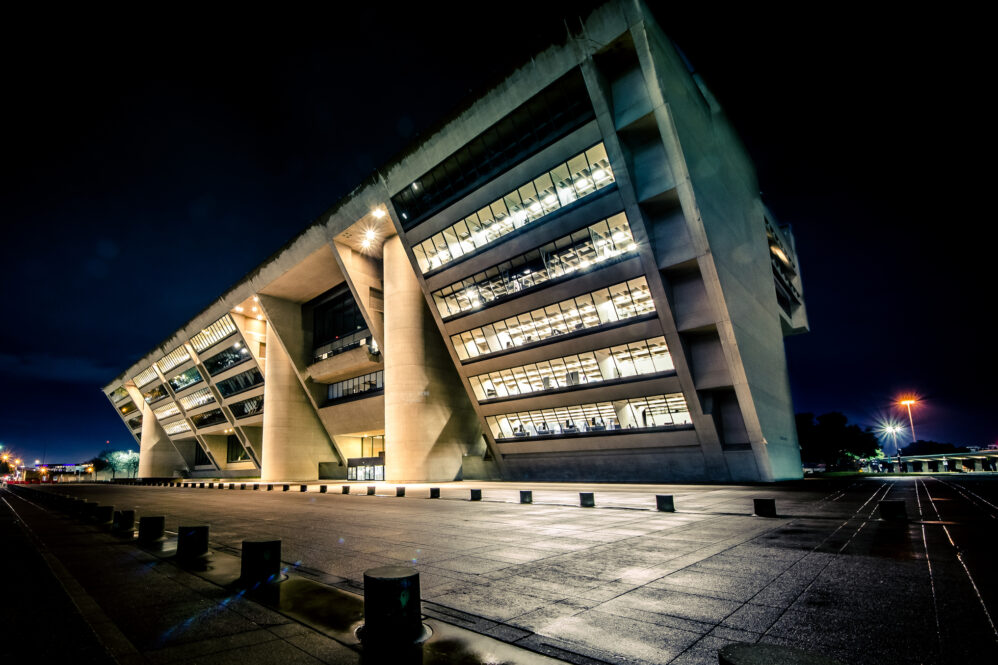
Opinion: Dallas City Hall’s future must embrace economic inclusion
The City of Dallas, long known as one of America’s largest and most economically vital cities is confronted with two consequential decisions: the future of its current city hall, and whether the Dallas Mavericks of the National Basketball Association, will retain its urban base after its American Airlines Center lease expires in 2031.
Although city hall’s deferred maintenance costs could go higher than $100 million, a 2026 Property Condition Assessment estimated city hall renovation costs between $906 million and $1.4 billion.
Conversely, if the decision is to relocate Dallas City Hall, what proposed site could equal the current one’s convenience or its 1.8 acre downtown footprint?
At the same time, the Dallas Mavericks have shared their vision for a 50-acre development that would also become a 365-day a year destination. A May 03 unsigned letter from the Mavericks states in part, “We appreciate the level of engagement the City continues to show and look forward to furthering our discussions to see if downtown could be the home for this project.”
The Maverick letter was one of over 400 submissions that Dallas received – not many for a city of 1.3 million. As reported by the New York Times, Dallas also received 321 plans to repair or restore the existing building, and 85 involved destroying it and erecting something else on the property.
A May 20 presentation by consultants already retained by city officials priced $324.9 million for just project planning and included an accuracy range spanning 20-50 percent.
Even in a big city, the combined sum for all the projected costs to date is a lot of money – public funds that Dallas government leaders have yet to identify how such costs would be underwritten.
North Dallas Gazette strongly encourages nonprofit organizations, the Regional Black Contractors Association, minority trade associations and concerned citizens to contact elected City officials and demand the public have more input in this project before spending $329+ million of taxpayers’ money.
A major public project of this scale demands greater and transparent public participation. Now, before a June 03 follow-up consulting presentation goes even further, city leaders are obliged to tell the public – prior to commitments – how these two dilemmas will bring equitable opportunities for all of Dallas’ 1.3 million residents.
Large scale public projects in other locales have utilized a planning process called Community Benefits Agreements (CBAs). For more than 20 years, CBAs have guided projects as diverse as the LAX airport expansion, Atlanta’s Beltline and new home bases for two Detroit professional athletic teams, the Red Wings hockey team and the Pistons basketball team.
These and other communities utilized CBAs to avoid legal logjams, facilitate more economic development, and give residents the chance to help shape a better future for all. In other words, predictable adversaries worked in concert as shared stakeholders.
CBAs have been so successful to capturing minority participation that the NAACP developed a 32-page Community Benefits Agreement template, designed as a comprehensive guidepost for cities and communities to ensure that large public-private partnerships deliver equitable developments as well as protections for renters, small businesses, Indigenous and Black communities.
“Economic equity is a crucial part of establishing holistic racial equity for Black people,” states the oldest civil rights organization. “It’s not just important that Black people be able to contribute to the economy as workers and consumers, but also as owners with the same access to resources and chance at success as anyone.”
The City of Nashville, commonly known as the nation’s Country Music Capitol, has one of the nation’s strongest and most successful CBAs. It is also an example of how professional sports and cities could work cooperatively for the benefit of all people.
In 2018 Major League Soccer (MLS) selected Nashville for its fourth expansion team. Nashville Soccer Holdings (NSH), worked with a local nonprofit organization, Stand Up Nashville (SUN), that ensured balanced and shared benefits in the negotiation of a historic Community Benefits Agreement located on 10-acres of the city’s 128-acre historic fairgrounds, offering mixed use development, only a few miles from downtown. Most importantly, the first to ever be signed in the state of Tennessee.
A negotiated Community Benefits Agreement (CBA) between Nashville Soccer Holdings and SUN, executed on September 3, 2018, secured key provisions for the project’s centerpiece, a 30,000-seat soccer stadium, is the largest soccer-specific venue in the nation that includes:
• Affordable Housing – 20% of all housing units are set aside for Affordable and
• Workforce Housing.
• Childcare – a 4,000 square foot facility operating on an income-based sliding fee scale
• Employment – targeted hiring, a first-of-its kind program designed to serve individuals with employment barriers, and guaranteed hourly wages
• Minority contractor inclusion
• Workplace Safety – Mandatory safety training for all construction workers supervisors.
• A permanent Community Advisory Committee, comprised of nearby residents and representatives from SUN and NSH, monitors and annually publicly reports progress. Its 2024 report, the most recent available, notes that the project was underwritten with $225 million in revenue bonds to build the stadium, and $50 million in General Obligation bonds for related infrastructure. A 99-year lease for ten acres of public land at the site for a mixed-use development built with private funds.
As stated in the report, “The team is responsible for repaying 100% of the revenue bonds and covering the stadium costs in excess of the revenue bonds… In addition, property taxes generated from the development (none currently) to be available for the city’s general fund with 50% of the property tax amount will be designated for Fairgrounds Nashville capital improvements.”
445 Park Commons, a 335-unit housing development opened with new studio, one-, two-and three-bedroom units. Of these, 120 were identified as Affordable and an additional 40 as Workforce units. As of December 31st, that year, 31% of the set-aside units were leased and in compliance with Fair Housing regulations.
It is time for Dallas to engage residents in a planning process that both envisions and delivers equitable economic development. A local CBA could accomplish that noble goal.
Related:
Ask us! What questions do you have about content, strategy, pop culture, lifestyle, wellness, history or more? We may use your question in an upcoming article!
Like MediaFeed’s content? Be sure to follow us.
This article originally appeared on North Dallas Gazette and was syndicated by MediaFeed.co.