Rankings: Most expensive cities for watering your lawn
The 2026 lawn care season is starting off on a dry note: Over 60% of the contiguous U.S. is currently in drought.
So, where is lawn watering the biggest drain on homeowners’ budgets?
To mark Water Awareness Month in May, we ranked the Most Expensive Cities for Watering Your Lawn in 2026.
Some lawn irrigation stats:
- An estimated 30% of average residential water use is spent outdoors, primarily on landscape irrigation.
- Across the 500 largest U.S. cities, households spend an average of 1.15% of their yearly income on water bills, but this ranges from $459 annually in Flint, Michigan (No. 426) to $2,160 in Newton, Massachusetts (No. 119).
- Water and sewer bills across the U.S. increased by 5.1% in 2025, outpacing inflation.
To rank the cities, we looked at climate metrics such as drought risk, precipitation rates, and growing season length. We also factored in yard size, how water-intensive the region’s most common grass types are, and whether rainwater harvesting systems are restricted or incentivized.
Explore our ranking of the 500 largest U.S. cities below. To learn how we ranked the cities, see our methodology.
5 most expensive cities for lawn watering
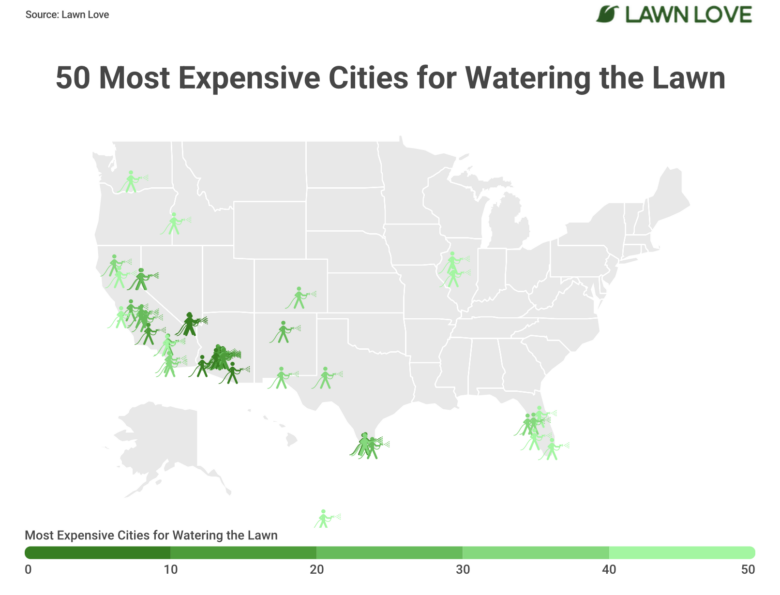
In 2026, the 5 most expensive cities for lawn irrigation include: 1. Scottsdale, Arizona; 2. Henderson, Nevada; 3. Las Vegas; 4. Tucson, Arizona; and 5. Buckeye, Arizona.
While keeping a traditional green lawn is costly in these cities, homeowners in each of these cities have access to incentives like rebates for sustainable upgrades, such as turf replacement or adopting smart watering systems.
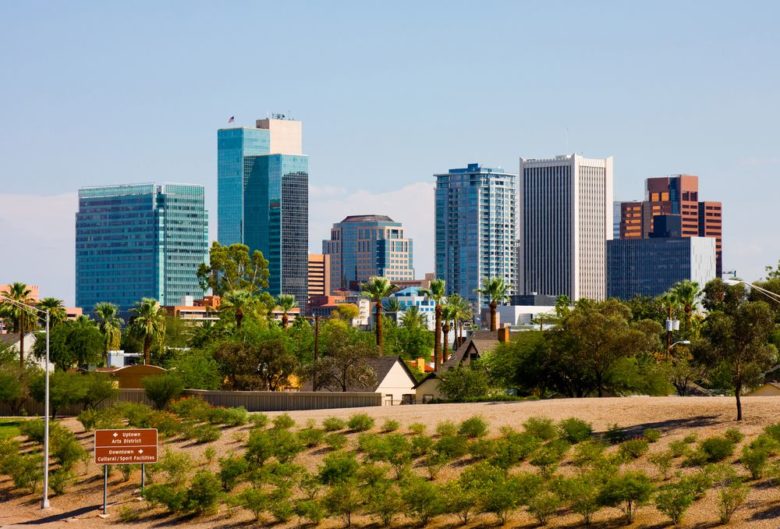
No. 1: Scottsdale, Arizona
- Overall score: 60.14
- Scottsdale ties with the 5th lowest historical average monthly precipitation: 0.6 inches.
- Ties with the most average annual number of extremely hot days, with 170 days above 90 degrees.
- Ranks within the top 20 cities spending the largest portion of their income on water, and just outside of the top 100 cities with the largest yard space.
Policies
As an affluent resort destination with sparkling pools and a strong golfing community, water is in high demand in Scottsdale.
In an effort to conserve water, the city prohibits natural grass front lawns in new residential construction and asks all residents and local businesses to help reduce their own water use by 5%. Scottsdale advises homeowners against overseeding, which increases watering needs.
The city has a Native Plant Ordinance, protecting 20 indigenous plants — including junipers and saguaros — from being removed, relocated, or destroyed without a permit from the city.
Rebates
Scottsdale has a program offering rebates for removing grass and pools, and also for installing Smart Home Water Monitors.
Other local tips
Locals can get landscaping inspiration from the Scottsdale Xeriscape Garden at Chaparral Park.

No. 2: Henderson, Nevada
- Overall score: 58.55
- Henderson ties with the lowest average monthly precipitation, 0.35 inches.
- Nevada limits rainwater harvesting to rooftop runoff from single-family homes for nonpotable domestic use (no permit needed), with no rainwater harvesting incentives.
- Ties with the 15th-highest number of extremely hot days (136 days above 90 degrees) and among the 100 cities spending the most on water bills relative to income.
Policies
Henderson has banned the installation of new natural turf in residential front yards and restricts turf to 50% or less of the total square footage of landscaping on side and/or rear yards.
Henderson has a mandatory seasonal watering schedule, which assigns households to certain days of the week when they are permitted to water their lawns.
Rebates
The Water Smart Landscapes Rebate can help reimburse up to $5 per square foot of lawn replaced with desert landscaping through the Southern Nevada Water Authority (SNWA). The city offers an additional $575 rebate for qualifying households replacing turf. SNWA also offers a $100 rebate for each new tree installed, and Henderson’s rebate stacks an additional $50 per tree.
Other local tips
H2One: Henderson’s Call to Conserve initiative helped remove over 3.2 million square feet of grass across the city, conserving an estimated 182 million gallons of water. This initiative was awarded by the American Planning Association in 2026.
SNWA offers free water-saving classes online or at Springs Preserve in Las Vegas.
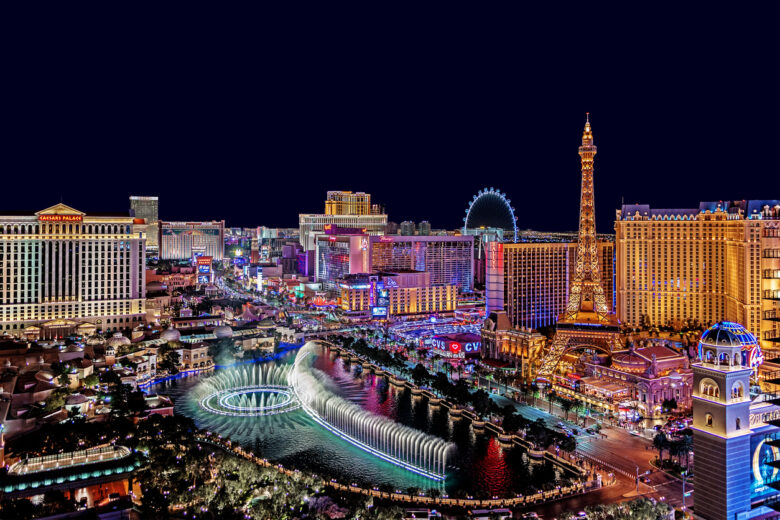
No. 3: Las Vegas
- Overall score: 58.46
- Las Vegas ties with the lowest average monthly precipitation, 0.35 inches.
- Nevada limits rainwater harvesting to rooftop runoff from single-family homes for nonpotable domestic use (no permit needed), with no rainwater harvesting incentives.
- Ties with the 15th-highest number of extremely hot days (136 days above 90 degrees) and among the 100 cities spending the most on water bills relative to income.
Policies
Nevada’s Nonfunctional Turf Removal Ban (AB 356) goes into effect at the beginning of 2027, prohibiting nonfunctional grass — aka lawn space with the sole purpose to be looked at and mowed — throughout the Las Vegas Valley (single-family homes are exempt).
Rebates
The Water Smart Landscapes Rebate can help reimburse up to $5 per square foot of turf replaced with desert landscaping through the Southern Nevada Water Authority (SNWA).
Las Vegas Valley Water District (LVVWD) offers a $2 per square foot rebate for lawn replacement, bringing the total “Cash for Grass” rebate for locals up to $7 per square foot for qualifying residential areas.
Other local tips
SNWA offers free water-saving classes online or at Springs Preserve, a 180-acre desert museum and botanical garden where homeowners can also get native landscape design inspiration.

No. 4: Tucson, Arizona
- Overall score: 57.92
- Tucson ranks among the 50 cities with the highest proneness to drought.
- Has the 14th-highest average number of extremely hot days, with 148 days above 90 degrees each year.
- Lands among the 100 cities with the largest yards, with an average yard size of 13,243 sq. ft. or 0.3 acres.
Policies
Tucson was the first city to pass a commercial rainwater harvesting ordinance in 2008, requiring commercial developments to use harvested rainwater for at least 50% of landscaping watering needs.
Rebates
Tucson Water offers rebates up to $2,000 for rainwater harvesting system installation and up to $1,000 for gray water irrigation systems. Additional rebates for lawn replacement are available for commercial and multifamily properties.
Other local tips
The Watershed Management Group offers free classes on rainwater harvesting, gray water, and sustainable desert living.
Homeowners can get inspired by native landscapes at Tohono Chul Park, a botanical garden full of plants native to or adapted to the Sonoran Desert, spanning 49 acres.
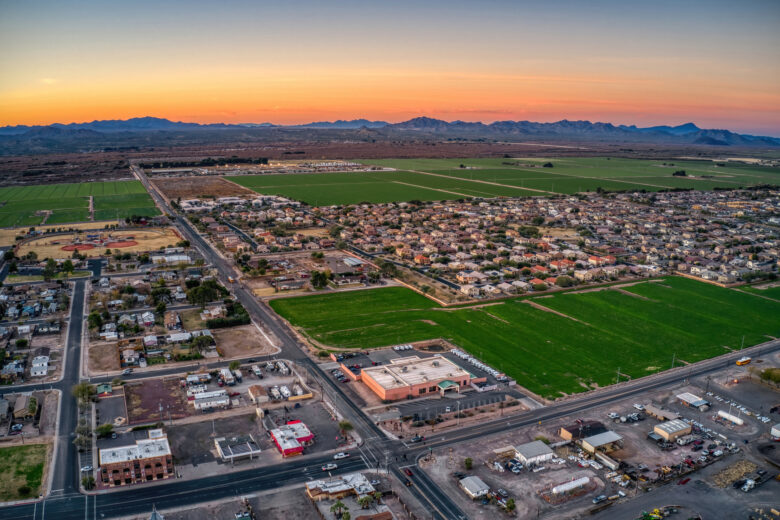
No. 5: Buckeye, Arizona
- Overall score: 56.97
- Buckeye ties with the 5th lowest historical average monthly precipitation: 0.6 inches.
- Ranks with the 67th longest average growing season, with 331 days of lawn growth each year.
- Ties with the most average annual number of extremely hot days, 170 days above 90 degrees.
Policies
One of the fastest-growing cities in the U.S., Buckeye is spending to keep up with rapid development. The city allocated $80 million to secure water rights for its rapid growth.
The city has a Drought Management Plan to activate in instances of severe water shortages.
Rebates
Buckeye has funds to allocate up to a total of $10,000 in water conservation rebates to homeowners on a first-come, first-served basis.
The city’s turf removal rebate program will pay 50% of removal costs (up to $1.75 per sq. ft.) for replacing natural lawns with xeriscapes or artificial turf. The city also offers up to $100 in rebates for smart irrigation upgrades.
Other local tips
Buckeye — along with Goodyear (No. 11) and Avondale (No. 18) — offers a series of free workshops to help homeowners learn about water conservation strategies.
The city encourages conservation with a tiered water rate structure, penalizing high-volume water use. Residents can track their water use with the EyeOnWater app.
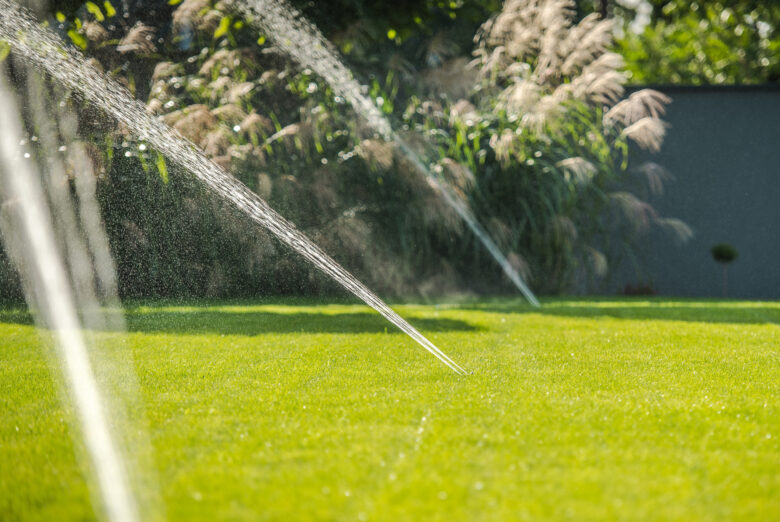
What the data shows: Regional water woes
- 47 of the 50 states are currently in drought at the time of writing, impacting over 153 million Americans.
- Average annual spending on water bills across the 500 largest U.S. cities in 2024 was $970.
- Estimates show up to 50% of water used for outdoor irrigation is wasted to runoff, evaporation, or wind.
Soaring Southwestern bills
40% of the 50 most expensive cities for watering your lawn are in the Southwest, with the majority located in Arizona and Nevada.
Much of this region has been incentivizing turf replacement or sustainable lawn upgrades.
My water utility offers rebates per square foot of grass turf converted to a low water-intensive landscape. The rebate goes towards my water bill, and I probably won’t have to pay a water bill for 5–6 years.
— Corbin (Albuquerque homeowner), via Reddit
- All cities throughout the Las Vegas (No. 3) and Phoenix (No. 8) metros score among the 25 most expensive cities for lawn watering. A desert climate with shrinking water resources means it’ll cost you to keep a green lawn.
- Residents of Gilbert, Arizona (No. 16) faced a 75% water increase between 2024 and 2025, with another 25% increase this year. Due to the spike in costs and issues related to the new utility billing portal, there’s an outstanding $3.4 million in unpaid utility fees across 4,500 accounts at the time of writing.
- Flagstaff, Arizona (No. 486), stands out due to its high elevation, with a milder climate and over 2X the average monthly precipitation of Phoenix.

Parched Pacific Coast
13 California cities score among the 50 most expensive cities for watering your lawn, led by Bakersfield (No. 12), Visalia (No. 20), and Fresno (No. 21). While conditions are less extreme in the PNW, snowpack levels reached a record low this year, leading Washington to declare a statewide drought emergency.
- Inland cities across the Golden State are more expensive for lawn watering, with a higher risk of drought, extreme heat, and large average yard sizes. Meanwhile, coastal cities like San Francisco(No. 341) and Irvine (No. 339) tend to rank lower due to smaller yards and lower spending on water bills relative to income.
- East of the Cascades, Yakima, Washington (No. 50), doesn’t get bountiful rain the way other PNW cities do. With just 0.67 inches of rain per month, Yakima has a high drought risk and scores just outside the 50 cities with the largest yards.

Gulf Coast: Heat, rain, and rising costs
Despite being along the rainy Gulf Coast, population growth, rising evapotranspiration rates, and sensitive aquifers cause vulnerable landscapes in Texas and Louisiana.
- Texas cities like Mission (No. 9), Edinburg (No. 19), and Brownsville (No. 22) score among the most expensive cities due to drought-prone climates and high spending on water relative to income.
- Texas HB 29 passed in 2025 to crack down on municipal water loss. Corpus Christi (No. 109) was predicted to be the first modern American city to run out of water as soon as next spring.
- Despite having among the highest precipitation rates, Louisiana cities Shreveport (No. 63) and Lake Charles (No. 80) land among the 100 most expensive cities for lawn watering with large backyards and high water bills relative to income. Prolonged drought caused the Mississippi River to run 10 feet below average near Baton Rouge (No. 172) earlier this year.

Historic Southeast drought
As of May 2026, the U.S. Drought Monitor reported 99% of the Southeastern U.S. is facing moderate to exceptional drought conditions.
Most people would not imagine we have problems with drought, but we do, during dry weather. I didn’t like the waste of constantly fertilizing, watering, and mowing a lawn, so I decided to xeriscape and, little by little, eliminate the lawn, even though my water bill is low. I’m also lazy and don’t want to have to think about watering.
— u/tillandsia (Miami homeowner), via Reddit
- It’s typically less expensive to keep your turf green in Jacksonville (No. 308), with high precipitation and low (but not zero) drought risk. Meanwhile, cities like Miami (No. 105) are more drought-prone, with the sensitive Biscayne Aquifer, a larger risk of saltwater intrusion, and higher population density.
- While only a handful of these states’ cities land among the most expensive in our ranking this year, Georgia, North Carolina, and South Carolina just faced their driest September to March period since 1895.
- As of May 2026, North Carolina cities Charlotte (No. 465) and Raleigh (No. 362) have enacted lawn watering restrictions.

Rainwater refuges
The Coastal PNW, Ohio, New Orleans (No. 380), Chesapeake Bay region, and Hawaii score as the rain refuges in our ranking — where natural precipitation does most of the watering work, bills are affordable relative to income, and drought is less of a risk factor.
The tradeoff? Homeowners are more likely to deal with fungus, moss, or drainage problems from the abundant rain.
Other notable insights
- In June 2025, lawn watering was banned across a large portion of Des Moines, Iowa (No. 139), due to near-record nitrate levels threatening the local water supply. They spent $9,000 a day on nitrate removal, totaling $1 million. Local reports say another ban might be coming for summer 2026.
- Limited water resources are slowing real estate growth across the country, including around Phoenix (No. 8), Cambria, California, Ogden Valley, Utah, and communities in Texas’ Rio Grande Valley, where planned housing developments have been constrained, delayed, or blocked.
Expert take: Making every drop count
As the data in our ranking makes clear, the pressure to water wisely isn’t just a Southwestern problem anymore.
With water bills rising and more lawn watering restrictions adopted across the country, we asked a series of experts — from irrigation engineers to turfgrass specialists — to weigh in on water costs and how homeowners can lower their bills. Explore their insights below.
- How have watering restrictions and bans on grass lawns impacted homeowners?
- What factors determine the local cost of water to consumers?
- What are your 5 best tips for minimizing the cost of lawn irrigation?
- Drip irrigation system vs. sprinkler system: Which is better and why?
- Climate change, inflation, and high energy costs are driving up Americans’ water bills. What measures can various levels of government take to lower water prices and keep them under control?
- How much water and expense do drought-tolerant grass types really save homeowners?
How we ranked the Most Expensive Cities for Watering Your Lawn
To rank the Most Expensive Cities for Watering Your Lawn in 2026, we compared the 500 largest U.S. cities across 9 metrics.
Our metrics covered 4 main themes:
- Climate Vulnerability Rank (48%): Historic average monthly precipitation (in inches), proneness to drought, historical average number of days in growing season, and the historical average annual number of extremely hot and extremely cold days.
- Cost Rank (20%): We factored in annual spending on water, adjusted to average household income.
- Watering Needs Rank (28%): We looked at the water requirement for the most common grass type(s) and the average yard size.
- Rainwater Harvesting Restrictions Rank (4%): We considered the accessibility of rainwater harvesting by state, giving the states a score of 1-6. States restricting rainwater harvesting received a score of 1, and states offering a comprehensive framework and incentives received a score of 6.
For each of the 500 largest U.S. cities, we then gathered data on each factor from the sources listed below the table. We eliminated 2 cities lacking sufficient data in a single category, Athens, Georgia, and South Fulton, Georgia, resulting in a final sample size of 498 cities.
Finally, we calculated scores (out of 100 points) for each city to determine its rank in each factor, each category, and overall. A city’s Overall Score is the average of its scores across all factors and categories. The highest Overall Score ranked “Most Expensive” (No. 1) and the lowest “Most Affordable” (No. 498).
Water-wise landscaping: Lower your water bill
When Elliott Gordon moved into his home in Albuquerque, New Mexico (No. 242), he inherited a yard with dying grass and invasive trees. He spent $11,000 to professionally overhaul the backyard and DIY-converted the front yard into a native xeriscape, utilizing local “tree-bates” (tree rebates) and sprinkler rebates to offset the transition.
“Neighbors called code enforcement on me twice in the first few years, but I never got a fine or citation,” Gordon says. “I think they finally accepted what I was doing.”
His suburban lot is now certified through the New Mexico Backyard Refuge Program, hosting 160 documented species of native plants with sightings of over 1,900 species of wild animals.
My average water usage last summer was 7,500 gallons per month ($90), and winter is about 3,000 gallons per month ($60). It’s tough being in a statewide drought, because I need to water the trees regularly year-round.
— Elliott Gordon (Albuquerque homeowner)
Xeriscaping with native plants — even in just a section of the yard — can help homeowners who are looking to decrease their water bills, increase backyard biodiversity, or just lower landscaping maintenance needs.
Ask us! What questions do you have about content, strategy, pop culture, lifestyle, wellness, history or more? We may use your question in an upcoming article!
Like MediaFeed’s content? Be sure to follow us.
This article originally appeared on Lawn Love and was syndicated by MediaFeed.co.