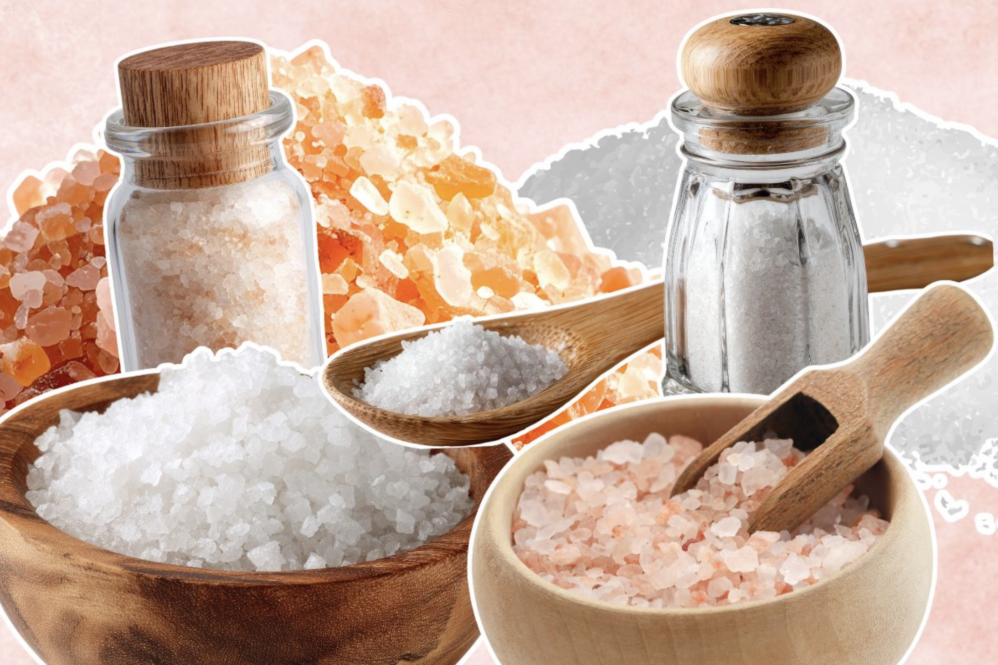
From Vogue to Parade to #WellnessTok, I’ve seen the claims multiply like sourdough starters: “Unprocessed salt has more electrolytes and trace minerals.” “Use Himalayan pink salt as a metabolic tonic.” “Celtic salt creates glowing, hydrated skin.”
But wait, there’s more! According to influencers, good old-fashioned iodized salt is the enemy: “bleached,” “stripped of nutrients,” and apparently so toxic it belongs next to a barrel of nuclear waste.
Screeeech. Hold up. Don’t we need iodine?
So we pay more for salt with “less processing”—more profit for companies, trace minerals we’d need to consume wildly impractical amounts of salt to benefit from, little to no iodine in many brands, and, in some lab tests, a side of heavy metals. And before you dismiss that as crunchy-salt paranoia: One 2023 study testing 10 gourmet salts found lead in every sample, with Persian blue salt hitting particularly eyebrow-raising levels. Not every fancy salt is a heavy-metal cocktail, but that is not exactly the artisanal wellness upgrade we were promised.
The Wellness Grift: Iodized Salt vs. Sea and Rock Salt
To make iodized salt, companies process sea or rock salt, mined from ancient seabeds. Processing removes both minerals and contaminants. Pure sodium chloride is white, so when influencers say it’s “bleached,” don’t believe it. That’s fake news.
Next, they add iodine, plus anti-caking agents—so that “when it rains, it pours,” the slogan that made Morton’s a household name.
“Gram for gram, all salts have the same impact on blood pressure, kidneys, heart, all the tissues that are sodium-sensitive,” explained Chris Chlebowski, a naturopathic doctor (N.D.) in Oregon. “I have a lot of [clients] who would term themselves health-conscious, who have completely steered away from iodized salt. It’s a concern of mine because you can end up iodine deficient.”
So Then Why Do Companies Still Add Iodine to Salt?
Companies started iodizing salt in the 1920s—one of the most successful public health interventions in human history. Adding iodine to salt became a cheap, effective way to eliminate goiter—swellings of the thyroid gland—resulting from extreme iodine deficiency in the 20th century.
Although we solved this problem a century ago, is wellness culture quietly undoing it? Nobody wants to get goiters again, right? Iodine is one of women’s most important trace minerals, which we can only get from the diet.
“We need it to make thyroid hormones,” added Chlebowski, which regulate metabolism, heart health, the nervous system, and more.
“If your thyroid doesn’t work well, women gain weight, they can have poor bone health—osteopenia and osteoporosis,” explained Chlebowski, noting that the thyroid also affects breast health. Inadequate iodine can cause fibrocystic breasts—more common in our 40s and 50s.
Are Specialty Salts Causing Iodine Deficiency?
The use of specialty salts skyrocketed in the 2010s. Their use grew so fast that, today, less than half the salt Americans buy is iodized.
Concurrently, iodine inadequacy in Americans doubled. And yes, experts have linked the two. To be fair, it’s not the only cause: lower dairy consumption and the rise of vegan and Paleo diets have also played a role. But the timing isn’t a coincidence.
“Most salt intake comes from processed foods in the Western diet,” said Bridgette Hamby, a dietitian with the Institute for Digestive Health and Liver Disease in Maryland—70% in fact. “If people cook most of their meals from scratch using whole foods, their overall salt intake will be lower.”
When people reduce sodium, they often reduce what they shake at home—paying less attention to processed foods. The result is less iodine, without significantly less sodium. This has contributed to the rise in iodine deficiency in women.
In the U.S., salt iodization is voluntary, which means not every table salt is iodized, and the salt in most processed foods usually isn’t, either. In 120 countries—including Mexico and Canada—all salt used for human consumption must be iodized. Perhaps we should change that?
If you’re vegan, rarely eat seafood, dairy, or eggs, and have broken up with iodized salt, don’t just cross your fingers and hope your thyroid gets the memo. Ask a clinician or dietitian whether a supplement makes sense for you.
Want more? Get PROVOKED’s free Thursday newsletter. Sign up at PROVOKEDMagazine.com.
Older Women and Salt Sensitivity
Women know salt sensitivity better than men: It causes fluid retention and bloating externally and inflammation internally. Along with a loss of collagen, weight gain, and other exciting body adventures, “postmenopausal women can become [even] more salt sensitive,” said Chlebowski.
When estrogen, progesterone, testosterone, and DHEA decline post-menopause, our blood vessels stiffen. That causes kidneys to filter salt less efficiently, which in turn, raises blood pressure.
Fortunately, salt sensitivity cuts both ways. Reducing sodium provides quicker benefits, like reduced blood pressure, compared with younger people.
Whatever our age, most Americans consume 3,400 milligrams of sodium daily, much more than the recommended daily allowance (RDA) of 2,300 milligrams. The American Heart Association recommends no more than 1,500 milligrams daily.
The Ingredient that Freaks Everyone Out
Anti-caking agents are one of the reasons “people run screaming” from table salt, said Chlebowski.
Ferrocyanides are some of the most common. The cyanide molecule freaks people out, but science shows the body excretes more than 99%. With growing concern over anti-caking agents, the European Food Safety Agency (EFSA) spent a decade re-evaluating many food additives and had enough data to conclude ferrocyanides aren’t carcinogenic or genotoxic, and, at current intakes, are “of no safety concern.”
For aluminosilicates, as well as calcium silicates and magnesium silicates, the agency determined safety “cannot be assessed” from existing data. The FDA hasn’t evaluated anti-caking agents since the late 1970s.
At any rate, “You have to eat a giant amount of conventional salt to have any problem,” added Chlebowski. And here’s the rub: Companies add them to many processed foods, including pre-grated cheeses, spices, powdered cocoa, and supplements—not just table salt. To eliminate anti-caking agents, you’d have to chuck processed foods entirely.
Influencers selling you $14 artisanal salt aren’t telling you that.
Essential Trace Minerals? Or Frightening Heavy Metals?
So now that I feel better about using iodized salt, what about my beloved specialty salts?
Scientists tested Himalayan salts (all of which come from the exact region in Pakistan), finding dramatic variation in nutrients. However, they concluded that a person must consume 6 teaspoons for “meaningful contribution to nutrient intake.”
In contrast, scientists testing 10 salts for 12 elements found that some could meaningfully add to daily requirements. Smoked salts were zinc-rich. Atlantic grey exceeded chromium requirements. Persian blue had high iron, copper, chromium, but—hold up—also heavy metals, including arsenic and lead. For comparison, the FDA’s 10-ppb action level applies to certain processed foods for babies and young children—not salt and not “most foods.”
Excuse me, what?
Per the World Health Organization, there’s “no level of exposure without harmful effects.” Several other studies have found lead, arsenic, and mercury in salts, at lower levels but still over limits. (Related: I’m A Dietitian Who Ate Nuts Every Day for a Month. Here’s What Really Happened.)
Unfortunately, the FDA rarely inspects imported salt. Companies are left to ensure their own products remain contaminant-free. And the FDA hasn’t followed up on these studies, at least not publicly. Clearly, someone missed the memo.
I’ll take the caking agents over mystery heavy metals, thankyouverymuch. Morton’s may not be clear either; an independent lab found 5 ppb lead—far lower than the salts in the previous study, though, and under FDA limits.
Enjoyed this story? Read more from PROVOKED at provokedmagazine.com.
It’s Everywhere. Literally. Microplastics.
Microplastics in salt did make the news, but they’re everywhere—in the sea, at the top of mountains, in our brains, guts, and lungs. The smaller, the more concerning.
“We’re mostly worried about the uptake of nanoplastics through our diet … because we know people haven’t done a good job of quantifying that yet,“ said Matthew Campen, health sciences professor at the University of New Mexico. “The problem is that, technologically speaking, we have no really great methods to detect that.” Though much remains science-in-progress, early findings suggest they cross cell membranes and even the mighty blood-brain barrier.
You might expect more microplastics in sea salt due to the widespread plastics in the ocean—remember floating plastic garbage patches, some the size of Alaska? Still there. Interestingly, terrestrial salts seem to have more plastic contamination than sea salt.
The Bottom Line
Understanding the important role iodine plays in our postmenopausal health was enough to make me pull out my navy-blue container of iodized salt and integrate more into my diet. Reducing overall sodium intake is also critical. But like the rest of us, I had no idea about the outrageous levels of lead and other heavy metals in some specialty salts. That’s an issue I feel compelled to take seriously.
If you wouldn’t trust Big Tobacco telling you cigarettes are safe, use the same skepticism toward influencers. Use their hot takes as conversation starters, rather than the endpoint. In other words, take it with a grain of salt.
Related:
- Can You Buy Your Way Out of Climate Guilt?
- Middle-aged Women: Myths, Truth, and the Eye Roll You Deserve
- Don’t Die of Modesty: Get Undressed. Get Checked.
Ask us! What questions do you have about content, strategy, pop culture, lifestyle, wellness, history or more? We may use your question in an upcoming article!
Like MediaFeed’s content? Be sure to follow us.
This article originally appeared on PROVOKED and was syndicated by MediaFeed.co.