A Glimpse of Life Beyond Earth: Training for the Final Frontier
Have you ever wondered what it’s truly like to live on a spaceship, where every window offers an endless vista of stars? From the tight quarters of the galley to the breathtaking views from the cupola, these photographs give us a rare, interstellar look at the everyday reality of space exploration.
However, many of the most striking images we see that appear to show astronauts “living” in space are actually captured during rigorous training exercises. These include deep-sea missions in NASA’s Neutral Buoyancy Laboratory (NBL), where buoyancy simulates weightlessness, or long-duration confinement studies that prepare crews for the psychological rigors of a trip to Mars. While they may not all be taken millions of miles from Earth, these photos are essential, showing the vital preparation, teamwork, and environments that make human survival in the cosmos possible.
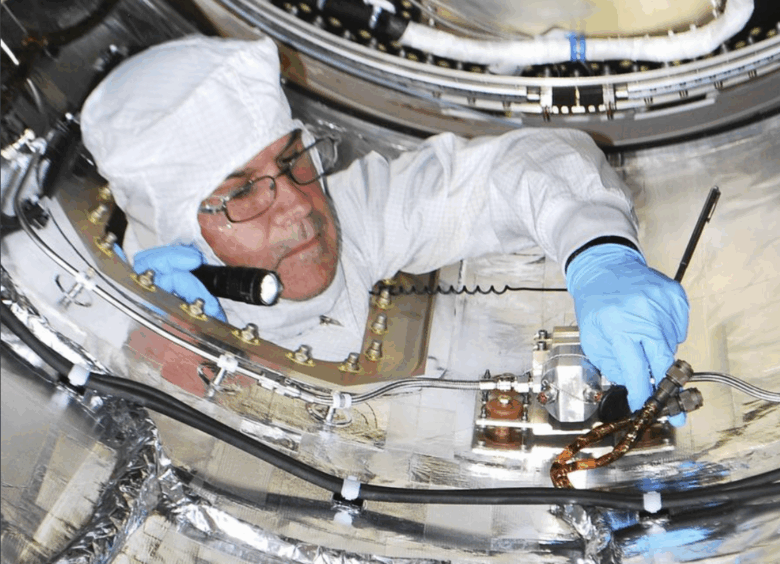
Inside NuSTAR Nose Cone
Inside the NuSTAR nose cone at Vandenberg Air Force Base in California, a spacecraft technician performs final closeout work on the NASA Nuclear Spectroscopic Telescope Array (NuSTAR) spacecraft on March 2, 2012.
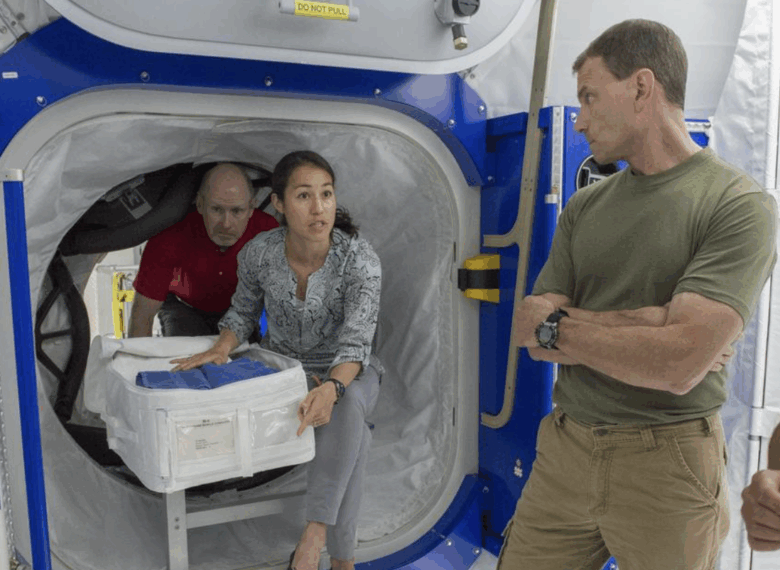
Boeing trainers conduct simulations inside the Boeing Exploration
Boeing trainers conducted simulations inside the Boeing Exploration Habitat Demonstrator with astronauts to evaluate the internal layout and ergonomics, which supports an efficient work-life balance aboard a deep space ship (Date Created: 2019-06-17; Center: MSFC; Photographer: Emmett Given).
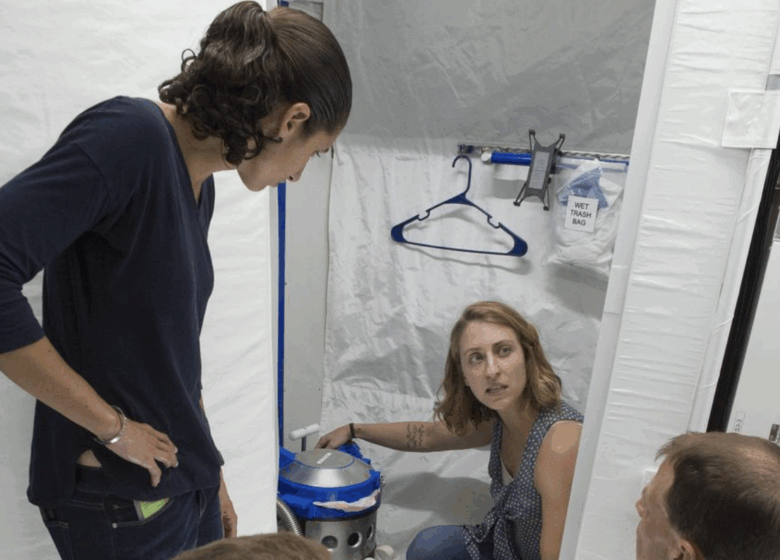
Boeing trainers conduct simulations
Boeing trainers evaluate the internal layout and ergonomics for efficient work-life balance aboard a deep space ship (Date Created: 2019-06-17; Center: MSFC; Photographer: Emmett Given).
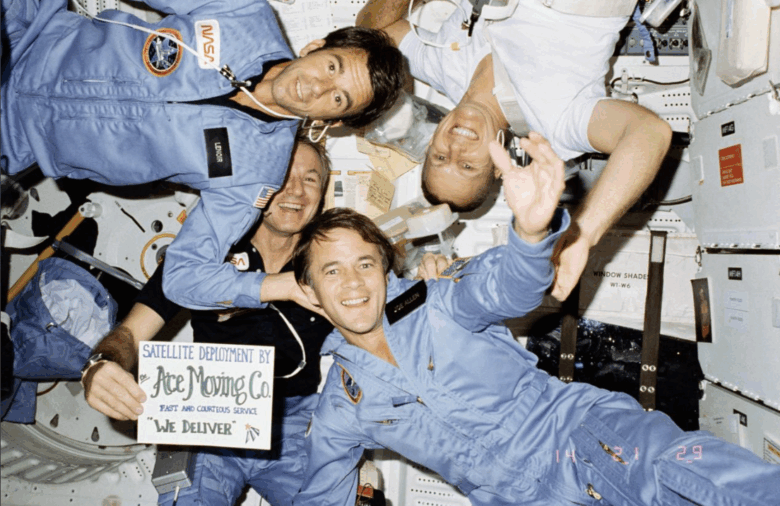
STS-5 crew onboard portrait on port side middeck
The STS-5 crew poses for an onboard portrait on the port side middeck, featuring Commander Brand holding an “Ace Moving Co” sign (referring to the successful deployment of two commercial satellites) and surrounded by Pilot Overmyer, Mission Specialist Allen, and Mission Specialist Lenoir, taken on November 16, 1982 (NASA ID: s05-07-266).
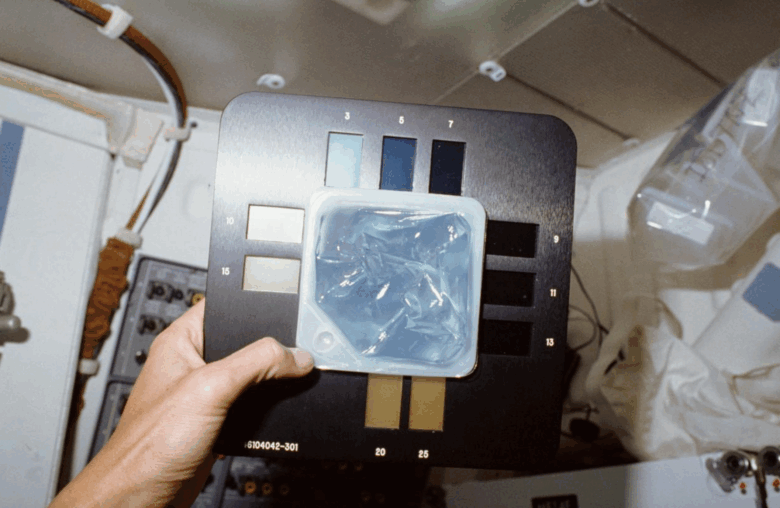
STS-34 onboard view of iodine comparator assembly used to check water quality
An onboard 35mm camera provides a closeup view of an STS-34 beverage container doubling as an experiment module for checking water quality by using a color chart to determine the degree of iodine content after adding starch to a water specimen produced by Atlantis’ fuel cell, taken on October 23, 1989 (NASA ID: s34-10-014).
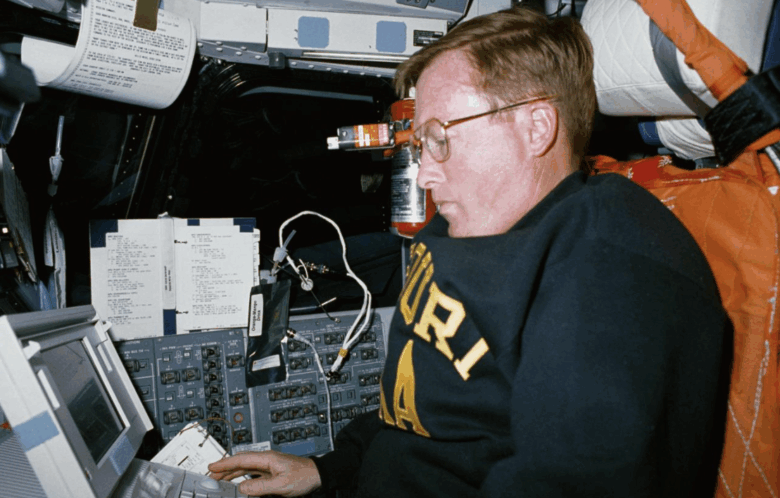
STS-41 Commander Richards uses DTO 1206 portable computer onboard OV-103
Astronaut Richard N. Richards, the STS-41 mission commander, utilizes the Shuttle portable onboard computer from the pilot’s station during the four-day flight on October 10, 1990 (NASA ID: s41-01-002).
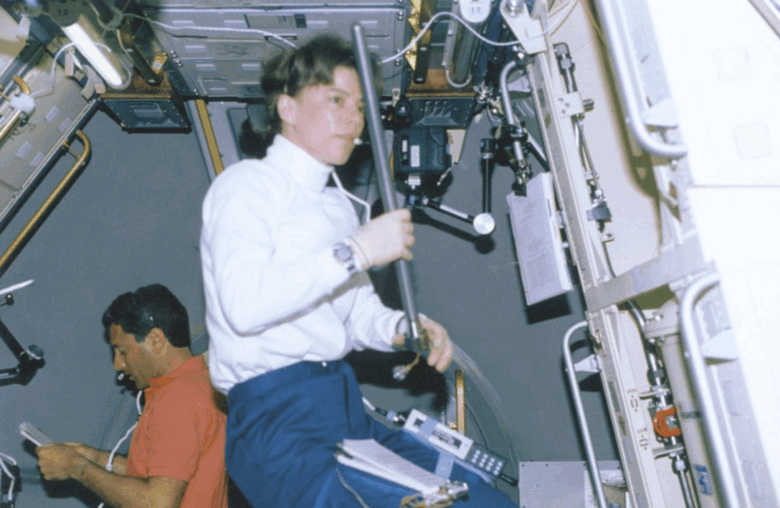
Microgravity
Payload Commander Bonnie Dunbar is seen loading samples into the Commercial General Purpose Furnace (CGF) onboard the Space Shuttle Columbia (STS-50, USML-1) on June 25, 1992 (NASA ID: 9402248).
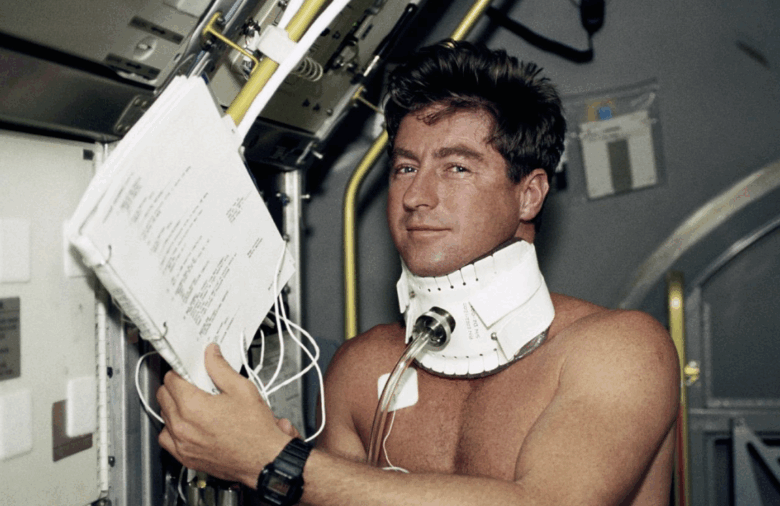
STS-55 Pilot Henricks with baroreflex collar in SL-D2 module onboard OV-102
STS-55 Pilot Terence T. (Tom) Henricks is seen wearing a specialized baroreflex collar in the Spacelab D-2 (SL-D2) module aboard the Space Shuttle Columbia (OV-102) to investigate how microgravity affects the reflex system regulating blood pressure, taken on May 6, 1993 (NASA ID: STS055-233-019).
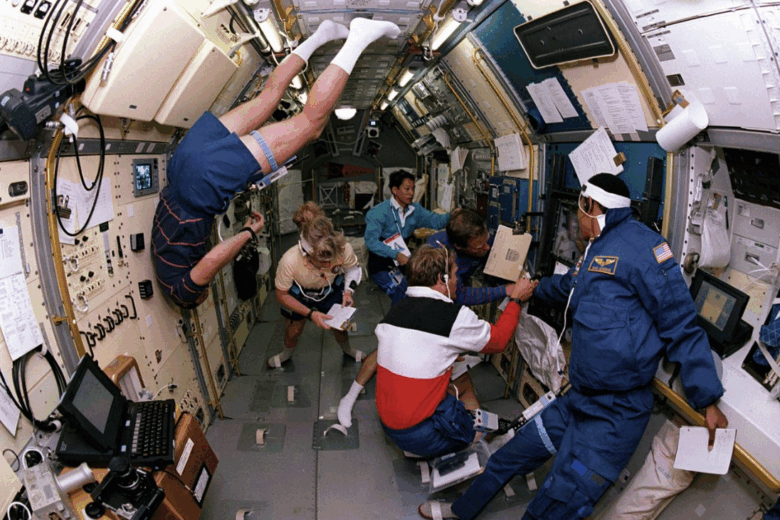
Spacelab
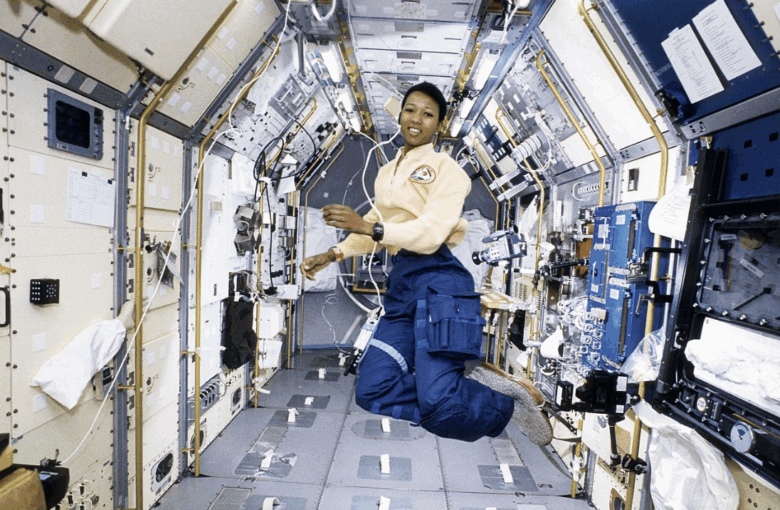
Microgravity
An onboard photo from the Space Shuttle Endeavour (STS-47) shows Astronaut Mae Jemison working in the Spacelab-J module, a combined NASDA and NASA mission with objectives in life sciences, microgravity, and technology research, taken on October 22, 1992 (NASA ID: 9265609).
Related:
- From 10k steps a day to brushing your teeth for 2 minutes: Everyday habits that are pretty arbitrary
- Earn extra income from home: 10 legitimate online jobs perfect for retirees
Like MediaFeed’s content? Be sure to follow us.
This article was syndicated by MediaFeed.org.