
According to National Oceanic and Atmospheric Administration (NOAA), greenhouse gas (GHG) emissions are at a historic high and governments are encouraging organizations of all sizes to begin reducing GHG emissions’ largest contributor, carbon. Enter: Carbon accounting as a way to see where your business’s emissions are coming from and how to create a targeted strategy to reduce them.
Anyone can begin incorporating carbon accounting into their financial practices to track, analyze, and reduce their carbon emissions.
But, what is carbon accounting, and how do you integrate it into your business plan? Read our beginner-friendly guide to learn how carbon accounting has the potential to help your small business make big changes in reducing greenhouse gas emissions and become a more sustainable business.
Why carbon accounting matters for businesses

Carbon accounting is not only a matter of compliance or reporting but also a strategic opportunity for businesses to create, test, and achieve sustainability goals. Businesses can improve their performance, reputation, and competitiveness in a low-carbon economy by measuring and managing their carbon emissions. Here are a few real-world examples of how emissions accounting is important for any business of every size.
GHG accounting monitors your carbon footprint
A carbon footprint is a measure of the greenhouse gas emissions that are associated with the activities of your small business. It includes both direct emissions, such as from fuel combustion or refrigeration, and indirect emissions, such as electricity use or transportation of goods and services.
Carbon accounting helps small businesses track and reduce their carbon footprint by providing a clear picture of their environmental impact and identifying opportunities for improvement in how they can run their business more sustainably.
Help fulfill GHG reporting requirements
Carbon accounting helps fulfill GHG reporting requirements by providing a standardized and transparent way of quantifying and disclosing the environmental impact of different business activities. The following global climate action initiatives require the use of carbon accounting to lower emissions:
- Greenhouse Gas Protocol: The GHG protocol provides guidance on measuring, managing, and reducing GHG emissions across different scopes and sectors.
- ISO 14064: A protocol designed by the International Organization for Standardization international framework that standardizes the quantification and reporting of greenhouse gas emissions.
- Global Reporting Initiative: The GRI helps organizations develop carbon accounting best practices via online courses, certificate programs, and specialized training.
These carbon accounting standards represent the global effort to lower greenhouse gas emissions, including carbon. As climate action continues to grow in importance and urgency, GHG reporting may also become the new normal for small businesses across the globe.
Increase efficiency at your small business
Understanding the emissions of your small business is the first step toward creating a more sustainable supply chain. Not only do carbon emissions take a toll on the environment, but they can also contribute to high energy costs.
Understanding which processes of your business contribute to the most GHG emissions could show you which areas could benefit from redevelopment. Perhaps this looks like redesigning how a good is processed or transported to consumers.
Demonstrate climate action to your customers
Show your customers, stakeholders, and supporters that you know the urgency of climate action and that your business is playing its part in creating a more sustainable future for the planet. Allow your actions to speak for themselves by investing in something tangible, like sustainable packaging materials.
Sharing these changes with your audience continues the conversation about climate action in your community, and it can establish your small business as being ahead of the sustainability curve.
Build long-lasting brand equity
Brand equity can influence customer loyalty, satisfaction, and willingness to pay. By adopting carbon accounting, small businesses can demonstrate their commitment to environmental and social responsibility, differentiate themselves from competitors, and attract and retain customers who value sustainable business practices
Carbon accounting can help businesses to comply with regulatory requirements regarding GHG emissions, avoid potential fines or penalties, and access incentives or subsidies for low-carbon activities. Investing in sustainability now is also a means of future-proofing your company’s Environmental, Social, and Governance (ESG) efforts.
How carbon accounting works (GHG protocols explained):

You do not need a carbon accountant to begin collecting GHG emission data from your business. In fact, this approach may feel familiar if your small business already has efficiency processes, like water conservation initiatives, currently in place.
To begin carbon accounting, your business needs to follow these steps:
- Define the scope and boundaries of the carbon accounting exercise. This includes deciding which emissions sources, activities, and periods your reports will include.
- Collect data on the emissions factors of each activity and organize them in a spreadsheet.
- Calculate the emissions for each source and activity using a spend-based, activity-based, or hybrid carbon accounting method.
- Report and communicate the results of the carbon accounting exercise to relevant stakeholders, customers, investors, regulators, and employees.
- Monitor and verify the accuracy and completeness of the carbon accounting process.
- Review and improve carbon accounting periodically to reflect changes in your activities, offerings, and methodologies.
To begin taking your next steps towards climate action, you’ll want to know which scope the emissions of your small business falls under according to the GHG protocol.
Scope 1
Scope 1 emissions are direct greenhouse gas emissions that occur from sources that your small business owns or controls. For example, Scope 1 can be emissions from a retailer’s fleet of delivery vehicles
Chemical leakages are also Scope 1 emissions since they directly stem from business production. Since Scope 1 emissions directly impact the other scopes, reducing this type of emission is crucial in achieving sustainable business practices that are better for your bottom line.
Scope 2
Scope 2 emissions are the indirect greenhouse gas emissions that result from the generation of electricity, heat, or steam a company purchased from a utility provider. For example, Scope 2 emissions can be the electricity small business owners use for their storefronts.
Small businesses can begin lowering their Scope 2 emissions by exploring the benefits of energy-efficient upgrades in their storefronts. Investing in renewable energy sources that decrease your business’ dependence on fossil fuels is also a viable climate action goal.
Scope 3
Scope 3 emissions are indirect greenhouse gas emissions that occur in an organization’s value chain—both upstream and downstream. They include emissions from sources that an organization doesn’t own or control, such as business travel, waste disposal, and the use of sold products.
Since scope 3 emissions can be challenging to omit entirely, some businesses invest in carbon offsets to neutralize indirect emissions. Although it’s not a perfect solution to reducing GHG emissions, carbon offset accounting is a viable way for small businesses to begin taking climate action.
Carbon accounting methods
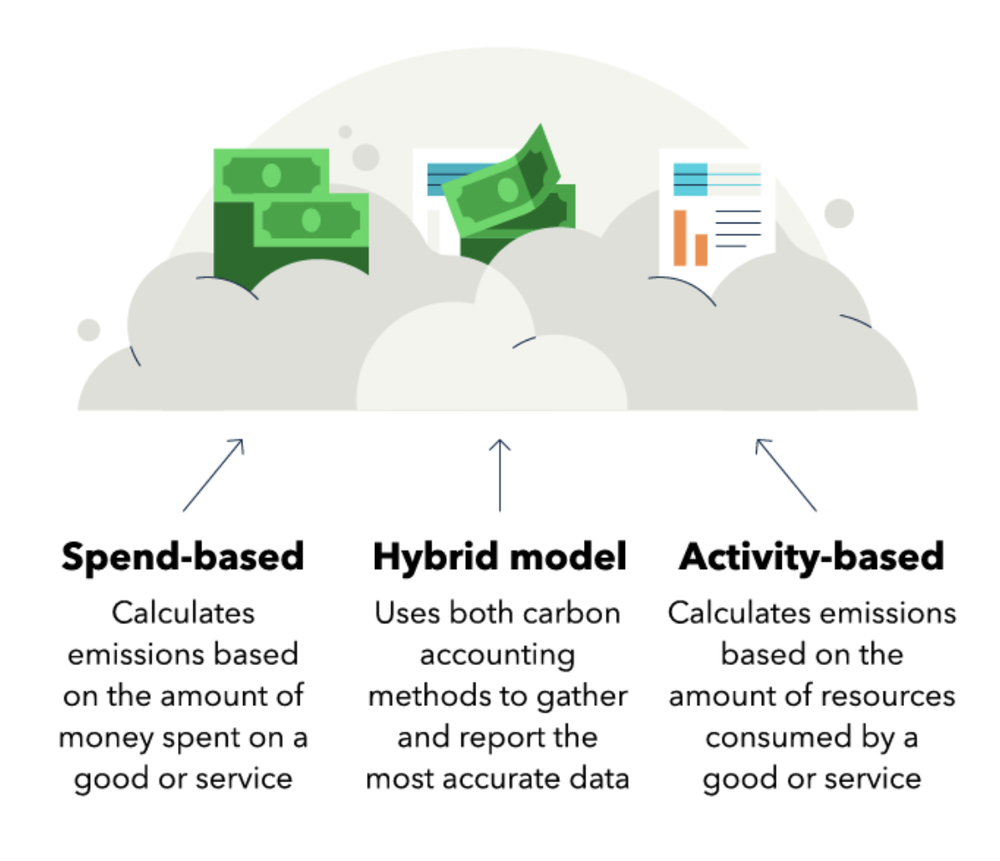
There are two main methods to calculate GHG emissions. However, some businesses use a hybrid of both methodologies to improve the quality of their carbon accounting by gathering the most accurate data possible. Let’s examine the pros and cons of each carbon accounting method to determine which is right for your small business.
The spend-based method
The spend-based method of carbon accounting assumes that every purchase or expense made by the business has an embedded carbon footprint, which reflects the emissions generated throughout the supply chain of the product or service.
To calculate the GHG emissions of your business, begin by multiplying the financial value of a good or service by an average emission factor of the sector. The equation looks like this:
Financial value of good or service x average emission factor = GHG emissions
Emission factors can be obtained from the Environmental Protection Agency. The sum of all the emissions from each category gives the total carbon footprint of the business.
The activity-based method
The activity-based method of carbon accounting involves identifying the activities that generate emissions and assigning emission factors to each activity based on the number of resources consumed.
To calculate the GHG emissions of your business, begin by multiplying the amount of resources consumed by a good or service by an average emission factor of the sector. The equation looks like this:
Resources consumed by a good or service x average emission factor = GHG emissions
Next, calculate the small business’s total emissions by summing up the emissions from each activity. This method can help small businesses to understand their environmental impact, identify opportunities for reducing emissions, and communicate their performance to stakeholders.
The hybrid model methodology
The hybrid model methodology relies heavily on the activity-based model and utilizes the spend-based model to fill in the gaps. The specificity of the activity-based approach is great for getting accurate data, but it isn’t always possible for indirect emissions.
Spend-based GHG emissions + activity-based GHG emissions + total GHG emissions
Although using both methods may appear erratic, it is an attempt to balance the trade-offs of both accounting methods and provide the most accurate results possible.
Benefits of carbon accounting
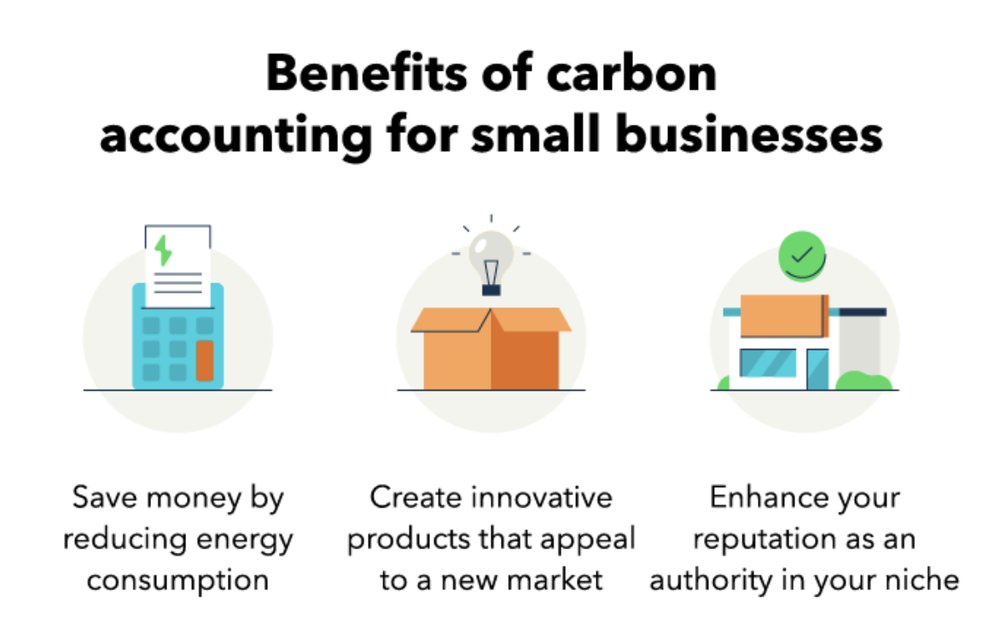
Similarly to the global implications of carbon accounting, calculating GHG emissions also has a direct impact on your small business. Some of the benefits of carbon accounting include the ability for your business to:
Save money
Carbon accounting can help small businesses identify and reduce their energy consumption and waste, which can lower operational costs. Reporting on your GHG emissions can grant your small business access to incentives and subsidies from governments or Non-governmental organizations (NGOs) that support low-carbon initiatives, such as renewable energy, energy efficiency, and carbon offsetting.
Innovate products
Taking stock of your emissions also has the potential to help your small businesses create innovative products or services that are more appealing to the eco-conscious market. Novel ideas backed by carbon accounting data facilitate the development and adoption of clean technologies such as renewable energy, energy efficiency, and carbon capture.
Enhance your reputation
Carbon accounting may help small businesses enhance their reputation and brand image since consumers and investors are increasingly aware of the environmental impact of their purchase decisions. GHG emission reporting can increase customer loyalty, attract new customers, and create a competitive advantage in your niche.
Challenges of carbon accounting

There’s no doubt that carbon accounting and GHG emission reduction strategies are wonderful ways for small businesses to become more sustainable and create a lasting impact in their sector. However, going green does come with its fair share of challenges that can lead to businesses dealing with the following.
Inconsistent or unreliable data
You may notice some reporting inconsistencies in the early stages of your carbon emissions accounting journey. This could be due to faulty accounting software, a change in business procedure, or several other factors outside of your control. Understand that it may take some time before you’re able to gather accurate information regularly.
High starting costs and time commitments
Although you can hire live bookkeeping services anytime, you may be used to managing your business accounts on your own. Given the learning curve of some carbon accounting methods, you may spend lots of time and money keeping your data organized and easily accessible.
Fluctuating sustainability initiatives
As the Earth continues to become warmer, our steps towards sustainability may begin to feel more rapid and ever-changing. Be prepared to navigate fluctuating initiatives that must remain adaptable to the planet’s needs and understand how this could affect your business’s ability to produce accurate reports on a regular basis.
How to choose carbon accounting software
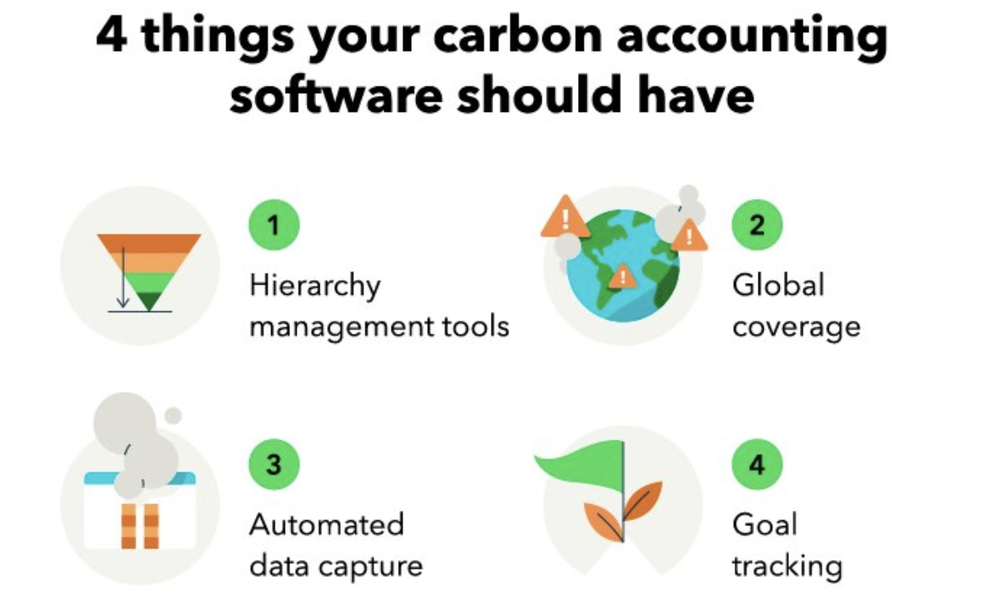
Carbon accounting software is a green business solution that helps small businesses measure and report their greenhouse gas emissions. It can help identify sources of emissions, track progress towards reduction goals, and comply with local environmental regulations. Effective carbon accounting software should potentially include:
- Hierarchy management tools that allow you to prioritize data groups
- Global coverage options to best comply with current climate action goals
- Automated data capture that you can access remotely
- Goal tracking options that you can customize to your small business
Although carbon accounting focuses on emission reductions, it also plays a part in your overall accounting routine. When choosing carbon accounting software, consider how easily it will integrate into your current small business accounting practice.
Can going green be good for your bottom line?
Carbon accounting is a pragmatic solution for small businesses that are eager to participate in climate action while improving the efficiency of their small businesses. Begin the journey to a more sustainable business by utilizing paperless accounting software that keeps your finances at your fingertips.
If you really want to level up your commitment to going green, learn how to conduct an energy audit for your brick-and-mortar business. This practice will quickly show your business how to create tangible results while combating climate change in your community.
This article originally appeared on the QuickBooks Resource Center and was syndicated by MediaFeed.org.
More from MediaFeed:
23 small business & side hustle ideas for 2023

When you’re thinking of starting a new business, there are plenty of possibilities to consider. But what if you don’t have a large startup budget ready to go? Doesn’t that limit your dreams severely?Whether you’re trying to launch a side hustle to supplement your day job or you just want to be your own boss, there are many businesses you can start that don’t require huge sums of money.
Explore this list of 23 of our best small business ideas. The sooner you get started, the sooner your small business might be the next great success story.
PixelsEffect/istockphoto

At-home workouts became popular during the pandemic restrictions, and it’s still a favorite go-to for busy people who need exercise. If you’re a fitness lover, you may be able to launch an online training business in one of a number of different ways. An easy way to get started and build an audience is by making videos to post on YouTube or sell as a course. According to a survey by Personal Trainer Development Center, online-only trainers made $54,000 yearly on average prior to the pandemic.
damircudic/istockphoto

Developing websites — building and maintaining their core structure — is a technical skill that’s in high demand. Yet, it’s also a skill that you can teach yourself through videos, website lessons, and books. Once you’ve mastered and practiced the skill, you can build a portfolio and start pitching clients. All of that takes time and effort but not really money.
Eva-Katalin/istockphoto

Web design is a skill set you can market as a freelancer, providing your services to multiple companies that need help with the usability and aesthetics of their sites. You can focus on helping design websites from scratch or on troubleshooting and/or redesigning existing websites, or even on a combination of both. Pay for web design may run at around $60 per hour and a full website design might pay between $5,000 and $10,000.
Drs Producoes/istockphoto

If you’re wondering what kind of business to start, you might think about consulting in an area you’ve already worked in, like human resources, management, IT, or operations. You can set your own hours, potentially charge more than you earned as a full-time employee, and pick and choose the projects you’ll enjoy the most.
SDI Productions/istockphoto

Starting your own graphic design business is another easy option for people who have the talent and experience. If that’s you, you can launch a website with some portfolio pieces and start pitching potential clients. If you’ve already been a graphic designer for a company, you likely already have everything you need to get started. As of May 15, 2021, the average hourly pay for a graphic designer in the U.S. was $17.99.
Kemal Yildirim/istockphoto

Life coaching can be an extremely satisfying business. You can pick a niche you’re passionate about, like career changes, productivity, health and fitness, or some other idea you find compelling. Getting certified as a professional coach may increase your clout and marketability. While that training probably won’t be free, you might consider it an investment and take out a loan to cover your tuition.
Prostock-Studio/istockphoto

Whether you’ve been a hobby sewer throughout your life or just picked up the new skill during the pandemic, you may be able to turn that interest into a business. You can specialize your services in any number of ways, like making alterations, designing custom home decor like curtains and pillows, or creating hand-sewn crafts to sell.
megaflopp/istockphoto

Résumé writing is in demand, thanks to how many people are job hunting. If this is something you have a knack for, you can either find clients on your own or freelance for a résumé agency. The average yearly income for a full-time résumé writer is $42,745, but pay varies. Bear in mind you may be able to earn more if you have expertise in a specific industry. (Learn more atWhat is a Swaption?)
David Gyung/istockphoto

Selling used books online can be fun as well as lucrative for bibliophiles. It does involve some startup costs since you’ll need to stock up on inventory, but sourcing inexpensive books from places like thrift stores or yard sales can be fun, too. Once you make your first few sales on a site like Amazon or eBay, you can reinvest some or all of the profits to keep your inventory growing.
Anastasia Gubinskaya/istockphoto

If you’re fluent in multiple languages, you can utilize those skills as an interpreter or translator. This is work that can often be performed from the comfort of your own home. Global businesses may not have a full-time need for translation services, so you may be able to step in and help them as a contractor. According to the U.S. Bureau of Labor Statistics, the most recently gathered median annual earning for an interpreter/translator was $52,330.
damircudic/istockphoto

Pet owners spare few expenses when it comes to pet care. And since many people adopted new pets during the pandemic, a pet walking or pet care business could provide a big market in many locations. Once you land your first few clients, you can then focus on getting referrals from those successes. Nationally, dog walkers make an average of $29,000 from dog walking, though it’s important to remember that it varies by region and that not all dog walkers view it as a full-time job.
fotografixx/istockphoto

Creating an online course is a fun way to share your knowledge about topics or skills you’re passionate about. There are many course platforms to choose from. All you need to do is create one or more videos and upload them to the teaching platform. Set a price and, ideally, you’ll soon make some sales.
fizkes/istockphoto

Designing and selling digital products (like videos or ebooks) is an easy business to set up, plus it becomes increasingly passive as you build up your library of products. From artwork to educational products, you simply upload your creations to your preferred platform so future customers can find your work.
Prostock-Studio/istockphoto

Gardens and landscaping became even more popular during the Covid lockdown. They remain favorite pursuits. If you’ve discovered that you have a green thumb, consider launching a landscaping or garden-care business to help your clients maintain beautiful yards all year long. Explore startup funding options to help finance new equipment if you need it.
Smederevac/istockphoto

Cleaning houses is a service that’s in demand in just about every city and town across the country. Decide what particular types of services you’ll offer and collect the necessary supplies. Also consider getting a general liability insurance policy to protect yourself and your new business since you’ll be in other peoples’ homes. House cleaning can pay from about $13.75 an hour to $19.75 an hour, but that may vary based on your location and what services exactly you’re providing, among other factors. (Learn more atOptions for a $50,000 Personal Loan)
Suphansa Subruayying/istockphoto

If you have an artistic knack, consider opening an online shop to sell your own handcrafted goods. You can launch your own website or list your items for sale on an existing platform. You can either build up a stock of inventory first or opt for a made-to-order business model, which can help you save on startup costs.
Liudmila Chernetska/istockphoto

Starting a dropshipping business can be ideal for people who enjoy online marketing. As a dropshipper, you curate goods from a wholesale supplier and market them for sale online. However, you don’t hold any inventory. Instead, the supplier handles shipping for you.
monkeybusinessimages/istockphoto

It’s easier than ever to launch your own interior design business, especially if you have some relevant design experience (your kitchen makeover!) to include in an online portfolio. There are a number of different services you might offer, like home staging, product curation, or online design plans. Consider picking a particular niche or style when you first get started so you can attract your ideal client.
DragonImages/istockphoto

You can start a tutoring business in person, but online tutors are also popular. Pick a subject you’re knowledgeable about, like math, language arts, or English as a second language. There are plenty of online platforms through which you can market your services, or you can network to find students in need of a tutor. Online tutors can make around $30 an hour or, if they teach advanced subjects, as much as $60 an hour.
damircudic/istockphoto

Starting your own virtual assistant business gives you a lot of flexibility in the type of work you do and the hours and location from which you work. You can offer a range of remote services as a virtual assistant, including managing schedules, sending emails, or even handling marketing activities.
nortonrsx/istockphoto

Opening a home daycare center is a more involved small business idea, but there’s definitely a need for this service. Be sure to check your area’s local rules and regulations about opening an in-home daycare center. It may be helpful to write a business plan to keep track of everything you need to do. Alternatively, you could start small by just babysitting or nannying for one family, or even working as a parents’ helper.
aquaArts studio/istockphoto

Video and audio content is increasingly popular, so you could offer voiceover services as your own business. It’s easier than ever before to do this as a remote job, plus you can get started with some inexpensive equipment, much of which you may already have, like a microphone, mic stand, headphones, and some recording and editing software. Prices for this service vary, but you might expect to make around $100 for a local radio commercial, up to $10,000 for a national television commercial, and anywhere from $200 to $300 an hour for an audiobook.
Dmytro Sheremeta/istockphoto

Flipping — finding and reselling or even fixing up and reselling — used items for a profit can be a great business idea if you love bargain-hunting at thrift stores, yard sales, or even clearance shelves. To get started with no budget, you can even flip your own unwanted items from your home on an online auction site, for instance. As you make a little money, you might want to start expanding your inventory.
FilippoBacci/istockphoto

Starting any new business takes some work, but the rewards are often worth it. As you get more involved in a new business — and even as it gets more profitable — you may find you need to put more resources into it. You can launch your next idea by exploring financing options.
This article originally appeared on SoFi.com and was syndicated by MediaFeed.org.
Please understand that this information provided is general in nature and shouldn’t be construed as a recommendation or solicitation of any products offered by SoFi’s affiliates and subsidiaries. In addition, this information is by no means meant to provide investment or financial advice, nor is it intended to serve as the basis for any investment decision or recommendation to buy or sell any asset. Keep in mind that investing involves risk, and past performance of an asset never guarantees future results or returns. It’s important for investors to consider their specific financial needs, goals, and risk profile before making an investment decision.
The information and analysis provided through hyperlinks to third party websites, while believed to be accurate, cannot be guaranteed by SoFi. These links are provided for informational purposes and should not be viewed as an endorsement. No brands or products mentioned are affiliated with SoFi, nor do they endorse or sponsor this content.
Communication of SoFi Wealth LLC an SEC Registered Investment Advisor
SoFi isn’t recommending and is not affiliated with the brands or companies displayed. Brands displayed neither endorse or sponsor this article. Third party trademarks and service marks referenced are property of their respective owners.
Communication of SoFi Wealth LLC an SEC Registered Investment Adviser. Information about SoFi Wealth’s advisory operations, services, and fees is set forth in SoFi Wealth’s current Form ADV Part 2 (Brochure), a copy of which is available upon request and at here. Liz Young is a Registered Representative of SoFi Securities and Investment Advisor Representative of SoFi Wealth. Her ADV 2B is available at here.
DjelicS/istockphoto

svetikd/istockphoto
Featured Image Credit: monkeybusinessimages/istockphoto.