
No matter how much you earn, you won’t build wealth if you spend every penny you bring in.
A person who earns $75,000 and saves $25,000 per year will create wealth faster than someone who earns $1,000,000 and spends $995,000 of it. Flashy cars and imposing homes may show off the illusion of wealth, but they actually slow your accumulation of wealth and passive income.
What really matters is your investable net worth, which exists on paper, not in status symbols or conspicuous consumption.
You build wealth based on the gap between what you spend and what you earn. In other words, based on your savings rate.
In This Article:
What Is Savings Rate?
Your savings rate is the percentage of your monthly income that you, well, save. Not exactly “rocket surgery,” eh?
People love to quibble over whether your savings rate should be based on your gross income or your net (after-tax) income. I personally urge you to base your savings rate on your net income, because the money you owe in income taxes isn’t actually yours; Uncle Sam is pretty clear on that point.
While that means that tactics to reduce your income taxes, such as IRA contributions or boosting your rental property tax deductions, will also impact your savings rate, using your after-tax income as the foundation to calculate savings rate still paints a clearer picture of your savings performance.
It’s also worth noting that “savings” doesn’t necessarily mean “putting cash in a savings account.” Any money you put toward investments (whether real estate or stocks or something else entirely), toward your emergency fund, toward paying off mortgages early, or toward other debts all count toward your savings rate. Note the emphasis on paying off debts early — your regular monthly payments don’t count!
How to Calculate Savings Rate
As calculations go, this one doesn’t require a math degree.
To calculate your savings rate, simply calculate the percentage of your net (or gross, if you prefer) income that you put towards savings, investment accounts, or early debt payoff. Here’s the formula:
Savings Amount / Income Amount
That’s it!
For example, if you earn $5,000 per month in net (after-tax) income, and save $1,000 of it, you have a savings rate of 20% ($1,000/$5,000 = 20%).
The greater the savings rate, the faster you can reach financial independence and optionally retire early (FIRE). To play around with your own numbers, see our financial independence calculator.
But retiring isn’t your only financial goal. Other savings goals often include buying a home or your first rental property, helping your kids with college tuition, or taking time off of your career to raise kids.
Calculator: Savings Rate
If putzing around with Excel sheets isn’t your bag, don’t sweat it. We put together a simple savings percentage calculator to help you run your own numbers and calculate your savings rate.
Savings Rate Calculator
It doesn’t get much more simple than this 🙂
Annual (or Monthly) Savings*
How much you save each year (or month)
Net Annual (or Monthly) Income*
Your after-tax income
Savings Rate
Keep in mind that every dollar you put toward savings, investments, or paying down your mortgages faster results in compounded results over time. Money you put toward buying rental properties starts generating more income for you, which you can in turn put toward buying more rental properties or other sources of passive income, in a snowball effect of building ever more income.
Bear in mind you can compound your growth over time by investing in tax-sheltered accounts. These include retirement accounts such as 401(k)s, IRAs including self-directed IRAs, 529 plans, ESAs, and HSAs. The tax benefits provide extra money you can reinvest to keep snowballing your passive income.
Get creative to find ways to save more of your annual income, and keep playing with the savings percentage calculator above and the FIRE calculator to see how quickly you can quit your job.
The Average Savings Rate in the US
What’s “normal”? What’s the average savings rate in the US, to help you gauge your success?
It turns out there’s a precise answer to that question — and it’s not very useful.
The average savings rate in the US hovered between 5-8% in the 2010s. Here’s a graph from the Federal Reserve showing the average personal savings rate in the US over the last 65 years:
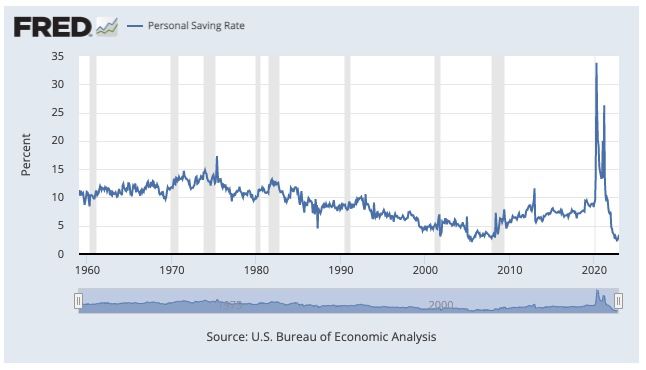
Note that sudden spike up to 32.2% during the coronavirus pandemic. That’s what fancy statisticians call an “anomaly,” and it already passed in the wake of high post-pandemic inflation. While a mildly interesting outlier, it doesn’t reflect the norm.
But here’s the thing about “the norm”: the Fed is calculating the average personal savings rate as a mean, not a median. That means the wealthy, and the FIRE walkers like you and me, heavily skew that number with our outrageously high savings rates.
Does anyone provide more accurate savings percentage data? Not really, but economists Emmanuel Saez and Gabriel Zucman calculated the average savings rates for the top 1%, the 90-99th percentiles, and the bottom 90% of Americans a decade or so back, and the numbers are telling:
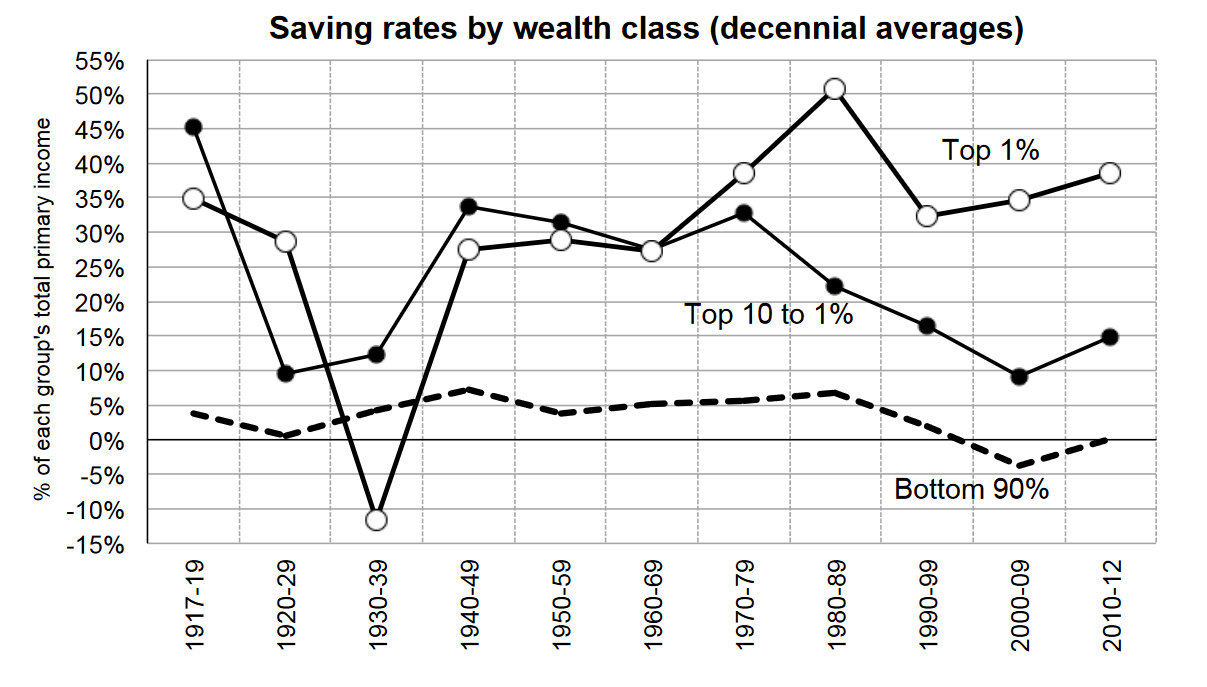

While these numbers don’t include the last few years, the pattern of the preceding century reveals more than enough. The bottom 90% of Americans save almost nothing, ranging between -5% and 5% depending on the strength of the economy.
Note that a negative savings rate means spending more than you earn, which typically takes the form of credit card- and other unsecured personal debts.
If you want to work and scrape for 40-50 years in order to afford a very modest retirement, follow the average American’s savings rate hovering around 0%. If you want to build wealth fast and reach financial independence within the next five-to-ten years, aim for an unreasonably high savings rate, such as living on half your income.
How Much of Your Paycheck Should You Save?
I see some variation of it asked on social media all the time:
Your savings rate determines how quickly you can retire or reach other financial goals. Regardless of your age, working becomes optional once you reach financial freedom and can cover your living expenses with passive income.
Toward that end, here are a few mindset shifts to help you approach your nest egg with more savvy:
- Stop thinking in terms of “retirement” and start thinking in terms of financial independence (FI): the ability to cover your living expenses with passive income from investments.
- Ignore age, and instead plan based on your FI horizon (AKA retirement horizon): the number of years you plan to take to reach financial independence. If you’re 40 and want to reach FI by 50, your FI horizon is 10 years.
- Set a target for monthly passive income to cover your living expenses. The lower your living expenses, the less money (and time!) it will take to reach financial independence!
With me so far? Great, let’s dive a little deeper into how savings rate impacts your retirement/financial independence planning.
Passive Income to Cover Your Living Expenses
Once you have a target for how much income it will take to cover your living expenses, you can start figuring out how to make it happen. Say you want $4,000 per month, or $48,000 per year. You could achieve that with:
-
- $2,000/month in net rental income
- $1,000/month in stock dividends and withdrawals
- $500/month in private REIT dividends (e.g. Fundrise and Streitwise, which pay 4-10% annually in dividends)
- $500/month in private notes (loans to other real estate investors)
For your stocks, imagine you’re following the 4% Rule, and planning to withdraw 4% per year from your stock portfolio to produce that $1,000/month in income. Start by multiplying that $1,000/month by 12 to reach the yearly amount ($12,000), then multiply that $12,000 by 25 to reach a target of $300,000 (4% x 25 = 100%). So you’d need $300,000 in stocks to produce $12,000 per year.
The good news is that you can bend the 4% Rule with rental properties. With a handful of rental properties, you can generate $2,000 per month in rental cash flow. You can even use tricks like the BRRRR strategy to keep recycling the same down payment over and over to build your rental property portfolio.
All in all, let’s say you want a nest egg of a million dollars. How long will it take you to save that up?
It depends on your savings rate, and the rate of return you can expect with your investments.
Savings Needed to Reach $1 Million
Over the last century or so, the S&P 500 has returned an average of around 10% per year, including dividends. Real estate investors can also expect to earn similar returns, albeit more predictably if they know how to use a rental cash flow calculator before buying.
I ran the numbers on how much monthly savings it takes to reach $1 million if you earn a 10% average return. Here’s what you’re looking at saving in order to reach financial independence over the following time horizons:
5 Years: $13,650/month
10 Years: $5,229/month
15 Years: $2,623/month
20 Years: $1,455/month
30 Years: $507/month
40 Years: $188/month
You can see why “Joe Six-Pack” doesn’t need a huge savings rate for retirement. He can live paycheck-to-paycheck because he plans to work a 40-50 year career. If you want to reach FI in just a few years, however, it takes a much higher savings rate.
!function(){“use strict”;window.addEventListener(“message”,(function(a){if(void 0!==a.data[“datawrapper-height”])for(var e in a.data[“datawrapper-height”]){var t=document.getElementById(“datawrapper-chart-“+e)||document.querySelector(“iframe[src*='”+e+”‘]”);t&&(t.style.height=a.data[“datawrapper-height”][e]+”px”)}}))}();
Tips to Boost Your Savings Rate
Like the idea of reaching financial independence in the next five or ten years, but not sure how you could possibly save all that money to do it?
Start with the Big 3 household expenses: housing, transportation, and food. According to the BLS, they make up nearly two-thirds of the average American household’s spending.
So yes, while cutting out the $5 latte helps, the greatest savings opportunities lie in a larger lifestyle overhaul that involves slashing your housing payment, transportation costs, and food costs. For gits and shiggles re-run the numbers in the savings percentage calculator above, cutting out your monthly housing payment. Quite the leap, eh?
Live for Free by House Hacking
I don’t pay for housing. Neither does our other founder Deni. How? By finding ways to make someone else pay for it.
The classic multifamily house hacking model involves buying a 2-4 unit property, moving into one unit, and renting out the other(s). But not everyone wants to live in a multifamily, and they’re hard to find in some areas.
Fortunately, there are plenty of other ways to house hack. I’ve used housemates before, and currently house hack through my wife Katie’s employer (which was not an accident: we designed our lives to make that happen). Deni has rented out storage space in her garage, moved into mixed-use properties, and even brought in international exchange students whose stipend covered her housing costs.
You can even house hack through your grown children with a kiddie condo loan.
Get creative with it, and find a way to make someone else pay for your housing!
Ditch at Least One Car
Americans don’t realize just how expensive cars are, when you add up all the costs.
According to AAA, the average cost to own a car for a year is $10,728, which includes maintenance, gas, parking, insurance, and, of course, the car itself. Think about how much faster you could build wealth and reach financial independence if you put that money toward your investments!
For years, my wife and I each owned a car. Then we got rid of one, and shared a car for four years, which saved us a ton of money. A few years ago, we intentionally moved to home where we can bike or walk to nearly everything we need to — in the rare instances we need a car, we take an Uber or rent a car for a weekend getaway.
It’s one of the ways we’ve achieved a 60% savings rate.
Stop Eating Meals Prepared by Someone Else
People love to fool themselves by categorizing restaurant meals, delivery, take-out, and other meals they didn’t make themselves under the broad category of “food” and calling it a necessity.
Basic groceries are a necessity. Meals that you pay someone else to make are a luxury and an entertainment expense. Stop kidding yourself.
In your budget, separate groceries from meals you pay someone else to prepare for you. Those should fall under the category of entertainment.
Pack your lunch every day. Host pot luck dinners rather than meeting friends out at restaurants. Stop ordering delivery and learn how to cook.
By cutting out meals you pay someone else to prepare, the median American family would save around $3,500 per year. And depending on your habits, that number could be far higher.
Cut Your Cable & Other Subscriptions
The average cable bill costs over $100 per month. You can instead pay around $10 for an online streaming service like Netflix or Hulu.
It’s a no-brainer. Cut the cord.
Then look into every other subscription you pay for monthly. Music streaming services, monthly delivery services like wine-of-the-month clubs or beauty product boxes, unused gym memberships, and a dozen other subscriptions sap your wealth every single month.
Pick one or two that you actually use all the time and can’t live without. Ditch the rest.
Try a Savings Challenge
Money saving challenges tend to be short-term sprints rather than ongoing lifestyle changes. But that doesn’t mean they can’t impact your long-term finances.
Savings challenges often prove to you that you can live on less than you previously thought possible. Sometimes they give you ideas for costs to cut, that you never would have thought up otherwise.
Even a quick, brief sprint can help you save a tidy sum quickly, that you can put toward a down payment on a rental property or some other income-producing investment. Which in turn helps you save money faster in the future.
Final Thoughts
What is a savings rate? It’s what enables you to build wealth — or what keeps you broke.
Which raises the next question: How much of your paycheck should you save?
It depends on how quickly you want to build real wealth and reach financial freedom. Real wealth isn’t conspicuous. You can’t drive it or wear it or show it off to your friends. Real wealth exists in ones and zeroes, in your financial investments and real estate holdings.
It’s precisely why people serious about growing their net worth talk about “stealth wealth.” They live in humble homes, share a car with their spouse, wear affordable clothes. And they build wealth far faster than their flashy friends.
You will build wealth and reach financial independence based on the gap between what you earn and what you spend. Grow the gap, and watch your riches start to compound on themselves.
This article originally appeared on SparkRental.com and was syndicated by MediaFeed.org.
More from MediaFeed:
- The funny & sometimes tragic real names of celebrities
- 25 American customs that make you look like a jerk abroad
- 39 surprising things you may not know about cannabis
Like MediaFeed’s content? Be sure to follow us.
The smartest ways to save for retirement

Saving for retirement is one of the most important financial goals there is, but it isn’t always easy. Even with the best intentions, it can be difficult to discipline yourself to put money away for a nebulous “someday,” especially when you’re busy trying to make ends meet now.
But there are plenty of ways to save for retirement more efficiently, making every dollar go a little bit further toward a well-deserved rest in your golden years.
A lot of the “getting started” part is becoming educated on how different retirement plans work and what your options might be depending on your financial situation.
gorodenkoff / iStock

If your company offers a 401(k), it’s usually a good idea to contribute to it at least a little bit. The contributions will be automatically deducted from your paycheck and may also be made from pre-tax money, which will lower your taxable income.
designer491 / istockphoto

If your employer offers a 401(k) match, there is even more incentive to contribute. A match is about as close as it comes to free money and is considered part of an employee benefits package. Your company may have a vesting schedule, meaning you don’t obtain full ownership of its contributions until you’ve been working at the company for a certain amount of time. You’ll always maintain full ownership over the money your contributions, however.
fizkes / iStock

Thanks to the power of compound interest, the earlier you start saving for retirement, the more you’ll likely make over time. It’s never too early to start, so get cracking!
Deposit Photos

Making regular contributions is one of the best ways to grow your retirement funds. With a company-sponsored retirement fund like a 401(k), the money comes out of your paycheck each period. But if you’re DIYing your retirement with an IRA, for instance, you’re in charge of making sure money’s going in.
DepositPhotos.com

Even if you are actively investing in a 401(k), you may be able to boost your retirement savings even more by also opening an IRA. If you’re self-employed or working at a job that doesn’t offer retirement benefits, an IRA might be the very best choice available for you. IRAs are easy to open and available to almost anyone, so long as you earn an income.
Depositphotos

The contribution maximum for IRAs is relatively low, compared to 401(k). For 2022, you can contribute up to $6,000 per year to your IRA, or $7,000 if you’re aged 50 or over and eligible for catch-up contributions. Maxing out your IRA each year can help set the foundation for a successful retirement and also help you save money on taxes during the year the funds are contributed if you’re eligible.
DepositPhotos.com

A Roth IRA works a little differently than traditional IRAs and 401(k)s. Rather than getting a tax break now, you’ll get it later when you take the funds out during your retirement years. If you’re eligible for a Roth account, you may be able to have some tax-free income in retirement.
DepositPhotos.com

If you earn more than $129,000 as a single person or $204,000 as a couple (for 2022), your eligibility to contribute to a Roth is reduced, and if you earn much more than that, you may be ineligible entirely. However, you can still transfer the funds in a traditional IRA into a Roth account, provided you pay income taxes when you do so. This can help you score those tax-free earnings, even if you earn too much to directly contribute.
DepositPhotos.com

Contributing to your 401(k), or any retirement account, is just the start. In order to get that money growing, you need to make sure it’s allocated into investment categories like stocks, bonds, and cash. How your investments are allocated is likely to change over time, depending on your risk tolerance and the length of time before you plan to retire.
(If you have specific investment questions, we always recommend chatting with a qualified financial planner or other investing professional.)
DepositPhotos.com

Allocation and diversification go together like peanut butter and jelly. Maintaining a diverse portfolio helps you avoid having all of your investment eggs in one basket. If one company (or even one segment of the market) starts to falter, you have other investments to fall back on.
insta_photos/istock

Even if you’re diligent in looking at how to maximize your retirement savings, maintenance and trading fees can quickly eat into your funds. These fees do vary depending on what financial institution manages your account. It’s worth shopping around for an account that has reasonable 401(k) fees.
DepositPhotos.com

An HSA, or Health Savings Account, isn’t a retirement vehicle in its own right, but it can help you boost your retirement savings if it is treated as a retirement account. To qualify for an HSA, you must have a High Deductible Health Plan, among other requirements. HSAs are portable, so you can take them with you if you change employers or retire. Distributions taken for qualified medical expenses are tax-free, but non-medical distributions are taxable and may be subject to an additional 20% penalty.
chrupka / istockphoto

These days, few people stay at the same job for their whole careers. If you’ve been accruing retirement savings in a 401(k), it could be tempting to cash it out and treat it as a windfall when you change employers. But early withdrawal comes with a 10% penalty tax from the IRS, not to mention the regular income taxes you’ll have to pay on the money. It’s probably a way better idea to roll it into a new 401(k) or IRA and keep it growing.
DepositPhotos.com

After you’ve taken the steps to start saving for retirement and have a solid plan in place, it’s a good idea to make sure you are contributing as much as you can during your prime working years.
DepositPhotos.com

This one might cause a little stress, but it can pay off with an income increase just with a single conversation. Gather the specifics about why you’re an awesome employee and put on your negotiating hat. If you’re feeling bold, you might also ask for a retirement-specific benefit as part of the deliberations, like an increased 401(k) match!
DepositPhotos.com

Budgeting is the key to so many personal finance matters, and saving for retirement is no different. By seeing where the money is coming in and going out, you might find some places to cut back and find more money to stash away for the future. If you haven’t spent some time with your budget in a while, sit down and get to know it.
DepositPhotos.com

The amount you’re able to set aside for retirement will depend on your current earnings, cost of living, and many other factors. While an oft-cited rule of thumb suggests saving 15% of your income, that may not be feasible for you.
However, it’s still worthwhile to sit down and set a specific monthly retirement savings goal and commit to putting that much away. Focusing on how to increase your savings rate when your income or other life factors change will likely keep your retirement goals in sight.
Related: How to Make a Monthly Budget
Extreme Media / istockphoto

When you’re budgeting your income and expenses, it can be easy to leave savings as the last line item. By committing to saving first (setting money aside as soon as you get it), you’ll ensure you’re actually contributing to your retirement fund on a regular basis, helping it continue to grow as effectively as possible over time.
DepositPhotos.com

One easy way to ensure you don’t fall behind: Automate your retirement savings. Most brokerages and platforms have an option to allow you to automatically invest a certain amount on a regular basis. Again, just be sure you’re actually allocating the funds once they hit your account.
Youngoldman / istockphoto

We’ve all got to eat, which means we all spend money on food. But how much money we spend is another matter entirely. According to the latest data from the USDA, a household of two might spend as little as $410.60 on a month’s worth of groceries or as much as $815.60, a wide range. There are plenty of suggestions online for saving money on a grocery budget, so paying attention to expenditures here and getting creative with meals will probably net some savings to add to a retirement account.
Prostock-Studio/ iStock

Victor Xok on Unsplash

You can only make so many budget cuts, but you can almost always find ways to make extra money. Whether it’s freelance writing or selling your crafts on Etsy, a side-hustle might be a great way to increase the amount of cash you have on hand to put toward retirement.
istockphoto

Regular interest-bearing checking and savings accounts are still out there. Even though the interest earned might be minimal compared to investment accounts, it’s still better than not earning interest on those accounts at all.
DepositPhotos.com

If you’re getting a tax return, it may be tempting to spend the money on fun things, but when calculating how to maximize your retirement savings, it’s worth considering funneling some or all of it into your investment account. Saving instead of spending this money could add up to major nest egg increases.
nicoletaionescu / istockphoto

Aside from housing, car ownership can be one of the most expensive parts of day-to-day living for many people. It’s not just the cost of the vehicle itself, but also insurance, maintenance, and fuel. If you live in the kind of city where you could rely on public transit or take your bike to work, doing so might be a great way to make some substantial monthly savings.
DepositPhotos.com

Assessing your true housing needs is likely a major decision within a household, but if you live in a house that’s bigger than you need or in a pricey part of town, for example, it could be worth it to look at alternatives. Paying less monthly rent, lower taxes or even saving on transportation costs by moving closer to work could lead to substantial savings each month and help maximize your retirement savings.
kupicoo

Renting can be a good option for certain needs, lifestyles, or periods of your life. But homeowners do tend to accrue more wealth over time. Buying and selling often tends to cost money in closing and moving costs, so if owning a home is something you want to do, buying a home and staying there for a number of years is typically a better way to handle an investment like this.
DepositPhotos.com

While any kind of debt can put an anchor on your retirement goals (and other financial goals, for that matter), credit card debt can be particularly egregious thanks to high-interest rates and compounding, which means you can end up paying interest on the interest you’ve already been charged. By tackling credit card debt and other high-interest debts, you’ll have the opportunity to save more money to put toward retirement.
kitzcorner // istockphoto

DepositPhotos.com

This relates indirectly to boosting your retirement savings, but since paying for a child’s college costs can quickly derail a parent’s retirement plan, thinking about this major expense ahead of time can be a wise financial move. Many experts suggest making sure you’ve funded your own retirement accounts before you fund education accounts for your children. Each state operates its own 529 plan, and the terms vary from state to state. The plans are not tax-deductible on a federal tax return, but a 529 plan can offer some tax advantages on the state level depending on the state.
DepositPhotos.com

Any amount you save for retirement will still be a finite amount, which means it’s important to plan ahead of time how you’ll budget for it. Consider the costs of everything, including food, medical care, housing, transportation, and entertainment. Try to envision ways to keep your cost of living low so each dollar goes further once you get there.
DisobeyArt/ iStock

No matter how much you’re able to save for retirement, the money will go a lot further if you retire somewhere with a lower cost of living. If you have decades before your retirement date, it may be difficult to predict what the cost of living will look like in different places, but start to think about which locations might offer all the lifestyle factors you want while also being affordable.
Related: Cost of Living per State (2022)
adamkaz

Once you reach age 50, the contribution caps on your IRA and 401(k) go up substantially, by $1,000 for IRAs and $6,500 for 401(k)s, in 2022. Maxing out these larger retirement caps can help you increase retirement savings you’ve fallen behind on or rebuild retirement savings you cashed out for something else.
DepositPhotos.com

For many of us, this step might not be coming up anytime soon. But once you’re eligible for Social Security retirement benefits, delaying it might give you a larger monthly benefit during retirement.
Zinkevych / istockphoto

Saving for retirement might be challenging, but it’s not impossible. Stretching every dollar as far as you can will make it a lot more doable. Like so many other financial goals, it all starts with your budget, and budgeting is a lot easier to do when you have a bird’s-eye view of your finances.
Learn More:
This article
originally appeared on SoFi.comand was
syndicated by MediaFeed.org.
SoFi Money
SoFi Money is a cash management account, which is a brokerage product, offered by SoFi Securities LLC, member FINRA / SIPC . SoFi Securities LLC is an affiliate of SoFi Bank, N.A. SoFi Money Debit Card issued by The Bancorp Bank. SoFi has partnered with Allpoint to provide consumers with ATM access at any of the 55,000+ ATMs within the Allpoint network. Consumers will not be charged a fee when using an in-network ATM, however, third party fees incurred when using out-of-network ATMs are not subject to reimbursement. SoFi’s ATM policies are subject to change at our discretion at any time.
Tax Information: This article provides general background information only and is not intended to serve as legal or tax advice or as a substitute for legal counsel. You should consult your own attorney and/or tax advisor if you have a question requiring legal or tax advice.
SoFi Invest®
The information provided is not meant to provide investment or financial advice. Investment decisions should be based on an individual’s specific financial needs, goals and risk profile. SoFi can’t guarantee future financial performance. Advisory services offered through SoFi Wealth, LLC. SoFi Securities, LLC, member FINRA / SIPC . SoFi Invest refers to the three investment and trading platforms operated by Social Finance, Inc. and its affiliates (described below). Individual customer accounts may be subject to the terms applicable to one or more of the platforms below.
1) Automated Investing – The Automated Investing platform is owned by SoFi Wealth LLC, an SEC Registered Investment Advisor (“Sofi Wealth“). Brokerage services are provided to SoFi Wealth LLC by SoFi Securities LLC, an affiliated SEC registered broker dealer and member FINRA/SIPC, (“Sofi Securities).
2) Active Investing – The Active Investing platform is owned by SoFi Securities LLC. Clearing and custody of all securities are provided by APEX Clearing Corporation.
3) Cryptocurrency is offered by SoFi Digital Assets, LLC, a FinCEN registered Money Service Business.
For additional disclosures related to the SoFi Invest platforms described above, including state licensure of Sofi Digital Assets, LLC, please visit www.sofi.com/legal. Neither the Investment Advisor Representatives of SoFi Wealth, nor the Registered Representatives of SoFi Securities are compensated for the sale of any product or service sold through any SoFi Invest platform. Information related to lending products contained herein should not be construed as an offer or pre-qualification for any loan product offered by SoFi Lending Corp and/or its affiliates.
Investment Risk: Diversification can help reduce some investment risk. It cannot guarantee profit, or fully protect in a down market.
External Websites: The information and analysis provided through hyperlinks to third party websites, while believed to be accurate, cannot be guaranteed by SoFi. Links are provided for informational purposes and should not be viewed as an endorsement.
Rawpixel/istockphoto

DepositPhotos.com
Featured Image Credit: Goran13/istockphoto.