Over more than a year, I crisscrossed the country, exploring battlefields, historic houses, forts, and more.
I went under the spell of an amateur hypnotist at a U.S. Army fort in Tennessee, admired a sunset from the grounds of the notorious Andersonville prison camp in Georgia, and briefly interviewed Louie the wild boar in Virginia’s Shenandoah Valley.
It was a trip unlike any I’d ever taken, and one I decided was worth sharing with readers who are as consumed with Civil War history as I am.
The following is one of the adventures I had during my trip, and it starts on the back of an ATV with a “psychotic connection” in Mississippi.
On the porch of a rickety cabin in backwoods Mississippi, 63-year-old Sid Champion V—my folksy and eclectic Champion Hill battlefield tour guide—introduces me to his cats Inki and Thudd. Then he plops himself into a chair, invites me to sit down across from him and slides a fly swatter across the table. On this balmy morning in the Deep South, bugs are already selecting victims. Hanging from the cabin wall are signs reading “Psycho Parkway” and “Hunters, Fishermen, and Other Liars Gather Here.”
We’re at Midway Station, the home of Champions since 1865, starting with Sid’s great-great grandparents. Woozy from a lack of sleep, I hand Champion a crisp roll of five 20s—his standard fee for a tour of a battlefield intertwined with his family since the morning of May 16, 1863, when gunfire erupted near where we sit. This is the beginning of what Champion later calls our “psychotic connection.” We’re both Civil War crazy.
Champion considers himself the family Shinto, the keeper of stories. He’s an epic storyteller, speaking in rapid-fire bursts punctuated with the occasional booming explosion of verbiage.
Minutes into our visit, I tell Champion about an adventure in moonshining and Civil War guerrilla fighting country in Middle Tennessee.
“Brother, you’re in moonshining country right here. I’ve got some ‘corn squeeze’ in the kitchen in the deep freeze, 120 to 130 proof. Cleans coins as well as your arteries.”
Now there may be a prohibition against the “squeeze” in the devout Champion’s Southern Baptist church in Hinds County, Mississippi, where he sings in the choir and serves as pianist and organist. So, I consider keeping this secret. Besides, I’m not visiting for the ‘shine. I’m here for the shrine—the hallowed ground that bears the Champion family name.
What a family history. What a battlefield. What a battle.
In 2019, the National Park Service incorporated 800 acres of the Champion Hill battlefield into the Vicksburg National Military Park. But core battlefield remains in private hands. In 2022, Champion, his California-based sister and two cousins sold 144 acres to the American Battlefield Trust, the national preservation organization. Champion initially was reluctant to sell. But he eventually came around because he retains hunting, fishing and access rights.
“Some of the finest white-tailed deer hunting right here,” Champion says.
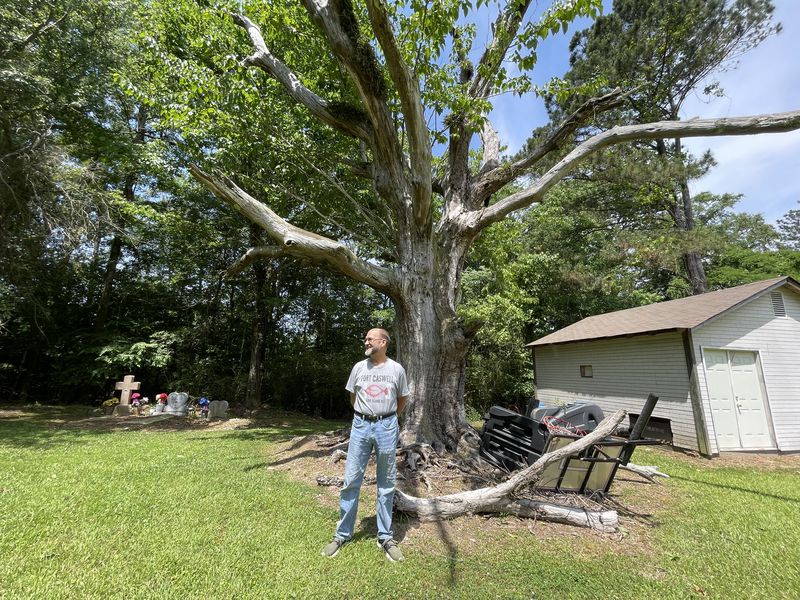
He plans to tear down the ramshackle remains of the house next to the cabin, build a new place to live in, and then move from Clinton, about 12 miles east. He might spend the rest of his life out here with his grumpy Italian honey bees and the spirits of kin buried in the family cemetery out back.
“This land was here before me, and it will be here after me. I’m just here to take care of it for a bit.”
My visit falls on the anniversary of the battle, which at least guarantees to raise the hair on the back of my neck. On that sweltering day at Champion Hill in May 1863, Ulysses Grant’s 32,000-man army defeated roughly 22,000 Rebels under John Pemberton, a Pennsylvania-born lieutenant general many in the Confederacy gave the side-eye.
“One of the worst people,” says the Vicksburg-born Champion of Pemberton, who was buried in Philadelphia, Pennsylvania, not far from where I came into the world.
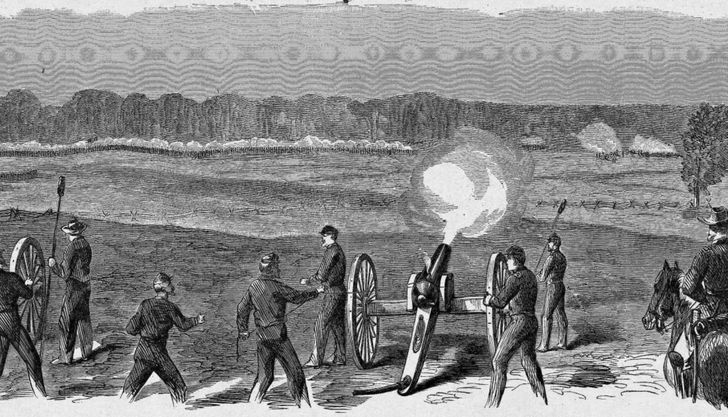
The Battle of Champion Hill, known by some as the Battle of Baker’s Creek, was a see-saw affair, with the U.S. Army turning the tide late in the fight. It lasted roughly four hours, “hard fighting,” Grant wrote in his memoirs, “preceded by two or three hours of skirmishing, some of which almost rose to the dignity of battle.” Soldiers fired blindly in the woods as battle smoke made it almost impossible to see. “The dead men and wounded laid as thick on the field as sheep in a pasture,” a U.S. Army soldier recalled of the carnage.
Of his 29,000 soldiers engaged, Grant lost 410 killed, 1,844 wounded, and 187 missing. Pemberton’s army suffered 381 killed, more than 1,000 wounded, and more than 2,400 missing—mostly prisoners. The Confederate Army of Mississippi fell back into the defenses of Vicksburg, never again a serious offensive threat. On July 4, nearly two months after their defeat at Champion Hill, the Rebels surrendered the strategic city—perhaps the turning point of war. The Yankees finally controlled the mighty Mississippi.
Until his high school days in Jackson, Mississippi, Champion hadn’t heard or read much about the battle on his family’s land.
“Daddy didn’t say much about it because he didn’t see how you could glorify war.”
Then a teacher brought Champion’s battlefield connection to the attention of his classmates: “We have a celebrity in the house.”
Champion’s reaction: “Say what?”
“Then I started asking questions. And then I found out our family had dozens of letters between Sid and Matilda Champion.”
In the early 1850s, Matilda Montgomery Cameron—a feisty, petite, redheaded divorcee with a young son—was living with her wealthy parents on a Madison County, Mississippi, plantation when she met Sid Champion, a studious, literature-loving bachelor. During the Mexican War, Champion had fought under Jefferson Davis—the future president of the Confederacy.
“Man, it was chemical,” Sid V says of the relationship between Sid and Matilda, his great-great grandparents.
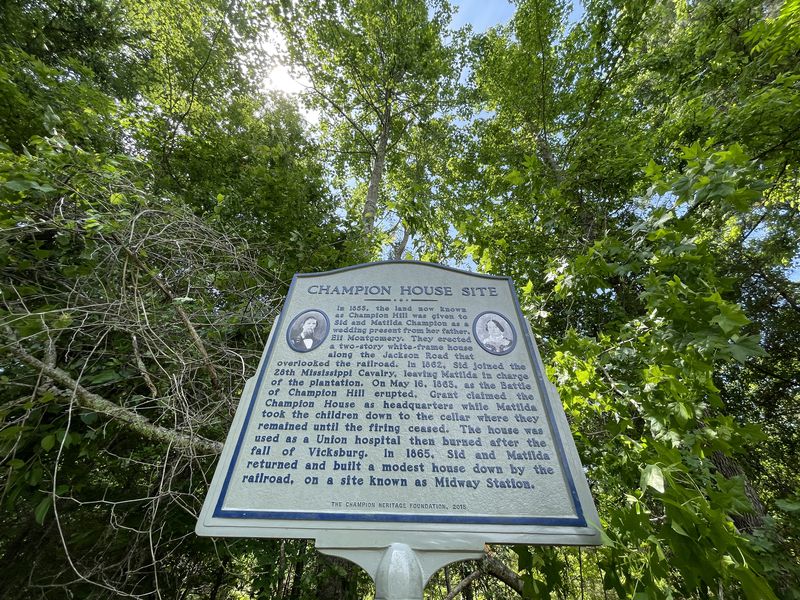
After Champion proposed, Matilda’s father Eli was aghast: No well-bred daughter of mine is going to marry the son of a dirt-poor farmer. But Matilda and her mother persuaded Daddy to give the chemical connection his blessing. In 1853, the couple married. Champion was 30; Matilda 26. As a wedding gift, Eli Montgomery gave the couple 68 slaves, 1,200 acres and a two-story, white frame house near the Old Jackson Road. Later, the plantation expanded to 2,000 acres and more than 160 slaves. Champion Hill became one of the state’s largest plantations.
In March 1862, nearly a year after the Rebels fired on Fort Sumter, Champion joined the Vicksburg-based 28th Mississippi Cavalry, serving as a third sergeant under Nathan Bedford Forrest, among others. Matilda bristled when Champion left her and their four young children behind with dozens of slaves and their overseer.
Back at Midway Station, Champion retrieves his 22-year-old ATV, our Champion Hill battlefield transportation.
“You ever hear of a man cave? Well, this is man land!” he hoots, stretching his arms wide.
Champion drives while I sit behind him atop a small, camouflaged pad thingy on a rack—no, not the Medieval torture kind. But I consider sending Mrs. B a proof-of-life photo anyway.
Here’s what you need to know about “man land”: It ain’t Antietam or Gettysburg, with paved park roads, granite statues of imposing soldiers toting muskets, and an ice cream shop in town. Heck, the closest town is Bolton (population 900), four bumpy miles away. There’s no ice cream shop there. No statues or huge monuments stand on the battlefield either.
Champion Hill itself consists of heavily wooded knobs, undergrowth, and sharp ledges, with fields of wild rye occasionally breaking up the ground. Baker’s Creek and its branches snake through this rugged, nearly pristine battlefield. On private and leased NPS land, farmers plant cotton, corn, and soybean.
The Old Jackson Road—once the main route between the state capital in Jackson and Vicksburg—winds through Champion Hill. Both armies used it. It’s just a narrow, dirt road now.
Now here’s what you need to know about my ATV driver: Even at max cruising speed, Champion will not warn you about fallen tree limbs at head-high height across the Old Jackson Road. Duck or risk decapitation. In 2009, an accident on an ATV laid up Champion for six months. Our experience has all the thrills and terrors of riding a mechanical bull in a Texas bar, minus the beer and pretty women.
But my oh my, what an experience it is.
John Banks is a columnist for Civil War Times and the author of A Civil War Road Trip of a Lifetime, from which this article was excerpted. It was published by Gettysburg Publishing. For details on how to purchase an autographed copy, email John Banks at [email protected]
This article was produced and syndicated by MediaFeed.
- Classic rock albums that Boomers love & the kids should, too
- Men over 60: These hobbies will keep you entertained & active
Like MediaFeed’s content? Be sure to follow us.
Featured Image Credit: Wikipedia / Public Domain.