Anyone remotely interested in travel should be at least familiar with how traveling using miles and points works as it has the potential of saving anyone an enormous amount of money. If you are terrified of spending loads of cash, but also have a compulsive need to explore the world, then using miles and points is definitely for you. I see it as the juncture where frugality and travel intersect. Travel using miles and points is the marriage of the two. But how does it exactly work?
What is travel using miles and points?
You have probably heard about frequent flier miles and points. This hobby is all about accumulating these points, except that it does not require travel.
Every major airline or hotel brand has its own loyalty program to encourage consumers to keep on coming back.
Loyalists tend to earn these points when they consistently fly the same carrier or book the same hotel.
The more points they accrue, the higher their chances of getting rewarded with free stuff – typically free flights or hotel stays.
But, what if you rarely fly or stay in hotels?
Previously, the only way to accumulate these “loyalty” or “frequent flier” points is by flying with the same airlines or staying in the same exact hotels every single time.
Thankfully, that is just now a thing of the past.
Currently, anyone can earn these frequent flier points by accruing miles and points.
Simply put, you can travel for nearly free by applying for specific travel credit cards in order to accrue generous sign-up bonuses that can be ultimately redeemed for free flights and luxurious hotel stays.
For example, one of the best travel cards out there – the Chase Sapphire Preferred – gives 100K points as a bonus after meeting a spending requirement. 100,000 miles is enough to fly to Hawaii round-trip….for 2 people!
Imagine if the only method to accrue points is from flying – it will take any casual tourist hundreds of flights just to get to 100,000 miles.
That is the reason why leveraging travel credit cards is a gift to the frugal tourist; anyone can practically earn lots of frequent flier points, even without stepping foot at an airport.
Travel for free by using miles and points
Another reason why points enthusiasts are passionate about stockpiling points is that their selections multiply when it is time to redeem.
In fact, first or business-class seats and rooms in grand hotels suddenly become attainable if you strategize well when deep dive into this hobby.
Conversely, if you do not optimize your approach by planning ahead and being flexible, there is a high likelihood that you will be left with lackluster awards.
However, no matter what your redemption is, as long as you’re not shelling out an enormous amount of cash, you are guaranteed to come out ahead.
Case in point, a Trans-Pacific flight in business class will require significantly more points than a seat on coach. Similarly, a 5-star hotel in the middle of Manhattan will most certainly need more points than a 3-star hotel in Queens.
Hence, one of the chief goals of traveling using miles and points is to master the art of systematically accumulating these points and identifying the best redemption options.
Who can use travel credit cards?
Whether you are a novice or an expert traveler, I highly recommend dabbling in accumulating travel miles and points by using travel credit cards.
It has allowed me to see places I would never have imagined visiting in this lifetime for a fraction of the price.
However, it is not for everyone. Although anyone can capitalize on this lucrative hobby, it only works with individuals who possess a certain financial profile.
Since this involves leveraging credit card debt for a specific purpose, banks will naturally only approve applicants they know will be responsible clients.
If you have an excellent credit score and an impeccable financial background, then kudos to you as you can, without a doubt, successfully optimize this strategy.
Here’s a litmus test to determine if you are compatible with using travel credit cards:
Is paying your credit card promptly not your strongest suit yet? Then I suggest holding off on this hobby until after you’ve reached a point that you’re debt-free and financially disciplined.
Despite their lucrative rewards, credit cards in general can ruin anyone’s financial future. Those steep bank interest charges quickly add up and can wreak havoc on your fiscal goals.
Is travel using miles and points really free?
Let’s get this fact out of the way – award flights are not completely free.
Passengers redeeming awards still need to pay the associated taxes.
Sometimes, airlines also unfairly add fuel surcharges and other carrier-imposed fees to the final sum, thus causing the cash portion of the redemption to skyrocket.
I’m looking at you, British Airways! If you redeem a ticket with British Airways, you will undoubtedly shell out hundreds of dollars to pay for fuel and taxes. So, steer clear!
The strategy is to avoid redeeming miles on airlines that charge this fee. You will most likely know if they do because your free ticket will come with a price tag amounting to a few hundred dollars. That should not be the case.
Pro Tip: Redeem your miles only with airlines that do not slap this excessive fee.
In my example below, I booked a business class ticket on Qatar Airways that required 70K points and only $15.70 on taxes for a flight from San Francisco to the Maldives. And, no carrier-imposed fees either.
This is an incredible redemption in the truest sense of the word. It would have cost over $6,000 if I had purchased this exact ticket in cash.

10 truths about travel using miles and points that every beginner should know
1. It is not easy
Please do not believe it when people say that travel using miles and points is a walk in the park, because nothing can be further from the truth. Leverage travel using miles and points requires a tremendous amount of research and legwork. But, if you are steadfast and passionate about it, then your efforts will surely be rewarded.
Behind all great accomplishments in life are hard work, determination, and flexibility. This hobby requires the same traits. Even if the methods appear quite simple at face value, it does involve so many moving pieces that it is relatively common for people to get overwhelmed and give up on it altogether.
At any rate, practice makes perfect, and the more you employ the tactics in this blog, the more competent you become in navigating this complex world of miles and points. Once you have come to terms with the fact that this hobby is not easy, you’re ready for the next step. Read along.
2. You need to have a travel goal
For this hobby to be motivating, you will need to have a goal that will serve as your North Star to keep you plugging along in this journey. It could either be a dream vacation with someone special or a bucket list destination you have been aiming to tour solo. Wherever it is you want to go, it will be within reach with travel miles and points.
When I was a child, I never would have envisioned that I would fly overseas, let alone visit Europe, Africa, the Maldives, and Tahiti.And yet, these are just a few examples of aspirational places I’ve recently ticked off because of this hobby.
Without a specific purpose, you can lose focus and be tempted to throw in the towel.
I recommend that you keep your eye on the prize, always.
Having a goal will fuel your drive to continue earning those valuable points regardless of the circumstances, like COVID19.
We may not be able to travel now but it is a far cry from being a permanent ban. For this reason, we should not press pause on accumulating points.
So, write down those goals on a piece of paper and visualize yourself lounging in an overwater bungalow on a remote island in the Indian Ocean. It might just happen!
Once you have a list of goals, it’s time to talk about strategy. How do you inch closer to attaining those goals?
3. Travel using miles and points has two parts
A novice travel points enthusiast must be familiar with the two essential parts of travel using miles and points.
- Accumulation
- Redemption
Accumulation pertains to the methods involved in earning points. There are several accumulation strategies available, and we will go over some of them later in this post.
Redemption involves the process of converting those points to rewards. There is almost always more than one way to redeem your points; therefore, it is crucial to be familiar with all possible redemption pathways before finalizing your selections.
The ideal points hobbyist is constantly accumulating points while simultaneously learning various redemption programs.
New opportunities for accumulation pop up almost daily, and airline programs frequently overhaul their redemption charts, so it is best to stay updated.
Feel free to join us in our free Travel Points and Miles Facebook Group where we talk about accumulation and redemptions strategies regularly.
In a nutshell, being skillful in both accumulation and redemption is the secret formula to being successful in using miles and points.
Pro Tip: Many points enthusiasts are fantastic with accumulation but struggle with redemptions. Do not give up – it’s undoubtedly a steep learning curve, but it gets better with practice. Before redeeming, do your due diligence by reviewing as many options as possible and select the superior (cheapest) alternative.
4. Accumulation is the easier part
Earning points is the easier task of the two, and can be done by applying for specific credit cardsthat earn travel rewards after meeting a minimum spending requirement.
As mentioned above, it is imperative to possess a stellar financial profile so banks will most likely approve your credit card applications.
Like saving money, the “Accumulation” phase takes time, but if you are earnest, methodical, and unwavering about this step, expect to be traveling to your next dream destination in no time!
I always operate with a mindset of consistent miles accumulation with the objective of redeeming free future travel for years to come.
At 43, I anticipate at least 20 more years of travel on the horizon. With my current pace of 3 international trips per year, I am looking at 60 international trips that I would need to afford using miles. Suffice to say, I need a couple of million miles!
Thus, I am consistently on the lookout for opportunities to boost my mileage accounts.
Aside from applying for credit cards that give out generous sign-up bonuses (SUB), I also take advantage of the following accumulation methods:
- Category bonuses: some credit cards give extra points when purchasing at certain establishments such as gas stations, hotels, or office supply stores.
- Shopping: some travel credit cards offer extra points for using their websites to shop.
- Dining: certain credit cards award miles for signing up in their dining rewards program.
Pro-Tip: Typically, I apply for new credit cards when I anticipate a considerable spending opportunity in the pipeline, such as property taxes, annual insurance dues, home repairs, etc. I also have some extra cash saved, so I’m able to pay for these credit card expenses when they are due.
5. Know the airline alliances and partnerships
Before we deep dive further into accumulation and redemption, you must be familiar with alliances and partnerships.
Airline alliances are partnerships among a group of airlines that allow for seamless sharing of route networks and frequent flier programs.
The three big airline alliances are Star Alliance, One World, and Sky Team.
In the United States, we have three major carriers that offer a global network – United, American, and Delta.
These three major carriers are affiliated with the 3 global airline alliances I mentioned above.
The table below illustrates the alliances and their respective members.
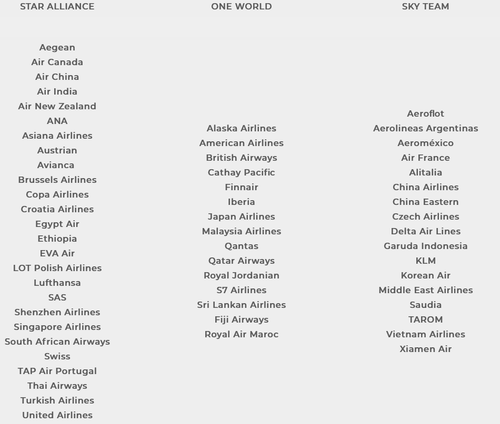
I cannot emphasize enough how important it is to be familiar with this list. Your travel strategy will somehow rely on your knowledge of these alliances.
You are probably curious why. Let me explain.
Accumulating points for an airline belonging to one alliance gives you the ability to redeem those points for flights on any other member airline in the same association.
For example, having United Airlines miles allows anyone the opportunity to redeem for flights on any of the Star Alliance members, such as Singapore Airlines, Air New Zealand, etc.
Likewise, since Delta is a Sky Team member, you can use your Delta frequent flier miles to fly with Air France, Korean Air, or any of the member airlines in Sky Team.
Some airlines, such as Southwest, are not a part of any alliance. Therefore, miles accrued from their affiliated credit cards can only be redeemed solely with the airline.
Partnerships
Alternatively, being familiar with airline partnerships is also recommended.
Simply put, these are agreements between two airlines that do not belong in the same alliance. Similar to alliances, these partner airlines share routes and frequent-flier benefits.
United Arab Emirates’ two flagship carriers – Etihad and Emirates – do not belong to any of the alliances as of this writing, but both have airline partners.
One of my most luxurious redemptions to date was Etihad’s First Class cabin called “The First Apartments.”
Each “First Apartment” comes with a suite with a door, a separate bed, an opportunity to shower up in the air, and dining on-demand with our own dedicated butler and chef.
It was an industry game-changer when it was introduced in the skies a few years back.
What was fascinating about this redemption was that I did not own Etihad miles at all.
ZERO.
And yet, I was still about to book that seat. How did I do it?
I leveraged partner awards.
What are the steps?
- Through research, I became aware that Etihad has a partnership with American Airlines.
- I applied for credit cards that earn American Airlines miles.
- Once I have accumulated the AA points required to book an Etihad flight, I went online on AA.com and searched for the particular flight I wanted on Etihad.
- After locating my particular flight, I used my AA miles to redeem a first-class seat on Etihad.
In short, collecting miles for one particular airline (e.g., AA miles) gives you access to redeem award seats with its partners, both within the same alliance or outside of the coalition.
So, how do we determine the particular airline miles to collect so we can have as many possible redemption selections available?
We will talk about that in the succeeding sections.
6. Your accumulation strategy should align with your goals
In this section, we will get a little bit granular. This is where the research begins.
Think of a destination you want to visit in the future as a goal.
Let’s say Dubrovnik, Croatia.
You need to figure out the airlines that fly to Dubrovnik, Croatia, and check if they are members of any of the alliances or partnerships. Here are the steps:
- Go to Wikipedia
- Type the city “Dubrovnik” and “airport”
- Click “Airlines and Destinations”
- Write down the airlines that you recognize to be a member of the alliances above
On a quick search, I can see that Turkish (Star Alliance) flies year-round from Istanbul, American (One World) flies seasonally from Philadelphia, and Air France (Sky Team) flies seasonally from Paris.
Since Turkish is a Star Alliance member, you can redeem Turkish miles for this particular route.
Technically, if there is a Turkish Airlines credit card available, you would want to apply for it. However, it is not as straightforward as that.
Pro Tip: Before applying for a credit card, you will need to figure out if it has the best offer available. Comparing it side by side with other current offers is recommended. Sometimes, waiting for generous offers to roll out before applying yields better returns.
But, since I live in the United States and I am based in San Francisco, a United Airline hub, a better option for me is to apply for a United Credit Card to accrue United miles.
Since United Airlines and Turkish Airways belong in the same alliance, I can then use my United miles to fly on Turkish Airways to get to Dubrovnik.
This is a simplified version of how using your knowledge of alliances can pave the way for flying on partner airlines.
As you advance your skills in this endeavor, you will learn additional tricks on how to maximize your redemptions to ensure you are getting the best bang for each mile.
(Turkish is a transfer partner of Citi ThankYou Points, therefore you can also apply for a Citi Credit Card that earns ThankYou points since you can transfer this currency to Turkish in order to fly to Dubrovnik.)
Advanced: Inflight products and services vary widely across airlines. So, it is not unusual for travel hobbyists to have accumulation goals centered on the type of cabin and aircraft they want to experience. My aim is always to shoot for the most lavish offering that I could not otherwise afford. For example, I have saved up a substantial amount of American Airlines miles because I am particularly interested in redeeming a spot on Etihad’s grand First Apartments on their Airbus A380 and Qatar Airways’ splendid Q Suites on their Airbus A350. Others, however, focus on quantity, or the number of awards they can redeem with their points. Either goal is fine!
7. Accumulation involves multiple credit card currencies
Since amassing generous credit card sign-up bonuses is a vital strategy in this hobby, we will devote this section to identifying the type of credit cards a beginner points enthusiast should apply for.
Travel credit cards can either be co-branded or flexible.
Both can churn out a tremendous amount of points. And yet, they are also fundamentally different from each other. It is necessary to learn their differences to assist you in choosing the best pathway in accumulating points.
Co-branded credit cards
In the prior section, we learned that some airlines have their own dedicated credit cards. These are called co-branded credit cards as they are born from a partnership between a bank and a travel partner.
For example, United Airlines has a partnership with Chase, so Chase Bank has the exclusive rights to offer United Airlines co-branded credit cards. Co-branded cards earn a specific type of point.
In this case, the United Airlines credit card will only produce United miles. In other words, it is a fixed currency in that you can only redeem it at the United website and can not be transferred to other programs.
The table below summarizes some of the popular ones.

Flexible Credit Cards
Besides applying for a co-branded credit card that produces a specific type of point, it is also possible to apply for bank credit cards that earn points that can be transferred to various airline and hotel partners.
I like to label these bank cards as flexible credit cards as the points earned from them can be redeemed using a variety of ways – from “cashback” to “transferring to multiple travel partners”.
The table below summarizes the most popular flexible bank currencies that can be used for travel, and the respective credit cards that generate them.

In summary, there are two types of credit cards that can generate airline points.
- Co-branded Credit Cards are affiliated with specific airlines and hotels. These cards only generate a particular type of point, hence it is a “fixed” currency. For example, the United Explorer Credit Card only churns out United Airlines miles. Note that United Airlines is a Star Alliance partner; therefore, United miles can be redeemed for flights on all of its alliance partners as long as the flights are redeemed at United.com.
- Flexible Credit Cards can be earned from specific Chase, AmEx, Citi, and Capital One cards. Points accrued from these credit cards can be redeemed in various ways, including transferring to airline and hotel partners. Note that there are other flexible credit cards out there, but I am only sticking with the major players in this article.
8. Flexible credit cards have transfer partners
One of the advantages of flexible credit cards is that their points are not restricted to just one airline or hotel brand.
Points earned from these cards can be transferred to multiple travel partners. This versatility is why it is my first choice when applying for credit cards.
Let’s explore the various transfer partners of the four bank travel currencies listed in the previous section.
| TYPE OF POINTS | AIRLINE PARTNERS |
| Chase Ultimate Rewards (UR) (1 UR: 1 mile) |
AerClub (Aer Lingus) British Airways Emirates Flying Blue Air France/KLM Iberia Plus JetBlue True Blue Singapore KrisFlyer United Mileage Plus Virgin Atlantic |
| American Express Membership Rewards (MR) (1 MR: 1 mile unless indicated otherwise) |
Aero Mexico (1 MR: 1.6 miles) Air Canada Alitalia AerClub (Aer Lingus) All Nippon Airways Avianca British Airways Cathay Pacific Delta El Al (50 MR : 1 mile) Emirates Etihad Flying Blue (Air France/KLM) Hawaiian Iberia Jetblue Qantas Singapore Virgin Atlantic |
| Citi ThankYou Points (TYP) (1 TYP: 1 mile) |
Aeromexico Air France-KLM Flying Blue Avianca LifeMiles Cathay Pacific Asia Miles Emirates Skywards Etihad Guest EVA Air Infinity Jet Airways JetBlue TrueBlue Malaysia Airlines Enrich Qantas Frequent Flyer Qatar Airways Singapore Airlines KrisFlyer Thai Airways Royal Orchid Plus Turkish Airlines Miles&Smiles Virgin Atlantic Flying Club |
| Capital One Miles (2 points: 1.5 miles) | Aeromexico Air Canada (Aeroplan) Air France & KLM (Flying Blue) Alitalia Avianca Cathay Pacific Etihad EVA Air Finnair Hainan Airlines JetBlue Qantas Qatar Airways |
| Capital One Miles (2 points: 1 mile) | Emirates Singapore Airlines (2:1) |
Upgraded Points has a marvelous tool that can calculate the miles you will get when transferring from each of these programs.
Remember that transferring to an airline partner is an irreversible process. Once you have successfully converted your bank points to miles, there is no turning back.
Before transferring, you want to do two things:
- Make sure the flight or hotel you want to redeem is available.
- Ensure that the airline partner you are transferring miles to allows instant transfers. Some transfers take a few days to complete, resulting in “stuck” miles in a partner airline when the flight you want to redeem has already been purchased by someone else.
Pro-Tip: Not all miles are created equal. Before you start accumulating, you need to research which programs generate miles that can be redeemed or transferred to multiple partners. You must also select airlines that require the least amount of points and cash. Personally, I collect flexible miles from Chase, AmEx, and Citi that I can transfer to partner airlines anytime. I also collect American Airlines & Alaska Airlines miles, by applying directly for their credit cards, since both can not be acquired from the aforementioned transferrable credit cards.
TRAVEL PORTAL
Points earned from flexible credit cards can also be redeemed via each bank’s travel portal.
A travel portal is a fancier way of saying online travel agencies (OTA).
An OTA (e.g., Expedia, Orbitz, etc.) is a website that sells a variety of travel products, such as flights, hotels, cruises, activities, and car rental, to consumers.
Instead of purchasing the product directly from a company, you go through OTAs to have access to an extensive menu of options.
All the banks featured in this post also run their own travel portals. This provides us with another medium by which to redeem our points.
The table below illustrates the value of each point when redeemed in each bank’s travel portal.

As you can see in the table above, the CSR provides the best value when redeeming at the Chase travel portal.
However, before you use this method, you must be aware that this path does not always yield the best value.
Compare this travel portal option with transferring to airline partners and select the option that would require the least amount of points.
Click here if you want to dive deep into the difference between travel portals and transfer partners.
Some cards also offer “travel eraser” perks. The points you accumulate from these cards (e.g., Capital One, Barclays Arrival, etc) can be utilized to pay off or erase any travel expenses charged to the card within a specific time frame. The redemption value is usually 1 cent per point. For example, you can pay off a $100 airline ticket with 10,000 points.
9. Redemption can be quite a challenge
Redemption is the complex process of determining how to redeem your miles so you will generate the best value.
Rule of thumb: For every destination, there is more than one possible redemption option to consider. Compare all redemption alternatives and select the best one!
For starters, you can familiarize yourself with Award Hacker, a terrific resource that provides information on various frequent flier programs that you can redeem between different city pairs.

In the image above, I was trying to determine the available flights that I can redeem using AA miles, to get from San Francisco (SFO) to Rome (FCO), in business class.
It shows that I need 57,500 miles to book this particular award flight on American Airlines (first option). The second option is operated by Alaska Airlines and British Airways, both are AA partners thus bookable using AA miles.
Award Hacker also includes a section for transfer partners. As previously mentioned, AA miles can not be obtained from AmEx MR, Chase UR, and Citi TYP.
But, it can be earned from Marriott Bonvoy (MB) for a conversion rate of 3 Marriott Bonvoy points to 1 AA mile.
If you have a lot of Marriott Bonvoy (MB) points, you may want to consider capitalizing on their 40+ airline partners, with a transfer value of 3 MB points per 1 airline mile for most partners. You also get a 5,000 bonus for every 60K transferred.
Aside from learning how to navigate Award Hacker, I suggest that you also focus on one program at the start.
If you apply for an American Airlines Credit Card since you live in an AA hub, I’d roll up my sleeves and focus purely on learning about American Airlines’ mileage redemptions and its partners.
You’ll ultimately realize that learning one program makes other programs easier to grasp.
Whether you redeem your points by using your credit card’s associated travel portal or transferring to its travel partners, make sure that you compare at least 2-3 options before forging ahead.
This ensures that you are covering your bases and making sure you are getting a phenomenal deal.
10. Cash or points
As previously mentioned, I want you to get the best deal ALL the time. However, this is not always possible to snag with points.
In this last section, I go over a method that helps me decide whether I should pay cash so I could save my points for a better redemption in the near future
This process entails always comparing the flights you’re booking using miles with their current cash price. Sometimes, paying cash provides a better deal.
Here are the steps to determine whether you should go for cash or miles when redeeming free travel:
a. Go to my recommended search engines and plug in your flight information.
b. Take note of the cheapest airfare on your desired travel dates for the specific flights you want.
Example: SFO-JFK in coach, direct flight ($450); therefore, b = $450
c. Then, figure out how many miles you need to redeem to book the exact flight. You can determine this number by using Award Hacker or logging on to the airline website where you are trying to book awards.
Example: SFO-JFK in coach, direct flight with AA miles (12,500); therefore, c = 12,500
d. Crunch the numbers: divide “b” over “c”.
In our example, it will be $450/12500 = 0.036; therefore, d = 0.036
e. Multiply “d” by 100, which will yield your CPP (cents per point) value.
In our example, 0.036 x 100 = 3.6 CPP (cents per point). This means that you are getting 3.6 cents for every point you are redeeming. A terrific value.
f. Rule of thumb: You would want your CPP value to be no less than the value of your specific currency.
Here’s a summary again of the value of each individual flexible currency.

In the table above, we know that a Chase Sapphire Reserve point has a value of 1.5 cents a piece. Therefore, you would want your CPP to be at least 1.5 cents.
In this example, redeeming miles is better than paying cash because each mile yields 3.6 cents, a remarkable redemption.
g. Once the CPP goes below 1.5 cents (0.015 or lower), then it is better to pay using cash.
For example, SFO-LAX requires 12,500 miles one way but there is an ongoing sale that sells the exact same tickets for $49 dollars.
Following our steps, you will divide $49/12500 miles = 0.00392 x 100 = 0.39 CPP or 0.39 cents per point valuation.
This is a horrible redemption because it is way below our threshold of 1.5 CPP, if you hold the Chase Sapphire Reserve.
In fact, this ticket is best purchased using cash or through the travel portal. Save your miles for another trip instead.
The same rules apply to hotels.
Compare the cash price with how much it will cost with points. Be aware of the natural tendency to immediately book a redemption using points.
Not all points are created equal
Similar to currencies of various countries, points do not have a fixed value. In order to crunch the numbers accurately, you would need the current valuation of each point. The table below summarizes the most common currencies.

Since one Hilton point is roughly 50 cents, you would want your redemption to have a value of over 50 cents per point.
Case in point, one night at the Conrad Maldives is about $1,000, but requires 95,000 Hilton points.
Referencing our formula in calculating the cents per point value:
Cash Price divided by Points Required X 100
Cash Price: $1000
Points Required: 95,000
1,000 / 95,000 = 0.105
0.105 X 100 = 1.05 cents per point
Since 1 Hilton point is valued at .50 cents, this redemption at the Conrad Maldives is considered “great” as each Hilton point generated a value of 1.05 cents apiece, markedly exceeding .50 cents.
SUMMARY: Cash or Miles
CPP = Cents Per Point
If the CPP is greater than your currency’s value, book with miles (the higher the CPP, the better) .
If the CPP is less than your currency’s value, pay with cash or use the travel portal.
Final Thoughts
As daunting and complicated as travel with miles and points sounds, it can also be incredibly gratifying.
This hobby has given me countless opportunities to travel the globe without inflicting a massive dent in my savings. I would not have been able to visit 85 countries on 6 continents if it had not been for travel credit card rewards.
I hope this post helped demystify some complex concepts so you can have a clearer understanding of how this hobby works. Moreover, I wish this guide has given you realistic expectations so you will not get disheartened when things do not go your way.
It is always never easy at the beginning, but with hard work and determination, this hobby can be a worthwhile endeavor.
Traveling is my passion, and with miles and points, getting to any place imaginable becomes possible!
Are you now interested in using miles and points? I hope to see you in the Facebook Group!
This article originally appeared on The Frugal Tourist and was syndicated by MediaFeed.org.
More from Mediafeed.org
Your complete guide to post-pandemic travel insurance

We will try to explain how to choose travel insurance, how they work, and the 11 things you need to know in a post-covid world.
Before we begin we want to tell you that we are not licensed insurance professionals and what we discuss here is for educational purposes only. Every time you choose to buy travel insurance you should always consult an insurance professional. Also, keep in mind that these are general rules, every insurance company is different and has a specific set of rules.
Did you know that before the Covid-19 pandemic only one in five Americans bought travel insurance? If there is one lesson we learned from the pandemic is that it is important to have insurance coverage before any trip, especially if you are traveling abroad. Let’s start discussing what is travel insurance and some important definitions:
DepositPhotos.com

Travel insurance is a travel package that covers the traveler and one or more components of the trip. Some policies only cover medical emergencies while traveling others cover many or all the components of the trip including objects such as luggage, camera, etc.
Most plans are individual and a separate insurance policy per person is required. Sometimes you can buy family plans that cover all the members of a family traveling together.
DepositPhotos.com

The trip cancellation component of the travel insurance refunds part of the whole amount of the trip in case one of the conditions in the policy happens. What does this mean? Generally, it means that in case one of the parties traveling or an immediate family member is sick the insurance company will refund part or the whole amount of the non-refundable fare.
The key in this component is to know exactly what are the conditions that can trigger the refund and what is the amount refunded. For example, some insurance companies include illness of a close family member or business conflicts, or even adverse weather conditions.
Some insurance companies let you purchase the “Cancel for any reason” add-on. In this case, the trip is refunded for any reason.
Also, remember that this only covers the nonrefundable part of your trip. Anything that can get refunded by the airline, hotel, car rental, cruise line, etc. is not included. Also, many insurances do no cover free flights, flights paid with points, or won in a contest!
Generally, this component of the travel insurance must be bought before the final payment of ANY part of the trip is made.
DepositPhotos.com

This component is very similar to the previous one. It means that if something happens while you are on your trip and you must interrupt it, you will get refunded the whole or a portion of the non-refundable fare. Like trip cancellation, you need to know which are the conditions that can trigger the refund and what is the maximum amount refunded.
Trip Delay
This component pays for any expenses incurred due to a delay in your transportation. For example, you miss a connection and you have to spend the night in a city, the insurance will pay for the hotel, food, taxis, etc. up to a certain amount. Most of the time you will have to pay out of your pocket and submit all the receipts to the insurance for a refund.
Cruise lines offer a special kind of trip delayed insurance in case your flight is delayed and you miss embarkation. In this case, the cruise line will take you to the next port of call to board the ship. You might need to buy the flight component from the cruise line in order to qualify for this coverage. (If you want to know more about booking your flight with a cruise line check this article)
Subbotina Anna/shutterstock

Consumers who choose to buy this type of travel insurance get their personal belongings covered in case they are lost, stolen, or delayed. Generally, the insurance company refunds you a set amount in case your personal belonging is stolen or lost and a lower amount in case they are delayed.
In general, airlines will refund you in case the baggage is lost or damaged by their fault. This insurance just adds an extra layer of protection. The insurance company might require some form of proof of the even (like a police report in case of stolen luggage).
DepositPhotos.com

Travel medical is probably the most important part of travel insurance people chose to buy. It covers the medical expenses (up to a certain amount) incurred by the insured during the trip. Also, travel medical often cover repatriation costs in case the traveler needs to be brought back home.
Most of the time you can choose to buy just this component of travel insurance. It can be short-term (less than one year) or long-term depending on the duration. This is the most important component for this reason you have to be incredibly careful to know exactly what diseases are covered. For example, check if it covers pre-existing conditions, the age, length of travel, and if there are any deductibles.
Our experience with travel medical insurance
In fact, we had to experience this procedure ourselves. A couple of years ago we were about to board an Alaska Cruise when I had a gallbladder attack. Rick brought me to the Emergency room and immediately after he called the Insurance company.
The Agent on the phone advised him that in order to submit a claim, for the cruise to be refunded, we had to have a letter from the doctors saying “Patient CAN NOT TRAVEL TODAY”. After the call, we asked the doctor and he prepared the letter right away. We submitted it to the insurance company and 3 weeks later we got the full refund.
If Rick did not call the insurance company, it would have been a nightmare. We would have had to find the same doctor that treated me. And then, ask for the letter after the event happened.
When you choose to buy travel insurance you will receive a card with a worldwide number. Certainly, you will need to use it in case you need to file a claim. And everyone I’ve seen always accepts collect calls. We strongly recommend you save this number on your phone right away so you won’t lose it. Actually, I recommend keeping a copy of the policy in PDF format on your phone as well – you never know!
DepositPhotos.com

A pre-existing condition is a condition that the traveler has before they purchase the insurance. Most insurance policies have different definitions of pre-existing conditions, and some don’t even cover pre-existing conditions, or they have a special premium for pre-existing conditions.
Many insurance companies have some medical questionnaires for the applicant to fill before being approved. In case you have a pre-existing condition it is imperative for you to consult with a licensed insurance professional before buying insurance. In fact, many companies DO NOT cover pre-existing conditions unless they are stable for at least 6 months. It is very important to answer each question in the questionnaire with the most amount details in order to avoid problems in case of a claim. Travel medical insurance also has age restrictions. Travelers that are older of a certain age are not eligible for insurance. So be careful.
Many travel insurances do not cover adventure sports such as bungee jumping, Kite surfing, etc. Be aware of this exclusion when choosing a travel insurance policy to buy. Also excluded from medical travel insurance are inquiries caused by alcohol or drug consumption. Up to before 2020, you could choose to buy almost any travel insurance policy, only to find they didn’t cover pandemics. Fortunately, this changed and nowadays a pandemic event is included in most policies.
DepositPhotos.com

Accidental death is a morbid part of insurance policies and covers all the costs incurred to repatriate a body. In this case, the beneficiary of the insurance will receive a lump sum from the insurance company.
Similarly, the beneficiary will receive a lump sum of money in case of a plane accident involving the traveller.
Even though this part of travel insurance is important, it is one component that we hope nobody will have to use.
After choosing the different components of Travel Insurance, let’s explore some important details that we need to know when it’s time to buy.
DepositPhotos.com

Validity duration is another very important detail to consider. The insurance MUST be valid for the entire duration of the trip. Many online travel insurances only cover trips up to 21 days. If you are going away for longer you need a different option.
It is also very important to know if every country on your trip is covered by the insurance. Sometimes it is necessary to buy extra insurance for a specific country. (For example, Europeans going to the U.S. need to buy specific insurance for that).
DepositPhotos.com

This part is incredibly important to know! When you think that you have a condition (illness, stolen baggage, etc) that might trigger an insurance claim it is imperative to call the number provided by the insurance company IMMEDIATELY and follow the instructions that you receive. Well, first contact the authorities, 911, or whomever. But next, call the insurance company. Do not skip this step otherwise, you might not be refunded by the insurance.
You see, some insurance companies only allow using specific hospitals while others cover any hospital (even private). This is another reason to call your insurance (if possible) before going to a hospital.
scyther5/istockphoto

Many travel points credit cards and gold and platinum credit cards come with built-in travel insurance. In most cases, this is enough to cover someone during the trip. But you still need to know what is insured, how much, and for how long.
Don’t just assume that because your card has travel insurance you are set. If you see that the coverage is not enough or your trip is longer than what is covered you can call your credit card company and ask if it is possible to buy extensions or extra coverage.
If you decide to use your credit card travel insurance also check the fine print. In fact, some credit cards require you to buy part of the whole trip using the card in order to be eligible for travel insurance.
Similar to credit cards, many health insurance plans cover medical expenses when traveling. These plans usually do not offer trip cancellation, trip interruptions, and baggage and personal effects insurance but just medical. If this option is sufficient for you contact your insurance provider to find out the details of the coverage while traveling.
DepositPhotos.com

Online travel insurance works well for younger and healthy travelers. Like People with no preexisting conditions or that are not taking any medications. Online travel insurers can be a cheaper option. But, if you decide to buy this type of travel insurance make sure it’s from a reputable company. So if you decide on this option do your research.
Zinkevych / istockphoto

If you travel abroad more than once or twice a year you should consider buying an annual plan that covers every trip you make, rather than a per trip insurance. Always do the math and see which plan is more beneficial for you.
The annual Travel Insurance plan lets you travel abroad for a set amount of time (15, 21, 30 days) several times a year.
This article originally appeared on TravelAddictsLife.com and was syndicated by MediaFeed.org.
Delta Airlines
Featured Image Credit: DepositPhotos.com.