If you’re in the market for a home, you may have come across the term “single-family home” and wondered what it means and if that is what you are looking to buy.
Generally, a single-family home refers to a freestanding home set on its own piece of property. It can be occupied by a single individual or a large family, as long as it’s occupied by a single household.
Owning a single family home comes with a number of benefits, including more privacy and space than other types of residential properties. However, this type of home also tends to come with a higher price tag and more responsibility. Here’s a closer look at what single family homes are and the pros and cons of buying one.
What Is a Single-Family Home?
Generally speaking, the term single-family home refers to a home that is designed for, occupied by, and maintained by one person or household. When you buy a single-family home, you will own both the home and the property it sits on. This is in contrast to other types of properties, such as condominiums (condos), where you only own the interior of your unit and share ownership of common areas with other homeowners in the complex.
In most cases, a single-family home is defined as one that is freestanding and not attached to homes owned by other individuals. However, the government has a broader definition. According to the U.S. Census Bureau, a single-family home includes fully detached homes, as well as semi-detached row houses and townhouses. In the case of attached units, the units must be separated by a ground-to-roof wall in order to be classified as a single-family structure. Also, these units must not share heating/air-conditioning systems or utilities.
In some places, a single-family home is defined in part by how many kitchens it has. Depending on zoning laws, adding a second full kitchen to an in-law’s apartment, for example, can cause a house to be redefined as a multi-family building. If you’re planning on doing this type of renovation, be sure to check local zoning laws beforehand.
Whether a home is classified as a single-family or multi-family home can have an impact on the type of mortgages you qualify for. Both single-family homes and two- to four-unit properties fall under residential lending guidelines. (A property with five or more units is considered commercial property.) You can use a conventional mortgage to purchase a home with four or fewer units, whether it’s a single- or multi-family home. If you’re buying a multi-family home with five or more units, you must use a commercial mortgage. Commercial mortgages have different terms than residential mortgages do.
Pros and Cons of a Single-Family Home
As you shop for homes, it’s important to consider the various advantages and disadvantages of a single-family residence.
Some of the advantages are:
- More space Single-family homes tend to offer more space than other types of housing, and it belongs to you alone. They may have large yards where children and dogs can play or where you can plant a vegetable garden. They may also have storage in attics, garages, or basements, which aren’t shared between multiple units.
- Privacy Single-family units that don’t share walls with neighbors offer more privacy. You are less likely to hear neighbors’ activities, and they are less likely to be bothered by yours.
- More design features Single-family homes may be available in a broader range of designs and layouts, from Cape Cods or colonials to ranch homes and contemporary designs. You can also make changes to the building or landscape design without input from neighbors with a shared interest in the space.
- Room to grow Single-family homes may offer you more options for additions if you have a growing family or if aging parents may come to live with you. For example, single family detached homes with larger plots of land may allow additions that wouldn’t be possible in condo units.
- May offer higher appreciation Single-family homes tend to appreciate in value more than condos and townhouses.
- Option to rent As the sole owner of a single-family home, you have the option to rent out the house if you decide to move and wish to hang on to the property.While these factors are attractive, it’s important to weigh potential disadvantages of buying a single-family home as well. Here are some to keep in mind:
- More expensive Single-family homes tend to be more expensive than other types of homes. That can mean a larger down payment and higher closing costs, and your mortgage payments may be higher.
- More maintenance Unless your single-family home is part of a homeowner association (HOA) that provides basic services, you’ll be in charge of all home maintenance like lawn mowing and roof repairs. You’ll either have to take the time to do it yourself or hire help.
- Possible HOA fees Planned developments usually require HOA fees to cover the upkeep of common areas and shared structures.
- Less income potential With multi-family homes, you have the option to live in one unit while renting out the others. This allows you to bring in regular income to cover the cost of the mortgage and maintenance expenses.
Finding a Single-Family Home
Before you start looking for a single-family home, you’ll want to first determine how much home you can afford. You might start by calculating mortgage costs and getting prequalified for a home loan; prequalification often only takes a few minutes and provides an estimate of how much you might be able to borrow and at what rate (without impacting your credit).
You’re probably already searching real estate listings online and noting the property types. You might also want to do some research on housing market trends, especially if you live in one of the nation’s real estate hot spots.
You may also want to engage a real estate agent. They have expertise in local housing and zoning laws, know whether a list price is fair or above or below average, and can help you negotiate the price of a home you’re interested in buying.
If there’s any question about how a house is zoned, you can often look up zoning information through a particular city’s website.
Who Should Get a Single-Family Home?
Single-family homes are a good fit for people who can cover the higher price tag, want privacy and flexibility, and are willing to take on a lot of responsibility.
If you qualify as a first-time homebuyer, there may be help available to buy a single-family home in the form of down payment assistance and low- or no-interest loans.
If you’re looking for a more affordable home and don’t mind giving up some privacy, you might want to consider a condo or townhouse.
A condo is like an apartment but is available for purchase. These units share walls with neighboring units, but you generally won’t have to worry about maintaining the property.
A townhouse, on the other hand, has multiple stories and will share one or two walls with other units. Like condos, townhouses are typically less expensive than single-family homes. Unlike a condo, you’ll own the property that the townhouse sits on.
If you’re looking to invest in real estate, you might consider buying a multi-family home. While this will likely cost more than a single-family home, you may be able to recoup the added cost (and, over time, earn even more) by collecting rent from tenants.
This article originally appeared on SoFi.com and was syndicated by MediaFeed.org.
SoFi Loan Products
SoFi loans are originated by SoFi Bank, N.A., NMLS #696891 Opens A New Window.(Member FDIC). For additional product-specific legal and licensing information, see SoFi. Equal Housing Lender.
SoFi Mortgages
Terms, conditions, and state restrictions apply. Not all products are available in all states. See SoFi for more information.
*SoFi requires Private Mortgage Insurance (PMI) for conforming home loans with a loan-to-value (LTV) ratio greater than 80%. As little as 3% down payments are for qualifying first-time homebuyers only. 5% minimum applies to other borrowers. Other loan types may require different fees or insurance (e.g., VA funding fee, FHA Mortgage Insurance Premiums, etc.). Loan requirements may vary depending on your down payment amount, and minimum down payment varies by loan type.
Financial Tips & Strategies: The tips provided on this website are of a general nature and do not take into account your specific objectives, financial situation, and needs. You should always consider their appropriateness given your own circumstances.
More from MediaFeed:
5 budget-friendly ways to to increase your home’s value in 2024

If you own a home, you probably always have a list of improvements you’re considering. Maybe you desperately want to replace those dated kitchen appliances that scream year 2000, or you want to focus on ways to lower your energy bills, whether that means some strategic air sealing or adding solar panels.
Chances are, you also want any upgrades you pay for to increase the value of your home. You want to know that if and when it comes time to sell your place, you’ll recoup a good percentage of what you invested.
So, whether you have the cash saved up for home investment or you are looking to borrow for your next home project, consider these wise investments.
gorodenkoff/istockphoto

We get it: You’re not going to invite friends over to see your new attic insulation.But it’s one of the best ways to increase your home’s energy efficiency.
You’ll not only profit when it’s time to sell, but you’ll also see immediate savings from the ongoing energy efficiency this upgrade provides. A properly insulated attic, combined with sealing air leaks throughout your home, cuts an average of 15% off your heating and cooling costs, allowing you to pocket the savings month after month. And who doesn’t want a lower energy bill?
Cost: $600 to $1,200 for blown-in insulation for a 1,000-square-foot attic. You may also need to rent the machine that blows in the fiberglass if you’re a DIY type. If you hire a pro, labor will run about $40 to $70 an hour.
(Learn more :Personal Loan Calculator)
brizmaker / istockphoto

New windows can do double duty. Not only do they update a room’s tired appearance, they can also have energy-efficiency benefits. Depending on how many windows you replace, this can be a very big-ticket item. The average cost for a vinyl window replacement is $850, and a whole-home job can ring in at $20,091, according to Remodeling magazine. (Wood windows are pricier still.)
But here’s some good news: Replacing those windows adds value to your home. Typically, to the tune of 69% of the cost of the window-replacement project.
Cost: Anywhere from $850 per vinyl window to $20,000+ for the whole house. Again, if you go for wood vs. vinyl windows or need custom size ones (or several French doors), the price can ratchet up significantly. In that case, you might want to look at home improvement loan options.
Aleksandr Zyablitskiy/istockphoto
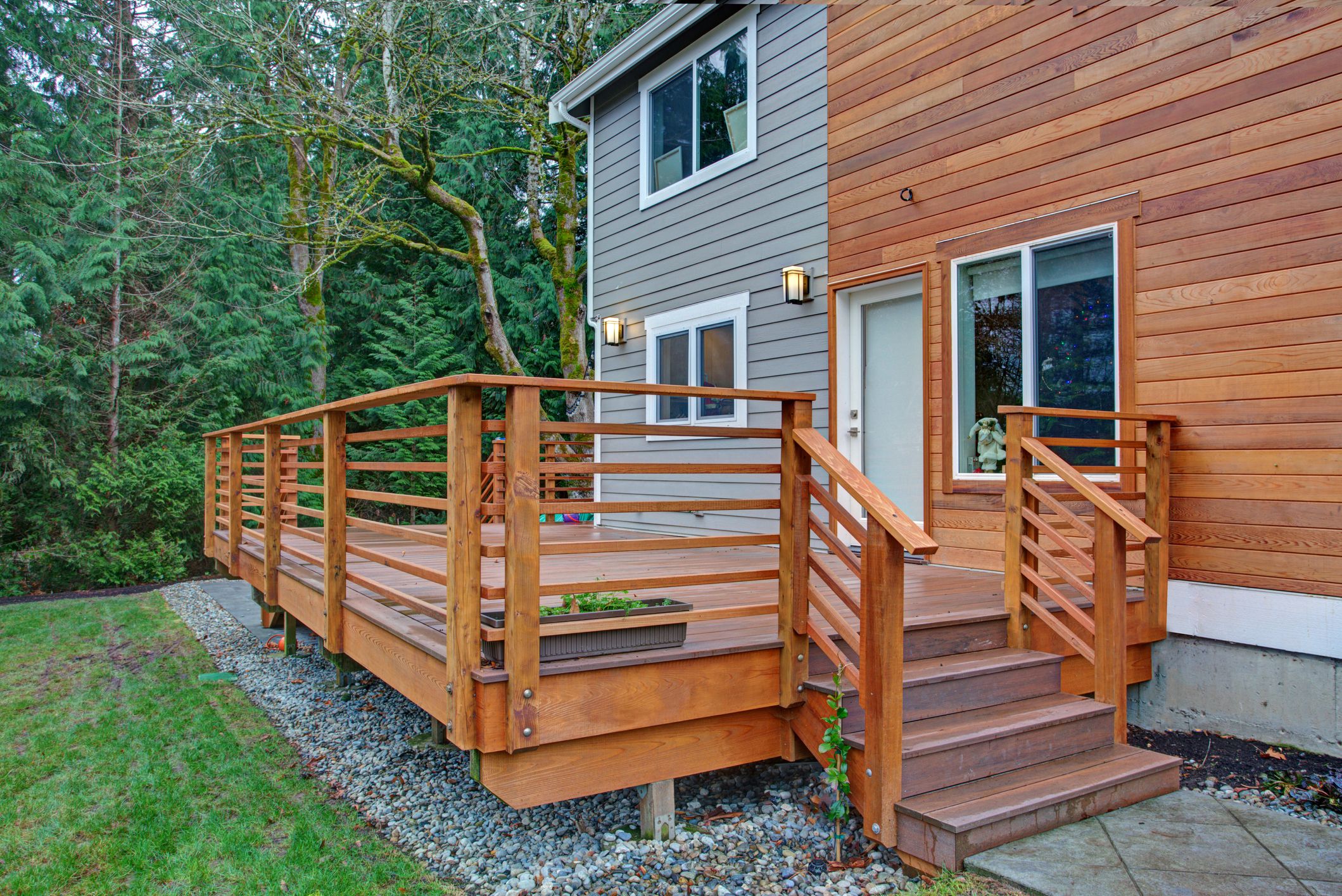
You and likely anyone who might buy your home in the future will love what a deck can do, lifestyle-wise. Weather permitting, you can have your AM coffee there, type away on your laptop during the day, and host friends, read, or just listen to the birdsong during off-hours. Here’s another nice thing about adding a deck: Your ROI is typically around 68% of the money you pay.
Cost: A new wood deck will cost on average $16,766. A composite one can cost more; on average, these are $22,426.
alabn/istockphoto

Who doesn’t love a beautiful new bathroom, whether your style is sleek and all white or if you prefer a warmer country cottage vibe? A bath remodel will cost, on average, between $6,627 and $17,494, according to Angi, the home renovation site. While an updated bath can definitely add to your home’s value, keep in mind that the sky’s the limit with the price tag. If you move the fixtures around and add one of those egg-shaped soaking tubs or a spa shower that has half-a-dozen mist settings, you may go well beyond the average range of costs.
Also, keep in mind that if you do something really singular (say, you pick tile in a super-bright shade), it may be harder to get your money out if and when you sell your property.
Cost: The average cost is $11,944, with cabinets and shelving accounting for 25% of the total, the shower and tub eating up 22% of costs, and your contractor’s fees usually being about 13% of your total expense. Of course, you can do a small bathroom remodel, perhaps repainting, adding some new artwork and a fresh shower curtain.
Artjafara/istockphoto

If you’re stuck with outdated appliances or hideous cabinets, a kitchen remodel is likely high on your list of improvements. It’s a great way to refresh your kitchen’s style and function.
But increasing home value with a new kitchen can fry your bank account: A remodel typically runs $14,612 and $41,392 according to Angi, but can cost much more if you move appliances’ position, opt for marble countertops, or fall in love with custom cabinetry. On average, you’ll recoup about 60% in ROI.
To update for less and wow your kitchen in a weekend, make some wallet-friendly upgrades: fresh paint, a new faucet, updated lighting (pendant lights are a good choice), and new cabinet pulls.
Cost: While you could just swap out cabinet pulls, which start at about $2 each, and repaint (plan on around $200), a larger kitchen remodel averages $26,849. Again, however, it’s worth noting you could spend multiples of that, depending on how large a project, how luxe the details, and where you live (cost of living can impact the price of goods and services in your area).
PC Photography/istockphoto

Even budget-friendly home improvements can set you back quite a bit. If you haven’t set aside the budget to bring more value to your home, you don’t necessarily have to dip into your retirement account or pay less on your student loans each month. You might want to consider a personal loan.
This article originally appeared on SoFi.comand was syndicated byMediaFeed.org.
SoFi Loan Products
SoFi loans are originated by SoFi Bank, N.A., NMLS #696891 (Member FDIC). For additional product-specific legal and licensing information, see SoFi.com/legal. Equal Housing Lender.
Disclaimer: Many factors affect your credit scores and the interest rates you may receive. SoFi is not a Credit Repair Organization as defined under federal or state law, including the Credit Repair Organizations Act. SoFi does not provide “credit repair” services or advice or assistance regarding “rebuilding” or “improving” your credit record, credit history, or credit rating. For details, see the FTC’s website .
Non affiliation: SoFi isn’t affiliated with any of the companies highlighted in this article.
Third-Party Brand Mentions: No brands, products, or companies mentioned are affiliated with SoFi, nor do they endorse or sponsor this article. Third-party trademarks referenced herein are property of their respective owners.
Financial Tips & Strategies: The tips provided on this website are of a general nature and do not take into account your specific objectives, financial situation, and needs. You should always consider their appropriateness given your own circumstances.
10255185_880/istockphoto

Saklakova/istockphoto
Featured Image Credit: monkeybusinessimages/istockphoto.