

Slang words and phrases emerge locally — but those that feel right in the imagination or on the tongue have the potential to spread globally.
The phenomenon is most visible online. Always-on international connectivity (some call it the ‘internet’) sends local slang airborne to travel virally. Slang that originates online — wildfiring across social networks or gestating within a particular forum or interest — has the capacity to leak out into unexpected places and real-life exchanges.
On the other hand, some slang stays put just because it loses its meaning or faces too much competition for use outside its home base. Alaska, for example, is so isolated from the contiguous states that locals call leaving the state “going outside.” Chicagoans say “woo wap da bam” when really what they mean is “yadda yadda yadda.”
To identify the states that favor their own home-grown slang for certain subjects (and bone up on potential left-field crossword clues), Crossword-Solver analyzed Twitter posts from all over America to find the slang that locals are using the most.
What We Did
Crossword-Solver curated a selection of the most popular slang words for partners, gaming, crypto and hip-hop, and also the most-used Gen-Z slang words. We found the most uniquely popular term in each state by comparing local usage rates of each word on Twitter against the overall national average for that word.
Key Findings
- Cutie is the most common slang word for boyfriend/girlfriend in nine states, more than any other such word.
- Glitch is the top gaming slang word in seven states.
- The crypto slang word that’s most popular in most states is NFT, which tops 15 states.
- Finna and simp are each the most common Gen-Z slang word in six states.
- Deuce is the most popular hip-hop slang word in eight states.
Americans Prefer ‘Shorty’ or ‘Cutie’ for Partners
Psychologists suggest that the use of nicknames in a relationship helps foster trust and intimacy. But let’s face it, sometimes it depends on the tone you use. Shorty, or shawty, is the top slang term of endearment in eight states. It’s a hip-hop word that has come to connote a sexually attractive woman, although the level of respect depends on the context in which it’s used. Shorty’s meaning has evolved since the word debuted in Too $hort’s “Everytime” (1985), and old-school hip-hop fans may use it to refer to a man or kid.

The most popular of all is cutie — which stands out in nine states, having been in use since 1908. A newer entry is bae, which emerged in 2005 and quickly became A Cool Thing To Say, getting shortlisted for Oxford Dictionaries’ 2014 Word of the Year before being declared dead at the end of the year. Whether the word is short for babe or stands for Before Anyone Else remains unconfirmed. Still, rumors of bae’s demise are exaggerated — it remains the top boyfriend/girlfriend slang word in Florida, Indiana, Louisiana, New Hampshire and South Carolina.
The Non-Gaming Terms That Became Common U.S. Gaming Slang
Glitch and nerf are duking it out for the top gaming slang term with seven states each. Nerf has been around nearly as long as online gaming and was first used in a slang context by players of the early Ultima Online MMORPG. Gamers found that the sword option was disproportionately stronger than other weapons and asked the developers to weaken it. They compared the new, weaker swords to foam Nerf toys and today, ‘to nerf’ in gaming means to make something weaker.

Surprisingly, glitch also has meatspace origins. The Smithsonian tells us the word “is derived from glitsh, Yiddish for slippery place, and from glitshn, meaning to slide, or glide” and was first used to describe verbal slips on 1940s radio shows. The TV industry adopted the word for technical issues in the ‘50s, and it later flourished among software programmers — but gamers themselves have adopted the term whether fetishizing programming slips in their favorite games or exploiting glitches to cheat. (Such cheaters are known as glitch gamers.)
Crypto Slang Users Gamble on ‘NFT’
Crypto slang started to enter the mainstream, but it seems it could go the way of Latin — a dead language maintained by a minority of specialists and enthusiasts. Perhaps the term with the best hope for survival is NFT, referring to the non-fungible tokens (unique digital assets) that became big news over the past couple of years. And if they’ve been much smaller news this year, they remain the most common crypto term in 15 states. If the technology can rebuild its reputation, maybe one day we’ll all be calling them “nefts.”

In a subculture of acronyms, it’s refreshing to find an abbreviation or two. Degen is the big little word in Colorado, Nevada, New Hampshire, New Jersey and Oregon. It’s an old betting term for a degenerate gambler, but in NFT culture the term can either be cast as an insult or worn as a badge of (reckless) honor.
Gen-Z ‘Finna’ Change the Way Everybody Talks
Jazz-age movers and shakers gave us “the bee’s knees” and “gams” (if not “the bee’s gams”). Boomers gave us “hip” and “doobie.” Every generation tortures the generations before and after with its slang, and today’s verbal culture is being re-shaped by Gen Z (those born after Tony! Toni! Toné! and before Rick and Morty). Simp and finna are making their case for mainstream acceptance, each being the most popular in six states.
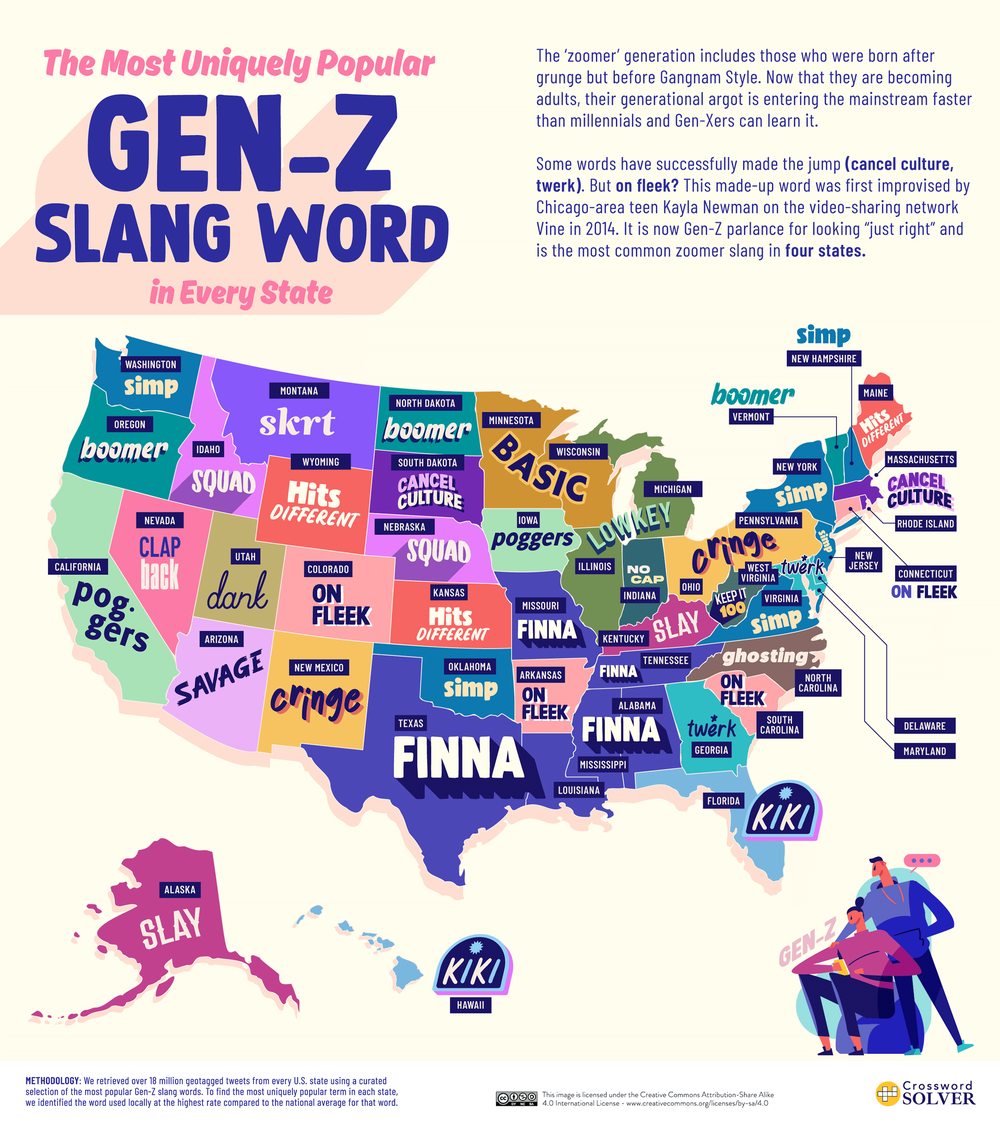
While much of the U.S. Gen Z slang landscape is a patchwork, there is a definite lean towards finna in southern states. That’s because it’s evolved out of the southern African American Vernacular English (AAVE) phrase, “fixing to,” meaning “gonna.” Not only is finna very southern, but it’s also very popular, appearing in 0.24%, 0.34% and 0.40% of tweets from Alabama, Louisiana and Mississippi. By comparison, basic appears in just 0.08% of Minnesota tweets and slay in just 0.02% of Kentucky’s.
‘Slime and ‘420’ Among Hip-Hop Slang with Well-Known Origins
Hip-hop has long been a source of emerging mainstream slang. It’s a popular medium with a strong emphasis on words, speech and meaning — and much of that is crafted from slang, whether new slang or the “transcriptions” of well-worn AAVE phrases. Indeed, hip-hop artists have the power to create entirely new slang words that gain wider use. For example, slime (friend) is the most commonly used hip-hop slang word in Hawaii, Kentucky and Washington. It was repurposed from its gooey meaning by rapper N.O.R.E., although it is best known from the work of Vado.

Geographically, there is a notable 420 belt running up the west of the country. This 50-year-old word for cannabis is the favorite hip-hop slang of Colorado, Oklahoma, South Dakota and Wyoming, although the phrase was originally coined by five Californian high school kids. (Its creation is well-documented here.)
Slang Like A Local Without the ‘Cringe’
Like any form of language, the response you’ll get from using slang will depend very much on where you are and to whom you’re speaking. In case it should help you to gel with “fellow kids,” we’ve gathered our findings in full in this interactive table so you can see what’s commonly said from state to state.
METHODOLOGY & SOURCES
To identify America’s most popular slang words, we retrieved over 18 million geotagged tweets from each state. We filtered these tweets to remove duplicates and non-English-language posts.
We curated a list of slang words for various categories: Girlfriend/Boyfriend, Gaming, Crypto, Gen-Z and Hip-Hop slang. Then we searched the retrieved tweets for these terms.
To find out which term was the most uniquely popular in each state, we calculated the usage frequency of each keyword on a U.S. and state level. By comparing these two figures, we were able to discover which terms are the most uniquely popular in each state, defined as the term with the highest percentage variation when compared with the national usage frequency.
To filter out outliers, we set a threshold for minimum appearances in each state. Finally, we calculated the average usage for 100K tweets for each selected term.
This article originally appeared on Crossword.solver and was syndicated by MediaFeed.
More from MediaFeed:
Silly old-school slang that deserves a revival

Nothing explains exactly what we want to say in a more confusing, nonsensical way than good old slang words.
Boomers and Gen X will remember “groovy” and “cool” as generational affirmatives for all things good, just like today’s teens use “dope” or “sick” or “lit” for pretty much the same reasons.
Of course, some slang terms are better than others, even if they didn’t remain in the public vernacular. So we decided to dig up some of our favorite vintage slang words and phrases that, we think you’ll agree, deserve a comeback.
wikimedia commons
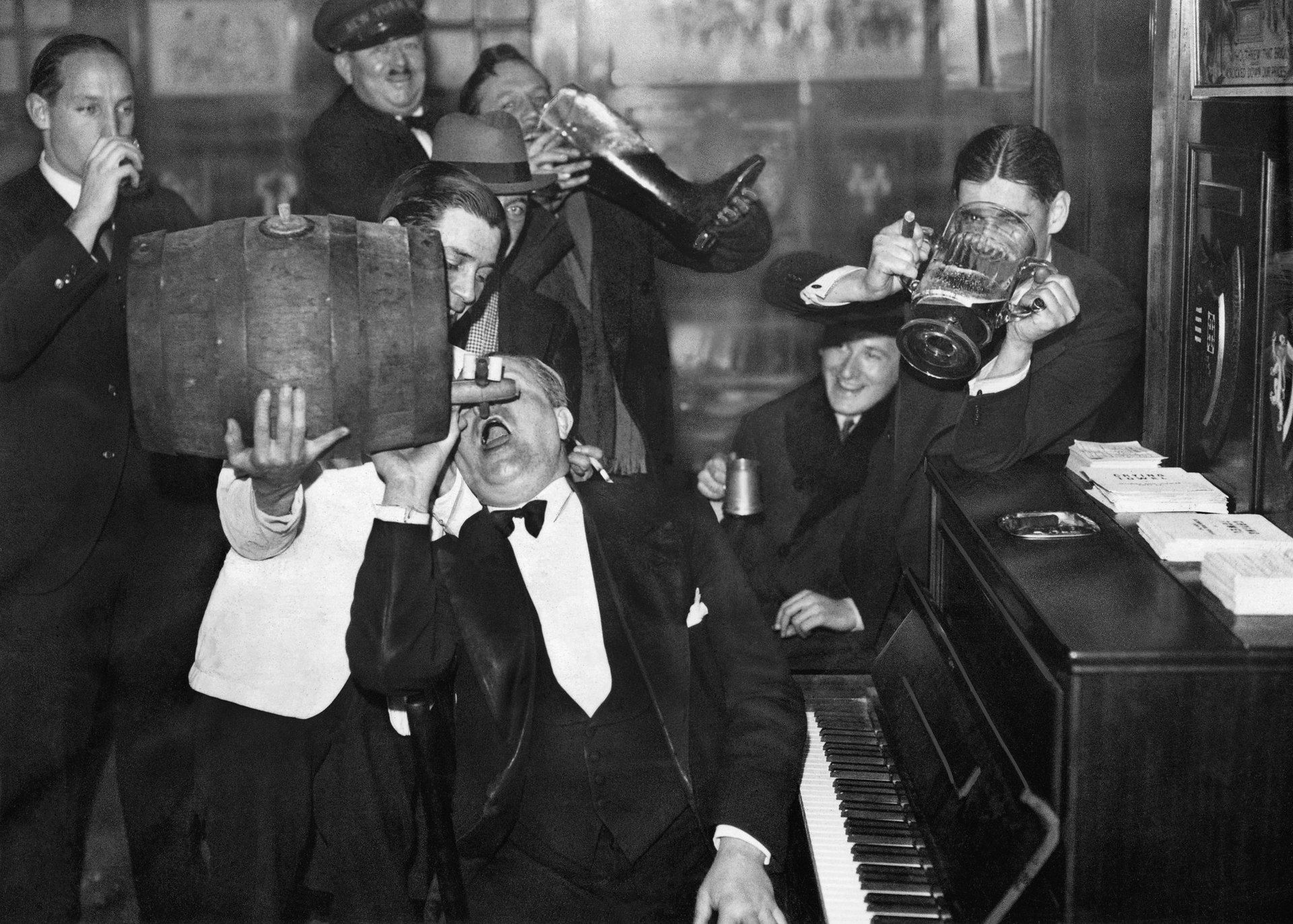
Used to describe: Any alcoholic drink, liquor or sparkling wine
In the roaring ’20s (that’s 1920s, kids!) during prohibition, giggle water was slang for any alcoholic beverage. You pay for the booze and the giggle is free.
Example: “Barkeep! It has been a rough day. Why don’t you slide me a shot of that giggle water?” We imagine only really tough guys would order this.
Wikipedia

Used to describe: Being drunk
An alteration of the older sozzled—which originated around 1886 —zozzled means to be drunk, with sozzle meaning to spill something in a messy manner.
Zozzled as a slang first appeared in Edmund Wilson’s “1927 Lexicon of Prohibition,” a catalog based on [Ben] Franklin’s “The Drinker’s Dictionary.”
Example: “Well, once you had all that giggle water, what did you think would happen, Dwayne? Of course! You were zozzled beyond belief last night! Knee draggin’ zozzled!”
Wikipedia

Used to describe: Sandals
In the 1960s, this was what the “happening” folk called sandals.
Example: “Hey, Mom! Can you run me to the mall? I gotta grab a new pair of Jesus boots for my Sadie Hawkins dress!” Hmmm….
KopiOri/iStock

Used to describe: An annoying person
The most distressing of all weasels, cheese weasel is someone extremely annoying or irritating. It started in the early 1990s and fell away far too quickly.
Example:“My little brother can be a real cheese weasel sometimes”
AntonioGuillem / iStock
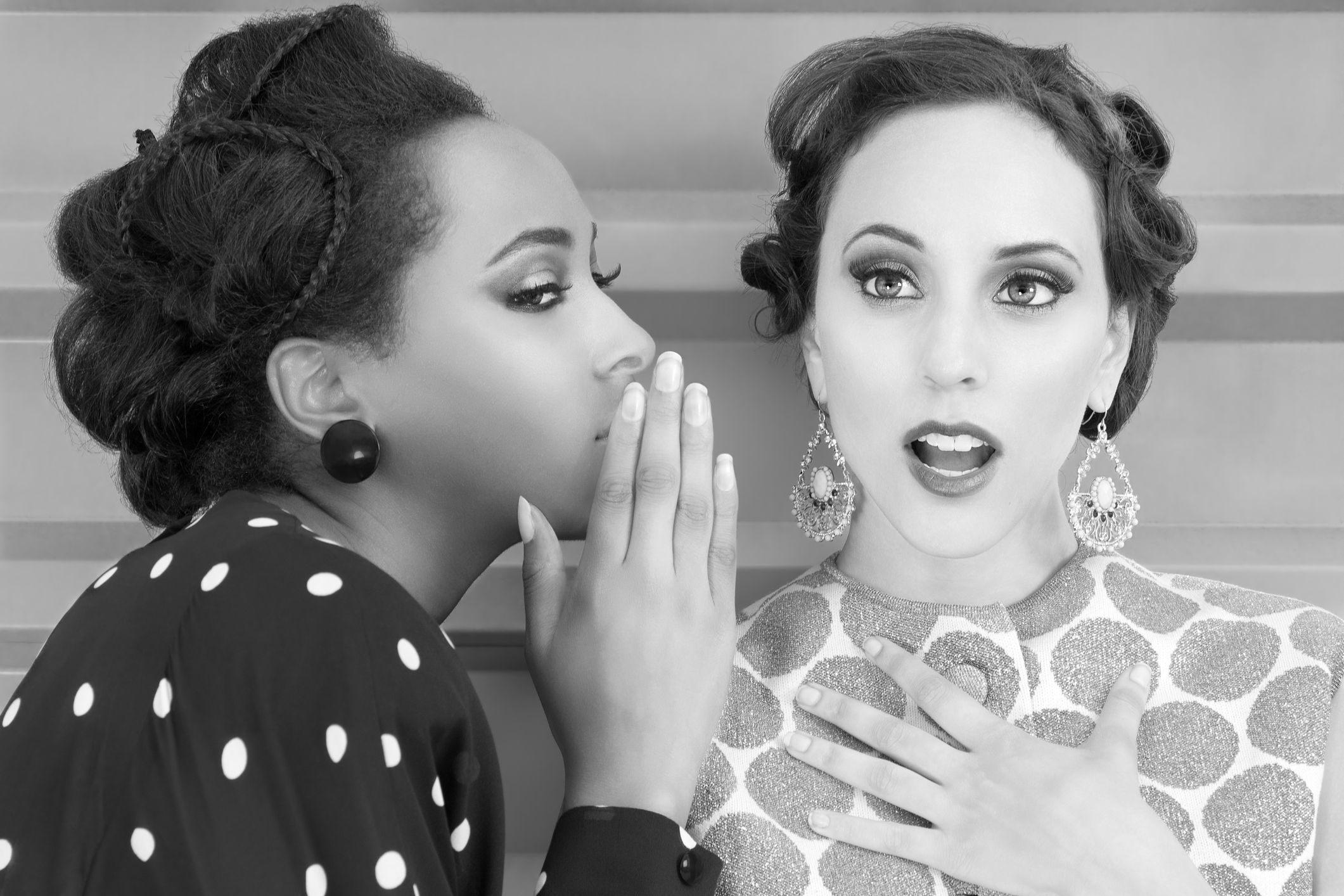
Used to describe: An older, unmarried woman who gossips a lot.
This colorful slang was commonly used in the Victorian era to describe unmarried old ladies who would gossip mercilessly while drinking tea and nibbling muffins.
Example: “Well, I’m not one to go around spreading rumors, but that Edna Merle is a real muffin walloper, bless her sweet unmarried heart.”
Stephanie_Zieber/iStock

Used to describe: Jail or prison
Coming from the Spanish word “juzgado” which means court of justice, hoosegow was a term used around the turn of the last century to describe a place where drunks in the old west spent a lot of their time.
Example: “Durn it! Slim is back in the hoosegow! Now who will I rustle cattle and listen to piano music with? “
thawornnurak/iStock

Used to describe: Someone who is always smiling
Here’s another one from the Victorian era. In old photos, Victorians are rarely seen smiling, and yet the slang term gigglemug comes from the late 1800s. Describing someone who laughs constantly, gigglemug comes from “giggle” which means laughing in a silly way, and “mug” which means face.
Example: “Bertram! Cut it out! No one will believe we are worth our salt as serious scientists if you insist on walking around like a gigglemug!”
Depositphotos

Used to describe: Water
Back in the 1930s, ordering a dog soup would get you a tall glass of good ol’ water. Considering that the slang originated during the Great Depression, it makes perfect sense.
Example: “Well, I have no idea what Princess Margaret will want to drink! Perhaps just some sparkling dog soup over ice with a slice of lemon?”
K_Thalhofer/iStock

Used to describe: Little kid or a small dog
This is actually an Australian slang used for small children that are only floor tall . The first records of the term comes from around 1850.
Example: “You know, in some homes the adults have to jump from couch to armchair to ottoman to get from the hall to the kitchen due to this kind of infestation of ankle biters.”
asiseeit

Used to describe: A hand
Meathook is a term from around 1840 used to describe the human hand. Ick.
Is it implying that your hand is made of meat? Or that you use your hand in a hook-like motion to swipe at meat until you “hook” it? Why wouldn’t you just lift it?
Example: “Professional hand models live lives of lavish luxury (Oooh! That’s fun!) all due to their beautiful, shapely and elegantly manicured meathooks.”
NataBene/ istockphoto

Used to describe: A coffin
The thing the carriage maker made a lot of every time Pistol Pete rode into town—a coffin. The poetic slang for a cheap coffin originated in the late 19th century, with the earliest use found in The Chicago Tribune.
Example: “Well, boys, it was a long ride, we had a good run…but…splutter, ack….I think it’s time for the old pine overcoat for me.”
iphotographer/iStock

Used to describe: Flattery, nonsense
To be full of applesauce in the 1920s meant to be full of nonsense.
Example: “Clyde said that he has moxie, but he’s just full of applesauce!”
SIphotography/iStock
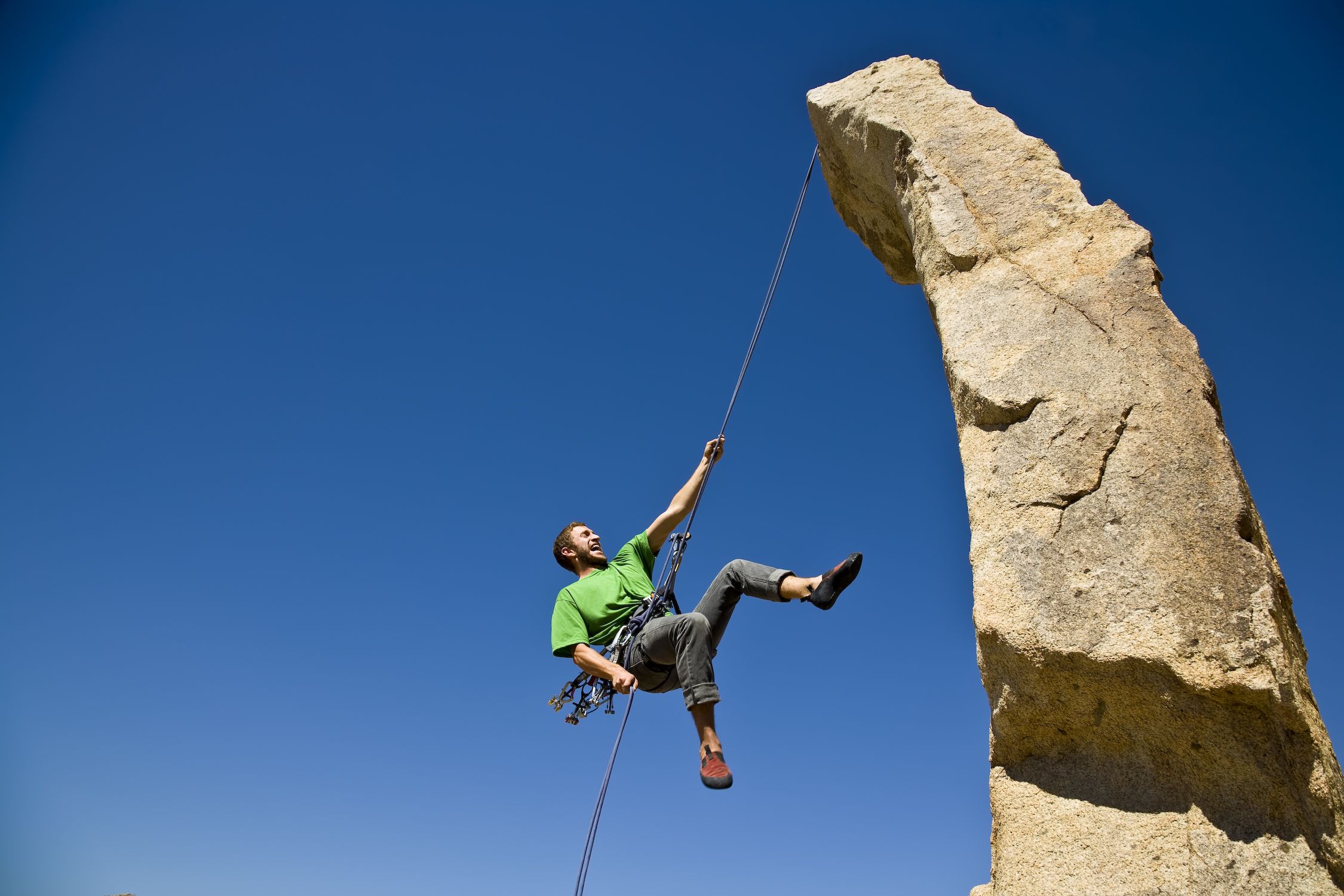
Used to describe: Energy, courage, determination
Deriving from the American soft drink Moxie made since 1885, the term became popular in the 1930s to describe “determination, energy, courage.” While not as common as it used to be, moxie is still in use to some extent.
Example: “I don’t know, Howard. It just seems like jumping the Grand Canyon on little Susie’s bike might be too much just to prove your moxie to Ramon. He doesn’t even care, Howard!”
gregepperson / iStock

Used to describe: A good looking male
In the 1950s, calling a guy a flutterbum, meant “super hot” or attractive fella.
Example: “I don’t know about you but I believe Paul Newman will be proven to be humanity’s favorite flutterbum.” (This is obviously more than an example sentence because it is also true.)
Wikipedia

Used to describe: Someone who believes they are special.
This is from the mid-19th century — obviously before sarcasm was a thing.
Example: “Just look at Madison! She thinks she’s so hot! What a sockdolager!”
Khosrork/iStock

Used to describe: A very good dancer.
This has nothing to do with avian-themed oyster crackers. Let’s break it down: In the 1920s, a shin cracker was used to describe someone with primo dance skills, and “ducky” was another word for very good. Therefore, a ducky shincracker is the one who excels at dancing.
Example: “Boy those Radio City Rockettes are a whole flock of ducky shin crackers!”
Prostock-Studio/ istockphoto
Used to describe: Having loads of fun
You might think that the famous idiom originated at a college party in the 1960s by some preppy frat boys. However, the use of “gas” for enjoyment goes back to the 19 century. There are two uses related to the origins of the saying. In 1839, Charles Dickens used the phrase “everything is gas and goiters,” meaning quite satisfactory. The second more direct origin of the current usage comes from 1914 when James Joyce used the Irish slang gas to describe joking or frivolity. During the “Jazz Age,” the expression was picked up by the African American community in the US.
Example: “What a great party, we are all having a gas”
wikimedia commons

Used to describe: A swindler, greedy person
Originating from the character Uncle Pumblechook in the Charles Dickens classic “Great Expectations.” The word means greedy, pompous or piggish swindlers.
Example: “That con man is trying to trick everyone into coughing up their life savings, What a Pumblechook!”
DepositPhotos.com

Used to describe: Asking for trouble.
In the 1940s, when you were asking for trouble or “a beating” you were cruisin’ for a bruisin.’ A military magazine first published the term in 1945, so it had likely been in use for a decade prior.
Example: “Kenickie to little nerdy punk: (in a growley menacing voice) You’re cruisin’ for a bruisin” (Especially intimidating cause the bruises will be quite bad, and you know that at any moment Rizzo, Danny, or Sandy herself will have an issue and you’ll be forced to sing and dance backup until they figure it out, plus you’ll be bruised.)
Nattanon Kanchak

Used to describe: Start doing something.
Dating back to 1908 “Let’s Roll” is a simple phrase meaning to book, to jam, to dip, to bolt, to jet, to bounce. Get it?
Example: “Hey, everybody! The new “Transformer” movie starts in 15 minutes….let’s roll.”
DepositPhotos.com

Used to describe: Taking off really fast, usually in an automobile.
Think of the race scene in Bullitt. That was burning rubber.
Man 1: “Hey, man, do you smell burning rubber? “
Man 2: “Oh! That’s just us! We’re burning rubber!”
Both: cover mouth with hand and giggle.
shapecharge

Used to describe: Slackers or a young, unemployed person who sleeps all day.
This is probably what Gen Xers would have been called in the 1920s by every other generation, and though they acted like they were too cool to care, it really stung.
Example: “The boy’s a good for nothing, Alice! A lousy dew dropper!”
AnnaStills/iStock

Slang used to describe: Clumsy person
In the late 19th century this was a “nice” way to say someone is clumsy or incompetent.
Example: “You know the weirdest thing about toddlers? Even though they are young and can’t help it, they are the single largest population of foozlers on Earth. It’s sad for them.”
Deagreez/ iStock

Used to describe: Something extremely cool
Reference any “Earth, Wind and Fire” videos from the ‘70s and ’80s. If they weren’t trying to become the definition of funkadelic what were they up to?
Example: “This album is totally funkadelic!”
More from MediaFeed:
- Stars who look nothing like their TV & movie characters
- The most bonkers burgers in America
- Countries where civilians have the most guns
Like MediaFeed’s content? Be sure to follow us.
This article was produced and syndicated by MediaFeed.org.
jacoblund/iStock

dolgachov / iStock
Featured Image Credit: Rawpixel / istockphoto.


