This article is part of our series about financial literacy. You can find the links to the other articles at the bottom of the article.
Dave Ramsey and Robert Kiyosaki are perhaps the most influential personal finance authors of the past 20 years. In many ways, they have differing advice. Which of them is correct?
I’ll give you the scoop on not just what they’ve said, but what they’ve done.
Let’s start with Robert Kiyosaki.
Robert Kiyosaki
Robert is the author of the book Rich Dad, Poor Dad: What the Rich Teach Their Kids About Money That the Poor and Middle Class Do Not!, the best-selling personal finance book of the late 1990s and 2000s.
It was so successful that it spawned a series of spin-off books and the hugely successful Rich Dad company.
Their mission is to “Elevate the Financial Well-Being of Humanity”.
Robert grew up in Hawaii. His real father, his “Poor Dad”, was a university professor. His father made a good income but made poor financial choices. He looked down on business people and thought that money-seeking pursuits were crass.
His “Rich Dad” was his friend’s father. “Rich Dad” was a wealthy entrepreneur who taught him and his friend lessons about money.
The book shares the following lessons, which Robert calls “the secrets of the rich”:
- The Rich Don’t Work for Money
- Why Teach Financial Literacy?
- Mind Your Own Business
- The History of Taxes and The Power of Corporations
- The Rich Invent Money
- Work to Learn—Don’t Work for Money
Lesson one makes the point that wealthy people don’t work for money – they work for assets. He defines an asset as anything that puts money in your pocket independent of your time input.
By his definition, assets bring cash flow. His definition of an asset includes rental property, dividend-paying stocks, income-producing royalties, and even gumball machines. Anything that produces passive income is an asset.
He does not consider depreciating possessions as assets. So cars, fancy clothes, expensive furniture, and even the house that you live in, are not considered assets in his book. He calls those “doodads”. They take money out of your pocket.
The “financial literacy” aspect of Rich Dad, Poor Dad, and indeed, all of Robert’s teachings, is regarding basic accounting.
Assets put money in your pocket, and liabilities take money out of your pocket. Therefore, your goal should be to increase your assets and reduce your liabilities.
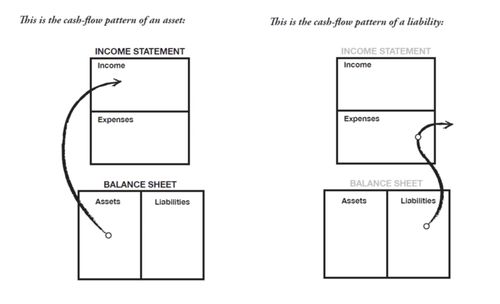
Rich people get rich because they collect assets that produce income independent of their time. The middle class earn a good income, but tend to spend all their disposable income on doodads, and then get into consumer debt.
Here is a Rich Dad break down of the different cash flow patterns of the poor, middle class, and the rich:
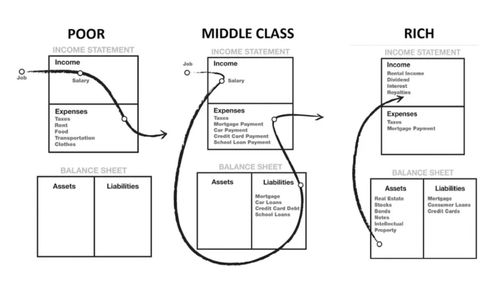
But he makes it clear that debt isn’t always bad.
If you can buy cash-flowing assets with debt, that could be a really smart decision. For example, if you buy a house and then rent it out, it could be a good investment.
Here is what cash flow positive rental property math looks like:
- Buy a house for $250,000. You pay a 20% down payment of $50,000, and the bank loans you the other $200,000.
- According to MortgageCalculator.org, you would have a total monthly payment of $1,189.76, assuming a 30-year loan at 3.5% interest, $2,500 per year in property tax, and $1,000 per year in house insurance.
- If you can rent the house out for $1,500 per month, then you have positive cash flow. $1,500 – $1190 = $310.
In this scenario, you’ll have $310 per month after all expenses are paid – a nice position to be in!
In reality, as any landlord will tell you, you’ll need to set aside a bunch of that money for repairs and vacancies. It’s not a huge cash flow, but it’s better than losing money every month.
In his books, Robert goes on and on about the glories of rental real estate investing. Not only are you increasing your monthly income from the cash flow, but you also enjoy the following benefits:
- Appreciation of the value of the house – real estate usually goes up in value over time
- Paydown of the debt – the tenant is paying your monthly mortgage for you
- Tax benefits – the law in the US and most developed countries give you a nice tax break for providing housing to the masses
To reiterate the point about financial literacy above – the rich get wealthy because they build or acquire income-producing assets and they pay down and avoid unproductive liabilities.
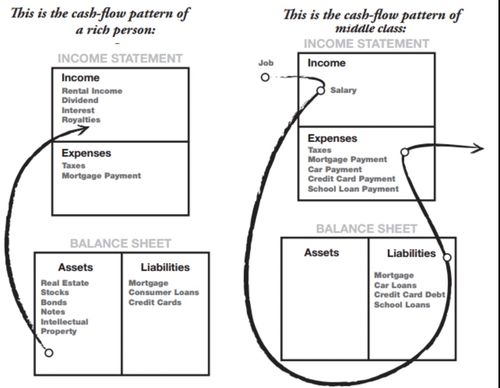
As you can see from these simplified financial statements, the middle class often struggle financially because of how they earn and spend their money.
Even if you have a job that makes a good income, you still only have one source of income. Which is risky, because you’re completely dependent on that income to survive.
Then, if you’re financially undisciplined, as most people are, you’ll spend all of your money on doodads and then you’ll get into a ton of consumer debt on top of it all.
Most people buy a house that’s much bigger and more expensive than what they need, get the fanciest car that they can afford the payments on, and will get into a ton of credit card debt.
Even debt that “makes sense”, such as student loans, often gets abused, as people acquire loans to get degrees that don’t have good earning potential.
I read my first Rich Dad book in 2008. I asked about it when an entrepreneur that I was working for had it out on a table while we were at lunch.
It piqued my interest, and I checked it out at the library. I was completely hooked from the beginning.
I quickly realized that the book was talking about me. Right before I read the book, I got a seasonal job making pretty good money. I was 21 and living at home at the time. As soon as I got the money, I spent it on a down payment on a truck and a wedding.
(The wedding didn’t materialize, but I lost money on non-refundable deposits!)
After the seasonal job ended, the high-paying job that I was hoping to get after that didn’t pan out. I eventually ended up in a series of low-paying jobs, including pizza delivery. But the truck payment still persisted!
Rich Dad helped me to realize that I was following a typical middle-class spending pattern – spending as much money as I could on doodads, and then even getting into debt for it.
The concepts of passive income, rental real estate investing, smart tax strategies, entrepreneurship, and financial statements were totally new to me. They set me on a path of entrepreneurship and wealth building. (And without knowing about all of this, I don’t think that I would have started Digital Honey.)
The Rich Dad books also discuss:
- The difference between self-employment and entrepreneurship
- Investing strategies beyond real estate
- Setting up legal entities like LLCs and corporations for minimizing taxes
- Deal making
- Learning to sell
- How to learn in the real world, vs book learning
All of this was revolutionary to me at the time. And although it took me a while, I now have implemented most of what I learned. (Still working on parts of it.)
My wife and I keep track of our monthly income and expenses in a shared Google spreadsheet. We also keep track of our balance sheet and net worth.
And since I’ve started my own business, I’m making way more money than I did in my former jobs.
We’ve 100% benefited from following the Rich Dad approach.
Criticisms of Robert Kiyosaki
One prominent criticism of Rich Dad, Poor Dad, is that the “Rich Dad” probably never existed as a single person. Many people think that he is an amalgamation of various mentors that Robert had.
Another criticism is his advocacy of multi-level marketing. (They’re also known as “MLMs”, or network marketing, like Amway or DoTerra.)
Robert was struggling to sell his book when it was new. He couldn’t find a publisher to sell it, so he put up his own capital and self-published.
I heard that he didn’t get much traction with it until he put in a section about how MLMs can be a great way to start a business. Then he pitched it to Amway distributors and it started flying off the shelves.
And still another criticism is that he actually only made money from talking about making money. One of his companies even filed for bankruptcy.
He claims that this was a strategic bankruptcy to avoid paying the full judgment amount from a frivolous lawsuit. Since he has his many assets wrapped within different legal entities and structures, this allowed him to protect his other assets and companies.
Personally, I don’t think that there’s any validity to the claim that he only makes money from talking about money. It’s been verified that he had a successful surfer wallet business (which later tanked, and he talks about it in the book) and owns a lot of real estate, like he also talks about in the book.
You’ll have to decide for yourself whether these criticisms hold any water.
My main criticism is that his books bash on traditional education too much. I actually agree with his main points – that traditional education doesn’t teach financial literacy, and that a reading and lecture-driven education don’t prepare young people for the real world well.
But he bashes on it too fervently because he performed poorly in school as a kid.
I will be the first to admit that college isn’t for everyone. (I didn’t finish college, despite getting good grades and having scholarships.)
However, for some people, going the “traditional route” is a wonderful path. Doctors, top-tier attorneys and accountants, and many others have thriving, fulfilling careers through the college path.
Overall, I love the Rich Dad books. I read over a dozen of them, and they set me on a career (and financial) path that I really love.
Dave Ramsey
Dave Ramsey is one of the most influential personal finance gurus out there. He has a popular radio show, best-selling books, and a high-traffic website. And in some instances, he recommends the exact opposite that Robert Kiyosaki does.
His most popular book is The Total Money Makeover: A Proven Plan for Financial Fitness. A friend of mine gave it to me over 10 years ago.
It covers budgeting, getting out of debt, and saving. There are six “Baby Steps” that he asks you to take:
- Save $1,000 for Your Starter Emergency Fund
- Pay Off All Debt (Except the House) Using the Debt Snowball
- Save 3–6 Months of Expenses in a Fully Funded Emergency Fund
- Invest 15% of Your Household Income in Retirement
- Save for Your Children’s College Fund
- Pay Off Your Home Early
It’s all solid advice based on personal finance basics.
What I like about Dave is that he is trying to change the unhealthy, modern culture of people taking on so much consumer debt. He says, “The paid-off home mortgage has taken the place of the BMW as the status symbol of choice.”
Not quite the truth in reality, but I think it’s a healthy vision.
One of his book reviews on Amazon said this, “Life Changing Book! Good book. Life changing! In 4 months, I paid off my car loan, all credit cards and doctor bills!!! About $6,000 total.”
Another review says, “Wanna be a millionaire? Get this book. If you work the process of this book the way Dave teaches, you WILL become wealthy. That said, it’s not an easy quick fix, but more of a paradigm shift on how to handle money for the long haul using a 7 step process.
“When I started out I had no savings and about $40k in consumer debt – basically a normal american. Fast forward 10 years and I’m almost a millionaire (net worth of about $800k) including a paid for house (which is Baby step 7 of 7). I’m now 40 years old. The stuff he teaches seems so simple (which is why it works), but hardly anyone does it.”
Many of Dave’s followers love his Christian beliefs and pro-family stances. He is a Southerner and has a large following of Evangelical Christians in the South and Midwest (although he has fans all over the country).
If you’re looking for motivation to pay off your personal debt, his book, YouTube channel or radio show may help you find the motivation that you seek.
Criticisms of Dave Ramsey
Dave is well known for his stance against taking on debt of any kind. Here are a few of his quotes:
- “Debt is not a tool; it is a method to make banks wealthy, not you. The borrower truly is slave to the lender.”
- “I tell everyone never to take more than a fifteen-year fixed-rate loan, and never have a payment of over 25 percent of your take-home pay. That is the most you should ever borrow.”
- “I do recommend that most people sell the car with the most debt on it. A good rule of thumb on items (except the house) is this: if you can’t be debt-free on it (not counting the home) in eighteen to twenty months, sell it. If you have a car or a boat that you can’t pay off in eighteen to twenty months, sell it.”
Dave also says, “You don’t need a credit score.”
I think that his position against debt is extreme – to the point that it’s fanatical and even harmful at times.
It’s true that a person technically doesn’t need credit to function in society. You also don’t need a social security number. (True story: you actually don’t have to have one.) But they’re tremendously helpful in the modern world!
When a person gets into a ton of credit card debt, there are usually a few underlying root causes:
- Lack of discipline
- Lack of financial knowledge
- Underlying emotional issues
You can fix all of those underlying root causes without swearing off debt forever, under any circumstance.
It’s true that most Americans are far too indebted. Most people really don’t have any business getting multiple credit cards. And, if we’re being honest, bankers have far too much political power in our country.
All that being said, it’s a complete lie that “debt is not a tool”. Here are a few things that credit cards help with:
- Refundable security deposits
- Covering dinner for friends who will pay you back
- International travel
- Building credit
- Starting a business
In our modern world, there are many businesses that don’t require debt to get started. And that’s a wonderful thing.
But many businesses take a lot of capital to get started. What if you want to start a restaurant? Open a franchise? Sell retail products, either in-person or e-commerce?
You’re going to need startup money to get the business going, and then if you want to grow at a good pace, debt is essential for that business growth.
Yes, you can take on investors instead of debt. But over the long term, giving up a chunk of equity is way more expensive than making payments on financing with less than 10% interest.
The same applies to real estate investing. But according to Dave, you should only invest in real estate if you can pay for a property with cash.
In his book, Complete Guide to Money, he recommends that no one invests in real estate unless:
- You have no personal debt at all, including your home loan
- You maxed out your 401k and Roth IRA investing options
- Can pay cash for the property
In other words, he doesn’t recommend that anyone who isn’t already rich invest in real estate.
Here’s the thing about Dave – he made a lot of money in his early 20s in real estate (in the 1980s). He was flipping properties that had negative cash flow, financed with high-interest, 90-day loans.
Then his lenders called his loans due all at once. He was ruined financially, and it hit him really hard on an emotional level. One book review that I listened to said that, “He cried in the shower every day and contemplated suicide.”
In my opinion, he was being an idiot. You can buy real estate with positive cash flow, low interest rates, and fixed payments – you don’t have to take crazy risks like he did.
If you play with fire, you’re going to get burned. And just because you get burned, it doesn’t mean that no one else should use fire ever again.
Another interesting criticism is that a former Dave Ramsey employee is suing his company, saying that there was religious discrimination and a “cult-like” atmosphere. My criticisms of Dave are mostly for his rigid advice, but you have to admit this one raises an eyebrow.
Dave Ramsey vs. Robert Kiyosaki: Who Should You Listen To?
Read both of the books and decide for yourself! There’s great advice in both of them.
If you’re a spendaholic, Dave Ramsey may be your man.
If you’re looking to get smarter about money, possibly start a business, or take a hands-on approach to your own investing, I recommend Robert Kiyosaki and the Rich Dad books.
I think that both of them are trying to make the average person more astute. Personally, the Rich Dad approach appeals to me because I’m ambitious and entrepreneurial.
If that approach also resonates with you, check out my other articles about personal finances:
- Good Debt vs Bad Debt: Know the Difference
- Why Is Credit Important? (In-Depth Analysis)
- How to Create a Personal Balance Sheet
This article originally appeared on DigitalHoney.com and was syndicated by MediaFeed.org.
More from MediaFeed:
10 easy ways to tame your financial chaos

There are several ways to boost your personal finances while keeping an eye on the future. Most of them sound easy, but often, people find it hard to apply them and instead come up with excuses that will in the end derail their plans.
So, here are 10 basic decisions to improve your financial horizon that are absolutely worth trying. If you’re looking for retirement in the long run, you can’t go wrong by applying them with discipline and courage.
SPONSORED: Find a Qualified Financial Advisor
1. Finding a qualified financial advisor doesn’t have to be hard. SmartAsset’s free tool matches you with up to 3 fiduciary financial advisors in your area in 5 minutes.
2. Each advisor has been vetted by SmartAsset and is held to a fiduciary standard to act in your best interests. If you’re ready to be matched with local advisors that can help you achieve your financial goals, get started now.
SolisImages / istockphoto
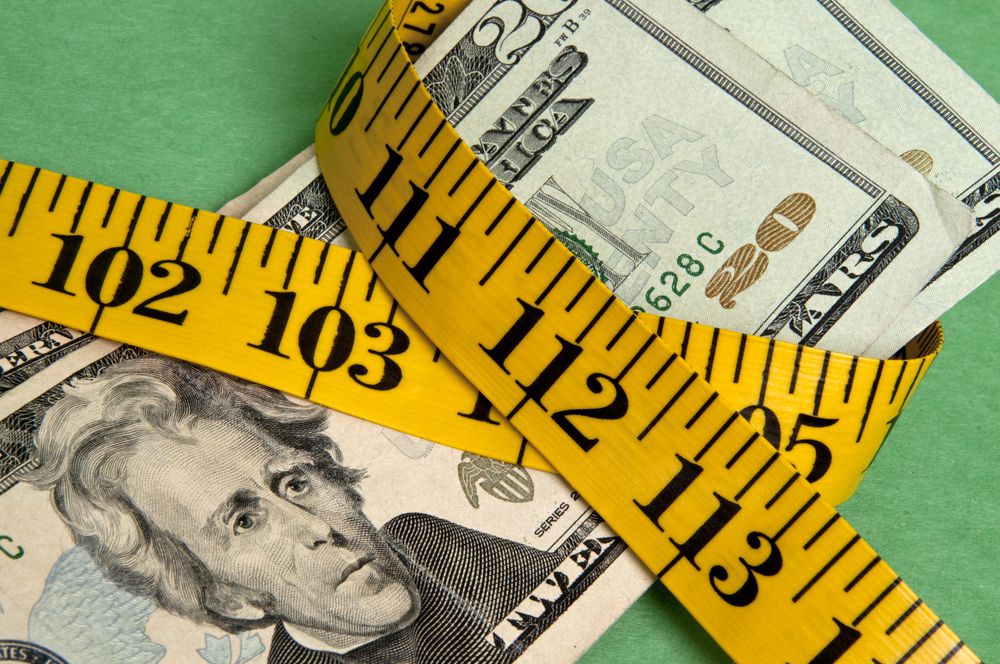
It sounds quite easy —it’s something you have read in many articles and personal finance media posts, but people still don’t apply it.
You must be resolute not to spend more months in the red or not to withdraw your savings to cover your discretional expenses —entertainment, clothes and things that you might not really need or want. Give up the excuse that you have to make sure you live in the moment.
DepositPhotos.com

Millennials are some of the most careful generations when it comes down to money and even 83% consider that they could save more. However, out of this percentage, just a few of them don’t go beyond mere consideration.
A good decision is to save a percentage of your income —say, at least 10%— before thinking about spending money or maintaining your lifestyle.
Alternatives like automating savings in your bank account make your life easier and prevent an excuse from taking precedence over your saving decisions.
DepositPhotos.com

Aspiring entrepreneurs must secure funds to start all their business ventures, and having no money to do so is not an excuse. This is so because, today, there are multiple options to secure capital to start the ball rolling.
Online business loans are a very interesting source of financing that you can use to start from scratch. Why else would you acquire this debt as opposed to a credit card?
These types of loans are classified as good debts since you will be generating income from them and consequently positively impacting your finances.
DepositPhotos.com

A budget is the best start to manage your personal finances. However, many people lack the discipline, they do not know how to do it, or don’t see any value in it —and they prefer to “go with the flow.”
Budgeting for a project or your personal finances is the best way to control your money, from income, fixed expenses and savings, to discretionary spending and more. In this regard, your budget must be flexible and contemplate any unexpected expenses and actual extra income that may emerge.
DepositPhotos.com

You must take the time to set your goals and start budgeting, saving, and spending accordingly. Goals are also a motivation, and depending on how much you want to achieve, you will have the discipline to succeed.
Bear in mind that a financial goal is not winning the lottery or improving your wage —you must devise the way you’re going to spend the money and the resources you have at your disposal, for how long, and what you expect as returns.
A good way to go about your financial goals is defining them according to a period: short-term, mid-term and long-term.
fizkes / istockphoto

The only way to improve something is to be able to measure it, so you must be open to evaluating yourself —by asking yourself how your financial performance was, what you spent your money on, what you invested in, which purchases were emotional and which decisions helped you reach your goals and which didn’t.
You can additionally come up with an Excel table to keep track of your developments, compare financial accomplishments between periods, how much expenses increased in specific rubrics, etc.
Undoubtedly, this is the best course of action to improve your finances immediately.
SPONSORED: Find a Qualified Financial Advisor
1. Finding a qualified financial advisor doesn’t have to be hard. SmartAsset’s free tool matches you with up to 3 fiduciary financial advisors in your area in 5 minutes.
2. Each advisor has been vetted by SmartAsset and is held to a fiduciary standard to act in your best interests. If you’re ready to be matched with local advisors that can help you achieve your financial goals, get started now.
nortonrsx/ istockphoto

Your financial responsibilities are of the utmost importance, so paying off your debts — especially those that do not generate income and have a high-interest rate — should be your priority.
At all times, you must avoid paying interest in arrears, which little by little rack your personal finances.
Paying your bills on time every month, or even in advance, will allow you to secure some savings that you could use as a margin of error when creating budgets. Later, you can invest.
DepositPhotos.com

Paying your debts on time has a direct effect on your credit reputation. Investment opportunities will open up every time you pay on time, due to a solid credit score.
Being decisive to pay your bills on time and stick to healthy debt habits will pave the way to a bright financial future. Reputation, and more specifically in the field of credit, is absolutely key to applying for financial products that can open up a myriad of opportunities.
DepositPhotos.com

As a rule of thumb, do not rely on just one source of income, namely your salary. According to a survey, 71% of Millennials think it is important to become an entrepreneur.
So, you can invest your salary in other sources like the stock market, real estate and in your friends’ companies —this way, your sources will be diversified, and the risk will be substantially reduced.
utah778/ istockphoto

Finally, you should try to educate yourself in personal finances, money management paradigms, and financial products. The biggest mistake people make, and the one that affects their finances the most, is ignorance.
People make important decisions with little or no information because personal finance is something that does not concern them or requires a high degree of prior knowledge.
So, invest in your financial education —either through books, courses, seminars and expert advice that help you understand how money works and how you can get the most out of it.
Once you make these 10 decisions, your personal finances will be positively impacted, and you’ll be building for the future. You just need to start today.
This article
originally appeared on ValueWalk.comand was syndicated
by MediaFeed.org.
Chaay_Tee/ istockphoto

Deagreez/ iStock
Featured Image Credit: DepositPhotos.com.