Could Saturn’s moon tell us something about extraterrestrial life?
In a Berlin lab, a thin beam of liquid water shoots into a vacuum and breaks into droplets. A laser hits them. A mass spectrometer reads what’s inside. The droplets are standing in for the ice grains that spray out of Saturn’s moon Enceladus.
The people behind that experiment, Frank Postberg and Fabian Klenner, are behind three results in three years about what’s inside those grains: phosphate, bacteria, and now salt. Each one changes what a spacecraft should look like.
Nobody has found life on Enceladus, and none of this changes that. Here’s what the three studies found, and why the newest one points to the odd grains.

Sphingopyxis alaskensis
It’s a bacterium common in waters off Alaska, and Klenner picked it for a reason. It’s much smaller than E. coli; it lives in cold water and needs only a few nutrients to survive. In 2024, his team mixed it into the water beam and showed that a spacecraft instrument could detect cell material even if it turned up in only one of hundreds of thousands of ice grains. Klenner said it was the first time anyone had shown that “even a tiny fraction of cellular material could be identified.”
Ocean scum
The team also asked how cells would even get into a grain. Their scenario starts at the ocean surface. Cells wrapped in a fatty membrane would form a skin there, the same ocean scum that helps make sea spray on Earth and contributes to the smell of the ocean. On an icy moon, the vacuum of space would boil the ocean. Bubbles rise and burst at the surface, and whatever was in the scum can end up in the spray.
Five of six
In 2023, Postberg’s team found sodium phosphates in the ice grains, at an estimated 100 times their concentration in Earth’s oceans. Earlier models had disagreed on whether the ocean held meaningful phosphate at all. It was the first phosphorus ever found in an ocean beyond Earth, bringing the tally of bioessential elements detected in Enceladus material to five of six.
A grain isn’t a scoop of the ocean
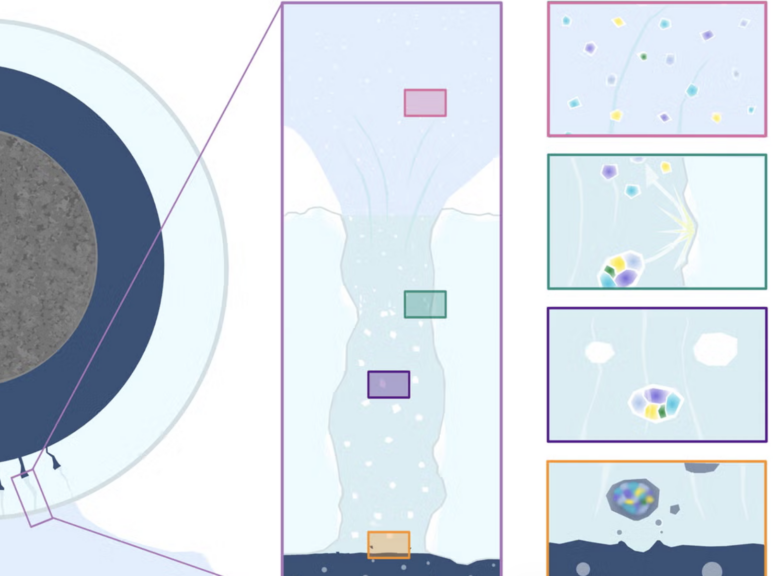
That’s Klenner’s phrase for the newest result, published Sept. 25 in Science Advances. His team examined nearly 1,000 salt-rich grains recorded by Cassini, and they varied widely. Some were mostly table salt. Others were packed with carbonates or phosphates. If each grain were a perfect sample of the ocean, they would all look alike.
So the team froze droplets of salt water modeled on the Enceladus ocean. Large droplets that cooled slowly separated their salts into distinct zones, and the smallest stayed uniform. They propose that the same thing happens in the vents, where frozen droplets speed up to a few hundred miles an hour and shatter against the icy walls. The pieces that come out are different from one another.
What would a spacecraft need to find?
The odd ones. The 2024 study had already argued that analyzing single grains, where cell material may be concentrated, works better than averaging across billions of them. The new one explains why the grains differ in the first place. “A future spacecraft has to find exactly those grains,” Klenner said.
Klenner’s laboratory is working on how organic molecules and possible biosignatures would look in individual ice grains, and how a mass spectrometer could tell biological chemistry from nonbiological chemistry. He has said he finds fatty acids and lipids more exciting targets than DNA building blocks, because fatty acids appear to be more stable. The 2023-2032 Decadal Survey recommended that NASA fly a mission with multiple Enceladus flybys.

The bottom line
Three studies point the same way. If there’s life in that ocean, it would hide in individual grains, and the instruments are being built to read one grain at a time.
Ask us! What questions do you have about content, strategy, pop culture, lifestyle, wellness, history or more? We may use your question in an upcoming article!
Related:
- Historical “discoveries” that turned out to be elaborate hoaxes
- Some of the most surprising record deals in music history
Like MediaFeed’s content? Be sure to follow us.
This article was syndicated by MediaFeed.co.