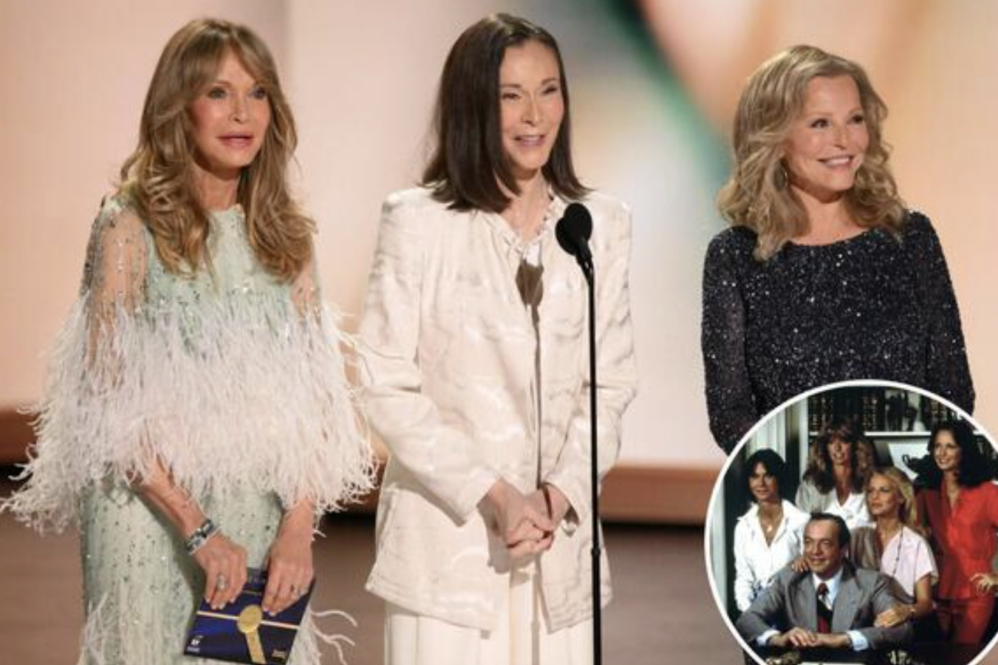
When the house lights dimmed at the Peacock Theater for the 78th Primetime Emmy Awards, the familiar pulse of a brass-heavy 1970s television fanfare commenced to swell through the hall. For a brief heartbeat, the black-tie crowd held its breath. Then, just like the old days, stepping, side by side, into the spotlight, there were Jaclyn Smith, Kate Jackson, and Cheryl Ladd.
A Closer Look
Fifty years after Charlie’s Angels debuted on ABC on September 22, 1976, the sight of the three women sharing a stage triggered an immediate, thunderous standing ovation. Dressed in coordinated evening wear that celebrated their enduring Hollywood royalty rather than playing to nostalgia, they offered an evocative picture of survival, beauty, and camaraderie in an industry that rarely allows women of a certain age to reclaim center stage on their own terms.
Smith, now 80, stood at center. Jackson, 77, and Ladd, 75, flanked her, radiating the effortless poise of women who had weathered the turbulent machinery of prime-time television when it was watched by upwards of 30 million people a week. Yet, as the applause subsided, the trio made it clear that this anniversary was not just about personal triumphs; an overdue tribute to the presence hovering over the room: Farrah Fawcett.
“I would like to acknowledge someone not standing with us tonight, and that’s my friend Farrah Fawcett,” Smith said, her voice rich with sentiment. Looking out at an audience packed with the modern creative vanguard of television, she added that Fawcett remains “here with us in everyone’s collective memory.”
Jackson nodded, stepping to the microphone with characteristic candor. The late actress, who passed away from cancer in 2009 at the age of 62, was, Jackson declared warmly, “the shiniest angel of all.”
Cheryl Ladd brought down the house with a touch of affectionate irreverence, celebrating the enduring visual mythos Fawcett carved into American pop culture. Concluding the tribute, Ladd quipped that Fawcett’s “iconic poster” featuring her sun-dappled smile in a daring red one-piece swimsuit still “lives in the minds and the garages of many a man.”
The moment encapsulated the duality of the Charlie’s Angels phenomenon: groundbreaking in its elevation of women as capable, gun-toting lead detectives, yet irrevocably anchored in the unapologetic male gaze of late-1970s network television.
The Architecture of an Obsession
When executive producers Aaron Spelling and Leonard Goldberg brought Charlie’s Angels to television screens alongside series co-creators Ivan Goff and Ben Roberts, the pitch was deceptively simple: three police academy graduates who had been consigned to menial clerical duties (filing, typing, directing traffic) are plucked from obscurity by the Townsend Agency. Their mysterious, fabulously wealthy benefactor, Charles Townsend, communicates exclusively through a sleek speakerphone on an ornate office desk, shielded by his dryly capable liaison, John Bosley (played with grandfatherly warmth by David Doyle).
The original triumvirate, Smith as the refined Kelly Garrett, Jackson as the sharp, street-smart Sabrina Duncan, and Fawcett as the breezy, athletic Jill Munroe—became an overnight sensation. The show’s mix of glamour, undercover intrigue, sun-drenched Southern California backdrops, and action choreography catapulted it into the television stratosphere. Between 1976 and its eventual wrap in June 1981, it was an anchor of ABC’s programming dominance.
Yet with success came an enduring media label. Critics swiftly coined the moniker “jiggle TV” to describe the relentless undercover scenarios that found the trio running down docks, infiltrating criminal cartels, or tailing suspects while dressed in bikinis, satin evening gowns, or unbuttoned tracksuits. Despite the objectification, the actresses elevated the camp material into a genuine celebration of female solidarity. In an era when women on network television were primarily housewives or damsels in distress, the Angels carried .38 revolvers, understood ballistic science, jumped out of airplanes, and repeatedly rescued one another from peril without relying on men.
Fawcett’s tenure, explosive as it was, lasted a mere 29 episodes. Her departure at the end of the first season ignited a bitter legal feud with Spelling and rocked the television industry. Into that vacuum stepped Ladd as Jill’s younger sister, Kris Munroe. Ladd brought her own sunny charisma and emotional balance to the team, cementing the show’s resilience and sustaining its run for another four vibrant seasons.
Motor Homes and Grievances: Inside Smith’s Memoir
The warmth of the 2026 Emmy stage stood in striking contrast to the complex, turbulent backstage relationships chronicled in Jaclyn Smith’s candid memoir, I Once Knew a Guy Named Charlie. The book pulls back the velvet curtain on the 20th Century Fox and Warner Bros. soundstages, presenting a nuanced look at the intense creative crucible that forged the series.
In her book, Smith, the only Angel to remain with the series for its entire five-season, 110-episode run, paints a vibrant yet unvarnished portrait of Kate Jackson. She describes Jackson as a deeply “complex person” possessing sharp intelligence and intuitive comedic timing, but someone whose frustration and anger “could get the best of her.”
Smith affectionately recounted one legendary afternoon when Jackson, who was “savvy and skilled, and at times downright silly,” reached her absolute boiling point on the lot.
“She climbed behind the wheel of her motor home, with me by her side, and just drove it in circles around the lot, over and over,” Smith wrote of a day Jackson flew into a fury over an on-set slight. “It was funny at first, but the teamsters were not happy with us.”
The tension, according to Smith, ran far deeper than routine production squabbles. Jackson held “a lot of resentment” toward the series’ creative hierarchy. From Jackson’s perspective, her creative fingerprints were all over the series’ most defining tropes. She had been instrumental in refining the show’s title, steering it away from early, cumbersome concepts like The Alley Cats, and had championed the narrative device of Charlie remaining an unseen voice, arguing that the speakerphone mystery would lend the agency an air of eccentric intrigue.
Because of those foundational contributions, Jackson believed she was entitled to both formal creator credit and a proportionate cut of the backend profits. “She felt that she was owed both an acknowledgment and a piece of the profit as a creator,” Smith documented. “Producers disagreed.” The ensuing stalemate left Jackson feeling artistically dismissed and financially sidelined, a bitterness that cast a shadow over her tenure until her eventual departure in 1979 after season three.
The Merchandise Machine
That financial disenfranchisement remains an active grievance. Earlier this year at the 2026 Paley Center Honors, Jackson pulled no punches when asked about the multi-million-dollar merchandising empire spawned by the series.
During the late 1970s, Charlie’s Angels was not merely a television show; it was an industrial retail footprint. From lunchboxes, thermoses, and board games to Halloween costumes, comic books, bubblegum cards, and fashion dolls produced by Hasbro and Mego, the likenesses of the Angels covered toy store shelves across the globe.
“Yeah, funny thing,” Jackson stated sharply to Page Six on the red carpet. “All that merchandising, somebody got rich off of it; it wasn’t the three of us! They’ll have to figure that one out; some attorney can figure that out.”
When pressed on whether the lingering imbalance still bothered her after five decades, Jackson was unequivocal: “Of course it annoys me.”
Her comments highlight a historic labor inequity of 1970s television contracts, where talent frequently signed away comprehensive likeness rights for minimal flat fees. Studios and producers generated astronomical fortunes from brand extensions while the performers who gave those characters life saw their royalties evaporate the moment products left the factory floor.
An Uncomfortable Succession
Jackson’s protective instincts over the series also contributed to a frosty climate when Ladd joined the ensemble in the autumn of 1977. Replacing Fawcett, an actress whose megawatt smile and voluminous blonde mane had made her a worldwide phenomenon, was an unenviable task, and the set became an emotional minefield.
Smith’s memoir details the tightrope she had to walk between her loyal friend Jackson and the newly arrived Ladd.
“It was difficult feeling caught between Kate and Cheryl,” Smith wrote. “Kate never fully accepted Cheryl. Maybe it was because she missed Farrah, and in Kate’s mind no one could take her place.”
Ladd arrived on set aware of the monumental expectations and the simmering grief surrounding Fawcett’s abrupt exit. While Ladd earned the crew’s respect through consummate professionalism and unyielding dedication, the emotional wall between her and Jackson took years to soften. It was an environment charged with unspoken rivalries, relentless 16-hour shooting days, and the exhausting pressure of sustaining a top-five Nielsen rating.
Half a Century of Sisterhood
Time, however, has a way of stripping away the petty grievances of production schedules, contract negotiations, and creative disputes. Standing together at the Emmys, five decades removed from their initial burst of fame, Smith, Jackson, and Ladd offered a testament to survival. They had outlived the network brass, the producers, their male co-stars, and their incandescent sister Farrah.
The half-century mark serves as a reminder that the enduring magic of Charlie’s Angels never belonged to Aaron Spelling, the ABC executives, or the disembodied voice coming through the speakerphone. It belonged to the women on the screen. By honoring Fawcett and stepping forward together, the Angels proved that their bond, forged in the high-stakes furnace of vintage Hollywood, remains as luminous as ever.
Related:
- The Potential TV “Angels” Who Got Their Wings Clipped: A Look Back
- ‘Hunter’ Star Stepfanie Kramer (‘Dee Dee McCall’) Turns 70
Like MediaFeed’s content? Be sure to follow us.
This article originally appeared on NewsBreak.com and was syndicated by MediaFeed.co