
Choosing the right autism assessment tool has direct consequences for your practice’s diagnostic accuracy, patient throughput, staffing requirements, and operational capacity. For clinicians and practice leaders evaluating how to build or expand diagnostic services, the comparison between the Childhood Autism Rating Scale, Second Edition (CARS-2) and the Autism Diagnostic Observation Schedule, Second Edition (ADOS-2) is one of the most common and consequential decisions.
Both tools are widely used and empirically validated, but they differ significantly in format, administration time, training requirements, and the type of data they produce. This guide provides a detailed, side-by-side comparison which may help you determine which tool—or which combination of tools—best fits your practice’s clinical needs and operational capacity. We also examine why a growing number of practices are adding objective, biomarker-based technology to complement both.
CARS-2 Overview: The Rating Scale Approach
The Childhood Autism Rating Scale, Second Edition (CARS-2) is a clinician-completed rating scale originally published by Eric Schopler and colleagues. First released in 1988 and updated to the second edition in 2010, CARS-2 has become one of the most widely used autism assessment tools worldwide, valued for its brevity, ease of use, and decades of empirical validation.
How CARS-2 Works
CARS-2 uses a 15-item rating scale in which a trained clinician rates the individual across functional domains, including relating to people, emotional response, body use, object use, adaptation to change, visual response, listening response, verbal and non-verbal communication, activity level, and consistency of intellectual response. Each item is rated on a four-point scale (1 to 4) based on the frequency, intensity, peculiarity, and duration of the behavior. Total scores are totaled across all 15 items, with higher scores indicating more pronounced ASD characteristics.
Two Versions for Different Populations
CARS-2 includes two versions: the Standard form (CARS-2-ST), designed for individuals under 6 years of age or those with communication difficulties or below-average estimated IQs, and the High-Functioning form (CARS-2-HF), designed for verbally fluent individuals aged 6 and older with IQ scores above 80. A third unscored form, the Questionnaire for Parents or Caregivers (CARS-2-QPC), gathers background information to support clinician ratings.
Scoring and Classification
On the CARS-2-ST, the traditional cutoff score of 30 distinguishes autism from non-autism, while scores between 25 and 29.5 suggest milder ASD presentations. The CARS-2-HF provides standard scores and percentile ranks. Research has demonstrated high sensitivity (ranging from 81–100%) and specificity (70–100%) for both versions when compared with DSM-5 criteria, though performance can vary by population and cutoff.
Training and Administration
One of CARS-2’s key advantages is its relatively low barrier to entry. The rating takes approximately 5–10 minutes once the clinician has gathered the necessary observational and background information (which may take 15–30 minutes of direct observation or review). There is no required multi-day workshop—clinicians with relevant experience can learn to use CARS-2 through self-study of the manual and supervised practice. The complete CARS-2 kit costs approximately $250–$350.
ADOS-2 Overview: The Structured Observation Approach
The Autism Diagnostic Observation Schedule, Second Edition (ADOS-2) is widely regarded as the gold standard in autism observational assessment. Developed by Catherine Lord, Ph.D., and colleagues, it is a semi-structured, standardized assessment that directly observes communication, social interaction, play, and restricted and repetitive behaviors.
How ADOS-2 Works
Unlike CARS-2’s rating scale format, ADOS-2 requires the clinician to actively engage the individual in a series of planned activities and social presses designed to elicit ASD-related behaviors. The clinician observes and codes specific behaviors in real time, then converts those codes to algorithm scores. ADOS-2 contains five modules (Toddler Module plus Modules 1–4), each tailored to a different age, developmental and language level.
Scoring and Classification
For Modules 1–4, algorithm scores across two domains—Social Affect (SA) and Restricted and Repetitive Behaviors (RRB)—are compared against empirically derived cutoff values to yield one of three classifications: Autism, Autism Spectrum, or Non-Spectrum. Modules 1–3 also generate Calibrated Severity Scores (CSS)—standardized scores on a 1–10 scale—that allow cross-module and longitudinal comparison. The Toddler Module produces a range of concerns rather than formal classifications. Validity research shows sensitivity of 83–91% and specificity of 80–94% across modules.
Training and Administration
The ADOS-2 typically requires a two-day clinical training workshop (approximately $500–$1,000 depending on the provider). While the publisher does not mandate supervised administrations for clinical use, many training programs recommend several practice administrations (often 5–10 per module) before clinicians use the instrument independently. The ADOS-2 starter kit costs roughly $2,400–$2,800. Administration usually takes 40–60 minutes per module, with additional time required for scoring and interpretation.
Side-by-Side Comparison: CARS-2 vs. ADOS-2
The following table compares the three tools across the dimensions that matter most for clinical decision-making: time, cost, training, clinical utility, and practical fit.
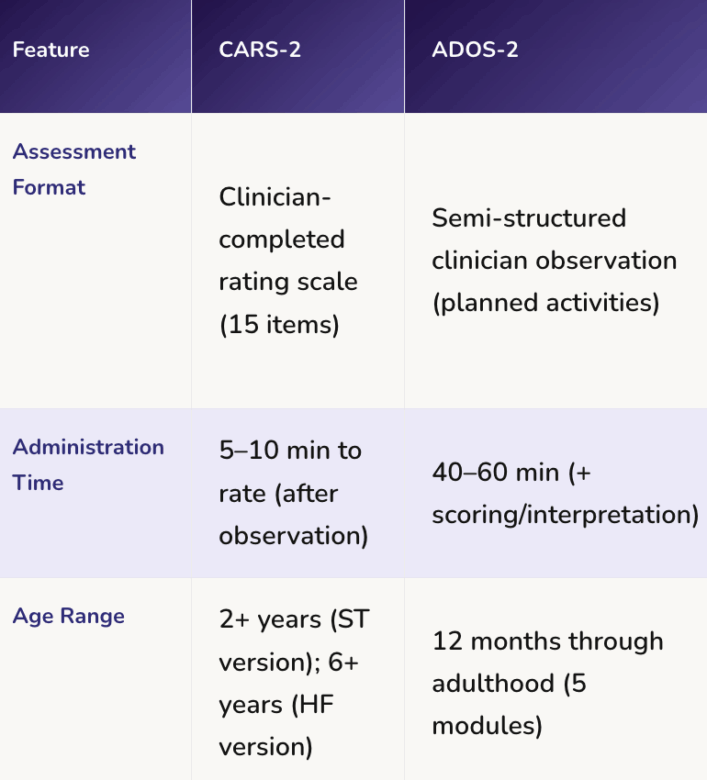
You can view the full comparison chart here.