
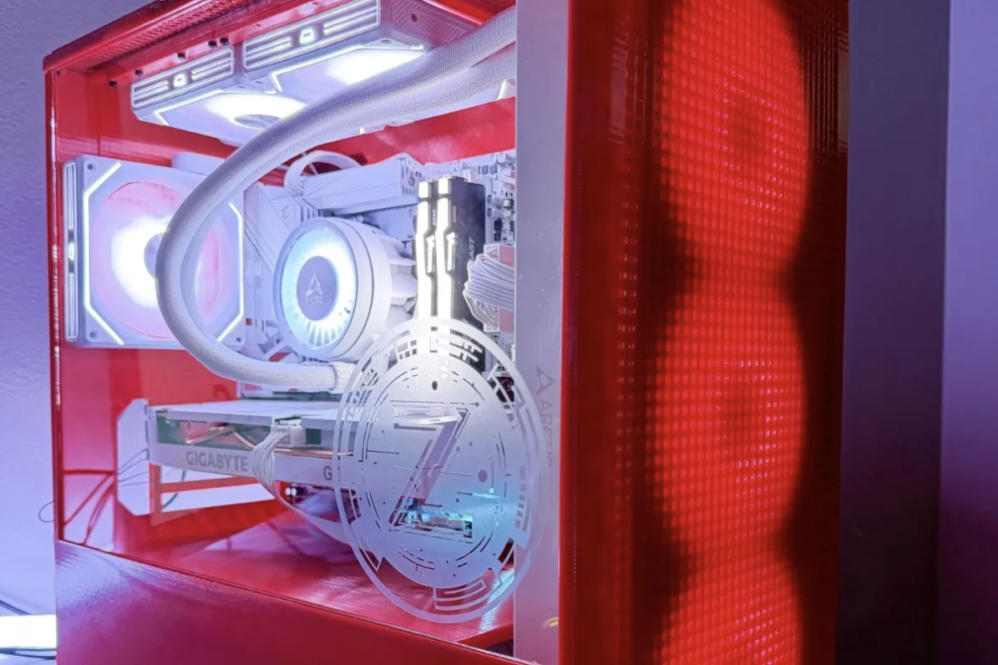
Yes, you can 3D print a computer case capable of housing a complete gaming PC. The harder question is whether you can make one that supports the hardware, manages heat, withstands regular handling, and can be manufactured consistently. Those are the challenges we’re working through at Esport Supply as we develop custom cases in Kansas for our Zodiac Labs gaming computers.
We’ve reached the point where we can assemble a complete PC inside one of our printed prototypes. It’s an encouraging milestone, but there’s a considerable difference between producing a working enclosure and developing something we’re ready to manufacture for customers.
What Does It Take to 3D Print a Computer Case?
A 3D printed case serves the same purpose as a conventional enclosure. It houses the motherboard, graphics card, power supply, and cooling equipment while providing secure mounting points and ventilation.
The difference is how it’s manufactured. Rather than stamping metal or molding plastic, we’re building the enclosure layer by layer from a digital design. That gives us more control over dimensions, ventilation, and appearance without investing in expensive manufacturing molds. It also introduces challenges involving production time, material behavior, and consistency that we’re learning to manage.
Why Did We Choose PETG+ for Our Computer Cases?
We’re currently printing our cases with PETG+, a modified PETG filament. We chose it primarily for its available colors, toughness, and better heat resistance compared with standard PLA.
PLA is popular because it’s relatively easy to print, but its lower temperature resistance makes it less attractive for computer enclosures. PETG offers a useful balance of strength and printability, while materials such as ABS and ASA can provide greater thermal resistance in certain applications. The Prusa Research material guide offers a helpful comparison of these materials.
Of course, selecting a stronger filament doesn’t guarantee a durable case. PETG+ formulations vary, and the printing process itself influences how a finished part performs. We’ll need to evaluate the material under actual operating conditions before drawing conclusions about long-term reliability.
How Are We Designing the Cases for Durability?
We’ve chosen to print the main case structure as a single piece rather than assembling several large printed sections. We’re also using relatively high infill settings, which means depositing more material inside the structure for reinforcement. That increases filament consumption and printing time, but strength is an important consideration at this stage.
Printing direction matters, too. Because 3D printed objects are built in layers, they can respond differently to forces depending on how those layers are oriented. A 2025 study published in Materialia examining PLA and PETG investigated how printing orientation affects mechanical performance.
We haven’t completed formal durability testing yet. Now that we can assemble a computer inside the enclosure, we can begin evaluating mounting points, repeated maintenance, material deformation, and how the case holds up during normal use.
Can a 3D Printed Computer Case Provide Enough Cooling?
Cooling has been a major consideration throughout development. Our design supports three intake fans and four exhaust fans, with the intention of creating negative pressure inside the enclosure. That means more air would be exhausted than actively drawn in, with replacement air entering through available openings.
The actual airflow depends on fan speeds, ventilation restrictions, and installed components. Negative pressure doesn’t automatically improve cooling and can introduce dust through unfiltered openings. Our goal is performance comparable to conventional gaming PC cases, particularly during extended gaming sessions, but we still need temperature testing to confirm the results.
One benefit of developing the enclosure ourselves is that we can adjust ventilation and fan placement around the hardware we’re installing. If testing identifies a problem, we can revise the design rather than work around the limitations of an existing case.
How Long Does It Take to 3D Print a Computer Case?
Producing one case currently takes approximately three days from start to finish using our prototyping equipment. Printing time depends on the machine, material, and design complexity, particularly when we’re using additional filament for structural reinforcement.
That timeline presents an obvious challenge for larger production runs. We’re considering a print farm, where multiple printers could manufacture cases simultaneously. Individual prints might still take considerable time, but overall production capacity would increase.
Quality control will be equally important. Every case needs consistent measurements so components fit properly, and we have to account for warping, surface defects, failed prints, and finishing work. Those factors affect manufacturing costs, particularly as quantities increase. We’re still determining whether the flexibility of 3D printing can justify those tradeoffs at a commercial scale.
Can Schools Customize Their Esport Supply Computer Cases?
Customization is one of the possibilities we’re particularly interested in for schools and universities. PETG+ comes in a variety of colors, allowing us to explore cases that complement a school’s branding or esports facility design.
For logos and other graphics, we’re leaning toward vinyl applications on the case glass rather than incorporating custom logos directly into the printed structure. That would give schools branding options without requiring an entirely different enclosure for each customer.
We haven’t finalized customization offerings or minimum order quantities, but it’s an area we intend to explore as the project develops.
Are Esport Supply’s 3D Printed Cases Available Yet?
Not yet. The cases are still in research and development, and additional testing is necessary before production.
Our longer-term objective is to manufacture them for Zodiac Labs gaming computers, including systems intended for school and university esports environments. Esport Supply already helps educational institutions plan, design, equip, and install esports facilities, and developing our own enclosures could eventually provide additional equipment options for those projects.
This project also connects to our interest in domestic manufacturing. In our earlier article, Can You Still Make Computer Parts in America? Why We Started 3D Printing Our Own Cases in Kansas, we explained why we began exploring locally manufactured components and what that could mean for smaller computer builders.
What Have We Learned From Building Our Own Cases?
One thing this project has reinforced is that designing a computer case and manufacturing one are different challenges. A design might look promising on a screen, but decisions about reinforcement, mounting points, and ventilation affect how easily the finished computer can be assembled, serviced, and eventually produced in larger quantities.
For Esport Supply, understanding those challenges firsthand matters. We work with schools and universities to develop esports environments, and the computers installed in those facilities need to perform reliably. Having more control over their design could give us greater flexibility, provided we can meet the same expectations customers have for conventional equipment.
We’re not trying to prove that every computer case should be 3D printed. We’re trying to determine whether this manufacturing approach makes sense for the computers we build. Getting a complete PC into our own printed enclosure was an important milestone. The next challenge is proving we can manufacture one consistently enough to put our name on it.
Related: