

While many business owners have to focus on managing the day-to-day, planning for the future is key to managing cash flow and finding growth opportunities. Budgeting and forecasting are essential financial tools businesses use to plan for the future, but they serve different purposes.
Think of a budget as where you want to go, but a forecast is where you think you’ll go. Let’s look at how to determine the differences between the two and how each can help your business:
What is a budget?
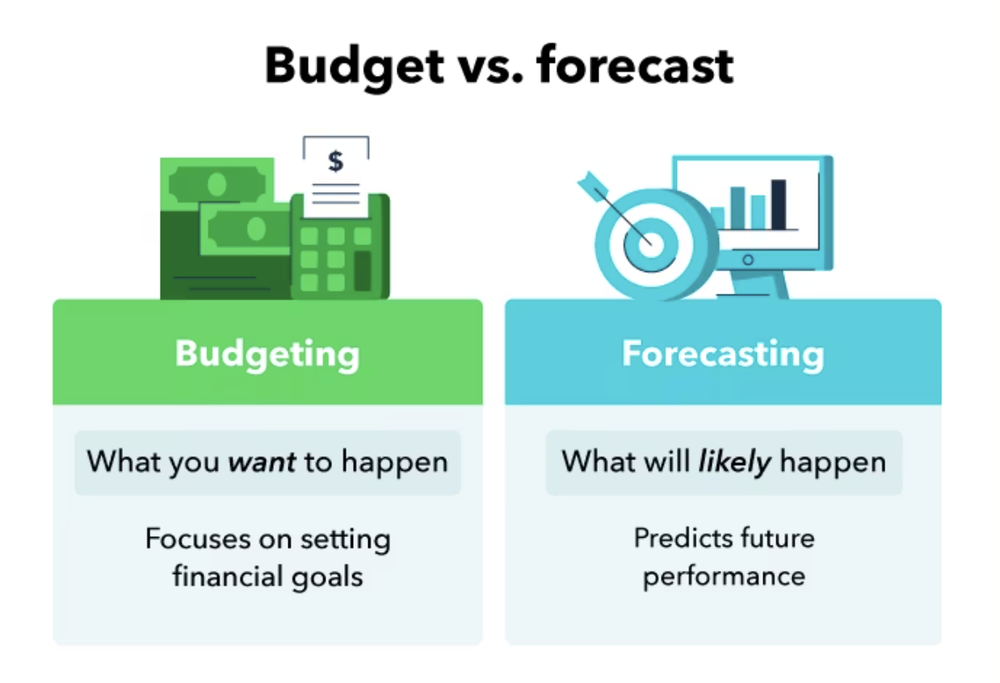
A budget is a financial plan for spending based on estimates of expenses and income over a specific period (usually a year). The purpose of a budget is to set and track financial goals for the business. It provides a framework for businesses to make strategic decisions on allocating resources and prioritizing expenses.
Depending on the company’s size, there may be a budgeting process—often done toward the end of the year. The budget tends to have input from various departments and managers. In smaller companies, the owner or a few key employees, such as the bookkeeper, handle budgeting.
Most budgets are static and set for the company’s fiscal year, although you can create monthly budgets. You’ll want to periodically compare the actual results to the budgeted amounts to identify discrepancies and take corrective actions if necessary.
What is a forecast?
A financial forecast is a projection of what will likely happen—generally at a higher level, such as crucial revenue items or total expenses. You can forecast for various periods, such as short-term (a couple of months) or long-term (aka five years). A longer-term forecast might look out over several years and be part of a longer-term strategic business plan. Shorter-term forecasts are for operational reasons.
There are different types of forecasts, such as a revenue forecast for determining headcount, production, and inventory. For accurate forecasts, rely on up-to-date financial reports, historical data, and market research.
Budget vs. forecast: 3 key ways they differ

Budget and forecast are important tools in financial planning for businesses. While they share some similarities, there are key differences between the two. Let’s look at three ways in which budgets and forecasts differ:
1. Why you create them
A budget and a forecast provide a roadmap for allocating resources and guide your operations and decision-making. But businesses tend to create:
- A budget to set financial goals and track performance.
- A forecast to predict future financial outcomes and make informed decisions.
Budgets help businesses maintain financial discipline by avoiding overspending and ensuring you manage effectively. It allows businesses to plan for future investments, expansion, or debt reduction by allocating resources accordingly.
Using a forecast offers several benefits for businesses. You can use them to create pro forma financial statements or optimize operations by aligning resources and activities with projected financial outcomes. It also helps identify potential financial gaps or shortfalls, allowing businesses to take proactive measures like securing additional funding or adjusting their spending plans.
2. What periods they cover
Budgets and forecasts serve distinct purposes in business planning and tend to cover different periods (although they can cover the same ones). The periods they cover are:
- Budgets generally cover set periods, such as one year.
- Forecasts cover longer-term periods, such as many years.
Budgets, once set, remain in place for the period. They provide a plan of action for the upcoming year. Forecasts can span several years, but you will want to update them on a rolling basis, such as monthly.
Updating your forecasts will ensure accuracy and relevance. It’s a tactical tool that helps businesses monitor and adjust items like inventory forecasts in response to changing market trends and business conditions.
3. What they track
Budgets and forecasts also differ with what they track, in particular:
- Budgets primarily track planned revenue and expenses.
- Forecasts track predicted financial outcomes.
A budget’s key metrics or components include revenue targets, variable costs, and debt reduction goals. By setting revenue targets and estimating expenses, budgets enable business owners and management teams to monitor progress and make necessary adjustments to achieve desired financial outcomes.
Forecasts project future financial outcomes based on historical data, market trends, and business conditions. You can also forecast in different ways, such as top-down vs. bottom-up forecasting.
Tracking these metrics helps business owners and management teams anticipate revenue fluctuations, prepare for market changes, and make well-informed decisions.
Best practices for budgeting and forecasting
Ideally, you’ll use a budget as a management tool to run the business. Compare your results to your budget periodically to see how you’re doing. If expenses in a certain area exceed your budget, dig deeper to see if the overage is from overspending.
Are revenues and profits on track with the budget? Did the company add additional revenue or lose business that was part of the budget? Reviewing the budget is a key step in managing your business finances.
Here’s how to get the most out of your budgeting efforts:
- Start with a realistic projection: Your revenue projections will drive this part, but you should also do a cash flow projection and be conservative here.
- Differentiate expenses: Break out your essential expenses, like electricity and internet, from your discretionary expenses, which are not essential to running the company, such as entertainment.
- Build in debt and cash: Include debt payments and incorporate building cash reserves into your budget to ensure any extra profits are a cushion against a future downturn in business.
Forecasting is an important tool to help a company make necessary adjustments in spending and focus during the year as the business changes. For example, if a major customer plans to reduce or add to their volume of business, this will have a significant impact on operations and cash flow.
Here are some best practices for forecasting:
- Consider using more than one forecast: Generally, you’ll want to create three. One that reflects an optimistic outlook, one that’s pessimistic, and one that’s most likely to happen. You can then plan for growth but must be able to make adjustments in case opportunities don’t materialize or happen slower than originally thought.
- Update your forecast regularly: Things change, such as market conditions, so you can prepare by updating your forecast monthly or quarterly.
- Involve key members of your team: Leverage managers or your sales team to get a better look at what’s happening in your markets. Your forecast will be more accurate with this information.
Using a budget and forecast, businesses can establish realistic financial goals, track their progress, and ensure long-term viability.
Run your business with confidence
While budgeting and forecasting are different functions, they are most useful when put in action together. A good forecast feeds the development of a sound budget. During the year, comparing the most recent forecast to the budget for the rest of the period can help the company adjust to changing business conditions.
To effectively utilize budgeting and forecasting, it’s crucial to have a flexible and accessible solution. The solution should be easy to use, allowing business owners and team members from different departments to collaborate seamlessly.
This article originally appeared on the QuickBooks Resource Center and was syndicated by MediaFeed.org.
More from MediaFeed:
18 loans for Hispanic-owned businesses

There are nearly 5 million Hispanic-owned businesses in the U.S., making this the fastest-growing segment of U.S. small businesses, according to the U.S. Small Business Administration (SBA). Yet, despite these big numbers, Hispanic and Latinx business owners frequently face challenges accessing capital and, as a result, often can’t successfully scale their businesses.
Fortunately, a number of organizations and government agencies in the U.S. are stepping up to address this unmet need, offering loans, grants, and other financing options to Hispanic and other minority entrepreneurs. These minority business loans may have lower interest rates and be easier to qualify for than some traditional loans. Here are 18 financing options that are worth checking out.
(Learn more: Personal Loan Calculator)
PeopleImages/istockphoto

To qualify as a Hispanic-owned business, more than 50% of the company must be owned by people of Mexican, Puerto Rican, Cuban, or other Hispanic origin. Currently, nearly one in four businesses are Hispanic-owned.
andresr/istockphoto

A minority business loan is a small business loan designed to provide financing options for underserved communities. While minorities are free to apply for any business loan, minority business loans may offer more competitive rates and have less stringent qualification requirements.
Groups that are considered minorities in the U.S. include African Americans, Asian Americans, Hispanic Americans, and Native Americans. Women are also considered minorities for many types of loans, as well.
FreshSplash/istockphoto

The following lenders offer different types of small business loans to Hispanic and minority entrepreneurs and were chosen based on our analysis of search volume.
1. Accion
Accion is a nonprofit financial institution that invests in underserved communities and offers low-cost lending opportunities to Hispanic- and minority-owned businesses. The Accion Opportunity Fund provides loan amounts from $5,000 to $100,000, and is quick and easy to apply for online.
Accion offers two types of small business loans — the Southern Opportunity and Resilience (SOAR) Fund and the Small Business Progress Loan. SOAR is geared toward those in the south and southeast who experienced economic hardship from the COVID-19 pandemic and have been in business since September 2019 or earlier. The Small Business Progress Loan, on the other hand, is open to all minority-owned businesses and women entrepreneurs, and is partnered with American Express.
Accion also offers online resources, events, and networking opportunities (in Spanish and English) to help minority business owners learn and grow their companies.
(Learn more at: Home Affordability Calculator)
Delmaine Donson/istockphoto

The Community Development Financial Institutions Fund (CDFI Fund), which is part of the U.S. Treasury, gives funds to companies and organizations that help underserved people and communities. Minority business owners can reach out to local banks and nonprofit groups that have received CDFI funds to discuss and apply for low-cost business loans.
JohnnyGreig/istockphoto

The owners of Camino Financial were inspired to start their lending business in order to help people like their mother, who lost her Mexican restaurant business when they were children. To that end, they offer simple and affordable loans to small businesses who find it difficult to borrow through banks. They offer bad credit loans, secured and unsecured loans, microloans, and working capital loans up to $35,000. To qualify, your business must have been in operation for at least nine months and generate annual sales of $30,000 or $2,500 a month.
monkeybusinessimages/istockphoto

The U.S. Small Business Administration (SBA) offers several financing programs that can help minority-owned businesses get access to the funding they need. Here are two programs you may want to check out to find a Hispanic small business loan:
Microloans
The SBA microloan program is administered by an intermediary network of nonprofit community-based lenders, rather than traditional banks. Through these lenders, the SBA aims to reach lower-income communities and minority-owned businesses that are often overlooked by traditional lenders. These loans come with low interest rates, six-year terms. and loan amounts up to $50,000.
Community Advantage Loans
The SBA’s Community Advantage loan program provides up to $350,000 in capital and is specifically designed to meet the needs of business owners in underserved communities. To qualify for an SBA community advantage loan, business owners need to have good credit and a strong business plan. However, the business’s balance sheet and amount of collateral will not affect eligibility.
mapodile/istockphoto

By offering crowdfunded loans with 0% interest, nonprofit Kiva is working to lift barriers to capital often faced by entrepreneurs from underserved communities. To apply, you need to market your Hispanic business to the community of 1.9 million individual lenders. These lenders can then choose to lend your company as much as $15,000 and you’ll have up to three years to repay them.
PeopleImages/istockphoto

CDC Small Business Finance is a nonprofit whose mission is to provide access to affordable and responsible capital to underserved entrepreneurs, including minority, veteran, and hispanic business owners. CDC offers loan amounts of $20,000 to $350,000 with five- to 10-year terms. They also offer SBA 504 commercial real estate loans of $250,000 to $40 million.If you are looking for advice to rebuild your credit, develop your business strategy, or manage financial reports, you’ll appreciate having access to small business advisors through CDC.
AaronAmat/istockphoto

Grameen America strives to achieve racial and gender equity by providing microloans of up to $2,000 to female and minority business owners. As part of their program, borrowers can open free savings accounts with commercial banks and build personal credit as they pay off their microloans. Grameen also offers training and support to women who want to start businesses and rise out of poverty.
ferrantraite/istockphoto

The Latino Economic Development Center (LEDC) offers Hispanic small business loans of $500 to $250,000 that can be used to purchase equipment, expand a business, hire staff, or purchase inventory. The three types of loans offered by the LEDC are as follows:
- LEDC Growth Loan: Loan amounts up to $250,000 for established small businesses that have been in operation for a minimum of two years.
- LEDC Startup Loan: Loan amounts up to $20,000 for new businesses with less than two years of business history.
- LEDC Seed Loan: Loan amounts up to $5,000 for businesses with less than one year of experience and with plans to launch a company within three months of funding.
LEDC also offers free business advice and credit-building services, as well as a directory of latino-owned small businesses.
svetikd/istockphoto

The National Association of Latino and Community Asset Builders (NALCAB) provides funding to a network of over 200 nonprofit organizations that serve diverse Latino communities throughout the U.S. With NALCAB support, these partner organizations offer Hispanic loans, grants, professional training, and support.
FG Trade/istockphoto

Hispanic small business loans aren’t the only way for your business to get funding. There are also minority business grants that can provide capital that you don’t have to repay. These grants are offered by federal and local government agencies, corporations, and nonprofits.
10. Grants.gov
Grants.gov is the largest database of federal grant opportunities. While most grants are not specifically targeted to Hispanic small business owners, awards are available for all types of entrepreneurs, especially those focused on healthcare, U.S. defense, and environmental protection.
Drazen_/istockphoto

digitalundivided’s BREAKTHROUGH Program (powered by JPMorgan Chase’s Advancing Black Pathways) offers $5,000 grants to Black and Hispanic women in the Dallas, Texas area. digitalundivided also provides training and resources to help businesses understand their customers, find financing, and choose the right business model.
alvarez/istockphoto

The National Association of the Self-Employed (NASE) works to provide resources for all self-employed individuals, including Hispanic business owners. They offer Growth Grants of $4,000, which can be used for a variety of business expenses, including marketing, advertising, hiring employees, and expanding facilities.
Besides access to grants, becoming a NASE member allows you to connect with experts who can advise you on subjects like finance, healthcare, strategy, law, and marketing. NASE membership also gives you access to discounts on healthcare, software, tax filing, and business travel.
PeopleImages/istockphoto

Hispanic businesses located in rural areas that have fewer than 50 employees and less than $1 million in gross revenue may want to consider applying for a Rural Development Grant from the USDA. Grants vary in size and can be used for a variety of projects that aid business development in rural areas, including training, technical assistance, acquisition or development of land, building construction or renovations, equipment purchases, and pollution control.
supersizer/istockphoto

The Small Business Innovation Research (SBIR) and Small Business Technology Transfer (STTR) programs are government grants from five different federal government agencies. These competitive grants are focused around tech and science and offer up to $1 million in capital (divided into two phases) to qualified small businesses.
Tempura/istockphoto

You may be able to find funding for your Hispanic small business through Candid.org’s Foundation Directory Online, which contains information on over 240,000 grantmakers in the U.S. Access to the directory requires buying a monthly subscription, but you can cancel at any time.
monkeybusinessimages/istockphoto

Comcast RISE, which stands for Representation, Investment, Strength, and Empowerment, is a grant designed for businesses that were hit hardest by COVID-19. The grant is worth $5,000 and is given to small business owners hoping to expand and recover from the effects of the pandemic. Awards go to those looking to uplift their communities with a focus on diversity, inclusion, and community investment.
Vergani_Fotografia/istockphoto

The Entrepreneurial Spirit Fund by SIA Scotch Whiskey awards $10,000 in grants to small businesses owned by people of color in the food and beverage industry. Created by Hispanic entrepreneur Carin Luna-Ostaseskis, one of SIA’s goals is to provide funding, mentorship, and community to small businesses.
monkeybusinessimages/istockphoto

If you’re a woman entrepreneur, consider applying for the Amber Grant, named after Amber Wigdahl, who passed at the age of 19 and never got to fulfill her business dreams. Each month, at least $30,000 is given in Amber Grant money. Applying takes just a few minutes and winners are announced by the 23rd of the following month.
andreswd/istockphoto

In addition to the grants and loans, there are organizations that can provide technical assistance, training, workshops, and networking opportunities to Hispanic businesses. Below are some you may want to check out.
digitalundivided
With a focus on assisting Black female and Latinx business owners, digitalundivided offers virtual training and a fellowship program for entrepreneurs. It also offers a pre-accelerator program for tech-enabled startup founders who have already begun to build their startup, are pre-revenue, and need assistance in developing their business model, marketing, and strategy.
Minority Business Development Agency
The Minority Business Development Agency is an advocate for Hispanic and other minority-owned businesses, and offers research, conferences, and resources to help entrepreneurs. Its Enterprising Women of Color Initiative is aimed to help minority women succeed in business through various offerings.
USHCC
The United States Hispanic Chamber of Commerce actively promotes the economic growth, development, and interests of Hispanic-owned businesses. Members have access to events and business resources to support them in their growth. In addition, members get listed in the Chamber’s online Hispanic business directory.
SCORE
SCORE is a national organization that connects business owners to free mentors to help them learn and grow their companies. SCORE also offers free workshops and a robust online database of useful business content.
Poike/istockphoto

Looking for — and applying for — a Hispanic business loan can feel like an overwhelming task. Here are some ways to simplify the process.
Consider Your Options
Before applying for a small business loan, it’s a good idea to take a look at your credit profile and business financials, as this will give you an idea of what type of loan you might qualify for. If you have excellent credit, solid revenue, and have been in business at least two years, you may be able to qualify for a long-term, low interest loan from a bank or SBA lender. If not, you may want to look into financing offered by lenders and grantmakers listed above, as well as online lenders (who often have less strict qualification requirements for loans).
Determine How Much Money You Need
To figure out how much of a loan you need to start or grow your Hispanic business, consider how you would like to use the funds from a loan, then create a detailed budget for your project, adding in some padding to account for unexpected expenses.
Consider the Best Location for Your Business
If you haven’t yet launched your business, consider what might be the best environment for doing so. You may want to explore the best metros for minority businesses, since they may have established communities of hispanic business owners and resources to help you.
Gather All Your Paperwork
Whatever type of funding you decide to pursue, you will likely need to supply an extensive amount of information about your business in order to apply. This often includes:
- Business EIN
- Industry
- Entity type
- Business license and permits
- Annual business revenue and profit
- Bank account statements (personal and business)
- Personal and business tax returns
- Balance sheet
- Proof of collateral
- Accounts receivable and payable reports
- Existing debt
- Commercial lease
- Purpose of the loan/grant
- Business plan
This article originally appeared on SoFi.com and was syndicated by MediaFeed.org.
Lantern By
SoFiSoFi receives compensation in the event you obtain a loan, financial product, or service through the Lantern marketplace. This Lantern website is owned by SoFi Lending Corp., a lender licensed by the Department of Financial Protection and Innovation under the California Financing Law, license number 6054612; NMLS number 1121636. (nmlsconsumeraccess.org
https://www.nmlsconsumeraccess.org/
). This site is NOT owned and operated by SoFi Bank. Loans, financial products, and services may not be available in all states.
All rates, fees, and terms are presented without guarantee and are subject to change pursuant to each provider’s discretion. There is no guarantee you will be approved or qualify for the advertised rates, fees, or terms presented. The actual terms you may receive depends on the things like benefits requested, your credit score, usage, history and other factors.
*Check your rate: To check the rates and terms you may qualify for, Lantern and/or its network lenders conducts a soft credit pull that will not affect your credit score. However, if you choose a product and continue your application, the lender(s) you choose will request your full credit report from one or more consumer reporting agencies, which is considered a hard credit pull and may affect your credit.
All loan terms, including interest rate, and Annual Percentage Rate (APR), and monthly payments shown on this website are from lenders and are estimates based upon the limited information you provided and are for information purposes only. Estimated APR includes all applicable fees as required under the Truth in Lending Act. The actual loan terms you receive, including APR, will depend on the lender you select, their underwriting criteria, and your personal financial factors. The loan terms and rates presented are provided by the lenders and not by SoFi Lending Corp. or Lantern. Please review each lender’s Terms and Conditions for additional details.
Many factors affect your credit scores and the interest rates you may receive. SoFi is not a Credit Repair Organization as defined under federal or state law, including the Credit Repair Organizations Act. SoFi does not provide “credit repair” services or advice or assistance regarding “rebuilding” or “improving” your credit record, credit history, or credit rating. For details, see the FTC’s website on credit (consumer.ftc.gov)
Financial Tips & Strategies: The tips provided on this website are of a general nature and do not take into account your specific objectives, financial situation, and needs. You should always consider their appropriateness given your own circumstances.¹
SoFi’s Insights tool offers users the ability to connect both SoFi accounts and external accounts using Plaid, Inc.’s service. When you use the service to connect an account, you authorize SoFi to obtain account information from any external accounts as set forth in SoFi’s Terms of Use. SoFi assumes no responsibility for the timeliness, accuracy, deletion, non-delivery or failure to store any user data, loss of user data, communications, or personalization settings. You shall confirm the accuracy of Plaid data through sources independent of SoFi. The credit score provided to you is a VantageScore® based on TransUnion® (the “Processing Agent”) data.
Personal Loan
SoFi Lending Corp. (“SoFi”) operates this Personal Loan product in cooperation with Engine by MoneyLion. If you submit a loan inquiry, SoFi will deliver your information to Engine by MoneyLion, and Engine by MoneyLion will deliver to its network of lenders/partners to review to determine if you are eligible for pre-qualified or pre-approved offers. The lenders/partners receiving your information will also obtain your credit information from a credit reporting agency. If you meet one or more lender’s and/or partner’s conditions for eligibility, pre-qualified and pre-approved offers from one or more lenders/partners will be presented to you here on the Lantern website. More information about Engine by MoneyLion, the process, and its lenders/partners is described on the loan inquiry form you will reach by visiting our Personal Loans page as well as our Student Loan Refinance page. Click to learn more about Engine’s Licenses and Disclosures, Terms of Service, and Privacy Policy.Personal loan offers provided to customers on Lantern do not exceed 35.99% APR. An example of total amount paid on a personal loan of $10,000 for a term of 36 months at a rate of 10% would be equivalent to $11,616.12 over the 36 month life of the loan.
Student Loan RefinanceSoFi Lending Corp. (“SoFi”) operates this Student Loan Refinance product in cooperation with Engine by MoneyLion. If you submit a loan inquiry, SoFi will deliver your information to Engine by MoneyLion, and Engine by MoneyLion will deliver to its network of lenders/partners to review to determine if you are eligible for pre-qualified or pre-approved offers. The lenders receiving your information will also obtain your credit information from a credit reporting agency. If you meet one or more lender’s and/or partner’s conditions for eligibility, pre-qualified and pre-approved offers from one or more lenders/partners will be presented to you here on the Lantern website. More information about Engine by MoneyLion, the process, and its lenders/partners is described on the loan inquiry form you will reach by visiting our Personal Loans page as well as our Student Loan Refinance page. Click to learn more about Engine’s Licenses and Disclosures, Terms of Service, and Privacy Policy.
NOTICE: The debt ceiling legislation passed on June 2, 2023, codifies into law that federal student loan borrowers will be reentering repayment. The US Department of Education or your student loan servicer, or lender if you have FFEL loans, will notify you directly when your payments will resume For more information, please go to https://docs.house.gov/billsthisweek/20230529/BILLS-118hrPIH-fiscalresponsibility.pdf https://studentaid.gov/announcements-events/covid-19
If you are a federal student loan borrower considering refinancing, you should take into account the new income-driven payment plan, SAVE, which replaces REPAYE, seeks to make monthly payments more affordable, and offers forgiveness of balances that were originally $12,000 or lower after 120 payments, among other improvements. Also, please note that once you refinance federal student loans you will no longer be eligible for current or future flexible payment options available to federal loan borrowers, including but not limited to income-based repayment plans, such as SAVE, or extended repayment plans.
Auto Loan RefinanceAutomobile refinancing loan information presented on this Lantern website is from Caribou, AUTOPAY, Engine by MoneyLion, and each of Engine’s partners (along with their affiliated companies). Caribou, AUTOPAY, and Engine by MoneyLion pay SoFi compensation for marketing their products and services on the Lantern site.
Auto loan refinance information presented on this Lantern site is indicative and subject to you fulfilling the lender’s requirements, including but not limited to: credit standards, loan size, vehicle condition, and odometer reading. Loan rates and terms as presented on this Lantern site are subject to change when you reach the lender and may depend on your creditworthiness, consult with the lender for more details. Additional terms and conditions may apply and all terms may vary by your state of residence.
Secured Lending DisclosureTerms, conditions, state restrictions, and minimum loan amounts apply. Before you apply for a secured loan, we encourage you to carefully consider whether this loan type is the right choice for you. If you can’t make your payments on a secured personal loan, you could end up losing the assets you provided for collateral. Not all applicants will qualify for larger loan amounts or most favorable loan terms. Loan approval and actual loan terms depend on the ability to meet underwriting requirements (including, but not limited to, a responsible credit history, sufficient income after monthly expenses, and availability of collateral) that will vary by lender.
BankingSoFi Lending Corp. (“SoFi”) operates this website in cooperation with Engine by MoneyLion presenting promotions for products and services offered by other banks, lenders, and financial institutions. If you select a promotion above, you will be connected to the website of the company offering the product. The promotions presented on this site are from companies that pay SoFi and Engine by MoneyLion compensation for marketing their products and services. This may affect whether a provider is featured on this site and could affect the order of presentation. Lantern and Engine by MoneyLion do not include all providers in the market or all of their available offerings. Click to learn more about Engine’s Licenses and Disclosures, Terms of Service, and Privacy Policy.
FG Trade/istockphoto

wagnerokasaki/istockphoto
Featured Image Credit: DepositPhotos.com.


