
Structural inequality in American often financially penalizes communities of color. Across the country, many Black and Latino citizens pay more for services and expenses, including home loans, property taxes and even car insurance, based on location.
To learn more about how disparities in car insurance costs impact people of color, MoneyGeek analyzed 1,648 ZIP codes in 69 cities across the U.S., comparing demographics and auto insurance premiums. The study found that drivers living in predominantly white ZIP codes often pay less for car insurance than people living in the same cities in ZIP codes with a lower proportion of white residents.
Among 69 cities with more than 10 ZIP codes available for analysis, 52 (75%) have a negative correlation (stronger than -0.60) between auto premiums and the percentage of white people in a ZIP code. Much like temperatures drop as elevation increases, car insurance prices fall as the ZIP code’s proportion of white residents increases.
MoneyGeek identified 12 cities across the country where premiums vary the greatest. Depending on the city, you could pay up to $130 more for car insurance for every 10 percentage points less white your ZIP code is.
Organizations, activists and academics have long questioned pricing variations in many industries that negatively impact consumers of color. On July 23, 2020, the National Association of Insurance Commissioners (NAIC) announced the formation of a special committee designed to examine current practices in the insurance industry that potentially disadvantage people of color. While insurance providers use a combination of factors to determine individual rates, the NAIC’s research will reveal how and if these practices negatively or disproportionately impact minorities. The committee is dedicated to making recommendations based on its findings by the end of the year.
Whiter ZIP Codes and Lower Rates Are Correlated
Auto insurers follow state specific-rules and regulations to set ZIP-code-level premiums that are based on the frequency and severity of claims, where severity refers to the cost of paying a claim. The more expensive and more frequent the claims, the higher the premium prices. MoneyGeek’s analysis compared rates across the country, utilizing a consistent driver profile to examine the pricing differences when ZIP code is the only variable changed. The demographics of each ZIP code were researched to calculate the correlation of a ZIP code’s auto insurance premium to the percentage of the ZIP code’s population that is white.
In cities across America, there is a correlation between a driver’s proximity to white populations and what they pay in car insurance. However, this correlation may be surprising for many drivers given that advertising often claims to reward safe driving and emphasizes that rates are based on good behaviors and customer loyalty.
However, in many cities across the United States, where a driver lives plays a large role in determining car insurance rates. Oakland, California, had one of the strongest negative correlations between white population percentage and annual car insurance rates among big cities (-0.925) in MoneyGeek’s study. People living in the five ZIP codes with the highest insurance rates pay an average of $360 more a year than people living in the five ZIP codes with the lowest rates, which have populations that are, on average, 42% more white.
In some cities like New Orleans, Louisiana, which has a -0.809 correlation between white population percentage and car insurance rates, the same discrepancy among ZIP codes that pay more and ones that pay less is a difference of $891 a year, on average.
Based on the analysis, ZIP codes with a smaller percentage of the population that is white tend to pay more for car insurance.
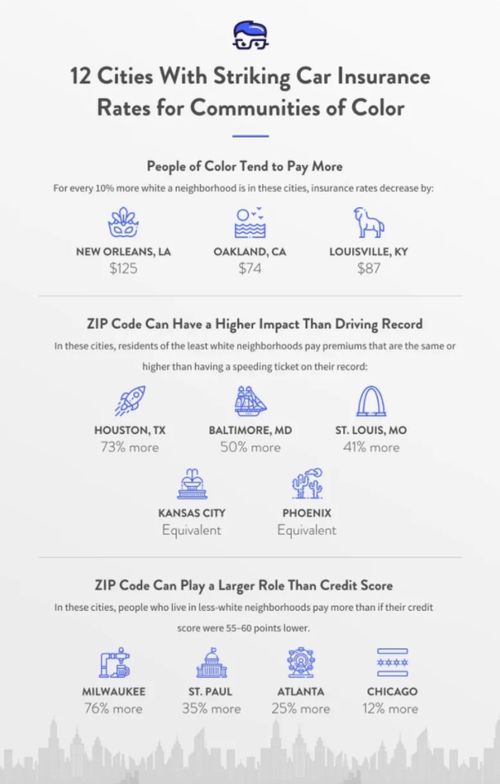
12 Cities Rank Highest for ZIP Code Premium Variations
Among all of the locations MoneyGeek analyzed, 12 cities (ranked in order of strongest negative correlation between white population percentages and car insurance rates) stand out as having extreme price variations in annual car insurance premiums based on ZIP codes.
Strongest Link Between Non-White ZIP Codes and Higher Premiums
|
City |
Correlation |
Premium Increase |
|---|---|---|
|
Oakland, CA |
-0.925 |
$360 |
|
Milwaukee, WI |
-0.916 |
$364 |
|
St. Louis, MO |
-0.895 |
$439 |
|
Chicago, IL |
-0.884 |
$257 |
|
Baltimore, MD |
-0.884 |
$570 |
|
Atlanta, GA |
-0.872 |
$365 |
|
Kansas City, MO |
-0.861 |
$231 |
|
Louisville, KY |
-0.858 |
$656 |
|
Houston, TX |
-0.847 |
$267 |
|
Phoenix, AZ |
-0.83 |
$344 |
|
New Orleans, LA |
-0.809 |
$891 |
|
St. Paul, MN |
-0.806 |
$348 |
These 12 cities all have pricing discrepancies greater than $230 a year, on average, when comparing the annual insurance costs of the five ZIP codes in each city charged the most versus the five ZIP codes charged the least. They represent a cross section of America, spanning the West Coast, Midwest, Southwest, South and East Coast — illustrating that the problem is not isolated to one particular region of the country.
While cities like St. Louis, Missouri; Chicago, Illinois; and Atlanta, Georgia have high levels of ZIP-code-based segregation, that difference is not always the determining factor.A common factor between the 12 cities is at least a 34 percentage point difference in white population between the more diverse ZIP codes that pay the most and the less diverse ZIP codes that pay the least.
In ZIP codes where premiums are more expensive, drivers are charged more not because of their personal driving history, but because of a higher frequency and severity of claims in the area.
3 Cities Experience the Highest Financial Impact
Three cities — New Orleans, Louisville, and Baltimore — have the highest auto premium disparities. While other cities in the top 12 fall within the $230–400 range for pricing variations, diverse ZIP codes in the three aforementioned cities pay much higher rates. In New Orleans, Louisville and Baltimore, average annual insurance rate differences between higher and lower-paying ZIP codes are $891, $656 and $570, respectively.
In New Orleans, the ZIP codes with the lowest premiums, where whites make up about 79% of the population, pay about $2,000 annually. Three clustered ZIP codes with white populations of about 5% pay the highest premiums — around $3,200 annually.
In Louisville, people living in the lowest-paying ZIP code cluster, with white populations ranging from 75–80%, pay around $1,300 for their annual premium. The two ZIP codes with the highest premium of about $1,950 have white populations ranging from 5–10%.
In Baltimore, the ZIP code paying the lowest premium has the highest population of white residents (79%). People in this ZIP code pay an annual premium of about $1,450. The two ZIP codes charged the highest premiums of around $2,150 have populations that are less than 10% white.
Location Can Cost as Much as a Speeding Ticket or Lower Credit Score
In some cities, living in a more diverse ZIP code can weigh as negatively on your car insurance payment as having a 16–20 mile-per-hour speeding violation or a 55–60 point drop in your credit score. This means that even with a spotless driving record, people living in ZIP codes with a higher Black and Latino population are often penalized despite their personal driving record.
The following table shows the observed premium differences and compares that difference to the cost of having a speeding ticket and credit score difference.
Insurance Costs of ZIP Code vs. Driving Behavior
|
City |
ZIP Code Penalty vs. Speeding Ticket Penalty |
ZIP Code Penalty vs. Credit Score Penalty |
|---|---|---|
|
Oakland, CA |
55.7% |
* |
|
Milwaukee, WI |
101.2% |
176.2% |
|
St. Louis, MO |
140.6% |
163.0% |
|
Chicago, IL |
80.8% |
111.5% |
|
Baltimore, MD |
150.4% |
125.0% |
|
Atlanta, GA |
77.4% |
124.9% |
|
Kansas City, MO |
97.0% |
100.1% |
|
Louisville, KY |
199.7% |
152.5% |
|
Houston, TX |
173.3% |
78.4% |
|
Phoenix, AZ |
103.2% |
105.9% |
|
New Orleans, LA |
103.4% |
115.2% |
|
St. Paul, MN |
98.2% |
135.1% |
*California does not allow pricing based on credit score.
In Houston, your premium may be 73% higher because of your ZIP code than a driver with a speeding ticket who happens to live in a ZIP code with a large white population. In Milwaukee, your premium may be 76% higher based on your ZIP code than a driver whose credit rating went from good to fair in a ZIP code with a higher white population.
Expert Insight on Car Insurance Rates and Equality
MoneyGeek engaged academic thought leaders with expertise in structural inequality advocacy and economics to answer pressing questions about auto insurance. The opinions and solutions expressed are the views of the individual subject matter experts.
Read their answers here.
What To Do If You Suspect Unfair Car Insurance Rates
Insurance and anti-discrimination laws vary widely from state to state. A University of Michigan study articulated that a “surprising number of jurisdictions do not have any laws restricting insurers’ ability to discriminate (based on) race, national origin, or religion.” This has led to premiums that are not always based solely on driving practices.
If you suspect that you live in a ZIP code with racially influenced car insurance rates, there are ways to speak up and find better rates.
- File a complaint. In housing and lending, the federal government prohibits discrimination by race, color, national origin, gender, age, religion, marital status, and whether you receive income from public assistance. Car insurance regulation, however, is left to the states, so contacting your state insurance commissioner is the most direct way to have your claims addressed. You can also contact your local congressman or state legislator.
- Contact the Federal Insurance Office (FIO). In 2016, the agency ruled that affordable auto insurance for low-income and minority communities should equal no more than 2% of the local median income. If you’re paying more than that, your insurance payment is considered unaffordable, which the FIO can investigate.
- Learn how carriers determine auto insurance rates. A newer model sports car, for example, could cause your auto premiums to skyrocket. Understanding how car insurance companies set rates can help you improve your driving record and lower your premiums.
- Shop around. The cost of the same type of auto insurance coverage may vary by thousands of dollars depending on where you live. Compare local auto insurance rates in your state, read reviews of insurance companies and ask other drivers in your area if they believe they are being charged fairly for insurance.
- Ask your insurance agent about discounts. Finding the best rates for car insurance may include discounts for being a good student, owning a low-mileage vehicle, taking a defensive driving class, raising your deductible, bundling your homeowners and auto insurance and, of course, having a good driving record.
Equity in Car Insurance and Beyond
Data is a vital tool to promote social and financial equality. Car insurance keeps society accountable and reduces risk, and as such, insurance payments based on individual risk and driving history can help keep drivers safe and covered in the event of an accident. The NAIC’s formation of a committee dedicated to researching and promoting equality is one of many steps being taken to examine and improve structural discrepancies across the country.
As more communities and companies confront unequal structures that financially impact communities of color, leveraging comprehensive data can serve as a catalyst for change that promotes equality and safety for all drivers.
Full Data Set
The following table summarizes the key data of all 69 cities where the data set included 10 or more ZIP codes.
See the full data set here.
Methodology
Using data received from Quadrant, MoneyGeek analyzed 2,000 ZIP codes in 126 cities across America comparing a ZIP code’s white population and auto insurance premiums. The analysis reviewed premiums holding all other factors equal. Each ZIP code was analyzed using the scenario of a 40-year-old male with a 2010 Toyota Camry and full auto coverage (100/300/100 comprehensive and collision with a $1,000 deductible).
MoneyGeek also used data from Quadrant to analyze the increased premium costs associated with a credit score decrease or a speeding ticket for the same driver profile in these cities.
MoneyGeek utilized the most recent five-year population estimates, including demographic data by ZIP code from the U.S. Census Bureau (census.gov).
About the Author
Author Poonum Desai is a former economics professor now turned video journalist and author. She is the author of Sincerely, Life: A Conversation to Find Yourself and the host of multiple Instagram Live series. Before she was an economics professor, she was a personal financial literacy coach at The University of Texas at Dallas (UT Dallas). During her time at UT Dallas, she was an Archer Fellow, a Graduate seminar instructor, and worked on Capitol Hill for Congresswoman Eddie Bernice Johnson’s office. In her free time, Poonum loves to work out, go to concerts (when it is safe again to do so), and spending time with family.
Sources
- Carlos Avenancio-Le´on, Indiana University and Troup Howard, University of California, Berkeley. “The Assessment Gap: Racial Inequalities in Property Taxation.” Accessed August 13, 2020.
- Consumer Federation of America. “Systemic Racism in Auto Insurance Exists and Must Be Addressed By Insurance Commissioners and Lawmakers.” Accessed August 13, 2020.
- Consumer Federation of America. “High Price of Mandatory Auto Insurance in Predominantly African American Communities.” Accessed August 13, 2020.
- Consumer Federation of America. “Auto Insurance: A National Issue of Economic Justice.” Accessed August 13, 2020.
- Federal Insurance Office. “FIO Driving to Understand the Affordability of Auto Insurance.” Accessed August 13, 2020.
- Insurance Information Institute. “What is Auto Insurance.” Accessed August 13, 2020.
- National Association of Insurance Commissioners. “NAIC Announces Special Committee on Race and Insurance.” Accessed August 19, 2020.
- Steve Evans. “Low-Income Drivers and Car Insurance.” Accessed August 13, 2020.
- University of Michigan Law School Scholarship Repository. “Understanding Insurance Anti-Discrimiation Laws.” Accessed August 13, 2020.
This article originally appeared on MoneyGeek.com and was syndicated by MediaFeed.org.
More from MediaFeed:
11 easy ways to pay less for car insurance

There are many factors that influence your car insurance premium. Many of the factors that determine whether you have affordable car insurance or not, including your age, sex and location, aren’t in your control. But there are some that are. Here are some ways to lower your car insurance bill.
SrdjanPav

If you haven’t shopped around for auto insurance lately, and you’re hoping for more affordable car insurance, you should probably make this task a priority. Most auto insurance companies will quietly raise your rates over time, which is why shopping around for new car insurance quotes can yield great savings and be a great way to find the cheapest car insurance. It’s also a good chance to check in on your coverage amounts. Many people have too much or too little insurance. This guide can shed some light on how much car insurance you really need.
DepositPhotos.com

Many car insurance companies also sell other insurance products — like homeowners and renters insurance — and many of those companies offer discounts for having two or more policies with them. If you have policies with different insurance companies, consider moving them all to one carrier to take advantage of bundling savings, also called “multiple policy savings.” The cheapest car insurance company may be the one you already have another policy with.
DepositPhotos.com

Teenagers aren’t the only ones who can earn insurance discounts by taking driver’s education courses. Many states offer lower rates to those who take defensive driving courses. In New York, for example, if you complete a defensive driving course after you start driving an insured vehicle, you’re eligible for a 10% base rate reduction on your liability and collision insurance for up to three years. Not all states, however, offer these courses, and discounts vary state to state. Check with your insurance company or state department of motor vehicles to see if these courses are available to you.
DepositPhotos.com

If you’re a student or you have a child who is a student and you are paying for their car insurance, you could save by taking advantage of one of several student discounts. Ask your insurance company about a good student discount. Additionally, if your child is a full-time college student attending a school 100 miles away or more, you could get a distant college student discount so they’re covered when they’re home, but you’re not paying for them when they’re not.
DepositPhotos.com

Some insurance companies offer discounted rates if you belong to a particular organization or if you work for a certain company. If you have a membership in an organization or work for a large company, ask about discounts.
DepositPhotos.com

Not everyone can afford to pay several months of insurance bills at the same time. But if you can swing one payment for the entire premium for a six-month period, you may be able to save money with a pay-in-full discount. The savings vary depending on the insurance company and where you live. Ask your insurance company if they offer a discount if you pre-pay your premiums, and make note for when you renew your policy.
DepositPhotos.com

While you can’t erase any past tickets or collisions on your record, driving safely today can help lead to lower insurance costs. The longer you avoid a wreck or a speeding ticket, the lower the rates can go.
DepositPhotos.com

Although most drivers with good driving records are already receiving good driver discounts, if you spent significant time abroad in the past several years or you’re a new immigrant, you could be paying a needlessly high rate. If you’ve just moved to the U.S., you may appear as a new driver in this country, even though you’ve been driving for years in your home country. Many insurance companies will quote you higher new driver rates based solely on your short driving record in the United States. But, you can get around this by providing your insurance carrier with a copy of your good driving record from your country. Ask your insurance company what kind of proof they need to give you a good-driving discount.
DepositPhotos.com

Insurers often look to your credit score to determine how risky you are as a driver. You can take steps to improve your scores including paying down your debts, maintaining a good payment history and keeping the number of inquiries on your credit to a minimum. Read more about how to improve your credit score.
DepositPhotos.com

Keeping a low deductible on your auto insurance typically requires you to pay a higher monthly rate. On the flip side, you can save money on auto insurance if you boost your deductible. But it only makes sense to do that if you can actually afford to pay the deductible in case of an accident.
DepositPhotos.com

Cars with high safety ratings generally have fewer accidents, and cars with fewer accidents are cheaper to insure. If you’re a good driver with a safe car — such as a Nissan Maxima, Volkswagen Passat or Toyota Avalon — you could be paying some of the lowest rates possible. So if you’re shopping for a new car and hoping to keep your car insurance affordable, it makes sense to choose the right car.
This article originally appeared on Policygenius and was syndicated by MediaFeed.org.
DepositPhotos.com
Featured Image Credit: JackF / istockphoto.