
Editorial Note: The content of this article is based on the author’s opinions and recommendations alone. It may not have been previewed, commissioned or otherwise endorsed by any of our network partners.
Every November, on Veterans Day, Americans honor the service and commitment that veterans have given to protect our country. While civilians and veterans may share similar financial issues, veterans may be in a unique position by relying on services provided by the Department of Veterans Affairs (VA) and navigating civilian life after military service.
LendingTree researchers set out to find which states may be better suited for veterans based on factors such as unemployment and poverty rates among vets, the population density of veterans and the quality and availability of local VA medical facilities.
The best state for any veteran may hinge on personal factors and preferences, but these rankings give insight into how accommodating states are for former service members.
Key findings
- South Dakota is the best state for veterans. The Mount Rushmore State saw the biggest jump in the percentage of veterans (0.3%) between 2018 and 2019, the latest available data. The state also has the second-lowest veterans unemployment rate
- Top-rated VA hospitals and growing veteran populations are common among the best states overall. All five states with the best average VA hospital quality rankings, and four of the five with the fastest-growing veteran populations appear in the 10 best states overall.
- California is the worst state for veterans. Quite the opposite of North Dakota, California has the worst housing costs relative to the percentage of income earned by veterans. In the Golden State, veterans need to spend 40% of their earnings, on average, to afford housing.
- High housing costs could be pricing veterans out of the 10 worst-ranked states. Three of the states with the highest housing costs-to-veteran income ratios also have three of the smallest veteran populations — California, Illinois and New Jersey.
The Dakotas welcome veterans
Low housing costs and strongly rated VA hospitals help South Dakota and North Dakota rank as the No. 1 and No. 2 best states for veterans. South Dakota has grown increasingly popular for veterans, seeing the largest increase in veteran population (0.3%) between 2018 and 2019 — the latest available data. The second-lowest unemployment rate among veterans in South Dakota (3.3%) also gives it an edge over its northern sibling.
“Some veterans may never have held a civilian job before, so just adjusting to job interviews and other aspects of the job search can be difficult and potentially keep them from getting jobs as quickly or with as much pay as they might like,” LendingTree chief credit analyst Matt Schulz says. The VA offers various resources, from job listings to resume building, to help veterans obtain employment after their service.
Two other Midwestern states — No. 6 Nebraska and No. 7 Iowa — join the Dakotas to give the region four of the 10 best states for veterans. Nebraska features the lowest unemployment rate — 2.7% — for veterans among all states.
North Dakota might make a more affordable option, however, with housing costs running at just 20% of average veteran income, compared with 24% in South Dakota. However, unemployment is way more common among veterans in North Dakota at 8.4%.
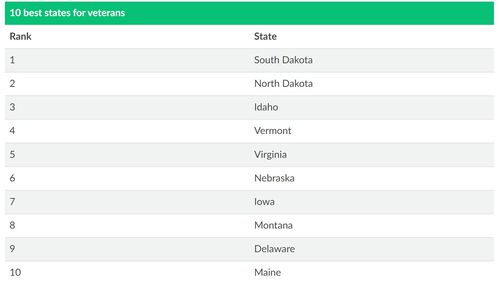
Growing veteran populations, top-rated VA hospitals and low unemployment rates common among best states for veterans
Of the metrics used to rank the states, the 10 best states don’t rank particularly well for housing costs and poverty rates. The Dakotas are the only states from the top 10 that rank in the top 10 for the lowest ratio of housing costs to veteran income.
With the third-lowest poverty rate (4.9%) among veterans in the U.S., Virginia does best in this category among top overall rated states. Nebraska and Vermont rank No. 9 and No. 10 nationally for veterans in poverty.
Of interest: Veterans are doing better than non-veterans when it comes to poverty rates. According to the latest U.S. Census Bureau data, 6.7% of veterans report incomes below the poverty line, versus 11.4% of nonveterans.
All five states with the best average VA hospital quality rating appear in the 10 best states overall. The VA determines a quality score for each medical facility using metrics such as postoperative or other treatment complication rates. Idaho features the country’s best average VA hospital quality rating at 86.0. Vermont, South Dakota, North Dakota and Maine follow in that order.
Though the overall best states tend to do well in more than one category, no state dominates across the board. The best states for each metric are as follows:
- Average VA hospital quality rating (among states with available data): Idaho (86.0)
- Access to medical care rating: Vermont (90.9%)
- Veterans as a percentage of the population: Alaska (10.7%)
- Change in density of veterans, 2018-2019: South Dakota (0.3%)
- Veteran unemployment rate: Nebraska (2.7%)
- Housing costs as a percentage of veteran income: West Virginia (19%)
- Veteran poverty rate: New Hampshire (4.6%)
High housing costs and unemployment rates make life more difficult for veterans
Among the worst overall states for veterans, high housing costs and high unemployment rates appear to be a running theme. California ranks as the worst state overall for veterans with the highest ratio of average housing costs to veteran income (40%) and the fifth-highest unemployment rate for vets (9.0%).
Though housing costs may be a little more affordable in the second-worst ranked District of Columbia, the nation’s capital has the highest poverty rate among veterans — 11% — of all the states. A small veteran community, just 4.3% of its population, and the worst average VA hospital quality rating of states with available data (53.0) also bring the capital down in the general rankings.
Arizona comes next due in part to the second-highest unemployment rate for veterans (9.6%).

Declining veteran populations contribute to poor overall rankings
It’s not all bad news for the least veteran-friendly states. The District of Columbia is the only state among the 10 worst overall to report positive growth for its veteran population, with the third-highest increase in veteran population in the country — 0.2% — from 2018 to 2019.
Hawaii features the second-largest drop in veteran population of 1.1% in the same period, with Alaska recording the largest drop (1.9%). Unlike Hawaii, though, Alaska has the largest share of veterans of any state, helping it land closer to the middle of the overall rankings.
Though Rhode Island doesn’t fare too well in the overall rankings, it has the second-best rating in the nation for access to medical care at 90.8%. As with the top-rated states, the worst states for each metric often find themselves toward the bottom of the overall rankings as well:
- Average VA hospital quality rating (among states with available data): District of Columbia (53.0)
- Access to medical care rating: New Mexico (71.9%)
- Veterans as a percentage of the population: New York (4.3%)
- Change in density of veterans, 2018-2019: Alaska (-1.9%)
- Veteran unemployment rate: Michigan (11.3%)
- Housing costs as a percentage of veteran income: California (40%)
- Veteran poverty rate: District of Columbia (11.0%)
Full rankings
!function(e,i,n,s){var t=”InfogramEmbeds”,d=e.getElementsByTagName(“script”)[0];if(window[t]&&window[t].initialized)window[t].process&&window[t].process();else if(!e.getElementById(n)){var o=e.createElement(“script”);o.async=1,o.id=n,o.src=”https://e.infogram.com/js/dist/embed-loader-min.js”,d.parentNode.insertBefore(o,d)}}(document,0,”infogram-async”);
Get your finances in line
Those expecting to leave the military and veterans who have already been discharged can take steps to help avoid financial turmoil and enjoy civilian life.
Use these tips to get your finances in line:
- Figure out your budget. One of the benefits of military life may be having things like housing, food and even clothes paid for or picked out for you. But as a civilian, you need to budget all those things for yourself. Start by calculating how much money is coming in and how much you need to pay for your monthly expenses. “Once you’ve put that together, you can begin to prioritize your spending on what’s most important, as well as figuring out whether you need additional income from a side hustle, second job or something else,” Schulz says.
- Make a plan to address any debt. If you’re carrying any debt, whether from credit cards or student loans, make sure you have a plan within your budget to stay on top of it. Veterans feeling overwhelmed with several different debts may benefit from using a military loan to consolidate debt.
- Save for the future. Emergencies can happen to anyone, but veterans may run into additional problems like long-term injuries or illnesses from their service. This makes it even more prudent for veterans to maintain an emergency fund to help them cover medical bills or other bills in a crisis or during the loss of income. As you’re making your budget, make sure you set some funds aside for savings. Some situations, like a wedding or medical treatment, may call for a personal loan. Learn about the different types of loans to see if there’s a good option for you.
Methodology
To rank the best and worst states for veterans, researchers analyzed data for the following seven metrics, all based on the latest available information:
- Quality of Veterans Affairs hospitals. Composite metric looks at different variables, from pressure ulcer rates to deaths with serious treatable complications after surgery. The metric was based on individual VA hospitals within each state and aggregated to get an overall number for the state. Alaska, Hawaii and New Hampshire didn’t have available information for this metric and were scored at 0 as a result. U.S. Department of Veterans Affairs’ Access to Care database, 2019.
- Access to medical care. Percentage of veterans who reported they were always or usually able to get care when they needed it. The metric was based on individual VA hospitals within each state and aggregated to get an overall number for the state. U.S. Department of Veterans Affairs’ Access to Care database, June 2020 to November 2020.
- Veterans as a percentage of the population. U.S. Census Bureau American Community Survey, 2019 one-year estimates.
- Change in density of veterans. U.S. Census Bureau American Community Survey, 2018 and 2019 one-year estimates.
- Veterans unemployment rate. U.S. Bureau of Labor Statistics, 2020.
- Housing costs as a percentage of veteran income. Median housing costs divided by veterans’ median annual earnings. U.S. Census Bureau American Community Survey, 2019 one-year estimates.
- Veterans poverty rate. U.S. Census Bureau American Community Survey, 2019 five-year estimates.
Analysts ranked each state in the metrics and then averaged each state’s ranking, with equal weight given to each. Analysts then assigned each state a score based on their average ranking.
Related:
This article
originally appeared on LendingTree.com and was
syndicated by MediaFeed.org.
More from MediaFeed:
Small business grants for veterans

After serving in the military, many veterans turn to small business ownership. The appeal of creating something from scratch and doing what they love has attracted millions of vets to become entrepreneurs in the United States. But as you know, running a business typically has a hefty price tag attached to it.
Funding one can include small business loans for veterans as well as small business grants for veterans. There are pros and cons to both types of funding, and small business owners may rely on a combination of the two. We’ll cover information to help you better understand small business grants for veterans, including:
- What small business grants for veterans are
- Where to find small business grants for veterans
- How to get a small business grant for veterans
- General eligibility requirements
- Other funding options for veteran business owners
- Additional training and resources for veterans
Drazen Zigic / istockphoto

When it comes to finding money to help you launch or grow a business, you have a few options. One is a business loan, which needs to be paid back over time. You can also seek investors who, in exchange for giving you capital, will typically then own a piece of equity in your business. Your third option is a small business grant.
Unlike a loan, a grant doesn’t usually have to be paid back. It is essentially debt-free financing that allows you to have the capital you need to start or grow a business. Almost any business can apply for a grant, but there are some grants specifically geared toward veteran-run businesses. Given the amount of competition the average federal grant sees, you may have more of a fighting chance of getting one if the pool is limited to only veteran business owners.
Grants provide capital that can be used for many purposes in a business, from covering startup costs to allowing you to hire employees. You could use the funds to buy equipment or technology that helps you work more productively — it all depends on the grant itself.
Olivier Le Moal / Getty

There are many government small business grants available to veterans. It’s just a matter of knowing where to look in order to find the right one for you and your business. Whether you’re seeking small business startup grants for veterans or business grants for disabled veterans, here are some resources to get a start on your search.
DepositPhotos.com

Grants.gov is a large database of all the federal grants available to anyone, including vets. You can search by agency, category or eligibility. Each grant has different eligibility requirements, and only certain types of organizations may apply. It’s important to read those requirements carefully to make sure you qualify.

Another database to spend some time on is GrantWatch. Here, you can find grants from federal, state and local government agencies, as well as foundations and corporations in each state.
DepositPhotos.com

Most states have web portals with resources for veterans living in that state. For example, California’s CalVet lists resources for veterans and service-disabled vets, which may include self-employment grants for service-disabled veterans. You can also find local Veteran Business Outreach Centers (VBOCs) by zipcode here.
Motortion / istockphoto

There are small business grants for veterans in a variety of situations, from disabled vets to those starting a brand new business. Requirements will vary, but most require you to be a veteran, reserve or transitioning active duty member of any branch of the U.S. military. Some grants are also open to spouses or children of military members.
Zinkevych / istockphoto

To apply for a grant, first review the eligibility requirements to ensure you meet them. Pay attention as well to deadlines so you don’t waste time filling out paperwork for a grant that’s already closed its window for applications.
DepositPhotos.com

Gather the required paperwork, which might include a business plan, financial statements or mission statement. Next, allot plenty of time to write your grant proposal and/or fill out the application. You may be asked how your business started or what you plan to do with the funds. Answer honestly, but don’t be shy about singing your company’s praise. This is your opportunity to display what is unique about your business.
DepositPhotos.com

Finally, carefully review your application and make sure you included everything required. Proofread your proposal, maybe asking a colleague to provide a second set of eyes. You want your application to be as flawless and engaging as possible.
You may also consider hiring a grant writer. This is someone who fills out grant applications for a living. They will likely be more familiar with the process and what reviewers are looking for in an application.
Prostock-Studio/ istockphoto

Grants are often difficult to get, with so much competition for each of them. You may still have other financing options, many of which are also geared specifically for veterans.
istockphoto / yacobchuk

While you may qualify for any business loan, when applying for small business loans, look for those that offer preference to vets. StreetShares, for example, offers both small business loans and lines of credit at low rates for veterans.
The SBA provides a variety of small business loans for veterans, including the Military Reservist Economic Injury Disaster Loan program, which provides capital to eligible small businesses to cover expenses it couldn’t otherwise cover because an essential employee was “called up” to active duty in the military reserve. There is also the Veteran’s Advantage Guaranteed Loans program, which provides up to $150,000 fee-free loans to veteran-owned businesses.
When evaluating loan options, it’s important to look at interest rates and terms. This includes how long you will be paying back the loan and how much you will spend over the length of that loan.
DepositPhotos.com

Angel investments or venture capital can provide another option for financing. Hivers and Strivers is an angel investment group that funds early-stage startup companies founded and run by graduates of the U.S. Military Academies. In addition to investing capital, the organization also provides useful contacts, industry experience and mentorship.
Ridofranz // istockphoto

If you happen to be a female vet, you may have even more resources at your disposal. There are small business loans for women, as well as small business grants for women, that can help you find the capital you need to grow your business.
Some cater specifically to female vets, like StreetShares Foundation’s Female Founders Veteran Small Business Award. This award gives three women $25,000 in total and provides them with the opportunity to pitch their ideas to investors.
To qualify for StreetShares Foundation’s grant, you must be a veteran, reserve or transitioning active duty member of any of the United States Armed Forces, a spouse of a military member or the child or immediate family member of a military member who died on active duty.
You must be 21 and own at least 51% of the veteran-owned business. The grant is given to qualified applicants who lack financial means to start or grow an early-stage business or non-profit.
vadimguzhva / istockphoto

Beyond grants and loans, there are resources that can help you plan, launch, and grow your veteran-owned business.
The Small Business Administration’s Office of Veterans Business Development provides resources and small business programs as well as training, counseling, and mentorship, as well as information on Federal procurement programs for veterans.Who is eligible for these services?
- Veterans
- Service-disabled veterans
- Reserve component members
- Their dependents or survivors
Here are some other funding options to consider.
AndreyPopov/istock

The federal government has the aim to award at least 3% of all federal contracting dollars to service-disabled veteran businesses each year. The Service-Disabled Veteran-Owned Small Businesses program assists service-disabled veterans in securing those government contracts. Their eligibility criteria is as followings:
- Small business
- At least 51% owned and controlled by one or more service-disabled veterans
- Have one or more service-disabled veterans manage day-to-day operations and make long-term decisions
- Service-connected disability
EvgeniyShkolenko / istockphoto

The Warrior Rising program includes the Warrior Academy, designed to help “vetrepreneurs” at every stage of business growth succeed. It also provides vets with mentoring, assistance in finding funding options, and a community of veteran business owners who offer one another support. Warrior Rising’s process includes:
- Intake and tracking: Phone interview to understand your background and determine where you most need help
- Instruction: Warrior Academy: Self-paced video modules with homework and feedback
- Mentoring: One-on-one coaching in specific areas like marketing or accounting
- Funding opportunities: Assistance helping you find the best grants or loans
- Warrior Community: Connects you with other “vetrepreneurs” in your area
Peppersmint / istockphoto

Patriot Boot Camp provides educational small business programs, mentors, and a community of experts and peers to active duty service members, veterans and their spouses looking to start a business. Programs offered include:
- 3-day bootcamps
- Lunch and learn sessions
- Webinars
Johnrob

Veterans Business Resource Center provides counseling and mentoring services for new veteran business owners, as well as training and webinars to continue their education. Services offered include:
- Marketing plan assistance
- Training and events
- Financial analysis
- Business strategy
- Consulting
- Government contracting assistance
DepositPhotos.com

Another entrepreneurship program, V-WISE IGNITE, targets women veterans looking to start a business. The one-day training event provides resources and support to help them on their path.Who is eligible for these services?
- National Guard and Reserve components
- Active duty women service members of any military branch, including National Guard and Reserve components
- Women spouses/same-sex life partners of above (including widowed spouses/partners)
DepositPhotos.com

The U.S. Department of Veterans Affairs has a program, Veteran Readiness and Employment (VR&E) Self-Employment Track, that provides assistance to veterans with service-connected disabilities or employment barriers. The program assists in creating a business plan, analyzing your business concept, and providing you with the resources you need to succeed. Who is eligible for these services?
- Service member or veteran with an employment barrier or handicap
- Service-connected disability makes it hard for you to prepare for, obtain and maintain suitable employment
qingwa / istockphoto

Boots to Business (B2B) is a program created by the SBA and Office of Veterans Business Development, and it provides courses to help vets become successful business owners.Who is eligible for these services?
- Transitioning service members (including National Guard and Reserve)
- Their spouses on military installations worldwide
Depositphotos

The Entrepreneurship Bootcamp for Veterans (EBV) program is offered free of charge to post-9/11 veterans and their families. It targets businesses in early-growth mode, providing entrepreneurship and business management training. Programs available include:
- EBV Accelerate: A bootcamp-style program that provides insight and education on financial, management, marketing, and strategic planning challenges established businesses encounter.
- EBV Program: cutting edge, experiential training in entrepreneurship and business management for companies in early growth mode.
- EBV-Families Program: Provides the same training to family of qualified veterans.
istockphoto/Ridofranz

If you are interested in bidding on government contracts, explore the Vets First Verification Program. Run through the Office of Small & Disadvantaged Business Utilization (OSDBU), this program gives vets priority when bidding on federal and state government contracts, as well as better access to capital and tax relief.Who is eligible for these services?
- Veteran owns 51% or more of the company
- Veteran has full control over the day-to-day management, decision-making, and strategic policy of the business
- Veteran has managerial experience
- Veteran is the highest-paid person in the company
- Veteran works in the business full time
- Veteran holds the highest officer position in the company
DepositPhotos.com

Small business grants for veterans provide a unique opportunity: access to capital free of charge that can help you realize your entrepreneurial dreams. Realize that the grant process may be slow, so it’s important to start your homework early to find the grants that you qualify for. In general, you can apply for and accept multiple grants.
You can also combine multiple financing options to launch or expand your business. This can mean a combination of grants and loans, and possibly investors as well. It’s a good idea to evaluate all funding sources to find what works best for you.
Learn more:
This article originally appeared on LanternCredit.comand was syndicated by MediaFeed.org.
Lantern by SoFi:
This Lantern website is owned by SoFi Lending Corp., a lender licensed by the Department of Financial Protection and Innovation under the California Financing Law, license number 6054612; NMLS number 1121636. (www.nmlsconsumeraccess.org)
All rates, fees, and terms are presented without guarantee and are subject to change pursuant to each provider’s discretion. There is no guarantee you will be approved or qualify for the advertised rates, fees, or terms presented. The actual terms you may receive depends on the things like benefits requested, your credit score, usage, history and other factors.
*Check your rate: To check the rates and terms you qualify for, Lantern conducts a soft credit pull that will not affect your credit score. However, if you choose a product and continue your application, the lender(s) you choose will request your full credit report from one or more consumer reporting agencies, which is considered a hard credit pull and may affect your credit.
All loan terms, including interest rate, and Annual Percentage Rate (APR), and monthly payments shown on this website are from lenders and are estimates based upon the limited information you provided and are for information purposes only. Estimated APR includes all applicable fees as required under the Truth in Lending Act. The actual loan terms you receive, including APR, will depend on the lender you select, their underwriting criteria, and your personal financial factors.
The loan terms and rates presented are provided by the lenders and not by SoFi Lending Corp. or Lantern. Please review each lender’s Terms and Conditions for additional details.
Personal Loan:
SoFi Lending Corp. (“SoFi”) operates this Personal Loan product in cooperation with Even Financial Corp. (“Even”). If you submit a loan inquiry, SoFi will deliver your information to Even, and Even will deliver to its network of lenders/partners to review to determine if you are eligible for pre-qualified or pre-approved offers.
The lenders/partners receiving your information will also obtain your credit information from a credit reporting agency. If you meet one or more lender’s and/or partner’s conditions for eligibility, pre-qualified and pre-approved offers from one or more lenders/partners will be presented to you here on the Lantern website. More information about Even, the process, and its lenders/partners is described on the loan inquiry form you will reach by visiting our Personal Loans page as well as our Student Loan Refinance page.
Student Loan Refinance:
SoFi Lending Corp. (“SoFi”) operates this Student Loan Refinance product in cooperation with Even Financial Corp. (“Even”). If you submit a loan inquiry, SoFi will deliver your information to Even, and Even will deliver to its network of lenders/partners to review to determine if you are eligible for pre-qualified or pre-approved offers. The lender’s receiving your information will also obtain your credit information from a credit reporting agency. If you meet one or more lender’s and/or partner’s conditions for eligibility, pre-qualified and pre-approved offers from one or more lenders/partners will be presented to you here on the Lantern website.
More information about Even, the process, and its lenders/partners is described on the loan inquiry form you will reach by visiting our Personal Loans page as well as our Student Loan Refinance page. Click to learn more about Even’s Licenses and Disclosures, Terms of Service, and Privacy Policy.
Student loan refinance loans offered through Lantern are private loans and do not have the debt forgiveness or repayment options that the federal loan program offers, or that may become available, including Income Based Repayment or Income Contingent Repayment or Pay as you Earn (PAYE).
Notice: Recent legislative changes have suspended all federal student loan payments and waived interest charges on federally held loans until 09/30/21. Please carefully consider these changes before refinancing federally held loans, as in doing so you will no longer qualify for these changes or other future benefits applicable to federally held loans.
Auto Loan Refinance:
Automobile refinancing loan information presented on this Lantern website is from MotoRefi. Auto loan refinance information presented on this Lantern site is indicative and subject to you fulfilling the lender’s requirements, including: you must meet the lender’s credit standards, the loan amount must be at least $10,000, and the vehicle is no more than 10 years old with odometer reading of no more than 125,000 miles. Loan rates and terms as presented on this Lantern site are subject to change when you reach the lender and may depend on your creditworthiness. Additional terms and conditions may apply and all terms may vary by your state of residence.
Secured Lending Disclosure:
Terms, conditions, state restrictions, and minimum loan amounts apply. Before you apply for a secured loan, we encourage you to carefully consider whether this loan type is the right choice for you. If you can’t make your payments on a secured personal loan, you could end up losing the assets you provided for collateral. Not all applicants will qualify for larger loan amounts or most favorable loan terms. Loan approval and actual loan terms depend on the ability to meet underwriting requirements (including, but not limited to, a responsible credit history, sufficient income after monthly expenses, and availability of collateral) that will vary by lender.
Life Insurance:
Information about insurance is provided on Lantern by SoFi Life Insurance Agency, LLC.
DepositPhotos.com
Featured Image Credit: Zinkevych / istockphoto.