
What do you say when you get a compliment?
Unfortunately, most of us aren’t born with social graces. Some people (think politicians, salespeople and many extroverts, for example) easily respond to compliments with quick, appreciative gesture; the rest of us, however, often become flustered and stammer out the first response we can think of — which often isn’t the best choice and doesn’t convey the actual gratitude we feel. Ideally, your response should leave the complimenter feeling appreciated and validated.
Here’s how to respond:
1. If your boss or coworker compliments your work
- Thank you! I really appreciate the feedback.
- That’s so good to hear! I’m glad [it turned out well/you were pleased with the end result/our hard work paid off].
- Thank you!
2. If someone compliments your appearance (and the comment is appropriate both in context and content)
- Thank you!
- Thank you for noticing, I [insert detail here, such as “I just bought the blouse this weekend,” or “I thought I’d try a new color, glad it’s working!” or “I found it at the new vintage store downtown.”].
- Thank you so much; that made my day!
How do you gracefully accept a compliment?
- Thank the person for complimenting you in whatever language feels appropriate to you.
- Your tone of voice should reflect gratitude, happiness, embarrassment (if you’re caught off guard) or another positive emotion (if the compliment is wanted, of course!). Try to avoid sounding dismissive or condescending.
- Accept the compliment! That means don’t dodge by shifting the praise to someone else (unless you’re complimented for a team project) or with self-deprecation.
- Look the person in the eye and smile as you thank them; remember, body language conveys much more information than words much of the time.
How do you respond to a thank you email from your boss?
The same way you respond in person: with a thank you!
A short note is acceptable; what you want to convey is that you’ve seen the praise. While not responding may seem like a good idea, especially if you’re trying to avoid clogging up their inbox, trust me, you’ll want to acknowledge you received the message.
Why are we so bad at accepting compliments?
The reasons are varied, ranging from not wanting to appear big-headed or vain to not wanting to be seen as taking the credit for something we may not have been totally responsible for. Perhaps you may struggle with Imposter Syndrome and feel that the work you’ve done doesn’t deserve praise for that reason, or maybe you’re just suspicious of flattery.
Add to all this the fact that in some cultures, humility is often heavily prized, and accepting a compliment could be perceived as having an overly superior sense of self or feeling better than others. I’ve certainly seen instances of this firsthand throughout my career, as well as noting the differences in people’s comfort levels when giving and receiving compliments across cultures and nationalities.
When you receive a compliment, the most important thing to remember is that someone has taken the time and effort to provide this positive feedback to you. So despite your feeling the urge to deflect or downplay it, the simplest and easiest response is to say a genuine and sincere “thank you” to the person who complimented you.
No matter how uncomfortable it may feel, recognize the gesture with grace and gratitude.
If you are given a compliment in person, it’s always important that you first and foremost communicate gratitude by saying “thank you” to the other party directly, ideally accompanied with eye contact, a positive demeanor and a friendly smile. Depending on the nature of your relationship with this person, you may even choose to say, “Thank you, I really appreciate you taking the time to say this.” This way, it shows that you really do acknowledge the compliment and aren’t just shrugging it off with an “oh, thanks.”
One area that has been known to cause especial discomfort is when someone compliments an individual of the opposite gender, especially at work. Certainly, not all supposed “compliments” are warranted — some are even flat-out inappropriate. You need to use your own personal judgment based on the relationship you have with an individual before complimenting them, but of course, positive feedback and genuine merit-based compliments should only bring happiness to the workplace.
It’s always important to remember that the person who paid the compliment needs recognition, too, for taking the time to pay it to you. However, that doesn’t necessarily mean you then need to throw a compliment straight back at them! Should you find an opportunity to provide praise or a compliment back, then do take it. Be sure to be specific about why are you complimenting them, though, so that it doesn’t seem disingenuous.
Don’t give in to the urge to just throw a compliment back at the other party.
This is especially the case if the compliment you’d be giving in return isn’t totally unwarranted. You’ll seem insincere, and the other person will likely wind up having to share in your awkwardness.
For those of us who have grown up in or worked in a company culture where giving praise or paying compliments is rare, we naturally assume we don’t really deserve it and surely the other person must be “after something” from us in saying it.
First and foremost, resist your urge to just “shrug it off” and use those immortal words of, “Oh, it was nothing.” You may think you are being modest in saying that, but in reality, you are potentially diminishing the feedback the person has just provided you. Worse still, it may be seen as a sign that you are actually “fishing” for more compliments (yikes!).
Think of a time when someone complimented you on an item of clothing. I suspect your first response was along the lines of, “Oh what, this old thing?” That could be seen as a way of you eliciting further compliments about your clothes or style when it was never your intention, but instead the result of your quick response. Besides, we should all be the practice of learning how best to take credit for the awesome work we do; therefore, undermining our work and achievements isn’t in our best interest.
Accept and respond to the compliment the first time you hear it – don’t ask for a repeat performance.
In the same way that it’s useful to always be specific when providing feedback, know that you don’t need to ask for a detailed explanation of what warranted the compliment. Just accept it for what it is. However, if you genuinely want to understand what specifically drove the person to call it out, you can always do that in a way that doesn’t make them feel like they are being interrogated by you or like they shouldn’t direct praise toward you.
In the case of an electronic compliment, a quick response from you is still needed.
If you happen to receive the compliment via email or over social media, still take the time to thank and acknowledge the person in a timely fashion. Don’t just assume you shouldn’t say “thank you” for receiving it just because it wasn’t in person. A genuine compliment via any form of medium still carries the same importance, and therefore a response is always appreciated.
Be sure to share the credit IF it was a group or team effort.
If you truly feel that the compliment doesn’t solely belong to you, take the time to acknowledge any others who may also deserve the recognition or praise. Make sure all contributions are acknowledged.
For example:“[Name teammates] also contributed to that piece of work — it was a true team effort! Thank you so much for taking the time to acknowledge our hard work.”
Try naming the others involved and giving the person the opportunity of also thanking them directly. Alternatively, if they feel more comfortable this way, you can always say that you’ll pass it on and again thank them for taking the time to provide the feedback.
And here’s how you can give a compliment
If a person’s achievements and/or contributions deserve a call-out, always be honest and specific. Simply saying, “Hey, that was a great job,” doesn’t allow the person to know exactly what they did that warranted such a compliment.
All of us are, in actuality, are eager to receive praise and have our hard work recognized by our peers. So getting the chance to hear exactly what the specific skill or task we demonstrated was can be valuable in ensuring we’re able to repeat it again in the future.
Go on — go give a compliment to someone who deserves it!
Related:
This article
originally appeared on FairyGodBoss.com and was
syndicated by MediaFeed.org.
More from MediaFeed:
Want to be happier? Stop self-sabotaging

Whether you’re aware of it or not, you might be sabotaging your own happiness.
That doesn’t mean you’re purposefully making things worse for yourself, or that you want to see yourself suffer.
It just means some of your behaviors might be holding you back from living your best life.
In my book Everyone Has a Plan until S*!# Hits the Fan, I share a formula for building up practical resilience to create a happier life. Here are 8 of the most common things people regularly do to sabotage their own happiness.
DepositPhotos.com

We all do it from time to time, but here’s the problem with comparing yourself to others: it’s not valid.
You can’t truly compare yourself with anyone, because your life circumstances are not equal. Your lives have been completely different from the start and your trajectories are not on the same plane. You’re starting the race from entirely different places and you’ve experienced different things along the way.
It’s apples and oranges all the way down. Instead of comparing yourself to others, try and focus on collaborating. Instead of separating yourself from other people, see how you can work together.
DepositPhotos.com
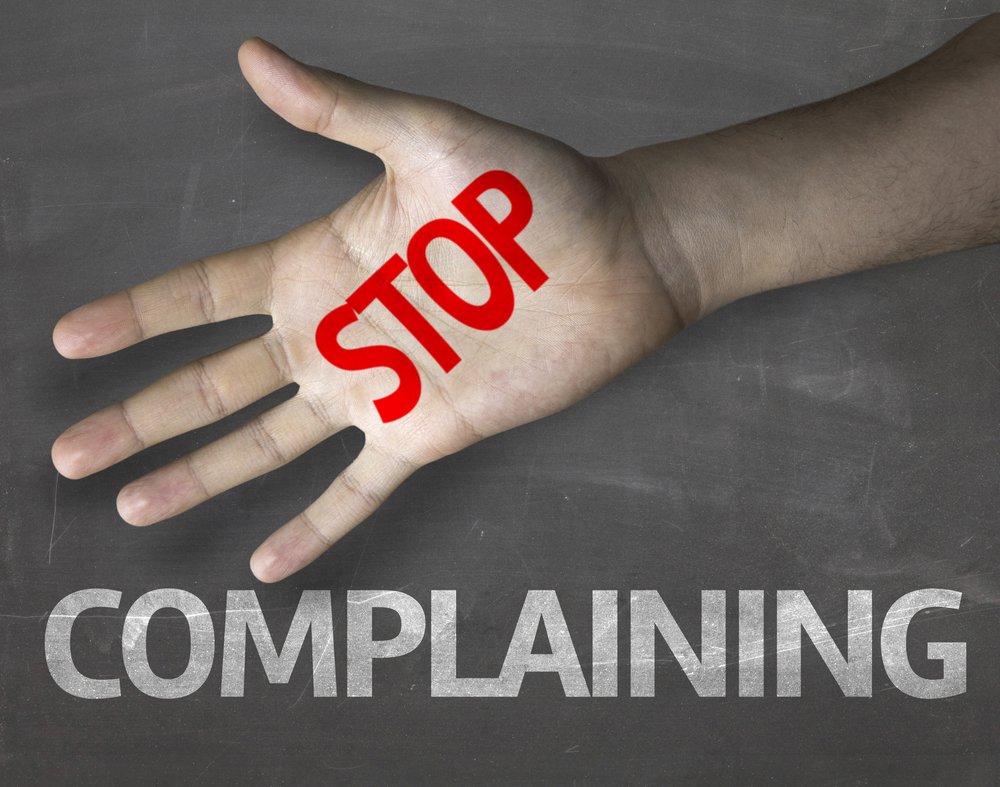
The problem with complaining is two-fold: you project negativity into the world, and it brings down the people around you. A major part of your happiness if the people you surround yourself with, and people want to be around people they actually like.
If you’re always complaining, you’re sabotaging the chance that people will want to spend time with you (or you’ll only attract people who live for negativity).
If you complain less, you’re going to be more desirable to others, and more quality people will want to be spend time with you.
DepositPhotos.com

When you set a goal, you’re usually only thinking about what you want—not about the possibilities of what could happen along the way.
It’s okay to have big goals, but you have to realize that it’s usually never a linear process from where you are to where you want to go.
Things will always come up that you didn’t expect and knock you off course. You will need to change paths, pivot, and persevere.
You can be ambitious, but don’t be unrealistic. Expect things to knock you off course from time to time instead of only fixating on the end result. Remember that life isn’t always linear, and try not to get discouraged when something gets in your way.
It’s all part of the process.
DepositPhotos.com

We all want certain outcomes in life, but sometimes we get so fixated on those outcomes that we forget about the bigger picture, and lose sight of what’s actually important.
Sometimes we forget that there’s more to life than achievement, or money, or whatever else feels like an urgent need that’s missing.
Instead of being fixated on attachment, we can focus more on detachment: living and accepting our experience without feeling the need to exert 100% control over everything.
Sometimes, that’s all we really need.
DepositPhotos.com

A friend recently told me: the past and the future are two time zones that don’t exist.
Not enough people are living in the present. They’re stuck in the past or worrying about the future.
Here’s an easy thing you can try to live more in the moment: set a reminder on your phone for 3 times each day to focus on your five senses.
When the reminder goes off, take a breath. Focus on what you see, hear, smell, and feel.
Take it all in, everything that you experience.
This is a very simple practice, but it really helps you focus on the present moment, on what’s actually real right now.
DepositPhotos.com

We tend to get accustomed to things and experiences very quickly and forget that we’re lucky to have them.
The opposite of entitlement is gratitude. You have to actively practice gratitude to stave off entitlement. It’s like a muscle.
You can find a lot online about how to build a gratitude practice, so I won’t go into it here.
Just remember that at the end of the day, you’re not entitled to anything, and you’re truly lucky to have what you do.
DepositPhotos.com

I get it: you have high standards for yourself. Who you want to be, what you want to accomplish, what you want your life to look like.
It’s so easy to beat yourself up over the gap between who you are and your ideal self, the person you think you should be.
Remember: your ideal self is not real.
You’re human. You’re not perfect. Evolution took million of years to produce you, and now you’re here. That’s already enough.
You’re okay.
DepositPhotos.com

I heard a quote recently: “You are the stories you tell yourself.”
We spend so much time creating these elaborate stories in our minds, about who we are and what we’re worth, why we’re valuable and why we’re not, where we exceed and where we fail.
And in the process we make very strong assumptions about ourselves: what’s possible for us, what we can accomplish, what our limitations are, where we’ll end up in life.
Sometimes we carry these stories around with us for decades. And over time they only get more powerful, assumptions hardening until they’re indistinguishable from the truth.
But at the end of the day, you are in control of your story.
Nothing is written in stone.
Your past is not your future.
You’re stronger than you think.
This story was adapted from Tofe Evans’ book Everyone Has a Plan until S*!# Hits the Fan and was syndicated by MediaFeed.org.
DepositPhotos.com
Featured Image Credit: fizkes/ iStock.