
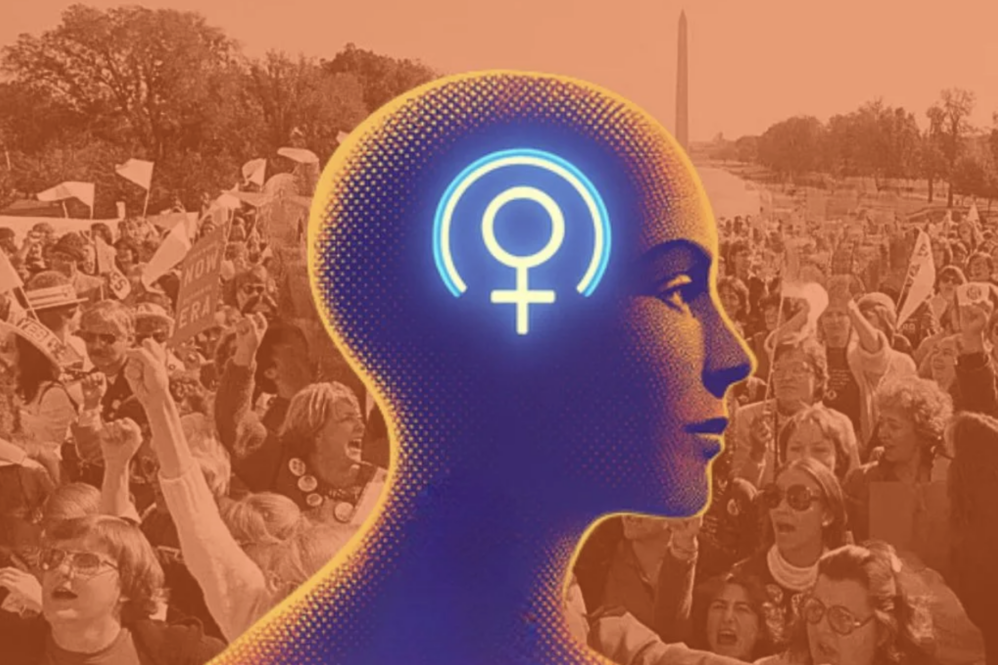
When our grandmothers marched for the vote in the early 20th century, they weren’t simply demanding a ballot. They were demanding to be seen in a system designed to erase them. That fight, like every feminist wave since, was never only about rights on paper—it was about autonomy, dignity, and visibility in the face of structures that profited from women’s silence.
A century later, the adversary is still politicians and the patriarchy. But there’s a new player: artificial intelligence, a sprawling ecosystem of algorithms and “agents” that promise convenience while quietly absorbing our most intimate selves. I’ve written before about the men building these systems—and how little they understand women’s lives. That blind spot continues. But now the threat runs deeper: The very structure of AI risks erasing women from view.
Convenient for Whom?
We’re told AI butlers will soon run our calendars, shop for our groceries, manage our health records, even draft our love notes. It’s Rosie the Robot from The Jetsons—except this Rosie doesn’t just dust the furniture. The tech industry insists this future is inevitable, frictionless, and benevolent.
But frictionless for whom? And benevolent on whose terms?
Margaret Atwood in The Handmaid’s Tale reminded us, “When we think of the past, it’s the beautiful things we pick out. We want to believe it was all like that.” The same nostalgia is now being peddled about the future: a fantasy of ease that glosses over the darker bargains.
The Assistant Wants Your Keys
Meredith Whittaker, president of the Signal Foundation, has already warned that so-called “AI agents” demand near-total access to our lives. Not just your email or shopping list but your bank accounts, location data, private texts—the nervous system of your digital existence. Her warning: These aren’t just standalone apps. The industry is building agents into the digital infrastructure we already depend on. In other words: The magic comes with a price tag we can’t afford to ignore.
The danger isn’t abstract.
Researchers have raised privacy concerns about WhatsApp messages dictated through Siri being sent to Apple’s servers. Apple disputes that this violates its privacy policies.
Researchers have demonstrated how malicious prompts could trick Gemini into leaking sensitive data or activating smart appliances to cause chaos in people’s homes. Google said it fixed the reported issue before it could be exploited.
If this sounds like the plot of Black Mirror, that’s because it practically is.
We’re the Users. Who’s Making the Decisions?
Timnit Gebru, founder of the Distributed AI Research Institute, has challenged the concentration of power in AI. Which brings us to the question: Who gets to set the rules for AI? Is it built for speed, profit, and the status quo—or for justice, transparency, and actual user needs?
And for women over 50—the demographic sitting on trillions in spending power and often steering multigenerational households—the stakes are particularly high. We’re not niche users.
We are the market.
Unless we act, the future being built may exclude us, just as past systems once did. (Related: I Trained the AI That’s Coming for My Job. Then I Became It.)
We’ve Fought This Fight Before
History is rhyming in dangerous ways. Each feminist wave confronted a system that declared women’s lives unimportant. AI is simply the newest iteration.
First Wave: Visibility. Women fought for recognition: votes, legal status, the right to be counted, to exist in civic life. Its lesson was blunt—invisibility is the oldest and most effective form of oppression. Tech platforms today operate on that same erasure—optimizing for the “average user,” who is rarely an older woman. Unless we demand representation in data sets and design labs, we risk vanishing again, not from history books this time, but from the code that will govern our daily lives. Ada Lovelace helped imagine what computing could become. We have a stake in what it becomes next.
Second Wave: Autonomy. From reproductive rights to financial independence, women rejected proxy decision-makers. Autonomy today means refusing to hand over wholesale control to a machine that promises efficiency while mining our lives for profit. UNESCO Women4Ethical AI initiative calls for women’s equal representation in AI’s design, use, and deployment. We should insist on privacy, too—not permission buried in settings. Seamless isn’t the same as safe.
Third Wave: Intersectionality. No woman’s story is complete without her race, age, class, or sexuality considered. Yet AI systems can reproduce biases in the data they’re trained on, failing the very people they claim to serve. The danger isn’t theoretical. Joy Buolamwini, founder of the Algorithmic Justice League, has shown how technology literally sees some women less clearly, if at all.
The Cost of Convenience
Whittaker put it starkly: Agentic AI—systems designed to take actions on your behalf—requires access not just to our apps, but to the nervous system of our devices. And once your private messages, financial accounts, and health data are absorbed into a corporate “data slurry,” you don’t control them anymore.
The pattern is familiar. Companies racing to monetize “the next big thing” cut corners on privacy, transparency, and safety. Whittaker warned that, unless challenged, we’re heading toward “an elimination of privacy and security at the application layer.”
Translation: The very foundation of private communication could collapse in the name of convenience.
The future they’re building is less Rosie the Robot and more Gilead—the theocratic dictatorship in The Handmaid’s Tale—a closed system where convenience trumps autonomy. The cost? Your sovereignty.
Want more? Get PROVOKED’s free Thursday newsletter. Sign up at PROVOKEDMagazine.com.
Now: The Feminist Blueprint for AI
So what do we do? We return to the feminist playbook our foremothers left us.
- Resist erasure. Visibility must be demanded, not assumed. Women over 50 should be in the test groups, the data sets, the focus panels. We belong in the room before the decisions are made. Insist.
- Guard autonomy. Don’t confuse ease with agency. Set limits on what tools can access. Refuse AI that overrides your choices in the name of efficiency. Opt out where you can.
- Demand intersectionality. Ask hard questions: Whose needs is this tool serving? Whose pain points count? Whose life is it making easier—and whose more precarious? As feminist scholar Sophie Toupin wrote, “True tech justice means co-designing systems with seldom-heard people, shaping tools around real lives—not optimizing for the majority.”
- Choose friction. A life without wrinkles, interruptions, or rough edges isn’t life—it’s performance. A fully automated life risks being no life at all.
Enjoyed this story? Read more from PROVOKED at provokedmagazine.com.
Why AI Matters for Women Over 50
This isn’t a distant problem. This is a now problem.
We aren’t a generation fading out—we are living another 20, 30, 40+ years. We have resources, influence, and lives ahead of us that deserve our say. If we abdicate control now, we risk consigning the rest of our lives to systems built without us.
Fourth Wave feminism will be about digital sovereignty, about reasserting the same principles—visibility, autonomy, diversity—that once won us the ballot, the paycheck, and the right to define ourselves. But only if we take the fight seriously.
AI will not replace us—unless we hand over our agency.
And the one lesson feminism has delivered across every wave is this: No one gives you power.
You take it.
Related:
- How to Live Artfully in the Age of Digital Slop
- AI in Therapy: Concerning or Comforting?
- It’s Not Them. It’s You. Why You’re Failing at Online Dating
Ask us! What questions do you have about content, strategy, pop culture, lifestyle, wellness, history or more? We may use your question in an upcoming article!
Like MediaFeed’s content? Be sure to follow us.
This article originally appeared on PROVOKED and was syndicated by MediaFeed.co