When I first saw The Breakfast Club at my local theater in 1985, I sat through two back-to-back screenings. My companion didn’t want to be seen in the lobby crying after the first show.
That was the effect this film had on many of us Gen Xers.
In hindsight, it’s clear why—honest movies about teen life were rare back then. But today, I’m also a little embarrassed by how we were seen. When my teenage daughter first watched The Breakfast Club and John Hughes’ earlier film Sixteen Candles, she was shocked at what we had accepted as “normal” when we were her age.
Same Movie. Different Eyes.
Molly Ringwald, co-star of both iconic films, dropped a bomb in 2018 when she wrote that those beloved artifacts could also be considered “racist, misogynistic, and, at times, homophobic.” Ringwald’s reassessment raised a question we’re still wrestling with—how to honor the cultural touchstones of our youth without ignoring what they got wrong. More than 40 years later, the film feels like a time capsule of everything we’ve outgrown—and everything we still haven’t. (Related: We Raised Them. So Who’s in Their Ear Now?)
For The Breakfast Club’s 40th anniversary in 2025, I took one of my best friends from high school to see it again in theaters. We were reminded of what we’d forgotten about those days, what this movie pioneered, and what its shortcomings reveal about a culture desperately due for change. One welcome difference: We were old enough to sip wine while watching this time.
Five Teens, One Saturday, All Those Feelings
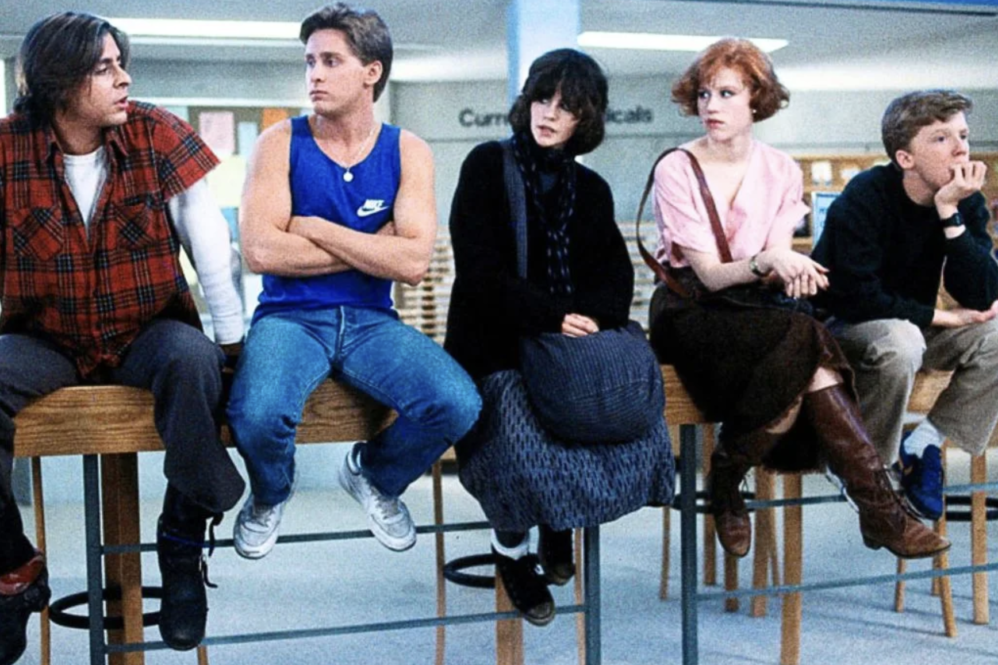
The Breakfast Club was a success when it premiered in 1985. It later topped Entertainment Weekly’s list of the 50 best high school movies of all time. Ringwald stars alongside Emilio Estevez, Judd Nelson, Ally Sheedy, and Anthony Michael Hall as a group of high schoolers stuck in Saturday detention. They fight, laugh, cry, and pair off—and each confesses the painful truth about what landed them in detention. Over the course of the day, they discover that despite entrenched differences, they actually have a lot in common.
Writer-director Hughes captures teen anxieties on realities like identity, relationships, mental health, family, growing up, and peer pressure in a way that felt revolutionary on screen back then. Rewatching in 2025 (and as an adult and parent) is a whole other experience. Sure, it still offers a visceral reminder of how deeply teenagers feel things. But this film might not even stand out in our saturated teen market today—and you can thank Hughes himself for that.
John Hughes Understood the Assignment
Hughes is sometimes credited with rediscovering the teen audience for Hollywood, and he spoke exclusively to them. He sold them an adolescence that was its own, superior universe, painting adulthood as a dark ravine lurking over a cliff’s edge. “When you grow up, your heart dies,” Sheedy’s character warns. Sounds bleak, but it’s a worldview that empowers the young—like the Bowie lyrics that grace the film’s opening frames: “And these children that you spit on / As they try to change their worlds / Are immune to your consultations / They’re quite aware of what they’re going through.”
By contrast, adults are cynical, one-dimensional characters. The only two real adult characters in The Breakfast Club—the buffoonish authoritarian vice principal, and the slyly knowing janitor—exist because they never fully escaped high school. The teens rate their parents on a scale of tolerable to abusive. You can find the natural progression of Hughes’ enhanced adolescence in today’s teen films and series, where parents take the blame for everything. There’s even a name for it—the “millennial parental apology fantasy.”
You Were Who You Sat With
But in the ‘80s, peer pressure surpassed parental involvement. Parents were less present in many of our lives, for better and worse. Teens forged their identities through their friendships. Cliques defined high school life, representing a stressful shorthand for your whole identity—tell me who you eat lunch with, and I’ll tell you who you are.
The Breakfast Club’s characters are known by their labels: the “Princess,” the “Athlete,” etc. When the “Brain” writes at the end of the day that the group had discovered likenesses beyond the labels, Gen X breathed a collective sigh of relief. Of course, not every ‘80s teen felt seen or represented by the film. For starters, the central cast is all white, and the film offers a narrow picture of who gets to belong. Mainstream movies of the era were not inclusive-–nor did they care to be.
Want more? Get PROVOKED’s free Thursday newsletter. Sign up at PROVOKEDMagazine.com.
The Boy Who Still Gets the Girl
And then there’s Bender. I always found this character (the “Criminal,” played by Nelson) disturbing, maybe even more so now, as a parent. I didn’t have the awareness or the vocabulary as a teen to express why, but Ringwald did. In 2018, with #MeToo in full bloom, she called out Bender’s treatment of Claire throughout the film. It’s so obvious when you go back and look for it: He pries into her private life, humiliates her, and repeatedly crosses her boundaries.
The pleasure Bender derives in making Claire squirm is more than typical teen teasing. It’s angry, personal, and deliberately humiliating—very adult for a teen boy. Nelson was 25 when the film was made; Ringwald was 16. Watching now, I find him more intimidating, not less. He still gets the girl. And the sad reality is that there are Benders everywhere in ’80s movies—from Sixteen Candles to Risky Business—boys whose mistreatment of girls somehow becomes part of their appeal.
In her confessional, Ringwald called out comedies of the era, like Animal House and Porky’s, as written by men for boys, with women reduced to one-dimensional roles. That’s just the way it was. Hughes reportedly cut a crude scene from The Breakfast Club—at Ringwald’s insistence—where the vice principal spies on a female teacher in a compromising position, and his two female characters do have agency, personalities, and their own voice.
Enjoyed this story? Read more from PROVOKED at provokedmagazine.com.
Loving It Isn’t the Same as Excusing It
There’s no denying the cultural importance of The Breakfast Club in its day. Hughes captured previously unscreened realities of teen life in the ‘80s—the good, the bad, and the ugly. His films sparked an industry of media products made for and about teens. They still remind adults to be patient and empathetic with our hypersensitive youth.
But The Breakfast Club is also one grown man’s version of adolescence. Its casual sexism and lack of diversity were products of their time. I can appreciate these contradictory realities now, with more than 40 years of distance. And I can accept our own role in the culture that surrounded them.
Yes, we can still love the films that shaped us—but loving them now means watching with eyes wide open.
Related:
- How to Live Artfully in the Age of Digital Slop
- My Therapist Convinced Me to Read Fifty Shades of Grey. Fifteen Years Late.
- Time Warp Again: How Rocky Horror Liberated a Generation
Ask us! What questions do you have about content, strategy, pop culture, lifestyle, wellness, history or more? We may use your question in an upcoming article!
Like MediaFeed’s content? Be sure to follow us.
This article originally appeared on PROVOKED and was syndicated by MediaFeed.co.