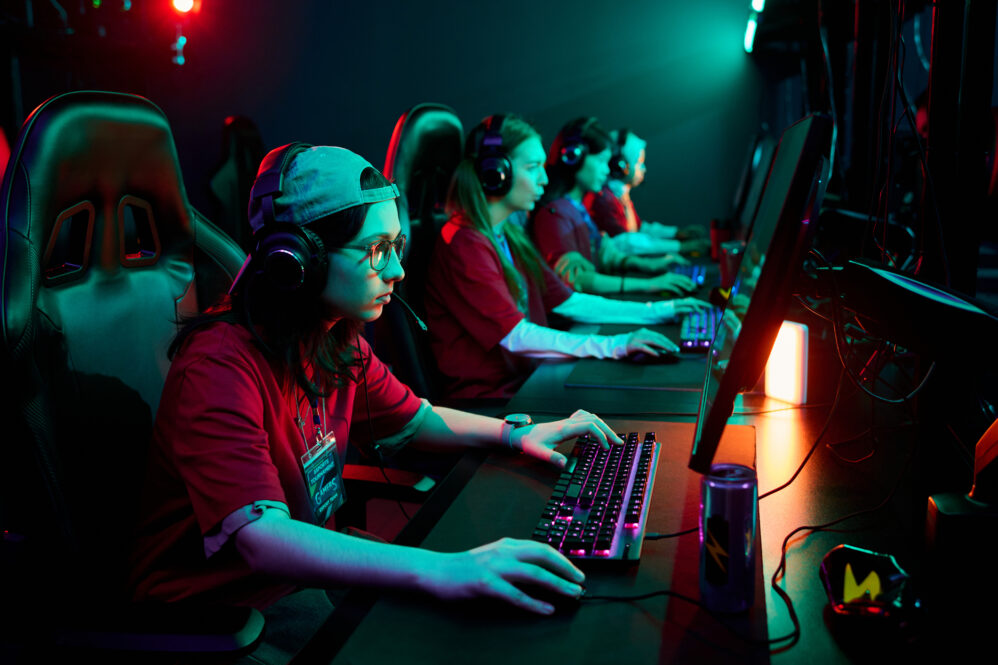
How do I choose an esports arena builder for a university?
Choosing an esports arena builder for a university comes down to more than comparing gaming equipment and project prices. Look for a partner with relevant higher-education experience, a strong understanding of technology and infrastructure, and the ability to deliver a facility the university can operate, support, and adapt over time. The right company should understand how the entire space needs to function, not just what equipment goes inside it.
START WITH EXPERIENCE, BUT FIND OUT WHAT THEY ACTUALLY DID
I’d certainly look at completed esports projects, but a project gallery only tells part of the story. Ask what the company was actually responsible for and whether its involvement extended beyond supplying equipment. There’s a big difference between delivering 30 gaming PCs and helping a university plan a 30-station esports facility that works as intended.
Higher-education experience matters, too. University projects involve procurement requirements, accessibility, campus IT standards, facilities teams, architects, construction schedules, and departments with different priorities. A company may have plenty of gaming experience without understanding how universities operate, and I’d want to know that before making a decision.
I’d also ask to speak with someone at a university where the company has completed a project. Find out whether installation went as expected, how problems were handled, and what support looked like after opening. A project gallery shows you the finished facility. A reference can tell you what it was like getting there.
PAY ATTENTION TO THE QUESTIONS THE BUILDER ASKS YOU
One of the easiest ways to evaluate an esports arena builder is to listen during the first few conversations. If the discussion immediately turns to computer models, monitors, chairs, and LED lighting, I’d be cautious. A good partner should first want to understand what the university is trying to accomplish. Is this primarily a varsity practice room, recreation space, academic lab, broadcast facility, event venue, or some combination? How many students will use it, and who will manage the space?
Those answers should guide the design rather than forcing the university into a predetermined equipment package. AVIXA’s AV/IT Infrastructure Guidelines for Higher Education reflect the importance of considering technology alongside architectural planning and building systems. An esports facility benefits from that same coordinated approach.
MAKE SURE THEY UNDERSTAND INFRASTRUCTURE
A room full of gaming PCs creates power, heat, network traffic, cabling, and maintenance requirements. Add broadcasting, spectator displays, consoles, cameras, and event production, and the technical demands become more complicated. Those details aren’t particularly glamorous, but overlooking them can create problems that are difficult and expensive to correct.
An esports arena partner doesn’t necessarily need to perform every electrical, mechanical, networking, or construction task. Those responsibilities often belong to campus specialists and licensed contractors. What matters is whether the esports partner can identify the requirements and communicate them early enough for everyone else to do their jobs properly. Our article onesports facility network infrastructure explains why these conversations should happen before the gaming equipment arrives.
FIND OUT WHETHER THE FACILITY CAN GROW WITH THE PROGRAM
Esports moves too quickly to design a facility around today’s exact hardware and assume it will remain unchanged for years. Computers will eventually need replacing, games will evolve, and the university may want to expand its competitive program or introduce new activities. That doesn’t mean building an oversized facility from the beginning. It means making sensible decisions about cabling, electrical capacity, modular furniture, and equipment replacement.
A Building Design + Construction article examining Arkansas Tech University’s student union and esports lab illustrates how esports can fit into broader campus environments that support different student activities. When reviewing a proposal, I’d ask whether the design gives the university reasonable flexibility as its program develops rather than locking everything into one configuration.
UNDERSTAND WHO IS RESPONSIBLE FOR WHAT
This is where projects can get frustrating. The furniture company assumes somebody else checked the power, IT assumes someone verified the network requirements, and the contractor assumes the technology team confirmed desk locations. Everyone may have completed their individual assignment, but the university can still end up with a room that doesn’t work properly.
Before selecting a company, establish who is responsible for design, procurement, installation, configuration, testing, documentation, training, warranties, and ongoing support. If multiple vendors are involved, someone needs to coordinate the work and resolve problems when responsibilities overlap. I’d pay particular attention to what happens after opening. University staff shouldn’t have to chase three different vendors to figure out who is responsible for a failed piece of equipment.
COMPARE THE SCOPE, NOT JUST THE PRICE
Universities obviously have budgets, but two proposals with similar equipment can represent very different projects. One may include design, installation, configuration, project management, testing, training, and warranty support. Another might be little more than an equipment quote, leaving the university to coordinate everything else.
Our guide to how much a university esports facility costs explains why infrastructure, room conditions, technology, and intended use can substantially affect the investment. Before deciding which company is less expensive, make sure the proposals describe comparable deliverables, identify exclusions, and explain what the university will be responsible for providing.
I wouldn’t automatically choose the company with the flashiest rendering, longest equipment list, or lowest bid. I’d choose the one that understands the university’s goals, can demonstrate relevant experience, and has a clear plan for delivering and supporting the facility. Opening day matters, of course, but so does everything that happens afterward.
Ask us! What questions do you have about content, strategy, pop culture, lifestyle, wellness, history or more? We may use your question in an upcoming article!
Like MediaFeed’s content? Be sure to follow us.
This article originally appeared on Esport Supply and was syndicated by MediaFeed.co.