
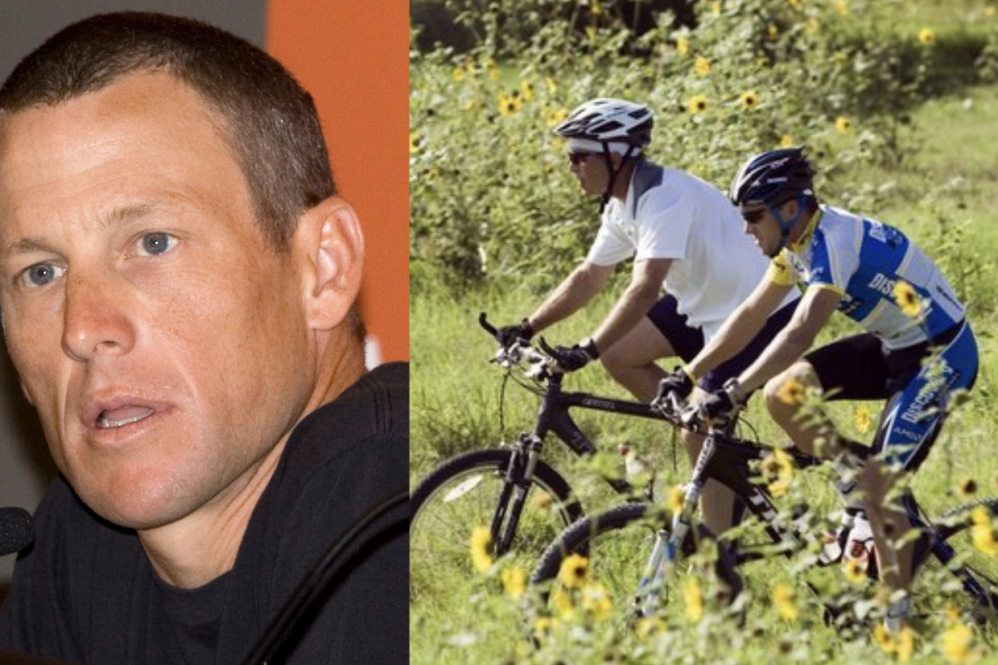
On October 22, 2012, Lance Armstrong, who had inspired millions after surviving cancer and was the winner of the Tour de France seven times, was stripped of his seven victories and received a lifetime ban from Olympic sports after an investigation by the United States Anti-Doping Agency (USADA) stated that Armstrong used performance-enhancing substances to help him win races.
Born on September 18, 1971, in Texas, Armstrong was raised by his mother. At the age of 10, he began running and swimming, then started cycling and training to become a professional triathlete.
Armstrong left high school for a short period when the U.S. Olympic development team invited him to train in Colorado, then started taking private classes and received his high school diploma in 1989.
In 1990, he joined the junior world team and won the best time of any American since 1976. That same year, he became the U.S. national champion, winning over many professional cyclists.
In 1993, Armstrong won cycling’s Triple Crown, and he came in second at the Tour DuPont. Three years later, he started looking tired and seemed to struggle in races. By the fall of 1996, Armstrong signed a lucrative contract with a new team, France’s Team Cofidis, not long after he was diagnosed with an advanced testicular cancer that had spread to his abdomen, lungs, and lymph nodes, and even to his brain.
After a successful surgery to remove his brain tumors, he started getting better and was cancer-free in February 1997.
Armstrong’s struggle with the disease didn’t stop him from thinking he’d race again, and he finally did after signing a $200,000-per-year position with the United States Postal Service team.
In his return in 1998, Armstrong won the opening stage of the Tour of Luxembourg. A year later, he became the second American after Greg LeMond to win the Tour de France. He won again in the 2000, 2001, 2002, and 2003 Tours.
In 2004, Armstrong won a record sixth title by over six minutes, then retired after securing his seventh victory in 2005.
Armstrong’s inspiring cancer comeback wasn’t convincing to everyone. Irish sportswriter David Walsh was among the first to become suspicious of Armstrong’s wins and to talk about performance-enhancing substances in the sport.
In 2001, Walsh published an article titled “Champ or Cheat?” in The Sunday Times about Armstrong’s secret relationship with controversial sports physician Dr. Michele Ferrari. Then Walsh got a confession from Armstrong’s assistant, Emma O’Reilly, and built his investigative case as the co-author of the 2004 book L.A. Confidentiel: Les secrets de Lance Armstrong.
In 2010, former teammate Floyd Landis admitted to using banned performance-enhancing substances and accused Armstrong, leading to a federal investigation and formal 2012 USADA charges.
Soon after, Armstrong said that he was giving up his fight with the USADA’s recent charges; he stated, “I have been dealing with claims that I cheated and had an unfair advantage in winning my seven Tours since 1999. The toll this has taken on my family and my work for our foundation and on me leads me to where I am today, finished with this nonsense.”
One day after, the USADA announced that Armstrong’s seven Tour titles would be taken away from him and he’d be banned from cycling for life. In addition, USADA released its evidence against Armstrong. Travis Tygart, chief executive of the USADA, said in a statement, “The evidence shows beyond any doubt that the U.S. Postal Service Pro Cycling Team ran the most sophisticated, professionalized and successful doping program that the sport had ever seen.”
In 2013, during an interview with Oprah Winfrey, Armstrong admitted, saying, “I am deeply flawed … and I’m paying the price for it, and I think that’s OK. I deserve this.”
In 2018, two weeks before his trial was scheduled to begin, Armstrong agreed to pay the U.S. Postal Service $5 million to settle their claims of being defrauded.
“While I believe that their lawsuit against me was without merit and unfair, I have since 2013 tried to take full responsibility for my mistakes, and make amends wherever possible. I rode my heart out for the Postal cycling team, and was always especially proud to wear the red, white and blue eagle on my chest when competing in the Tour de France,” said Armstrong.
Ask us! What questions do you have about content, strategy, pop culture, lifestyle, wellness, history or more? We may use your question in an upcoming article!
Like MediaFeed’s content? Be sure to follow us.
This article was syndicated by MediaFeed.co