

Key takeaways
- Medicare does not travel. With narrow exceptions for emergency care near U.S. borders, the federal health insurance program pays nothing for care received outside the United States.
- International health insurance fills the gap, but policies vary enough in coverage and exclusions that comparing them requires real diligence. A plan that looks affordable at enrollment can carry limitations that only surface when care is needed.
- Many countries where American retirees concentrate offer private healthcare systems that are accessible, high-quality, and a fraction of U.S. costs. Learning to navigate those systems is a practical skill worth developing before a health event makes it urgent.
- Healthcare planning for life abroad is not a one-time decision. Coverage needs change with age, health status, and the regulations of both the host country and the United States.
For many Americans, retiring abroad has its appeals. The bureaucratic friction that defines so much of American daily life – the insurance pre-authorizations, the billing disputes, the six-month wait for a specialist – starts to look optional from a distance. But what happens if something goes wrong medically while living abroad?
Fortunately, for many, the answer is less frightening than expected. Healthcare outside the United States is not a void. In many of the places American retirees actually go, it is a functioning system, often staffed by physicians who trained at institutions that are recognizable, at costs that are startlingly low by American reference points. A bit of preparation before heading abroad is all most Americans need to access good, affordable healthcare options.
Planning for healthcare in retirement? Explore professionals who can help you account for coverage decisions and potential healthcare costs.

Medicare limitations
Medicare is the federal health insurance program administered by the Centers for Medicare and Medicaid Services (CMS), covering most Americans at 65 through four distinct structures:
- Part A for hospital care
- Part B for outpatient and physician services
- Part C for Medicare Advantage plans that replace the original program through private insurers
- Part D for prescription drugs
Coverage outside the United States
Outside the United States and its territories, Medicare pays for nothing. Retirees who have spent their working lives contributing to the system and assume the coverage follows them as a passport will likely discover otherwise only when it matters most.
The exceptions that technically exist are narrow enough to be irrelevant for anyone actually living abroad. For instance, Part B may cover emergency care on a ship within six hours of a U.S. port. Medicare may also pay for care in Canada or Mexico if a U.S. hospital is not reasonably accessible given the geography. Neither of those carve-outs applies to a retiree whose primary address is in Lisbon, Medellín, Chiang Mai, or elsewhere outside of North America.
Medicare Advantage coverage abroad
Medicare Advantage (Part C) plans, the private alternatives to original Medicare, carry similar restrictions, though most include some emergency coverage outside the United States. Many plans cap emergency overseas coverage in the tens of thousands of dollars and limit it to a defined period. For a retiree traveling abroad, one week per year is useful. For a retiree who has relocated permanently, it is the wrong tool for the problem.
Keeping Medicare while living abroad
Maintaining Medicare enrollment while living abroad is a decision with real costs on both sides. Part B carries a standard monthly premium of $202.90 in 2026, covering care received only within the U.S. borders. A retiree who keeps it active is essentially paying to preserve optionality, the ability to return to the American system without penalty. Whether that optionality is worth $202.90 a month depends on how permanent the move actually is, and on what it would cost to re-enter the system later without it.
Part B adds 10 percent permanently to the monthly premium for each 12-month gap without coverage. A retiree who drops Medicare at 67 and returns at 77 without having maintained enrollment arrives with a 100 percent surcharge attached to their premium for life. The people who tend to get these reentry charges are the ones who weren’t aware of the price reversing it would require.
Go Further: Medicare 101: Understanding Parts A, B, C and D covers the full structure of the program, including how the late enrollment penalty is calculated and what creditable coverage means in the context of gap years without enrollment.

International health insurance
The category of coverage designed to fill the gap left by Medicare is called international health insurance, sometimes referred to as expat health insurance in marketing materials. It is a private market product designed for people living outside their home country for extended or indefinite periods, and it is structurally different from two things it is often confused with.
Travel insurance is built for trips with defined endpoints and generally excludes pre-existing conditions from day one. Local health insurance sold in the destination country may:
- Require legal residency status
- Operate entirely in a language the policyholder does not read,
- Fail to cover medical evacuation back to the United States.
Carriers in this space include Cigna Global, Aetna International, Allianz Care, and Bupa Global, among others. Premium levels vary considerably with age, country of residence, and the scope of coverage selected. The variable that most people underestimate before shopping is the effect of including or excluding the United States as a country where the policy pays for care.
American healthcare costs drive insurance mathematics in a way that no other country does. Adding U.S. coverage to an international plan can raise the premium by 50 to 100 percent. Retirees who have genuinely accepted that they will not seek care in the United States except in an emergency can substantially reduce their annual premium by limiting or removing that coverage from their policy.
Before any policy is purchased, three elements of the contract deserve a closer reading:
1. How pre-existing conditions are handled
This is the first and most consequential element. Some plans exclude pre-existing conditions permanently. Others apply a waiting period, typically six to twelve months, after which covered treatment begins. Others accept pre-existing conditions with a premium loading, an additional charge built into the base rate to account for anticipated claims. A retiree managing a chronic condition who buys a plan without reading this section carefully may discover the gap only at the pharmacy or the specialist’s office.
2. Annual and lifetime benefit maximums
A $1,000,000 annual benefit sounds adequate until a serious oncology case demonstrates otherwise. Cancer care involving chemotherapy, radiation, surgical intervention, and extended hospitalization can move through that ceiling faster than most policyholders anticipate when they sign. Policies with very high or no annual maximums exist at a higher premium, and whether carrying that additional cost makes sense depends on health history, age at enrollment, and appetite for financial exposure.
3. Evacuation and repatriation coverage
A medical evacuation benefit pays for transport to the nearest appropriate medical facility when local care is insufficient; in remote areas, this may require chartered aircraft, which can cost six figures without insurance. Repatriation covers the cost of returning a patient to their home country for continuing care or, in the worst outcome, returning remains. Most comprehensive international health plans include both. For retirees in destinations with strong private healthcare infrastructure, these benefits rarely come into play. For those in more remote locations, they are among the most valuable features on the policy document.
The International Association for Medical Assistance to Travelers (IAMAT) is a nonprofit organization that operates entirely outside the insurance framework. It maintains a global network of vetted physicians in more than 90 countries who agree to see IAMAT members at a standardized fee schedule and meet baseline criteria for English-language communication and training. Membership carries no cost. For retirees navigating an unfamiliar healthcare system who want a pre-screened starting point rather than a cold search, it is a practical resource the insurance industry does not advertise because it competes with nothing it sells.
Using local private systems
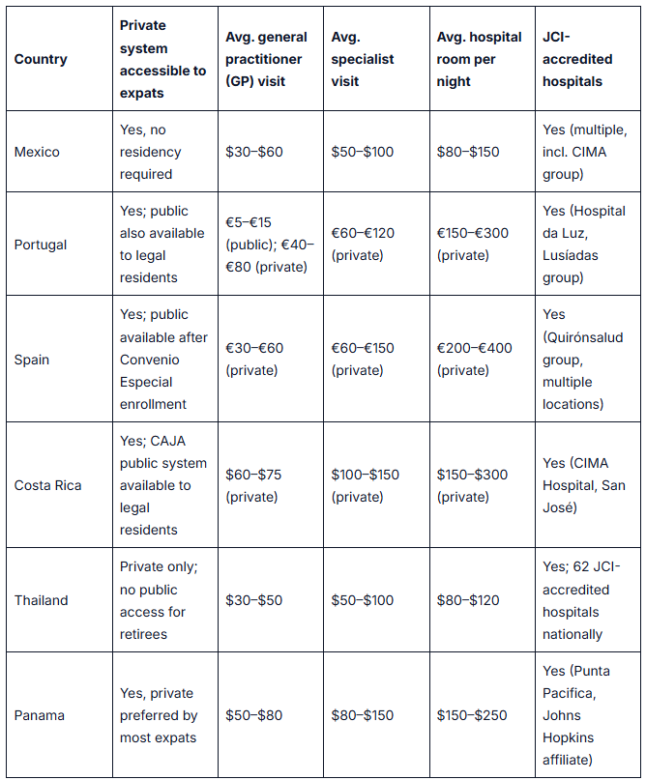
The following table covers the six most common US expat retirement destinations and what private healthcare access actually looks like for American retirees in each.
Not buying insurance at all is an option that surprises many Americans researching healthcare abroad. In many of the destinations where American retirees actually concentrate, the local private healthcare system is accessible, competent, and priced at levels that make the insurance calculation genuinely complicated. These figures are not historical artifacts preserved in a guidebook from fifteen years ago. They reflect what patients are paying now in cities that have spent two decades building private healthcare infrastructure specifically to serve internationally mobile patients.
The hospitals anchoring that infrastructure are not informal operations. Several are internationally accredited institutions staffed by physicians who trained at European and American medical schools, equipped with current diagnostic technology, and operating at surgical complication rates that compare favorably with comparable American facilities:
- Bangkok, Thailand: Bumrungrad International Hospital (JCI-accredited; serves over 500,000 international patients annually)
- São Paulo, Brazil: Hospital Israelita Albert Einstein (JCI-accredited; consistently ranked among Latin America’s top hospitals)
- Lisbon, Portugal: Hospital da Luz (JCI-accredited; largest private hospital group in Portugal)
- Spain: Hospital Quirónsalud group (JCI-accredited; multiple locations across the country)
- Panama City, Panama: Punta Pacifica Hospital (Johns Hopkins Medicine International affiliate)
The accreditation most of these institutions pursue is issued by the Joint Commission International (JCI), the international arm of the same body that accredits American hospitals. JCI accreditation requires meeting the same fundamental safety and quality standards that American patients assume when entering a domestic facility. It is not a marketing certificate.
For a retiree in good health managing routine care in one of these cities, the direct-pay model typically results in annual out-of-pocket costs of $1,500 to $3,000 USD, covering general practitioner visits, specialist consultations, and generic prescriptions. The math changes for anyone managing a complex chronic condition, anticipating a surgical procedure, or living in an area with a thinner private care infrastructure.
Most long-term expats end up in a hybrid: a catastrophic international health insurance policy with a high deductible, priced low enough to sustain, covers hospitalization, surgery, and evacuation. Everything below that threshold gets paid directly at local rates. The total annual cost of maintaining a private, local healthcare routine in most established expat destinations tends to run significantly lower than what you would pay for standard domestic health insurance premiums alone in the United States.
Access to local public healthcare systems is a separate question with a country-specific answer. Portugal and Spain extend access to the public system to legal residents who have registered and, in some cases, made social security contributions. Most of Southeast Asia and Latin America operate dual systems in which private care is the practical path for expatriates, regardless of residency status. Arriving in any country with assumptions about public access that have not been verified against that country’s actual regulations is a mistake that quickly becomes expensive.

How a financial advisor can help
Healthcare abroad sits at the intersection of several financial planning questions that interact in ways that planning one at a time tends to miss. The Medicare enrollment decision has consequences that extend fifteen or twenty years into the future. Currency exposure affects the effective dollar cost of care year over year. The tax treatment of Social Security benefits abroad depends on whether a tax treaty exists between the United States and the country of residence, on whether the retiree is filing U.S. taxes as required, and on which provisions apply to their specific income mix.
The Medicare decision deserves a full scenario model before it is made. A retiree who drops Part B at 65 and lives abroad for twelve years, then returns at 77 with a deteriorating health picture, faces a 120 percent premium surcharge on Part B and a potential coverage gap while waiting for enrollment to take effect. Running that scenario against the cost of maintaining coverage throughout the absence, the probability of return, and the projected cost differential between care abroad and in the United States is the kind of work that looks like detail management from the outside and functions like financial protection from the inside.
Currency exposure is the variable that surprises retirees who do well at everything else. A plan built on paying for care in euros at today’s exchange rates works differently if the dollar weakens 20 percent against the euro over seven years, which has happened before and will happen again. An international health insurance policy denominated in dollars removes that exposure for covered care. Direct-pay care in local currency does not. Over a decade, the gap between a hedged and an unhedged approach to healthcare costs abroad can run to tens of thousands of dollars in either direction.
Social Security benefits remain payable to Americans living in most countries, with exceptions for Cuba, North Korea, and a few others. The taxation of those benefits in the country of residence depends on the tax treaty in place, if one exists. The Foreign Earned Income Exclusion and the Foreign Tax Credit affect how income earned or received abroad interacts with U.S. tax obligations, which most Americans living abroad continue to carry regardless of where they reside.
Go Further: For American citizens moving abroad, navigating citizenship-based taxation means using either the Foreign Earned Income Exclusion (FEIE) or the Foreign Tax Credit (FTC) to avoid double taxation on the same income. The FEIE allows you to completely exclude a set limit of your foreign-earned salary from your U.S. tax return, provided you meet strict residency or physical presence tests. It is highly beneficial if you move to a low-tax or tax-free country. In contrast, the FTC reduces your U.S. tax liability dollar-for-dollar by the amount of income tax you have already paid to your host country, which is typically the more advantageous route if you settle in a high-tax nation or wish to preserve eligibility for benefits like the Child Tax Credit.
A fee-only fiduciary with specific experience in expat financial planning, rather than general retirement planning, is the right professional for this work. The overlap between international tax law, Medicare regulations, and foreign healthcare systems is narrow enough that generalist advice tends to miss the edges where the real exposure lives.

FAQs
Does Medicare cover emergency care abroad?
In the vast majority of circumstances, no. The exceptions are specific to geography: emergency care on a ship within six hours of a U.S. port, emergency care in Canada or Mexico under defined conditions where a U.S. hospital is not reasonably accessible, and a limited number of situations where a foreign hospital is the nearest appropriate facility to an American living near the border. A retiree living abroad as a primary residence should not rely on Medicare for any care received outside the United States, emergency or otherwise.
What is the difference between travel insurance and international health insurance?
Travel insurance is designed for trips with defined start and end dates. It covers emergency medical care during the trip, trip cancellation, and similar disruptions, and it typically excludes pre-existing conditions from the first day of coverage. International health insurance functions more like a conventional health policy: annual renewal, underwriting that addresses pre-existing conditions on a case-by-case basis rather than categorically excluding them, and benefit structures designed to cover the full range of healthcare needs over an indefinite coverage period. A retiree living abroad for years at a stretch needs international health insurance. Travel insurance is the wrong product for that purpose.
Can a retiree use the public healthcare system in another country?
It depends on the country and on the retiree’s legal status within it. Legal residents with documented passive income or work authorization may qualify for access to public systems in Portugal and Spain. Tourists and short-term visitors generally do not. Some countries have social security totalization agreements with the United States that affect contribution requirements for eligibility in the public system. The specific rules for any destination country should be verified through that country’s immigration and health ministry resources before the move, not after arrival, when the question becomes urgent.
How do American hospitals treat patients who received care abroad?
American physicians and hospitals generally accept patients who received prior care at foreign institutions, though the practical challenge is documentation continuity. Carrying a complete medical record in English or a professionally translated clinical summary reduces the friction of resuming care upon returning to the United States. Care received at JCI-accredited institutions abroad is documented to standards recognized by American physicians. The quality of the prior care is rarely the obstacle at handoff. The documentation of it is.

Glossary
Medicare: The federal health insurance program administered by CMS covering most Americans at age 65. Structured into Parts A (hospital insurance), B (outpatient and physician services), C (Medicare Advantage, private plan alternatives to Parts A and B), and D (prescription drug coverage). Does not cover care received outside the United States except under narrow border-area emergency conditions.
Medicare Advantage (Part C): Private health insurance plans approved by CMS that replace original Medicare Parts A and B. Must provide at minimum the same coverage as original Medicare. Most include some emergency coverage outside the United States, typically capped in the tens of thousands of dollars and limited to a defined period. Not a substitute for international health insurance for retirees living abroad on a permanent or long-term basis.
International health insurance: Private insurance designed for people living outside their home country for extended periods. Covers hospitalization, outpatient care, specialist consultations, and typically evacuation and repatriation. Distinguished from travel insurance by its indefinite coverage period and its underwriting approach to pre-existing conditions, which varies by carrier rather than applying a blanket exclusion.
Pre-existing condition: A health condition that existed before a policy’s start date. International health insurance plans handle pre-existing conditions in three primary ways: permanent exclusion, a waiting period before coverage begins, or acceptance with a premium loading added to the base rate. The specific treatment of pre-existing conditions is among the most consequential contract terms to review before enrolling in any international health plan.
Medical evacuation: Transport of a seriously ill or injured patient to the nearest appropriate medical facility when local care is insufficient. In remote areas, this can require chartered aircraft and costs reaching six figures without coverage. Included in most comprehensive international health plans and available as a standalone product through specialized providers.
JCI (Joint Commission International): The international accreditation arm of the Joint Commission, which accredits American hospitals domestically. JCI accreditation indicates a foreign healthcare facility has met quality and patient safety standards comparable to those applied to domestic U.S. hospitals. A reliable baseline filter for identifying internationally recognized facilities in expatriate destinations.
IAMAT (International Association for Medical Assistance to Travelers): A nonprofit organization that maintains a global directory of vetted physicians in more than 90 countries who see members at a standardized fee schedule. Not an insurance product. Membership is free. Useful for retirees entering unfamiliar healthcare systems who want a pre-screened starting point with baseline English-language communication capability and documented training standards.
Foreign Earned Income Exclusion: A U.S. tax provision allowing Americans living abroad to exclude a portion of their foreign-earned income from U.S. federal income tax. Applies to earned income from work or services, not to Social Security benefits, pension distributions, or most investment income. Relevant to retirees abroad who continue earning income from consulting or part-time work.
Late enrollment penalty: A permanent increase in Medicare Part B premiums applied to beneficiaries who did not enroll when first eligible and lacked creditable coverage during the gap period. Part B adds 10 percent per 12-month gap without coverage. Retirees who let Part B lapse while living abroad and later return to the United States carry the surcharge for the remainder of their Medicare enrollment.

Important Information
SteadyRetire is a retirement education platform offering practical financial resources and access to a financial advisor matching service. This article is intended for informational and illustrative purposes only and does not constitute financial, legal, tax, or investment advice. The information provided does not create a professional-client relationship and should not be used as a substitute for consultation with a qualified financial advisor, tax professional, or attorney. While we strive to provide accurate and up-to-date information, rules and regulations regarding retirement are subject to change. Always consult with a certified professional regarding your specific financial situation.
Ask us! What questions do you have about content, strategy, pop culture, lifestyle, wellness, history or more? We may use your question in an upcoming article!
Like MediaFeed’s content? Be sure to follow us.
This article originally appeared on SteadyRetire and was syndicated by MediaFeed.co.